June 4, 2026
Understanding the Evolving Energy Security Paradigm
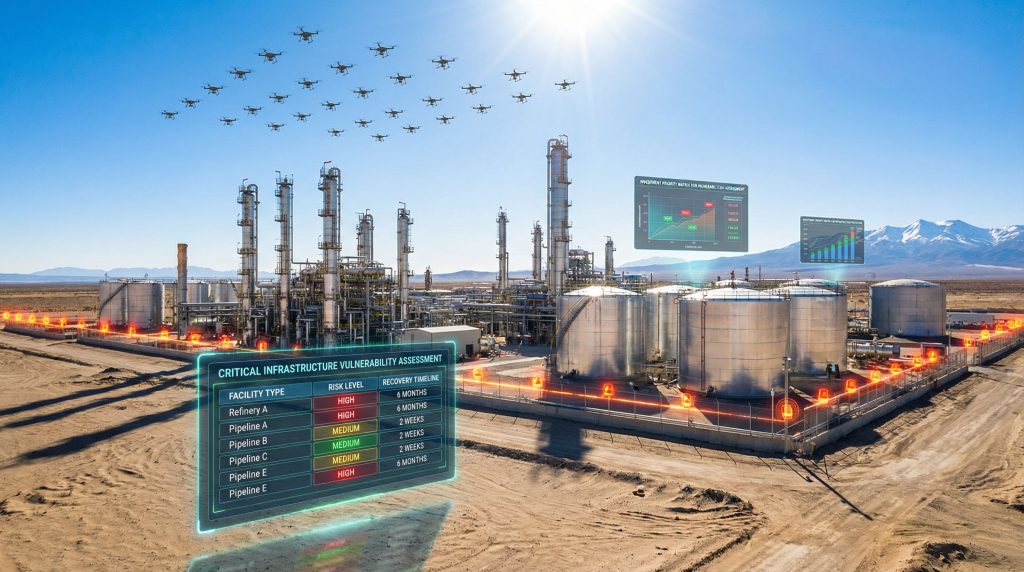
Energy infrastructure has fundamentally transformed from protected civilian assets to primary strategic targets in modern warfare. The systematic targeting of power generation, oil processing, and desalination facilities across the Gulf region represents a paradigm shift where asymmetric warfare tactics focus on disrupting economic lifelines rather than traditional military objectives.
This strategic evolution reflects the cost-effectiveness of deploying low-cost drone platforms against high-value energy installations. Commercial drone technologies, originally developed for civilian applications, now possess 150-300+ kilometre range capabilities depending on platform design and payload requirements. Modified military variants can extend operational reach significantly beyond these baseline specifications.
The September 14, 2019 attacks on Saudi Aramco's Abqaiq and Khurais facilities demonstrated this vulnerability dramatically, temporarily disrupting approximately 5.7 million barrels per day of crude oil production, representing roughly 5% of global daily supply. Market volatility from that single incident persisted for weeks, illustrating how oil price volatility can generate worldwide economic ripple effects.
The Economics of Infrastructure Vulnerability
Modern energy facilities require substantial restart timelines following emergency shutdowns. Gulf refineries typically need 7-30 days for restart procedures following disruption, depending on facility complexity and damage extent. This timeline reflects cooling system requirements, process validation protocols, and safety verification procedures that cannot be accelerated without compromising operational integrity.
The 2019 Saudi Aramco incident revealed how facility damage cascades beyond initial impact zones. Secondary equipment damage including heat exchanger corrosion and seal failures extended recovery timelines approximately 2 months beyond initial damage assessments, delaying return to full production capacity substantially longer than preliminary estimates suggested.
Insurance markets responded swiftly to these demonstrated vulnerabilities. War risk insurance premiums for tankers operating in the Persian Gulf increased 50-150% depending on vessel type, with Lloyd's of London underwriters adding specific regional conflict clauses to energy infrastructure policies. These premium adjustments stabilised at elevated levels 4-6 months post-incident, establishing new baseline risk assessments for the region.
When big ASX news breaks, our subscribers know first
Geographic Concentration Creates Systemic Vulnerabilities
The Persian Gulf's energy infrastructure demonstrates dangerous geographic clustering that amplifies systemic risk exposure. Kuwait's critical facilities illustrate this concentration pattern with eight major coastal power generation facilities, the majority co-located with desalination units essential for freshwater supply in this arid environment.
| Facility | Country | Capacity | Strategic Classification |
|---|---|---|---|
| Mina al-Ahmadi | Kuwait | 346,000 b/d | Export-Critical Refinery |
| Mina Abdullah | Kuwait | 454,000 b/d | Primary Processing Hub |
| Ras Tanura | Saudi Arabia | 550,000 b/d | Global Supply Chokepoint |
| Yanbu | Saudi Arabia | 450,000 b/d | Red Sea Export Terminal |
| Shuaiba | Kuwait | 140,000 b/d | Integrated Processing |
Technological Dependencies and Single Points of Failure
Regional power systems operate through the GCC Interconnection Grid, linking Saudi Arabia, UAE, Qatar, Kuwait, Bahrain, and Oman with approximately 4,000 MW cross-border transmission capacity. This interconnection creates vulnerabilities where disruption to major generation facilities (1,000+ MW capacity) can trigger cascading load-shedding across multiple national jurisdictions.
Desalination facility dependencies create particularly acute vulnerabilities in Gulf states. The UAE, Kuwait, and Saudi Arabia derive 90%+ of freshwater from desalination processes that require continuous electrical supply. Reverse osmosis plants cannot operate during power outages, while thermal desalination facilities co-located with power generation create interdependent failure modes.
Thermal power plants throughout the region depend on continuous seawater intake for cooling operations. Damage to terminal intake systems can disable substantial generation capacity within 12 hours, creating secondary cascades affecting desalination capacity and triggering water rationing protocols within 72 hours.
Strategic Chokepoint Vulnerabilities
The Strait of Hormuz represents the world's most critical energy chokepoint, measuring only 20.5 nautical miles wide at its narrowest point. Approximately 80-90 million barrels daily of crude oil transit this geographic constraint, representing 25-30% of global seaborne crude oil trade and 21% of total global petroleum flows.
Historical precedent demonstrates willingness to target these economic chokepoints. Houthi forces conducted confirmed attacks against energy transportation infrastructure, demonstrating asymmetric maritime targeting capabilities. Similar targeting of Red Sea shipping approaches in 2023-2024 showed strategic focus on economic disruption rather than traditional military objectives.
Infrastructure Interdependency Exploitation Strategies
Modern conflicts increasingly exploit energy system interdependencies to maximise disruption impact through cascading failure mechanisms. Power grid disruptions directly affect oil production and refining operations, while water system failures impact cooling and processing operations essential for facility operation.
Cascading Failure Mechanisms
"The interconnected nature of modern energy infrastructure creates multiplication effects where single-point failures can cascade across multiple systems, transforming localised incidents into regional crises with global implications."
Power Grid-to-Oil Production Linkage:
- Crude oil extraction requires continuous electrical supply for pumps, compressors, and processing equipment
- Saudi Arabian oil fields consume approximately 5-7% of produced crude for on-site power generation
- Major field shutdowns cascade to export terminal inability within 36-48 hours
Seawater Cooling Dependency:
- Thermal power plants require uninterrupted seawater intake for cooling operations
- Cooling water intake damage disables 500+ MW generation capacity within 12 hours
- Secondary impacts include loss of desalination capacity and industrial operations reduction within 72 hours
Transportation Network Isolation:
- Fuel depots and petrochemical loading terminals require continuous road and pipeline access
- Infrastructure damage connecting production sites to export terminals creates immediate bottlenecks
- Logistics coordination systems represent additional vulnerability points for systematic disruption
Cross-Border Impact Amplification
Regional interconnections amplify localised disruptions across multiple jurisdictions. The GCC Interconnection Grid's 4,000 MW cross-border flow capability means major node failures trigger coordinated load-shedding responses affecting civilian populations across multiple nations simultaneously.
Shared resource dependencies create additional multiplication effects. Kuwait and Saudi Arabia operate coordinated facilities in the Neutral Zone producing approximately 500,000 barrels daily. Disruption in either nation's supporting infrastructure impacts joint operations, demonstrating how cross-border dependencies create systemic vulnerabilities.
Strategic Market Response Patterns Through Scenario Modelling
Furthermore, global energy markets demonstrate predictable response patterns to infrastructure targeting, creating opportunities for strategic scenario modelling and risk assessment frameworks. The targeting of Mideast Gulf energy sites hit by drones has established consistent global market responses that can inform future planning.
Immediate Response Phase (0-30 days)
- Price volatility spikes in crude oil and refined products reaching 10-25% above baseline pricing
- Emergency reserve releases by strategic petroleum reserve holders (historically 30-60 million barrel releases)
- Temporary supply route adjustments and alternative sourcing through non-affected terminals
- Insurance market reassessment with immediate premium adjustments for affected regions
Medium-Term Adaptation (1-12 months)
- Insurance premium restructuring establishing new baseline risk assessments
- Accelerated investment in defensive technologies and backup systems
- Regional cooperation agreements on shared infrastructure protection protocols
- Supply chain diversification reducing dependence on concentrated production areas
Long-Term Structural Changes (1-5 years)
- Geographic rebalancing of global energy production capacity investments
- Technology integration for resilient infrastructure design and operation
- International frameworks development for critical infrastructure protection standards
- Energy security prioritisation in alliance structure and cooperation agreements
Investment Priority Matrix for Infrastructure Protection
Energy companies must adapt comprehensive risk management strategies incorporating multi-layered defence systems and resilience frameworks. However, the increasing frequency of Mideast Gulf energy sites hit by drones necessitates accelerated implementation timelines.
| Protection Level | Technology Focus | Investment Range | Implementation Timeline |
|---|---|---|---|
| Basic Security | Perimeter security, surveillance | $10-50M per facility | 6-12 months |
| Enhanced Defence | Active defence systems, hardening | $50-200M per facility | 12-24 months |
| Advanced Integration | AI defence networks, full redundancy | $200M+ per facility | 24-36 months |
Operational Resilience Framework Development
Multi-layered defence systems must integrate physical and cyber security components with real-time threat assessment capabilities. Advanced detection networks utilising multi-spectrum radar systems enable early drone identification at ranges exceeding 20 kilometres, providing sufficient warning time for interception system activation.
Rapid response and recovery protocols require pre-positioned spare parts inventories and trained maintenance teams capable of 5-15 day component replacement timelines for critical equipment. Specialised turbine and compressor equipment procurement typically requires 8-16 weeks depending on manufacturer inventory levels, necessitating strategic stockpiling approaches.
Alternative supply chain activation procedures must include diversified transportation routes and backup processing capabilities. Modular facility design enables rapid component replacement while distributed processing systems reduce single-point vulnerabilities that create facility-wide shutdown risks.
Advanced Detection and Interception Technologies
Multi-spectrum radar networks provide layered detection capabilities covering low-altitude approaches traditionally exploited by drone platforms. Integration with directed energy weapons enables non-explosive neutralisation without creating debris fields that could damage nearby infrastructure.
AI-powered threat assessment systems coordinate response protocols across multiple facility locations while maintaining communication with regional defence networks. These systems process threat data in real-time, enabling automated response activation within seconds of confirmed threat identification.
Infrastructure hardening innovations include underground facility construction and distributed system architectures. Critical processing units can operate independently during attacks on secondary systems, maintaining essential production capabilities during threat periods.
Insurance Market Evolution and Risk Assessment
Insurance markets continue adapting coverage frameworks to address evolving infrastructure threat environments with sophisticated risk modelling approaches. In addition, the sustained pattern of attacks has prompted comprehensive policy restructuring.
Premium Structure Evolution
Geographic risk modelling now incorporates conflict probability assessments alongside traditional engineering risk factors. Facility-specific ratings based on defensive capabilities create incentive structures for infrastructure hardening investments.
Dynamic pricing mechanisms adjust policy terms based on real-time threat level assessments. Regional conflict escalation triggers automated premium adjustments within 24-48 hours, reflecting immediate risk environment changes.
Coverage Gap Analysis
Traditional insurance policies excluding acts of war create significant protection gaps for infrastructure operators. Specialised products addressing asymmetric warfare and terrorism coverage fill these gaps, though international reinsurance market capacity constraints limit available coverage levels.
Risk assessment methodology evolution incorporates geopolitical analysis with traditional engineering assessments. Real-time threat monitoring affects policy terms and pricing through collaborative risk modelling between insurers and security intelligence agencies.
The next major ASX story will hit our subscribers first
International Framework Development for Infrastructure Protection
Regulatory and legal frameworks continue evolving to address critical infrastructure protection in conflict environments. Moreover, the implications for energy security and transition have prompted accelerated policy development.
Legal and Regulatory Development
International humanitarian law application to civilian infrastructure remains under development, with particular focus on dual-use facilities serving both civilian and military functions. Economic sanctions targeting infrastructure attack capabilities create deterrent frameworks, though enforcement mechanisms remain limited.
Multilateral agreements on critical facility protection standards establish baseline defensive requirements and technology sharing protocols. Joint research initiatives promote defensive technology development while information sharing protocols enhance threat intelligence coordination.
Technology Transfer and Cooperation Mechanisms
Standardisation efforts for infrastructure protection systems enable interoperability between different national defence networks. Technology export controls for defensive systems balance security concerns with commercial cooperation requirements.
Future regulatory evolution anticipates 2026-2027 emergency protocols for infrastructure attack response, 2027-2030 comprehensive international frameworks, and integrated regional defence cooperation agreements extending beyond current bilateral arrangements.
Market Psychology and Investment Implications
Investor sentiment demonstrates increasing sensitivity to infrastructure vulnerability assessments, with geopolitical risk premiums of $3-8 per barrel becoming sustained baseline adjustments rather than temporary volatility spikes. Consequently, energy sector valuations increasingly incorporate defensive capability assessments alongside traditional production capacity metrics.
Capital allocation patterns show accelerated investment in geographic diversification strategies and defensive technology integration. UAE sovereign wealth funds increased renewable energy investment allocation as diversification strategy responses to infrastructure vulnerability concerns, while Kuwait announced accelerated natural gas processing facility development reducing crude burn dependencies.
Furthermore, Saudi Aramco allocated $3-5 billion to facility redundancy and hardening initiatives following the 2019 attacks, establishing precedent for major infrastructure protection investment programs. These investment levels suggest defensive technology integration represents 5-15% of total facility capital costs depending on protection level requirements.
Additionally, the influence of OPEC production impact decisions has become more closely tied to security considerations. Recent critical minerals order initiatives reflect growing awareness of supply chain vulnerabilities in strategic sectors.
Navigating the Transformed Security Architecture
The evolution of energy infrastructure targeting represents permanent transformation in global security dynamics requiring comprehensive adaptation strategies. Success demands balancing operational efficiency with defensive capabilities while maintaining economic viability underpinning international energy security.
Organisations operating in elevated risk environments must integrate advanced technology solutions with international cooperation frameworks and adaptive operational protocols. Geographic diversification, defensive technology investment, and collaborative threat intelligence represent essential components for long-term operational sustainability.
For instance, recent incidents involving Kuwait's critical infrastructure demonstrate how rapidly security situations can escalate. The companies and nations mastering these integrated approaches will establish competitive advantages in transformed energy markets where security capabilities directly impact operational reliability and investor confidence.
Infrastructure resilience becomes core competency rather than supplementary consideration in strategic planning processes. The sustained targeting of Mideast Gulf energy sites hit by drones has fundamentally altered investment priorities across the global energy sector.
This analysis is based on publicly available information and market data through April 2024. Readers should consult current market intelligence services for the latest developments in Middle East energy infrastructure security.
Investment Disclaimer: This analysis contains forward-looking statements and risk assessments based on current market conditions. Infrastructure investment decisions should incorporate comprehensive due diligence including current threat assessments, regulatory compliance requirements, and financial risk tolerance evaluation.
Ready to Capitalise on Energy Market Volatility?
Discovery Alert's proprietary Discovery IQ model delivers real-time alerts on significant ASX mineral discoveries, including critical energy transition minerals essential for global infrastructure security. Navigate the evolving energy landscape with actionable insights into major discoveries that have historically generated substantial returns, and begin your 14-day free trial today to position yourself ahead of market volatility.