
July 7, 2026
The Energy Security Paradox: Mexico's Position in Global Maritime Disruptions
The Strait of Hormuz closure impact on Mexico presents a complex economic equation where geopolitical tensions thousands of miles away can simultaneously create fiscal opportunities and economic challenges. This narrow waterway's role as a critical energy chokepoint demonstrates how global supply chain vulnerabilities affect even geographically distant economies through intricate market mechanisms.
Mexico's unique position as both an oil exporter and refined product importer creates contradictory pressures during international energy crises. Furthermore, the country's integration into North American supply chains means that disruptions in Persian Gulf energy flows can cascade through multiple economic sectors simultaneously.
When big ASX news breaks, our subscribers know first
Understanding the Persian Gulf's Global Energy Chokepoint
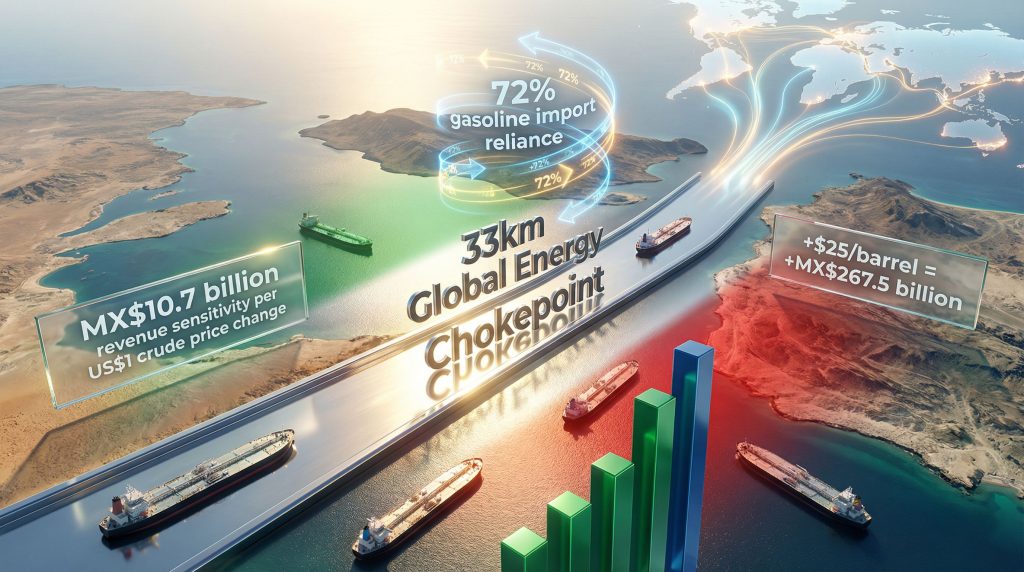
The Strait of Hormuz functions as one of the world's most critical energy transit corridors, facilitating the movement of approximately 20-21 million barrels per day of petroleum products, representing roughly 20% of global daily oil consumption. This narrow waterway, measuring just 33 kilometers at its narrowest point, also carries approximately one-fifth of globally-traded liquefied natural gas shipments, making it an indispensable component of international energy infrastructure.
However, recent developments highlight the fragility of these supply chains. The escalating tensions have already demonstrated how quickly markets respond to OPEC production impact scenarios and geopolitical uncertainties.
The Strategic Architecture of Maritime Energy Transport
The strait's importance extends beyond simple volume statistics. Its unique geographical position connecting the Persian Gulf to the Gulf of Oman creates a natural funnel through which energy exports from major producing nations must pass. Alternative pipeline routes cannot match the capacity requirements, while alternative maritime routes add 10-12 days of transit time and substantially increase transportation costs.
This chokepoint vulnerability becomes particularly acute when considering the energy dependencies of major importing regions. Asian economies demonstrate extreme exposure, with Japan importing 85% of its total energy needs, South Korea importing over 80%, and similar percentages applying to Taiwan and Singapore. These dependencies create a web of interconnected vulnerabilities that extend far beyond the immediate Persian Gulf region.
Historical Precedents and Market Response Patterns
Previous disruptions to Persian Gulf energy flows provide valuable insights into potential economic transmission mechanisms. During the 1980-1988 Iran-Iraq War, periodic tanker attacks created temporary transit disruptions that resulted in immediate insurance premium spikes and price volatility. More recently, the 2019 tanker attacks on Saudi Aramco facilities caused 15-19% intraday oil price increases within 48 hours, demonstrating the market's hypersensitivity to supply threat perceptions.
The oil price rally analysis from recent geopolitical developments shows similar patterns emerging. Economic analysis suggests that modern markets respond more rapidly to disruption threats than historical precedents might indicate.
Advanced financial instruments, real-time information systems, and algorithmic trading platforms can amplify price movements within minutes of geopolitical developments. Consequently, this creates both opportunities and risks for exposed economies like Mexico.
Mexico's Complex Energy Market Positioning
Mexico occupies a unique position in global energy markets, simultaneously serving as a significant crude oil producer while maintaining substantial dependencies on refined product imports. This dual exposure creates complex economic dynamics when international energy prices experience volatility.
Fiscal Revenue Sensitivity to Price Movements
Mexican government finances demonstrate extraordinary sensitivity to international crude oil price fluctuations. Each $1 increase in annual average crude prices generates approximately MX$10.7 billion in additional federal petroleum revenues, equivalent to roughly $618 million USD. This sensitivity coefficient means that sustained price increases of $25-50 per barrel could generate fiscal windfalls ranging from MX$267.5 billion to MX$535 billion annually.
Following recent geopolitical developments, Mexico's crude benchmark reached eight-month highs, trading at levels not observed since July 2025. This 5% price increase compared to February 2026 baseline levels demonstrates the immediate transmission of international tensions to domestic energy markets.
| Price Increase Scenario | Annual Revenue Impact | Fiscal Policy Implications |
|---|---|---|
| +$10/barrel | +MX$107 billion | Reduced subsidy requirements |
| +$25/barrel | +MX$267.5 billion | Potential budget surplus |
| +$50/barrel | +MX$535 billion | Significant fiscal windfall |
Import Dependencies and Vulnerability Exposure
Despite substantial domestic crude production, Mexico imports approximately 72% of its gasoline consumption due to refining capacity constraints and operational inefficiencies within Pemex facilities. This dependency creates direct exposure to international refined product pricing, which correlates closely with crude oil price movements.
Mexican refineries operate at approximately 60-70% of nameplate capacity due to maintenance requirements and operational constraints. Primary facilities including Tula, Salina Cruz, and Cadereyta face ongoing challenges that limit domestic refining self-sufficiency. Moreover, refined product imports follow international pricing benchmarks with typical 2-3 week lag periods for full price transmission.
The government maintains fuel tax subsidy mechanisms through the IEPS (Impuesto Especial sobre Producción y Servicios) system, which provides fiscal incentives to moderate domestic price increases during international price spikes. However, these subsidies create direct fiscal burdens that can reach 2-3% of federal discretionary spending during sustained high-price periods, as experienced during 2022-2023.
Supply Chain Disruption Cascades Through Mexican Industries
Maritime shipping disruptions extend far beyond direct energy costs, creating complex cascading effects throughout Mexican industrial sectors. Historical precedents suggest that freight rate increases and transit time extensions can multiply supply chain costs in ways that exceed simple transportation cost calculations.
Maritime Freight Cost Escalation Dynamics
Industry experts project that Strait of Hormuz disruptions would extend transit times by 10-12 days for rerouted cargoes, forcing vessels to navigate around the Cape of Good Hope or through alternative Mediterranean routes. This additional 9,600-10,500 kilometer distance reduces effective global fleet capacity by approximately 5-8% as vessels become locked in extended transit cycles.
The 2020 COVID-19 pandemic provides relevant precedent for understanding freight cost escalation patterns. During that crisis, container freight rates increased 500-600% above baseline levels, with specific routes like Shanghai-Rotterdam jumping from approximately $1,500 per forty-foot equivalent unit to $7,000-9,000 at peak disruption periods.
For Mexico-specific trade routes, trans-Pacific rates increased 400-500% during the 2020-2021 disruption period. Current Hormuz closure scenarios suggest more moderate but still substantial increases:
- Container freight rates: Potential 15-25% immediate increases
- Tanker rates: Potential 30-50% increases due to crude oil rerouting
- Specialized LNG carriers: Potential 50-100% increases due to extreme rerouting requirements
Sectoral Vulnerability Assessment
Mexican manufacturing sectors demonstrate varying degrees of exposure to supply chain disruptions based on their import dependencies and energy intensity profiles. In addition, the tariffs impact on markets compounds these challenges through additional cost pressures.
Export-oriented Manufacturing:
- Automotive and electronics sectors maintain 40-60% import dependency for components
- Working capital pressure increases as payment cycles extend
- Production scheduling complications from unpredictable delivery timeframes
Energy-intensive Industries:
- Chemicals, cement, steel, and aluminum face dual pressure from higher energy input costs and increased freight expenses
- Operating margin compression from multiple cost vectors
- Competitive disadvantage relative to regions with more stable supply chains
Consumer Goods Distribution:
- Extended inventory cycles increase carrying costs
- Retail chains face financial burden from longer working capital requirements
- Price transmission to consumers occurs with 4-8 week lag periods
Port Congestion and Logistics Infrastructure Strain
Alternative shipping routes create concentrated pressure on specific port facilities ill-equipped to handle sudden cargo volume increases. The 2020-2021 precedent demonstrated how port congestion can create secondary bottlenecks:
- Los Angeles/Long Beach ports experienced 40+ vessel backlogs with average wait times extending to 8-12 days
- Demurrage charges reached $15,000-20,000 per vessel per day
- Multiplied across Mexico's monthly container movements, additional costs reached $75-100 million monthly
Similar congestion patterns would likely emerge at Singapore, Rotterdam, and other major transshipment hubs during extended Hormuz disruptions. Therefore, this creates compounding delays and cost escalations for Mexican importers.
Strategic Economic Response Frameworks for Mexico
Mexico's economic policy toolkit contains several mechanisms for managing external energy shocks, though their effectiveness depends on disruption duration and severity. Understanding these response options provides insight into potential economic stabilisation pathways during extended crises.
Short-term Fiscal and Monetary Adjustments
The Mexican government possesses immediate response capabilities through existing subsidy mechanisms and strategic reserve utilisation. The IEPS fuel tax system can provide temporary consumer price protection, though at significant fiscal cost. During 2022-2023 high-price periods, fuel subsidies consumed substantial portions of discretionary government spending.
Strategic petroleum reserves offer limited buffer capacity for refined product supply disruptions. However, Mexico's reserve levels remain modest compared to other major economies, providing perhaps 30-45 days of import replacement under normal consumption patterns.
Central bank monetary policy options become complex during external price shocks. Higher energy costs create inflationary pressure, potentially requiring interest rate increases that could slow economic growth during an already challenging period. This creates the classic stagflationary policy dilemma where tools to address inflation may worsen growth outcomes.
Medium-term Market Adaptation Strategies
Extended disruptions would likely accelerate existing trends toward energy supply diversification and regional cooperation. Mexico's participation in the USMCA framework provides potential pathways for enhanced North American energy coordination, particularly regarding refined product sharing arrangements with U.S. Gulf Coast refiners.
Furthermore, domestic refining capacity expansion, while requiring substantial capital investment and extended development timeframes, could reduce import vulnerabilities over 3-5 year horizons. However, such investments require sustained policy commitment and favourable economic conditions for project financing.
Alternative supplier relationship development presents opportunities for geographic diversification away from traditional Persian Gulf dependencies. Caribbean refineries, South American producers, and expanded North American integration could provide more resilient supply chain architectures.
The US natural gas forecast indicates potential opportunities for increased cooperation in regional energy markets during crisis periods.
Long-term Structural Resilience Building
Fundamental energy security enhancement requires comprehensive infrastructure development and economic diversification strategies. Renewable energy transition, while primarily motivated by climate considerations, also provides energy security benefits by reducing dependence on volatile international fossil fuel markets.
Supply chain redundancy development extends beyond energy sectors to encompass broader manufacturing and logistics infrastructure improvements. Investment in port capacity, transportation networks, and inventory management systems can reduce vulnerability to external disruptions across multiple economic sectors.
Economic diversification toward less energy-sensitive industries represents a long-term structural adjustment that could reduce overall exposure to international energy price volatility. Service sectors, technology industries, and value-added manufacturing typically demonstrate lower energy intensity than heavy industrial activities.
Global Market Integration Effects on Mexican Economic Exposure
Mexico's integration into global commodity markets creates complex exposure patterns that extend beyond direct bilateral trade relationships. Understanding these transmission mechanisms helps illuminate potential economic impacts during major supply disruptions.
International Price Transmission Analysis
Crude oil price formation occurs through interconnected global markets where regional disruptions affect worldwide pricing benchmarks. Brent crude, which serves as the primary international benchmark, demonstrated 13% intraday increases to $81.57 per barrel following recent geopolitical developments, subsequently moderating to $77.53 per barrel but maintaining 6.4% weekly increases.
These price movements transmit rapidly to Mexican markets through several channels:
- Direct benchmark pricing for Mexican crude exports (Mezcla Mexicana)
- Refined product import pricing tied to international margins
- Financial market spillovers through energy sector equities and currency movements
- Expectations-driven price adjustments in anticipation of supply disruptions
The WTI-Brent spread relationship becomes particularly important for North American markets during Persian Gulf disruptions. Wider spreads typically favour Western Hemisphere producers like Mexico while creating relative disadvantages for economies dependent on Atlantic Basin crude imports.
How Would Different Economies Handle Similar Disruptions?
Mexico's economic exposure to Strait of Hormuz closure impact on Mexico appears moderate compared to other major energy-importing nations, though specific vulnerabilities create concentrated risks in particular sectors:
| Economy | Energy Import Dependency | Alternative Route Costs | Strategic Reserve Capacity |
|---|---|---|---|
| Mexico | 72% gasoline imports | Moderate (Atlantic routes) | Limited (30-45 days) |
| Japan | 85% total energy imports | High (Pacific rerouting) | Substantial (150+ days) |
| South Korea | 80%+ energy imports | High (Cape route required) | Moderate (90 days) |
| Germany | 60% oil imports | Very High (African routing) | Moderate (90 days) |
Mexico's Western Hemisphere location provides natural advantages through proximity to North American energy suppliers and Atlantic Ocean shipping routes that bypass Persian Gulf dependencies. However, refined product import requirements create specific vulnerabilities not shared by crude-exporting neighbours.
Regional Integration and Competitive Positioning
North American energy market integration through USMCA frameworks provides Mexico with potential resilience advantages during global supply disruptions. U.S. Gulf Coast refining capacity could theoretically supply Mexican refined product requirements, though logistical constraints and existing contract commitments would limit immediate availability.
Enhanced regional cooperation during crisis periods could include coordinated strategic reserve releases, temporary trade agreement modifications to facilitate emergency supplies, and shared transportation infrastructure utilisation. These arrangements require advance planning and political coordination that extends beyond normal commercial relationships.
Mexico's competitive position as an energy exporter improves during periods of elevated international prices, potentially offsetting some negative effects from higher import costs and supply chain disruptions. This natural hedge provides economic stabilisation benefits that pure energy importers cannot access.
The next major ASX story will hit our subscribers first
Broader Economic Development Strategy Implications
Extended energy supply disruptions would likely influence Mexico's long-term economic development priorities and policy frameworks. Understanding these potential shifts provides insight into structural adjustments that may emerge from crisis management experiences.
Inflationary Transmission and Monetary Policy Challenges
Energy price increases create complex inflationary pressures that extend beyond direct fuel costs to encompass transportation, manufacturing, and service sector price adjustments. Economic analysis suggests that $10-15 per barrel crude oil increases typically translate to 0.3-0.5 percentage point increases in consumer price index measurements over 6-12 month periods.
Mexico's central bank faces challenging policy trade-offs when external price shocks create simultaneous inflationary and growth pressures. Traditional monetary policy responses of raising interest rates to combat inflation may exacerbate economic slowdowns caused by higher energy costs, creating stagflationary conditions that resist conventional policy solutions.
The US–China trade war impact provides additional context for understanding how multiple external pressures can complicate domestic economic management.
Real wage impacts vary significantly across income brackets and geographic regions. Lower-income households typically spend higher percentages of disposable income on energy and transportation, making them disproportionately vulnerable to energy price increases. Urban areas with better public transportation infrastructure may demonstrate greater resilience than rural regions dependent on private vehicle transportation.
Investment Climate and Capital Flow Implications
Geopolitical uncertainty combined with energy price volatility creates complex effects on Mexico's investment climate. While higher oil prices generate increased government revenues that could fund infrastructure development, broader economic uncertainty may discourage foreign direct investment in non-energy sectors.
Capital market volatility during crisis periods affects peso stability and government debt servicing costs. Extended periods of elevated energy prices historically correlate with emerging market currency pressures as investors seek safe-haven assets in developed economies.
Long-term infrastructure project financing becomes more challenging during periods of elevated uncertainty. Energy-intensive projects face particular scrutiny from lenders concerned about input cost volatility, while transportation and logistics investments may receive increased attention due to supply chain resilience considerations.
Trade Balance Adjustment Mechanisms
Mexico's trade balance experiences complex adjustments during energy price disruption periods. Higher domestic energy costs reduce export competitiveness in energy-intensive industries while simultaneously increasing import costs across multiple sectors.
Import substitution opportunities may emerge as relative price changes favour domestic production in previously import-dependent sectors. However, realising these opportunities requires existing domestic capacity or rapid investment in new production capabilities, which may not be feasible during crisis periods.
Regional trade agreement utilisation could provide mechanisms for temporary adjustments to normal trade patterns. Emergency provisions within USMCA and other frameworks might facilitate increased North American energy cooperation during extended supply disruptions.
Future Energy Security Framework Development
Mexico's experience managing energy supply disruptions would likely influence long-term strategic planning for energy security and economic resilience. Analysing potential policy directions provides insight into structural changes that may emerge from crisis management learning.
Accelerated Diversification Strategy Implementation
Extended supply disruptions typically accelerate existing trends toward energy supply diversification and reduced dependence on volatile international markets. Mexico's renewable energy resources provide opportunities for reduced fossil fuel import dependencies, though transition timelines span decades rather than months or years.
Regional energy integration within the North American context offers more immediate diversification benefits. Enhanced coordination with U.S. and Canadian energy systems could provide mutual benefits through shared strategic reserves, coordinated infrastructure development, and emergency supply arrangements.
Strategic partnership development with non-Persian Gulf suppliers could reduce geographic concentration risks in Mexico's energy import portfolio. South American producers, West African suppliers, and North Sea exporters provide alternative sourcing options, though each carries distinct logistical and political risk profiles.
Research indicates that Strait of Hormuz closure impact on Mexico would be significantly influenced by the availability of these alternative supply arrangements. According to analysis from regional experts, Latin American economies face varied exposure levels depending on their energy infrastructure and trade relationships.
Economic Resilience Framework Enhancement
Comprehensive resilience building requires coordination across multiple policy domains and economic sectors. Early warning systems for supply chain disruptions could provide Mexican policymakers with improved crisis preparation capabilities, though effectiveness depends on international intelligence cooperation and market monitoring sophistication.
Flexible fiscal policy mechanisms designed to respond rapidly to external shocks could reduce economic disruption during future crises. Pre-positioned response authorities, contingency funding arrangements, and streamlined decision-making processes enable more effective crisis management compared to improvised responses.
Private sector coordination protocols during emergency periods require advance planning and regular testing to ensure effectiveness during actual disruptions. Public-private partnerships for strategic resource management, information sharing arrangements, and coordinated response capabilities enhance overall economic resilience.
Strategic Assessment: Mexico's economic exposure to Strait of Hormuz closure impact on Mexico demonstrates the complex interconnections between geopolitical risks and domestic economic stability. While natural advantages from Western Hemisphere location and energy export capacity provide some protection, refined product import dependencies and supply chain integration create significant vulnerabilities requiring comprehensive policy response frameworks.
Risk Management Note: The analysis presented reflects current market conditions and historical precedents. Actual economic impacts during supply disruption events may vary significantly based on crisis duration, alternative supply availability, international cooperation effectiveness, and concurrent economic conditions. Investors and policymakers should consider scenario planning and stress testing for various disruption severity levels when developing strategic responses.
Looking to Capitalise on Energy Market Volatility?
Discovery Alert's proprietary Discovery IQ model provides instant notifications on significant ASX mineral discoveries, particularly those in critical energy transition commodities that benefit from supply chain disruptions like the Strait of Hormuz crisis. Understanding how geopolitical tensions create opportunities in Australian mining discoveries enables investors to position themselves ahead of market movements during volatile periods.