August 24, 2026
Energy Security Architecture in Asia-Pacific Strategic Reserve Systems
Modern economies increasingly recognise petroleum reserves as critical infrastructure for maintaining energy security during supply disruptions. The South Korea oil reserves release demonstrates how these government-controlled stockpiles serve as essential buffers against price volatility and geopolitical instability, enabling nations to sustain economic operations when traditional supply chains face interruption.
Foundation of Strategic Reserve Operations
Strategic petroleum reserves function through sophisticated management systems that balance immediate accessibility with long-term storage stability. Nations maintain these reserves through various storage methodologies, from underground salt caverns that provide natural protection against temperature fluctuations to above-ground facilities that enable rapid deployment during emergencies.
Asia-Pacific Reserve Coverage Standards
Regional strategic reserve holdings demonstrate varying approaches to energy security preparedness:
| Nation | Coverage Duration | Primary Storage Method | Total Capacity |
|---|---|---|---|
| South Korea | 200-208 days | Underground caverns, surface tanks | ~100 million barrels (government) |
| Japan | 200+ days | Underground facilities, private cooperation | 590+ million barrels |
| China | 100+ days (estimated) | Underground facilities, commercial integration | 500+ million barrels |
| India | 39 days (expanding) | Underground rock caverns | 39 million barrels |
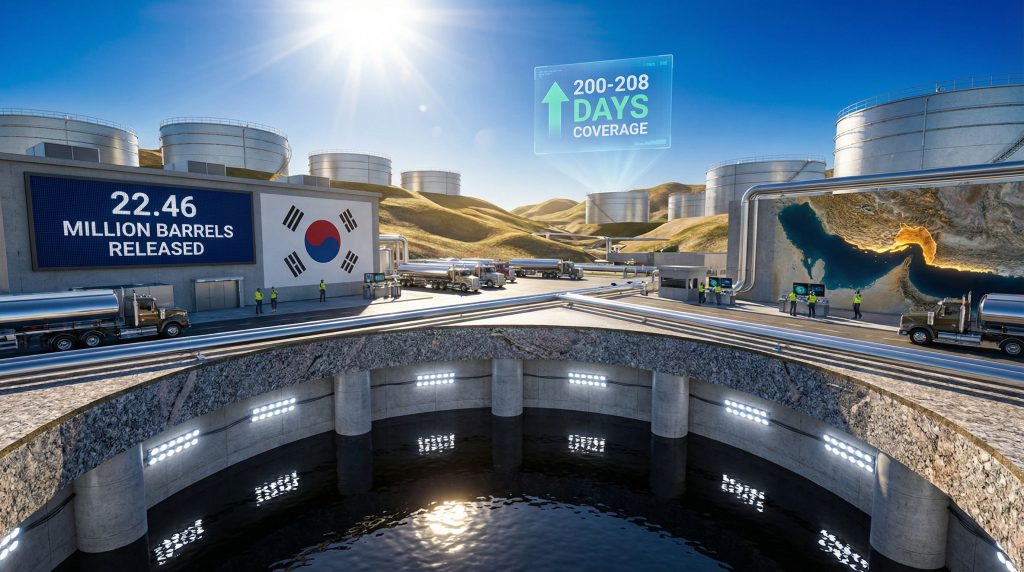
South Korea's strategic reserve infrastructure represents a sophisticated multi-facility network designed for both emergency response and operational flexibility. The Korea National Oil Corp manages approximately 100 million barrels in government reserves, with combined national holdings including private sector stocks reaching 200-208 days of domestic consumption coverage.
Technical Reserve Management Protocols
Effective strategic reserves require continuous management protocols that include:
• Quality maintenance cycling to prevent crude degradation during extended storage
• Infrastructure testing to ensure rapid discharge capabilities during emergencies
• Integration systems connecting government reserves with commercial distribution networks
• Capacity optimisation balancing storage costs against security requirements
These operational considerations become critical during actual deployment scenarios, where technical capabilities determine response effectiveness. Furthermore, the OPEC production impact on global supply chains makes strategic reserves even more vital for energy security.
When big ASX news breaks, our subscribers know first
International Energy Agency Coordination Mechanisms
Global energy security relies on coordinated response frameworks that enable member nations to deploy strategic reserves collectively during supply crises. The International Energy Agency operates sophisticated decision-making processes designed to maximise market impact through synchronised releases.
Unanimous Decision Framework
IEA emergency responses require unanimous agreement among 32 member states, ensuring comprehensive commitment to coordinated action. This consensus-building approach strengthens market confidence while guaranteeing proportional burden-sharing based on each nation's import dependency and reserve capacity.
The March 2026 coordinated release demonstrates this framework's effectiveness, with member states unanimously approving a 400 million barrel deployment in response to Strait of Hormuz disruptions. South Korea's contribution of 22.46 million barrels represents 5.6% of the total release, positioning the nation as a significant contributor despite its smaller economy compared to major oil consumers.
Historical Precedent Analysis
South Korea's strategic reserve deployments reveal escalating involvement in international energy security coordination:
| Release Event | Year | South Korea Contribution | Global Context |
|---|---|---|---|
| Gulf War Response | 1990 | 4.94 million barrels | First major IEA coordination |
| Ukraine Conflict Response | 2022 | 11.65 million barrels (two phases) | Largest previous contribution |
| Middle East Crisis Response | 2026 | 22.46 million barrels | Historic high for South Korea |
This progression illustrates South Korea's growing strategic importance in global energy security architecture and its increased capacity for emergency response contributions.
Implementation Timeline and Logistics
Coordinated releases involve complex logistical considerations that extend beyond simple storage discharge. Nations must coordinate timing to maximise market impact while accounting for domestic infrastructure constraints and refinery intake specifications.
The current IEA release allows member countries flexibility in deployment schedules appropriate to national circumstances. However, this framework acknowledges varying storage facility discharge rates, transportation infrastructure limitations, and domestic market conditions that affect implementation speed.
Major Contributor Deployment Profile (2026)
The March 2026 coordinated release demonstrates significant participation across major IEA members:
• United States: 172 million barrels over 120 days (approximately 1.4 million barrels daily)
• Japan: 80 million barrels from government and private reserves starting March 16
• South Korea: 22.46 million barrels through coordinated timing with IEA secretariat
• United Kingdom: 13.5 million barrels through established discharge protocols
These contributions represent substantial portions of member states' available emergency reserves, highlighting the perceived severity of current supply disruptions.
Import Dependency and Energy Security Policy Frameworks
Nations heavily dependent on petroleum imports develop comprehensive policy frameworks addressing both immediate crisis response and long-term supply diversification. South Korea's energy security strategy exemplifies how import-dependent economies balance emergency preparedness with structural vulnerability reduction.
Geographic Vulnerability Assessment
South Korea's petroleum supply chain demonstrates classic import dependency challenges, with significant reliance on Middle East producers whose output transits through the Strait of Hormuz chokepoint. This geographic concentration creates systemic vulnerability to regional conflicts, natural disasters, or infrastructure failures affecting the critical shipping corridor.
The current crisis illustrates this vulnerability acutely, as Iranian military actions have effectively halted commercial traffic through the strait, immediately impacting global oil supply chains and triggering the largest coordinated strategic reserve release in IEA history.
Multi-Layered Policy Response Systems
Energy security policy in import-dependent economies typically involves multiple complementary mechanisms:
Supply Diversification Initiatives
• Partnership development with non-Middle Eastern producers
• Long-term contract negotiations with multiple supplier nations
• Alternative transportation route development reducing chokepoint dependency
• Domestic production capacity enhancement where geologically feasible
Demand Management Capabilities
• Fuel efficiency standards for transportation and industrial sectors
• Alternative energy acceleration to reduce petroleum dependency
• Emergency conservation protocols including potential rationing frameworks
• Price stabilisation mechanisms through tax adjustments or subsidies
Infrastructure Optimisation
• Refinery upgrade programs to process diverse crude specifications
• Storage capacity expansion for both strategic and commercial reserves
• Transportation network redundancy development
• Regional cooperation frameworks for shared emergency response
In addition, the renewable energy transformation across various sectors demonstrates how nations are reducing long-term petroleum dependency whilst maintaining strategic reserves for crisis management.
Crisis Duration Expert Assessment
Industry experts provide varying assessments of current disruption duration. Harold Hamm, founder of Continental Resources, estimates Strait of Hormuz traffic restoration could require several weeks, stating that resolution would occur fairly quickly but acknowledging potential extended timelines. However, he warns of severe price volatility risks, noting concern about oil prices potentially reaching $200 per barrel during the disruption period.
This expert assessment suggests confidence in near-term resolution whilst acknowledging significant downside risks that justify coordinated strategic reserve deployments.
Strategic Reserve Market Impact and Economic Effects
Strategic petroleum reserve releases create complex market dynamics that extend beyond simple supply addition. These deployments affect both physical oil availability and market psychology, with effectiveness depending on coordination timing, release volume, and underlying disruption duration.
Immediate Price Response Patterns
The announcement of coordinated strategic releases typically generates immediate market reactions, often providing price relief even before physical oil enters commercial distribution systems. Consequently, the March 2026 IEA announcement demonstrated this pattern, though underlying supply concerns continued generating price volatility.
ICE Brent crude futures climbed to $100.01 per barrel by 11:00am Singapore time on March 12, 2026, representing an 8.7% or $8.03 per barrel increase despite the coordinated release announcement. The contract reached an intraday high of $101.59 per barrel, whilst April Nymex WTI rose 8.2% to $94.40 per barrel with an early trading high of $95.99 per barrel.
Physical Supply Integration Challenges
Converting strategic reserves into market-available supply involves multiple logistical coordination requirements:
• Discharge rate limitations based on storage facility infrastructure capabilities
• Quality specification matching ensuring released crude meets refinery input requirements
• Transportation coordination during periods of elevated demand and potential infrastructure constraints
• Commercial integration connecting government reserves with private sector distribution networks
These technical factors determine actual supply impact timeline and effectiveness, often creating delays between release announcements and market supply availability.
Market Psychology vs Physical Supply
Strategic reserve releases serve dual functions in oil markets, providing both actual supply augmentation and psychological stabilisation effects. The psychological component often generates immediate price response, whilst physical supply effects develop over weeks or months depending on deployment logistics.
Furthermore, the oil price rally analysis reveals how market sentiment can sometimes overwhelm physical supply considerations.
Reserve Release Effectiveness Limitations
Several factors constrain strategic reserve deployment effectiveness:
| Limiting Factor | Impact on Release Effectiveness |
|---|---|
| Underlying disruption duration | Reserves provide temporary buffer only |
| Market speculation intensity | Can overwhelm physical supply additions |
| International coordination timing | Synchronised releases maximise impact |
| Alternative supply development | Determines long-term price stabilisation |
| Infrastructure constraints | Limits actual discharge and distribution rates |
Current market conditions suggest these limitations remain significant, with persistent supply concerns continuing to generate price volatility despite coordinated release announcements.
Regional Market Differentiation
Strategic reserve releases affect different regional markets variably based on:
• Geographic proximity to release locations and affected supply disruptions
• Refinery specifications determining compatibility with released crude types
• Transportation infrastructure connecting reserves to regional distribution systems
• Alternative supply availability from non-disrupted sources
Asia-Pacific markets face particular challenges during Middle East supply disruptions due to traditional supply source concentration and longer alternative transportation routes from other producing regions.
Long-Term Energy Security Evolution and Policy Implications
The South Korea oil reserves release signals broader transformations in energy security policy frameworks, reflecting changing geopolitical conditions, technological capabilities, and climate transition considerations that reshape traditional energy security approaches.
Enhanced International Cooperation Frameworks
The coordinated nature of current emergency response demonstrates strengthening international cooperation mechanisms for energy security management. This cooperation extends beyond traditional IEA frameworks to include:
• Real-time information sharing systems for supply disruption monitoring
• Coordinated response timing mechanisms maximising collective market impact
• Technology sharing for reserve management and deployment optimisation
• Joint procurement strategies for reserve refilling following emergency deployments
These enhanced cooperation frameworks represent evolution from national energy security approaches toward integrated international response capabilities.
Technology Integration for Responsive Management
Modern strategic reserve systems increasingly integrate advanced technologies for improved response capabilities:
Automated Monitoring Systems
• Real-time crude quality tracking preventing degradation during storage
• Automated discharge testing ensuring rapid deployment capabilities
• Integrated market monitoring for optimal release timing decisions
• Predictive maintenance systems minimising infrastructure downtime
Advanced Logistics Coordination
• Digital integration connecting government reserves with commercial distribution networks
• Transportation optimisation systems during emergency deployment periods
• Multi-facility coordination enabling complex release scheduling
• Quality matching systems ensuring compatibility with regional refinery specifications
Climate Transition Integration
Long-term energy security planning increasingly accounts for renewable energy transition timelines and petroleum demand evolution. This integration affects:
• Reserve sizing decisions based on projected future petroleum dependency
• Infrastructure investment planning balancing emergency preparedness with transition economics
• Alternative fuel integration within emergency response protocols
• International cooperation evolution incorporating renewable energy security considerations
Regional Geopolitical Implications
Coordinated strategic reserve deployments demonstrate strengthened alliance frameworks in the Asia-Pacific region, with energy security becoming increasingly integrated with broader security partnerships. Moreover, the trade war oil impacts illustrate how geopolitical tensions can influence regional energy cooperation mechanisms.
This integration influences:
• Bilateral energy partnerships between major consuming nations
• Regional infrastructure development for shared emergency response capabilities
• Diplomatic coordination mechanisms linking energy security with broader foreign policy objectives
• Military cooperation frameworks for protecting critical energy infrastructure and shipping corridors
Investment and Infrastructure Planning Evolution
Current crisis experience will likely influence future strategic reserve investment and infrastructure planning across multiple dimensions:
Capacity Expansion Considerations
• Reserve sizing optimisation based on crisis duration experience
• Geographic distribution improvements reducing single-point vulnerabilities
• Storage technology upgrades enhancing discharge flexibility and speed
• Integration improvements connecting reserves with evolving distribution networks
Private Sector Integration Enhancement
• Commercial storage cooperation frameworks for emergency response
• Industry partnership development for rapid deployment capabilities
• Information sharing systems connecting government and commercial operations
• Regulatory frameworks encouraging private sector emergency preparedness investment
In addition, the US drilling decline demonstrates how domestic production capacity affects strategic reserve planning and deployment strategies.
Frequently Asked Questions
How Do Strategic Petroleum Reserves Compare Internationally?
Strategic petroleum reserve systems vary significantly across nations based on import dependency, economic capacity, and infrastructure capabilities. South Korea's 200-208 days of combined coverage aligns with other major developed economies, though specific operational capabilities differ based on storage technology and discharge infrastructure.
What Determines Reserve Release Effectiveness During Supply Crises?
Reserve release effectiveness depends on multiple factors including coordination timing with international partners, physical discharge capabilities, integration with commercial distribution systems, and underlying supply disruption duration. Synchronised international releases typically achieve greater market impact than unilateral actions.
How Long Do Strategic Reserves Sustain Normal Consumption?
Coverage duration depends on consumption patterns, alternative supply availability, and demand management measures implemented during crises. South Korea's reserves provide approximately 200-208 days at normal consumption rates, though actual duration varies based on crisis-specific consumption changes and alternative supply development.
What Happens After Emergency Reserves Are Depleted?
Nations must secure alternative supply sources, implement comprehensive demand reduction measures, or face significant economic disruption following reserve depletion. Current emergency response assumes normal supply chain restoration before reserve exhaustion, though contingency planning addresses extended disruption scenarios.
How Do Reserve Releases Affect Domestic Energy Prices?
Strategic reserve releases can moderate domestic price increases but do not eliminate global market price transmission effects. Domestic fuel costs continue reflecting international market conditions, transportation costs, taxation policies, and local supply-demand dynamics despite government reserve interventions.
What Role Do Private Sector Reserves Play in National Energy Security?
Private sector reserves complement government strategic stocks through commercial storage systems that provide operational flexibility and additional emergency capacity. These systems require regulatory frameworks ensuring emergency availability whilst maintaining commercial viability during normal operations.
The next major ASX story will hit our subscribers first
Strategic Reserve Policy in an Interconnected Energy Future
The South Korea oil reserves release represents a critical milestone in international energy security cooperation, demonstrating sophisticated coordination mechanisms developed through decades of IEA partnership and crisis response experience.
This deployment illustrates how modern energy security transcends national boundaries, requiring coordinated international responses that balance individual nation requirements with collective market stabilisation objectives. The unanimity achieved among 32 IEA member states for the 400 million barrel coordinated release demonstrates institutional maturation and shared commitment to maintaining global energy stability.
The effectiveness of strategic reserve deployments ultimately depends on successful restoration of normal supply chains, but the policy frameworks and coordination mechanisms developed through these experiences will continue shaping energy security strategies as nations balance crisis management capabilities with long-term renewable energy transition planning.
Investment Implications and Future Preparedness
Current crisis experience provides valuable insights for future strategic reserve investment and operational planning. Nations will likely evaluate reserve capacity adequacy, discharge infrastructure capabilities, and international coordination effectiveness based on 2026 deployment results.
These assessments will influence upcoming decisions regarding reserve expansion, technology upgrades, and regional cooperation framework development as energy security policy evolves to address both traditional supply disruption risks and emerging transition-related challenges.
The integration of strategic petroleum reserves within broader energy security frameworks demonstrates their continuing relevance as critical infrastructure, even as economies gradually transition toward renewable energy systems and reduced petroleum dependency over coming decades.
This analysis is based on publicly available information and expert assessments. Energy market conditions and strategic reserve policies continue evolving based on geopolitical developments and crisis response experience. Readers should consult current official sources for the most recent policy updates and market conditions.
Ready to Capitalise on Energy Market Volatility?
Discovery Alert's proprietary Discovery IQ model identifies significant ASX mineral discoveries in real-time, including critical energy minerals that benefit from global supply disruptions and strategic reserve deployments. Start your 14-day free trial today and position yourself ahead of market-moving announcements in the energy and resources sector.