
May 21, 2026
The Geology That Makes the Orinoco Belt Impossible to Ignore
Few petroleum provinces on Earth command the same level of strategic attention as Venezuela's Orinoco Heavy Oil Belt. Stretching roughly 600 kilometres across south-central Venezuela, this geological formation contains an estimated 1.2 trillion barrels of extra-heavy crude oil in place, according to U.S. Geological Survey assessments, making it one of the most resource-dense petroleum accumulations anywhere on the planet. For context, that figure dwarfs even the Canadian oil sands in terms of raw resource volume, though both formations share the defining characteristic that separates them from conventional crude: the oil does not flow easily, and it cannot be exported without substantial processing.
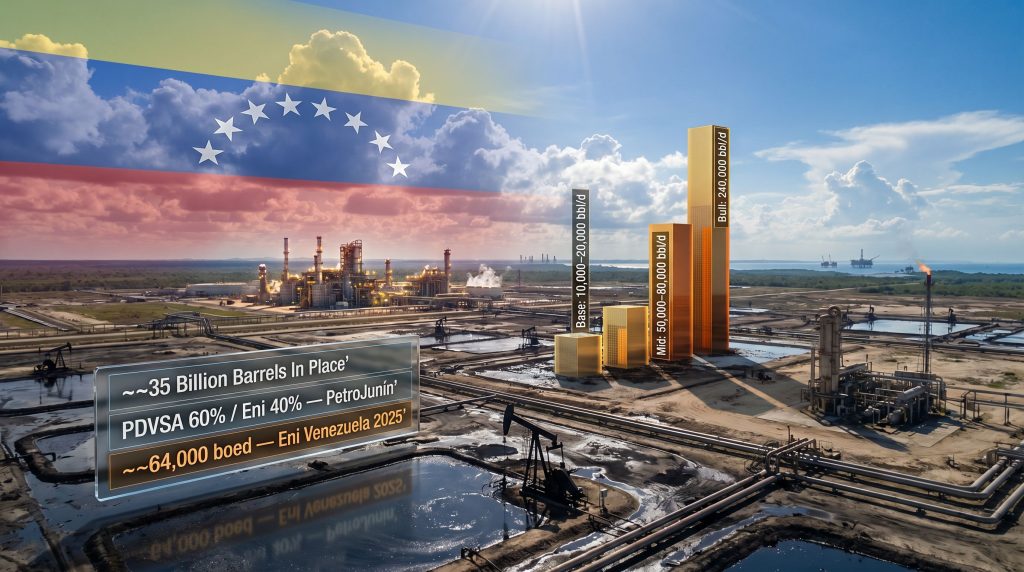
Within this colossal petroleum system, the Junin-5 block represents a particularly consequential asset. With approximately 35 billion barrels of oil in place, it sits at the heart of one of the most debated questions in global energy supply: can Venezuela's Orinoco Belt ever be meaningfully reactivated? The programmatic agreement signed between Eni S.p.A., Venezuela's Ministry of Hydrocarbons, and state oil company PDVSA in April 2026 offers the clearest signal yet that serious momentum is building toward an answer.
When big ASX news breaks, our subscribers know first
Understanding the Programmatic Agreement: Architecture Before Operations
The language used to describe Eni Venezuela Junin-5 oil operations restart matters enormously for anyone trying to assess what this development actually means. The term programmatic agreement is a legal and commercial classification with a specific meaning in the upstream oil industry: it establishes the governance framework, contractual obligations, capital allocation responsibilities, and technical standards that must be in place before field operations can advance. It is the foundation of a structure, not the structure itself.
This distinction is frequently misunderstood, and the misunderstanding tends to generate either inflated expectations or unwarranted dismissal. A programmatic agreement does not commit either party to immediate production ramp-up, capital deployment, or drilling campaigns. What it does do is create the legal and commercial architecture through which those operational decisions can subsequently be made. Think of it as establishing the rules of engagement before the game begins.
The agreement was announced following a direct meeting in Caracas between Eni CEO Claudio Descalzi and Acting President Delcy Rodríguez, alongside government and PDVSA officials. The CEO-to-head-of-government format of that engagement carries its own signal value: in Venezuela's complex operating environment, where regulatory, financial, and political dimensions of upstream investment are deeply intertwined, high-level diplomatic alignment is a prerequisite for operational progress, not a byproduct of it.
"A programmatic agreement establishes the legal and commercial architecture for future operations. It is the foundation, not the structure itself. Understanding this distinction is critical for accurately interpreting the scope of Eni's commitment at Junin-5."
Junin-5: Scale, Geology, and the Physics of Extra-Heavy Crude
Why Extra-Heavy Oil Is Fundamentally Different From Conventional Crude
The crude produced from the Orinoco Belt's Junin blocks is not oil in the conventional sense that most energy market participants envision. Extra-heavy crude from this formation typically has an API gravity in the range of 8 to 12 degrees, compared to approximately 31 to 37 degrees for a typical light crude benchmark. This matters because API gravity is a proxy for viscosity, fluidity, and refining complexity.
At these API grades, the crude behaves more like thick tar than flowing liquid under reservoir conditions. It cannot be transported through conventional pipelines without either heating or blending with lighter hydrocarbons known as diluents. Furthermore, it cannot be refined in a standard atmospheric distillation column without pre-treatment, and it cannot reach export markets in its raw form without passing through upgrading infrastructure that converts it into a synthetic crude of sufficient quality for conventional refineries.
The processing pathway for Orinoco extra-heavy crude involves several sequential steps:
- Extraction and separation at the wellhead, removing water and gas from the heavy oil stream
- Diluent blending or thermal treatment to reduce viscosity sufficiently for pipeline transport
- Transport to the Jose Industrial Complex, the refinery and upgrader cluster on Venezuela's northeast coast
- Partial upgrading through processes such as visbreaking or hydrocracking, converting the heavy crude into a synthetic crude of approximately 20 to 25 degrees API
- Export of the upgraded synthetic crude to deep-conversion refineries capable of handling residual heavy fractions
Each step in this chain represents a potential bottleneck. Infrastructure degradation at the Jose complex following years of underinvestment under Venezuela's economic crisis has, consequently, emerged as one of the most significant structural constraints on any realistic production recovery scenario.
The Production History That Reveals the Scale of the Challenge
Understanding the gap between Junin-5's resource potential and its historical output is essential context for evaluating the new agreement. The Junin-5 field's development history illustrates just how dramatically ambitions diverged from reality.
| Milestone | Target / Recorded |
|---|---|
| Production commencement | March 2013 |
| Initial production target (end-2013) | ~15,000 bbl/d |
| Medium-term target (early 2015) | ~75,000 bbl/d |
| Long-term target (end-2018) | 240,000 bbl/d |
| Actual recorded output (2018) | ~10,274 bbl/d average |
| Shortfall vs. long-term target (2018) | ~95.7% below plan |
| Certified oil in place | ~35 billion barrels |
The collapse from a 240,000 bbl/d ambition to approximately 10,274 bbl/d average daily output in 2018 was not primarily a geological failure. The reservoir resource base remained intact. The failure was operational, financial, and geopolitical: escalating U.S. sanctions constrained PDVSA's access to technology, equipment, and financing; workforce attrition across PDVSA's technical divisions hollowed out institutional capacity; and chronic underinvestment in upgrading infrastructure at Jose created a downstream bottleneck that neutralised wellhead production gains even where they occurred.
Eni's Venezuela Portfolio: A 28-Year Operational Footprint
The Competitive Advantage of Institutional Longevity
Eni has maintained a continuous operational presence in Venezuela since 1998, an uninterrupted 28-year engagement that represents one of the most durable international energy company commitments to Venezuelan upstream operations in the modern era. This longevity confers structural competitive advantages that are difficult for a new entrant to replicate quickly.
Those advantages include established working relationships with PDVSA technical and commercial teams, familiarity with Venezuela's regulatory architecture and contract administration norms, existing infrastructure partnerships, and a detailed operational understanding of the specific geological and logistical challenges involved in Orinoco Belt heavy oil production. In a jurisdiction where local knowledge and relationship capital directly determine execution feasibility, these factors are not incidental — they are central to the investment thesis.
Mapping Eni's Venezuelan Asset Base
Eni's Venezuelan portfolio is structured across multiple asset classes:
| Asset | License / Field | Commodity Type | Joint Venture Structure | Operational Status |
|---|---|---|---|---|
| Perla | Cardón IV | Offshore gas (largest in Latin America) | Eni / Repsol S.A. JV | Active; sustainability agreement signed |
| Junin-5 | Orinoco Belt (PetroJunín) | Onshore extra-heavy oil | PDVSA 60% / Eni 40% | Programmatic restart agreement (April 2026) |
| Corocoro | PetroSucre JV | Offshore oil | Eni / PDVSA | Active |
| Downstream | Petrochemical operations | Refining / chemicals | PDVSA partnership | Active |
In 2025, Eni reported total Venezuelan production of approximately 64,000 barrels of oil equivalent per day (boed), with the dominant share derived from natural gas operations at the Perla field. This gas-heavy production profile is the direct context for understanding why Junin-5 matters strategically: it represents Eni's primary lever for increasing liquid hydrocarbon exposure within its Venezuelan operations.
The Perla Field as Portfolio Anchor
The Perla field, operated by Eni in partnership with Repsol under the Cardón IV license, carries a distinction that rarely receives adequate emphasis in coverage of Venezuelan energy: it is recognised as the largest offshore gas discovery in Latin America. The recently signed sustainability agreement at Perla is designed to maintain current production levels while expanding gas volumes supplied to Venezuela's domestic market and preserving optionality for future export pathways, including potential LNG development scenarios.
The strategic logic becomes clear when viewed through a portfolio lens. Perla functions as the stable, long-duration production base generating consistent cash flows. Junin-5, however, represents the recovery and growth option that, if successfully reactivated even to a fraction of its original development targets, would meaningfully transform the liquids-to-gas ratio of Eni's Venezuelan output profile.
The Sanctions Architecture: Why U.S. Policy Is a Structural Variable, Not a Background Factor
The U.S. Treasury Department's Office of Foreign Assets Control (OFAC) maintains a general licence framework that determines which international energy companies can legally conduct business with PDVSA, move funds through the financial system, and export Venezuelan crude. Eni and Chevron are among the operators that have operated under such authorisations, which permit specified oil and gas activities while requiring financial flows to be routed through designated channels. Recent US policy shifts on Venezuela have introduced additional complexity to this already intricate framework.
What makes this framework critically important for assessing any long-term capital commitment to Junin-5 is not the current status of these licences but their structural characteristics: they are discretionary, revocable, and conditional. A change in U.S. executive policy or a diplomatic deterioration in U.S.-Venezuela relations can alter the licensing environment with relatively short notice, creating a fundamental uncertainty that sits above all operational planning assumptions. Furthermore, the broader impact of oil prices and Venezuela tariffs adds another layer of financial risk to any long-term development scenario.
"The conditional and revocable nature of U.S. general licences for Venezuela operations represents a persistent structural risk for any long-term capital commitment to Orinoco Belt development, regardless of the strength of the underlying resource base."
PDVSA's own institutional constraints compound this external risk. The state oil company has experienced severe workforce attrition, with skilled petroleum engineers, geologists, and operations personnel leaving Venezuela in large numbers over the past decade. Capital availability remains constrained by Venezuela's debt obligations and limited access to international credit markets. These internal limitations mean that even under favourable sanctions conditions, PDVSA's capacity to act as an effective co-investor and operational partner requires careful assessment.
Three Scenarios for Junin-5 Production Recovery
Projecting production outcomes for Eni Venezuela Junin-5 oil operations restart requires a scenario framework that honestly accounts for the infrastructure, financial, regulatory, and geopolitical variables involved. The following three pathways represent a credible range of outcomes, not a forecast.
Scenario 1: Minimal Reactivation (Base Case)
- Scope: Infrastructure rehabilitation, reactivation of existing wells, restoration of pre-decline production levels
- Estimated output: 10,000 to 20,000 bbl/d within 24 to 36 months
- Key dependencies: PDVSA co-investment, continued U.S. sanctions stability, Jose upgrader partial functionality
- Assessment: Achievable without large-scale new capital deployment; primarily an operational reconstitution exercise
Scenario 2: Phased Development (Mid-Case)
- Scope: New well drilling campaign, upgrader utilisation improvement, expanded processing throughput at Jose
- Estimated output: 50,000 to 80,000 bbl/d within 48 to 60 months
- Key dependencies: Sustained oil prices above approximately $70/bbl, continued U.S. sanctions relief, meaningful PDVSA capital participation
- Assessment: Represents a genuine recovery scenario requiring coordinated investment from both partners
Scenario 3: Full-Scale Development (Bull Case)
- Scope: Realisation of the original 240,000 bbl/d long-term development plan
- Timeline: 7 to 10 years from agreement activation
- Key dependencies: PDVSA financial restructuring, comprehensive Jose upgrader rehabilitation, stable regulatory environment, and significant inflows of foreign capital
- Assessment: Technically achievable given the resource base; geopolitically and financially contingent on sustained improvements across multiple external variables simultaneously
The distance between these scenarios is substantial, and the factors that determine which pathway materialises are mostly non-geological. The reservoir is not the variable. The variable is everything surrounding the reservoir. In addition, crude oil price trends in 2025 will play a meaningful role in determining which scenario becomes commercially viable first.
The next major ASX story will hit our subscribers first
The Competitive Landscape: International Operators in the Orinoco Belt
Eni's programmatic restart agreement at Junin-5 does not exist in isolation. Other international operators maintain positions across the Orinoco Belt, and their activity levels provide useful comparative context.
| Operator | Asset / Block | Stake Structure | Current Status |
|---|---|---|---|
| Eni | Junin-5 (PetroJunín) | 40% (PDVSA 60%) | Programmatic restart agreement signed, April 2026 |
| Chevron | Petropiar, Petroboscan, others | Various | Active under U.S. general licence |
| Repsol S.A. | Cardón IV (Perla, gas) | Joint venture with Eni | Active |
Eni's move carries a signal value that extends beyond the specifics of Junin-5. When a European energy major with 28 years of in-country experience formalises a framework for heavy oil re-engagement, it communicates to other operators holding dormant Orinoco Belt positions that the operational and regulatory environment may have shifted sufficiently to justify renewed commitment assessments. However, whether that signal catalyses broader international re-engagement will depend heavily on how quickly the Junin-5 framework translates into verifiable operational progress.
Risk Matrix: What Could Derail the Restart
Honest evaluation of the Junin-5 opportunity requires clear-eyed assessment of the factors that could prevent the programmatic agreement from progressing to meaningful production.
| Risk Category | Specific Risk | Severity | Mitigation Pathway |
|---|---|---|---|
| Sanctions risk | OFAC licence revocation or modification | High | Diversified portfolio, diplomatic monitoring |
| PDVSA counterparty risk | Capital shortfall, workforce limitations | High | Structured co-investment frameworks |
| Upgrading infrastructure risk | Jose complex operational bottleneck | High | Phased approach; diluent blending as interim solution |
| Geopolitical risk | Venezuela domestic political instability | Medium-High | Long-term bilateral agreements |
| Commodity price risk | Sub-$60/bbl oil price rendering development uneconomic | Medium | Project staging aligned with price cycle |
| Technical risk | Well integrity degradation after years of inactivity | Medium | Detailed well assessment prior to reactivation |
Extra-heavy oil development is among the most capital-intensive forms of petroleum production, with upgrading infrastructure representing the single largest cost category in the full development pathway. Any recovery scenario that assumes Jose complex rehabilitation is straightforward or inexpensive should be treated with significant scepticism.
Venezuela's Broader Production Recovery and Global Supply Implications
Venezuela's crude production peaked above 3 million barrels per day in the late 1990s, a period during which the country was a reliable and substantial supplier to U.S. Gulf Coast refineries specifically configured to process heavy and extra-heavy grades. The subsequent collapse through the 2010s and into the 2020s removed a significant volume of heavy crude from global supply, forcing those refinery configurations to seek alternative feedstocks, primarily from Canadian oil sands and select Latin American and Middle Eastern heavy crude exporters.
The arithmetic of even partial Orinoco Belt reactivation is meaningful in global supply terms. U.S. Gulf Coast refineries built around complex coking and hydrocracking units cannot simply switch to light crude without significant yield penalties. The structural demand for heavy feedstocks persists regardless of energy transition narratives, and Venezuela holds one of the few remaining large-scale heavy oil resource bases capable of supplying that demand at scale. Consequently, the US-China trade war's effect on oil prices introduces yet another variable that will influence the commercial viability of Orinoco Belt investment over the medium term.
For European energy majors like Eni, maintaining exposure to resource-rich but operationally complex jurisdictions reflects a deliberate portfolio strategy: preserving hydrocarbon asset optionality as a hedge against uncertainty in the pace and scope of energy transition. The calculation is not that transition will not happen; it is that the timing and depth of transition across different end-use sectors remains genuinely uncertain. Furthermore, the broader trade war impact on oil markets underscores why high-resource, long-life assets in jurisdictions like Venezuela retain strategic value precisely because of that uncertainty.
Disclaimer: This article contains forward-looking scenario analysis and projections that are inherently speculative. Production estimates, timelines, and financial thresholds discussed represent analytical scenarios, not forecasts or investment recommendations. Investors should conduct independent due diligence and seek professional financial advice before making any investment decisions related to companies or assets discussed herein. Geopolitical and regulatory conditions referenced reflect information available at time of publication and are subject to change.
Frequently Asked Questions: Eni Venezuela Junin-5 Oil Operations
What is the Junin-5 oil field and where is it located?
Junin-5 is a heavy oil development block situated within Venezuela's Orinoco Heavy Oil Belt, one of the world's largest petroleum resource accumulations. The field holds an estimated 35 billion barrels of oil in place and is developed through the PetroJunín joint venture, in which PDVSA holds a 60% interest and Eni holds the remaining 40%.
Has Eni actually restarted production at Junin-5?
The April 2026 announcement describes a programmatic framework agreement rather than a confirmed production restart. This type of agreement establishes the contractual and commercial structure for future development planning and operational re-engagement. Actual output recovery will depend on subsequent capital allocation decisions, infrastructure assessments, regulatory approvals, and the continued availability of relevant U.S. sanctions authorisations.
How long has Eni been active in Venezuela?
Eni has maintained a continuous operational presence in Venezuela since 1998, representing an uninterrupted 28-year engagement across multiple upstream and downstream assets as of April 2026.
What was Eni's total Venezuela production in 2025?
Eni reported Venezuelan production of approximately 64,000 boed in 2025, with the majority of that volume derived from natural gas operations at the Perla field under the Cardón IV licence. According to Eni's CEO, the company can now receive oil from Venezuela as payment for gas, marking a significant structural shift in how the partnership operates commercially. (Source: World Oil, April 2026)
What is the Perla field and why does it matter to Eni's Venezuela strategy?
The Perla field, operated by Eni in partnership with Repsol S.A. under the Cardón IV licence, is recognised as the largest offshore gas discovery in Latin America. It serves as the cornerstone of Eni's current Venezuelan production base and is subject to a separate sustainability agreement designed to maintain output while expanding domestic gas supply and preserving future export optionality.
Why does U.S. sanctions policy matter for Junin-5 operations?
U.S. Treasury general licences administered by OFAC govern whether international companies can legally conduct business with PDVSA and process financial transactions through the global financial system. Without active authorisation, Eni's ability to invest in, operate, and monetise Venezuelan assets would be severely constrained. The discretionary and revocable nature of these licences represents a persistent structural risk factor for any long-term capital commitment to Orinoco Belt development.
For additional context on South American upstream operations, World Oil maintains ongoing coverage of Venezuelan energy developments at worldoil.com.
Want to Track the Next Major Resource Discovery Before the Market Does?
Discovery Alert's proprietary Discovery IQ model scans ASX announcements in real time, instantly identifying significant mineral discoveries and turning complex data into actionable investment insights — explore historic discovery returns to see what's possible, then begin your 14-day free trial at Discovery Alert and position yourself ahead of the broader market.