July 21, 2026
When Equipment Orders Surge, the Whole Mining Industry Takes Notice
Mining equipment procurement cycles are among the most reliable forward indicators in the extractive industries. Unlike commodity spot prices, which can move on sentiment alone, capital commitments to drill rigs, underground loaders, and autonomous haulage systems reflect genuine mine development decisions made months or years in advance. When a major original equipment manufacturer reports double-digit order growth, it is not merely a company-level event.
It is a signal that operators across the global mining landscape are committing real capital to expand production capacity. This broader mining industry evolution makes understanding these procurement signals more important than ever for investors and analysts alike.
That framing matters enormously when interpreting the Epiroc Q2 results for the second quarter of 2026. The Stockholm-headquartered mining technology group, which trades on OTC markets under the ticker EPIAF, delivered a set of numbers that speaks directly to the health and direction of the global mining investment cycle.
When big ASX news breaks, our subscribers know first
Understanding Epiroc's Role in the Global Mining Ecosystem
Before dissecting the financials, it is worth establishing why Epiroc functions as a barometer for the broader sector. With more than 19,000 employees operating across mining jurisdictions worldwide and full-year 2025 revenues of approximately SEK 62 billion (roughly C$9 billion), the company sits at the intersection of exploration, mine development, and operational productivity.
Epiroc's business is structured across several interlocking segments:
- Mining and infrastructure equipment, including underground drilling rigs, surface blast hole rigs, and rock reinforcement tools
- Automation and digitalisation solutions, covering autonomous operation systems and remote monitoring platforms
- Battery-electric vehicle (BEV) fleets designed for underground hard rock environments
- Aftermarket services, encompassing parts, maintenance contracts, and operator training
- Tools and attachments, including drill bits, rods, and specialty consumables
This diversified structure means Epiroc captures revenue from both the upfront capital expenditure decisions of mine developers and the ongoing operational spending of producing mines. That dual exposure is what makes its quarterly results so analytically rich.
Breaking Down Epiroc's Q2 2026 Financial Performance
Revenue and Order Intake: The Headline Numbers
The Epiroc Q2 results for 2026 were unambiguous in their strength across every major financial dimension.
| Metric | Q2 2026 Result | Year-on-Year Change |
|---|---|---|
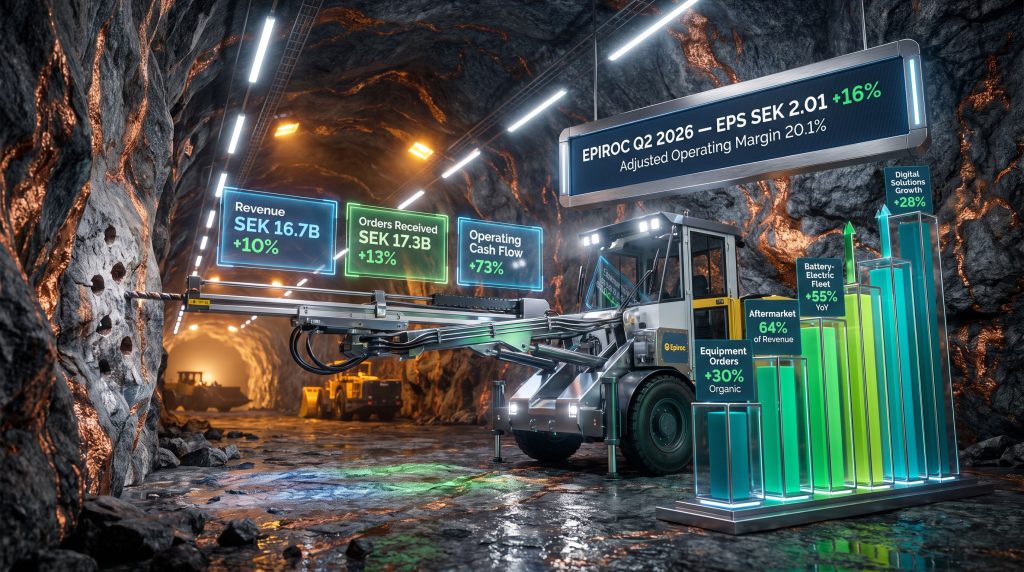
| Orders Received | SEK 17.3 billion (~C$2.51B) | +13% (+13% organic) |
| Revenue | SEK 16.7 billion (~C$2.42B) | +10% (+11% organic) |
| Operating Profit (EBIT) | SEK 3.3 billion (~C$480M) | +17% |
| Adjusted Operating Profit | SEK 3.35 billion (~C$490M) | +12% |
| Operating Margin | 19.9% | Expanded YoY |
| Adjusted Operating Margin | 20.1% | Improved |
| Basic EPS | SEK 2.01 | +16% |
| Operating Cash Flow | SEK 1.9 billion | +73% |
| Net Debt | SEK 11.4 billion | Reduced |
| Net Debt / EBITDA | 0.75x | Improved |
Analytical Note: The +73% surge in operating cash flow to SEK 1.9 billion is arguably the most underappreciated figure in this result set. Cash flow growth at nearly five times the rate of revenue growth suggests that working capital management improved materially, likely aided by more favourable payment timing and a lower tax outflow in the period. For long-cycle industrial businesses, cash conversion quality is often more informative than headline profit margins.
What Drove the 13% Order Growth?
Order intake is the mining equipment sector's equivalent of a forward booking. The composition of Epiroc's order growth in Q2 2026 reveals several important dynamics:
- Equipment orders grew 30% organically, a figure that substantially outpaced service order growth and reflects a wave of front-loaded capital expenditure commitments from tier-one mining operators
- Service orders expanded 6% organically, a more measured pace consistent with an installed base that is still in relatively early expansion phases following recent equipment deliveries
- Large orders totalled SEK 720 million, indicating that multi-system, major project commitments from significant mining clients formed a meaningful portion of the intake
- Currency headwinds compressed to just -1% in Q2 2026, versus a punishing -9% drag in the equivalent period of 2025, which mathematically flatters year-on-year comparisons but also reflects genuine underlying demand momentum
The 30% organic equipment order growth figure deserves particular attention. In mining equipment terms, this kind of acceleration typically corresponds to a phase where operators have gained sufficient confidence in commodity price trajectories to commit to multi-year mine development or expansion programmes. Equipment orders of this scale are not made lightly; they involve procurement cycles, logistics planning, and workforce readiness assessments that can span 12 to 24 months of internal approval processes.
Revenue Mix and the Aftermarket Advantage
One structural feature of Epiroc's business model that consistently attracts investor interest is the weight of aftermarket revenues within total sales. In Q2 2026, the revenue composition broke down as follows:
- Service segment: 41% of total revenues
- Tools and Attachments: 23% of total revenues
- Equipment: 36% of total revenues
Why the 64% Aftermarket Share Matters: Aftermarket revenues are inherently more predictable and margin-accretive than equipment sales. Once a mine operator has committed to a specific equipment platform, the manufacturer supplying that platform gains a structural advantage in providing compatible parts, consumables, and service contracts. This creates an installed-base effect where each piece of equipment sold today generates a recurring revenue tail that can extend across a 10 to 20-year equipment lifespan. For Epiroc, this means that even if new equipment procurement slows in a future downcycle, approximately two-thirds of its revenue base remains relatively insulated.
How Margin Expansion Reflects Operational Discipline
The Architecture Behind the 19.9% Operating Margin
Epiroc's adjusted operating margin reaching 20.1% in Q2 2026 is not simply a function of revenue volume. Several operational factors converged to support this outcome:
- Fixed cost leverage: Higher invoicing volumes spread overhead expenses across a larger revenue base, reducing unit costs
- Efficiency programme contributions: Ongoing internal restructuring and process optimisation initiatives reduced the cost base over prior periods
- Favourable currency dynamics: The shift from a -9% to a -1% currency headwind removed a meaningful translation drag that had suppressed reported margins in comparable prior periods
- Service mix enrichment: The aftermarket business carries structurally higher margins than equipment sales, meaning service growth exerts an upward pull on blended margins even when equipment revenue grows faster in volume terms
Balance Sheet Quality and Earnings Per Share Recovery
Net debt of SEK 11.4 billion at a net debt/EBITDA ratio of 0.75x positions Epiroc with considerable financial flexibility. A sub-1x leverage ratio for an industrial company of this scale provides the optionality to pursue targeted bolt-on acquisitions, increase shareholder returns, or accelerate investment in technology platforms without straining the balance sheet.
Basic earnings per share of SEK 2.01, representing a 16% year-on-year increase, is significant for a different reason. This EPS level represents the highest print since mid-2023, meaning Epiroc's earnings recovery has now fully retraced the period of margin compression and currency headwinds that characterised 2024 and early 2025. For investors tracking the earnings cycle, this restoration to prior peak levels raises the analytical question of whether the next leg of earnings growth could push into new territory.
Strategic Growth Pillars: Technology, Electrification, and Local Presence
Automation and Electrification as Competitive Differentiators
Epiroc's strategic positioning in autonomous drilling and battery-electric underground equipment represents a convergence of two powerful structural trends. The growing adoption of electric mining vehicles is fundamentally altering the economics of underground operations, reducing ventilation costs and eliminating diesel particulates at the point of use. This directly reduces the ventilation infrastructure required to maintain safe underground air quality — a less commonly appreciated economic argument for electrification.
Furthermore, mining automation trends are reshaping how drilling operations are managed. Automation reduces the variability introduced by operator skill differences, improving hole accuracy, reducing ore dilution, and extending drill bit life. In hard rock mining environments where drill bit wear is a significant consumables cost, autonomous drilling systems that optimise penetration rate and rotation parameters can generate measurable cost savings per metre drilled.
Local Presence as a Structural Competitive Moat
Epiroc's operational philosophy centres on maintaining deep local service infrastructure close to mine sites. CEO Helena Hedblom has consistently articulated that geographic proximity enables the company to help customers improve productivity and safety while maximising equipment availability. This is more than a service delivery principle — it is a competitive barrier.
For smaller OEM competitors, replicating a global service network with technicians, parts inventories, and workshop facilities positioned near major mining districts requires capital investment and organisational scale that takes years to develop. Epiroc's existing footprint creates switching costs for customers who rely on rapid response times to minimise equipment downtime. In underground mining particularly, where a single broken piece of critical equipment can halt an entire production panel, the value of guaranteed response times is quantifiable and significant.
The Large Order Pipeline and its Revenue Implications
The SEK 720 million in large orders recorded during Q2 2026 carries forward-looking revenue significance. Major project equipment orders in the mining sector typically convert to revenue recognition across a 12 to 24-month delivery and commissioning window. Consequently, a portion of Q2 2026's large order intake will contribute to revenue in late 2026 and into 2027, providing a degree of near-term earnings visibility that supports analyst confidence in forward estimates.
Benchmarking Q2 2026 Against Historical Performance
| Performance Dimension | Q2 2025 Context | Q2 2026 Outcome |
|---|---|---|
| Currency Impact | -9% headwind | -1% headwind |
| EPS Level | Below mid-2023 peak | Highest since mid-2023 |
| Cash Flow Growth | Baseline period | +73% YoY surge |
| Organic Order Growth | Lower base | +13% organic |
| Equipment Order Growth | Moderate | +30% organic |
The year-on-year comparison is materially enhanced by the currency reversal. However, stripping out currency effects and focusing on the 11% organic revenue growth and 30% organic equipment order growth confirms that underlying demand conditions are genuinely strong, not an artefact of favourable translation arithmetic.
The next major ASX story will hit our subscribers first
What Epiroc's Results Signal for the Broader Mining Equipment Sector
Equipment Orders as a Leading Indicator for Mine Development Activity
Mining equipment procurement is structurally forward-looking. A mine operator placing a large equipment order in Q2 2026 is implicitly signalling that it expects to have productive use for that equipment within the next 12 to 24 months. Aggregated across the industry, rising equipment order volumes therefore indicate that mine development and expansion activity is accelerating, not merely that existing operations are performing well.
This makes Epiroc's order data a useful cross-reference for investors tracking global mining capex trends. When one of the world's largest mining equipment manufacturers reports 30% organic growth in equipment orders, it is consistent with a market environment where major operators are deploying capital at an elevated rate — whether to develop new critical minerals projects, expand existing copper and gold operations, or replace ageing equipment fleets approaching end-of-life.
The Dual Demand Cycle: Traditional Mining Plus Critical Minerals
The mining equipment market in 2026 is not driven by a single demand source. Two parallel cycles are operating simultaneously, and the critical minerals demand surge is proving to be an especially powerful driver of new equipment procurement:
- Traditional mining expansion: Gold and copper producers are investing in capacity additions as sustained high prices improve project economics across a range of ore body types and jurisdictions
- Critical minerals development: Lithium, nickel, cobalt, and rare earth projects are advancing toward production to supply battery supply chains, creating demand for exploration drilling rigs, underground development equipment, and processing infrastructure
Epiroc's exploration solutions division is particularly well positioned to benefit from the second cycle. Exploration drilling activity requires specialised rotary and diamond drill rigs capable of reaching depths of several hundred to several thousand metres, and the consumables intensity of exploration programmes generates recurring aftermarket revenue even from projects that have not yet reached production decisions.
In addition, the integration of AI-powered mining efficiency tools is accelerating across the sector, further reinforcing demand for sophisticated equipment platforms that can interface with digital monitoring and optimisation systems.
Frequently Asked Questions: Epiroc Q2 2026 Results
What were Epiroc's total revenues in Q2 2026?
Epiroc reported total revenues of SEK 16.7 billion (approximately C$2.42 billion) in Q2 2026, representing 10% reported growth and 11% organic growth compared to the same quarter in 2025.
How much did Epiroc's operating profit grow in Q2 2026?
Operating profit rose 17% to SEK 3.3 billion (~C$480 million), producing a reported operating margin of 19.9%. On an adjusted basis, operating profit reached SEK 3.35 billion at a 20.1% margin.
What drove the order growth in Epiroc's Q2 2026 results?
Orders grew 13% to SEK 17.3 billion, with equipment orders expanding 30% organically and service orders growing 6% organically. Large orders totalled SEK 720 million, reflecting major project commitments. These Epiroc Q2 results confirm that broad-based demand across equipment categories is genuinely robust.
How did currency movements affect the results?
Currency translation exerted a -1% impact on reported results, a significant improvement from the -9% headwind in Q2 2025, which materially improves year-on-year comparisons on a reported basis.
What is Epiroc's aftermarket revenue share?
Aftermarket revenues represented 64% of total Q2 2026 revenues, with services at 41% and tools and attachments at 23% of total sales.
What is Epiroc's current balance sheet position?
Net debt stood at SEK 11.4 billion following Q2 2026, with a net debt/EBITDA ratio of 0.75x, reflecting a conservatively leveraged and financially flexible balance sheet. For further detail on Epiroc's financial disclosures, the full interim report provides comprehensive data on segment performance and capital allocation.
Who leads Epiroc as CEO?
Helena Hedblom serves as President and CEO of Epiroc, overseeing the company's global strategy spanning automation, electrification, and aftermarket service network expansion. Additional context on Epiroc's investor positioning is available through the Epiroc investor relations page.
Key Takeaways from Epiroc's Q2 2026 Performance
- Double-digit growth across revenue, profit, and orders confirms the global mining equipment procurement cycle is in a genuine expansionary phase, not a statistical recovery
- 30% organic equipment order growth reflects operator-level conviction in multi-year mine development programmes, particularly in copper, gold, and critical minerals
- Aftermarket revenues at 64% of total sales provide structural earnings resilience that insulates the business from near-term equipment cycle fluctuations
- Operating cash flow +73% demonstrates that profit growth is translating into real balance sheet improvement, not merely accounting gains
- EPS at the highest level since mid-2023 signals that the Epiroc Q2 results recovery has matured into a sustained performance trend with potential for further upside
- Currency tailwind shift from -9% to -1% removes a structural reporting headwind that suppressed prior year comparisons and improves the quality of organic growth signals
- Net debt/EBITDA of 0.75x preserves significant capital allocation flexibility as the cycle continues to develop
This article contains forward-looking analysis and sector commentary intended for informational purposes only. It does not constitute financial advice. Readers should conduct their own due diligence before making investment decisions.
Want to Capitalise on the Next Major ASX Mineral Discovery Before the Market Moves?
Epiroc's 30% organic equipment order surge signals that mining operators are committing serious capital to multi-year development programmes — and where equipment spending accelerates, significant mineral discoveries often follow. Discovery Alert's proprietary Discovery IQ model delivers real-time alerts the moment major ASX mineral discoveries are announced, turning complex data across 30+ commodities into actionable insights for both traders and long-term investors — explore historic discovery returns on the Discovery Alert discoveries page and begin your 14-day free trial to position yourself ahead of the market.