May 14, 2026
When Bigger Becomes Better: The Strategic Logic Behind the Equinox Gold Acquisition of Orla Mining
Gold mining has always rewarded patience, but the current cycle is rewarding something else entirely: scale. Across the global bullion industry, a structural realignment is underway that is redrawing the competitive map for producers of every size. Mid-tier companies that would have been considered well-positioned just a decade ago now find themselves in an uncomfortable position, too large to be ignored by acquirers, yet too small to attract the institutional capital flows that flow toward senior producers. The Equinox Gold acquisition of Orla Mining, announced in May 2026 and valued at approximately $18.5 billion, is one of the clearest expressions yet of this industry-wide reckoning.
Understanding why this deal happened requires stepping back from the transaction itself and examining the deeper forces reshaping how gold companies compete, capitalise, and grow.
When big ASX news breaks, our subscribers know first
The "Grow or Be Acquired" Reality Facing Mid-Tier Gold Producers
The gold sector has entered a phase where the middle ground is shrinking. With bullion prices trading near historic highs, the financial arithmetic of large-scale consolidation has fundamentally changed. Deals that would have destroyed shareholder value at $1,200 per ounce gold become strategically compelling when prices sustain well above $2,000 per ounce, as higher margins across an enlarged asset base can absorb integration costs and dilution effects far more easily.
This price-driven dynamic creates a self-reinforcing consolidation cycle. As senior producers grow through acquisition, they command lower costs of capital, better debt terms, and stronger institutional investor access. Mid-tier producers left outside this consolidation wave face a widening cost-of-capital disadvantage that compounds over time, making organic growth progressively harder to fund on competitive terms. Furthermore, the gold price and mining equities relationship has never been more consequential for M&A decision-making.
The risk profile attached to single-asset or geographically concentrated gold companies has also become a more significant valuation discount factor. Institutional allocators increasingly apply a premium to multi-asset, diversified platforms that can absorb operational disruptions at any single mine without materially impacting overall production guidance. Companies that cannot demonstrate this resilience face a structural valuation ceiling regardless of asset quality.
Scale is no longer merely a competitive advantage in gold mining. It has become an increasingly non-negotiable prerequisite for institutional capital access, index eligibility, and sustainable cost-of-capital management in a market where the premium for proven, diversified production platforms has never been higher.
What the Equinox and Orla Combination Actually Builds
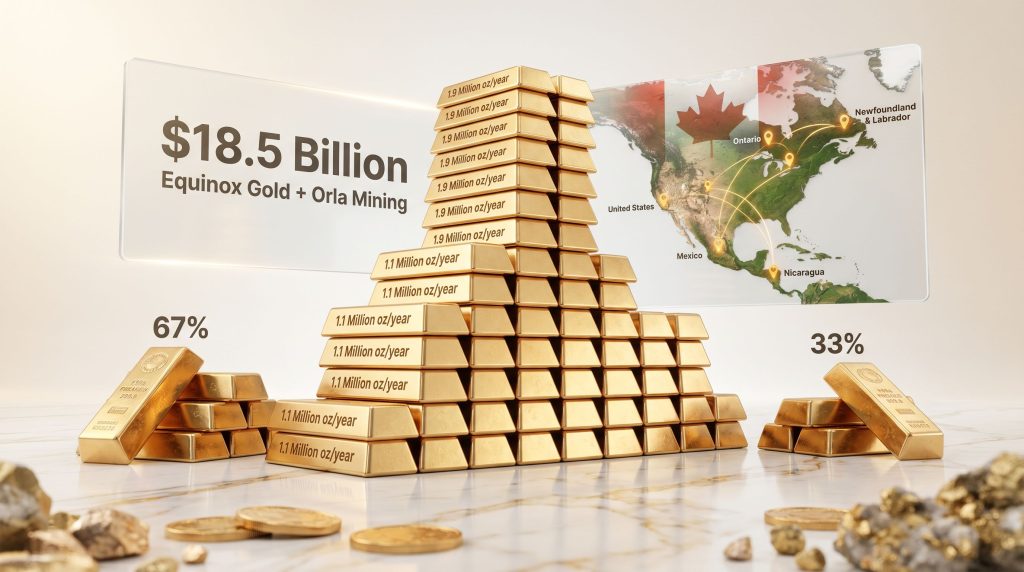
At its core, the Equinox Gold acquisition of Orla Mining is an all-share business combination that joins two TSX- and NYSE-listed producers into a single North America-focused entity. The mechanics of the deal are straightforward: existing Equinox Gold shareholders will retain approximately 67% of the combined company, with Orla Mining shareholders holding the remaining 33%.
The combined entity enters the market with annual gold production capacity of approximately 1.1 million ounces per year at transaction close, drawing from a geographically diversified portfolio of operating mines across Canada, the United States, Mexico, and Nicaragua. According to the official merger announcement, the deal positions the combined company as North America's new senior gold producer.
Key Asset Contributions at Transaction Close
| Asset | Contributing Company | Location |
|---|---|---|
| Greenstone Mine | Equinox Gold | Ontario, Canada |
| Valentine Mine | Equinox Gold | Newfoundland & Labrador, Canada |
| Musselwhite Mine | Orla Mining | Ontario, Canada |
| Mexican Operations | Both | Mexico |
| Central American Operations | Equinox Gold | Nicaragua |
The leadership architecture of the merged company preserves institutional knowledge from both sides. Darren Hall, current Chief Executive Officer of Equinox Gold, will lead the combined company as CEO, while Jason Simpson, current CEO of Orla Mining, will transition into the role of President. This dual-leadership structure is designed to retain operational depth from Orla's track record of disciplined asset development while maintaining strategic continuity from Equinox's existing senior management.
Hall has described the combination as creating a producer with the scale, growth profile, and asset quality to drive a meaningful revaluation for shareholders. Simpson, for his part, has emphasised that Orla was built on disciplined acquisition and operational excellence, and that the combined entity can now compete at a level neither company could independently reach.
How This Merger Reshapes the North American Gold Producer Hierarchy
The Equinox Gold and Orla Mining combination is not simply a transaction between two willing counterparties. It is, however, a deliberate repositioning move within the global gold producer hierarchy, targeting a peer group that includes mid-to-senior producers operating primarily in stable, low-geopolitical-risk jurisdictions.
The "North America-first" identity of the combined company is a conscious strategic differentiation from producers carrying significant exposure to jurisdictions in West Africa, Latin America, or Southeast Asia, where sovereign risk, community relations complexity, and permitting unpredictability can apply persistent discounts to market valuations. By anchoring operations across Canada, the United States, Mexico, and Nicaragua, the merged entity constructs a portfolio that institutional investors tend to evaluate more favourably on risk-adjusted terms.
Jurisdictional Risk Profile: North America-Focused vs. Globally Diversified Gold Producers
| Dimension | North America-Focused | Globally Diversified |
|---|---|---|
| Sovereign Risk | Low | Variable, can be elevated |
| Permitting Predictability | Generally high | Moderate to low |
| Community Relations Complexity | Manageable | Often significant |
| Institutional ESG Alignment | Typically stronger | More complex |
| Valuation Premium | Generally higher | Often discounted |
For competing mid-tier North American gold producers, the emergence of a combined $18.5 billion entity producing 1.1 million ounces annually changes the competitive baseline. Access to lower-cost debt, stronger equity currency for future acquisitions, and enhanced analyst coverage all compound the advantages of greater scale, creating a strategic moat that smaller producers will find increasingly difficult to bridge organically.
The broader gold M&A activity consolidation cycle is well established: sustained high bullion prices improve the financial logic of large-scale combinations, and once a new benchmark scale is established among peers, remaining mid-tier producers face intensified pressure to either find merger partners or demonstrate a differentiated path to value creation.
The Production Growth Scenario: From 1.1 Million to 1.9 Million Ounces
One of the most significant elements of the Equinox Gold acquisition of Orla Mining is not the production base at close, but the development pipeline that underpins long-term growth ambitions. The combined companies have indicated that their organic development pipeline could grow annual gold output by approximately 70%, from the approximately 1.1 million ounces at close to approximately 1.9 million ounces per year.
Production Growth Scenario Modelling
| Scenario | Projected Annual Output | Key Dependency |
|---|---|---|
| Base Case (at close) | ~1.1 million oz | Existing operating mines only |
| Development Pipeline Execution | ~1.9 million oz | Full organic project delivery |
| Upside Case | Exceeds 1.9 million oz | Exploration success and potential further M&A |
If the development pipeline scenario is realised, the combined producer would be positioned among the larger gold companies focused on stable North American jurisdictions, representing a meaningful step-change in scale rather than incremental growth.
It is important for investors to understand the distinction between a production target and a production guarantee. The pathway from 1.1 million to 1.9 million ounces is capital-intensive, multi-year, and dependent on successful execution across multiple concurrent development projects. Variables including capital costs, permitting timelines, construction execution, and gold price assumptions all influence whether the development pipeline converts into producing ounces on the projected timeline.
Investors should treat the 1.9 million ounce target as a scenario analysis rather than a near-term forecast. The credibility of this target will be established through consistent quarterly execution, transparent capital allocation reporting, and demonstrated ability to bring development assets into production on schedule and within budget.
Evaluating the Strategic Rationale: Bull Case and Bear Case
Any transaction of this scale carries both a compelling strategic case and legitimate risks that require honest evaluation.
The Bull Case: Why Scale Creates Structural Value
- Capital market access: A combined entity at $18.5 billion commands lower-cost debt, broader analyst coverage, and eligibility for institutional mandates that require minimum market capitalisation thresholds.
- Operational synergies: Shared technical teams, combined procurement leverage across multiple operating mines, and unified corporate overhead costs can reduce per-ounce all-in sustaining costs over time.
- Portfolio quality upgrade: The concentration of high-quality, long-life assets in politically stable jurisdictions reduces the sovereign risk discount that both companies carried individually.
- Re-rating potential: Neither Equinox nor Orla independently achieved the valuation multiples of senior gold producers. The combined entity, by meeting scale and asset quality thresholds, has the structural characteristics to justify higher enterprise value-to-production multiples.
- Organic growth pipeline: The development pipeline represents embedded future production that does not require an acquisition premium, providing a cost-efficient path to further scale.
The Bear Case: Risks That Could Constrain Value
- Integration execution risk: Combining operating cultures, management structures, and workforces across four countries introduces complexity that is easy to underestimate.
- Dilution concerns: Existing Equinox shareholders absorb meaningful dilution through the 33% ownership transfer to Orla's shareholder base. Whether that dilution is justified depends entirely on the execution of the combined growth strategy.
- Development pipeline uncertainty: The 70% production growth target carries substantial execution risk. Capital overruns, permitting delays, or construction complications at any major project could materially defer the timeline to 1.9 million ounces.
- Gold price sensitivity: The financial logic of the transaction is partly calibrated to sustained high gold prices. A material correction in bullion prices would compress margins across the enlarged asset base and potentially delay development project investment decisions.
The next major ASX story will hit our subscribers first
Transaction Structure and Capital Market Context
The all-share structure of the Equinox Gold and Orla Mining deal is itself a strategic signal worth examining. In an environment where gold prices are near historic highs, equity currencies of producing gold companies are at their most potent. Using shares rather than cash or debt to fund an acquisition preserves balance sheet flexibility, avoids incremental interest burdens, and aligns both shareholder groups with the long-term performance of the combined entity.
Prior to the announcement, Equinox Gold shares closed at C$20.28 on the Toronto Stock Exchange, while Orla Mining shares closed at C$19.77, providing a comparable starting valuation baseline for both parties and facilitating a more straightforward negotiation of the exchange ratio. As reported by Reuters, the deal represents one of the more significant combinations among North America-focused producers in recent years.
The transaction is targeted for completion in Q3 of the current calendar year, subject to regulatory review and shareholder approvals from both companies. The dual listing of both entities on the TSX and NYSE broadens the combined shareholder base, enhances post-merger liquidity, and maintains accessibility for both Canadian and American institutional investors.
Frequently Asked Questions
What is the total value of the Equinox Gold and Orla Mining deal?
The transaction is valued at approximately $18.5 billion, positioning it among the more significant gold sector M&A transactions among North America-focused producers in recent years. For context, the gold price outlook has been a key driver of improved deal economics across the sector.
How much gold will the combined company produce annually?
At transaction close, the combined entity is expected to produce approximately 1.1 million ounces of gold per year, with a development pipeline that could grow that figure to approximately 1.9 million ounces annually.
Who will lead the combined company?
Darren Hall, current CEO of Equinox Gold, will serve as Chief Executive Officer. Jason Simpson, current CEO of Orla Mining, will transition to the role of President.
What ownership split will shareholders have?
Existing Equinox Gold shareholders will hold approximately 67% of the combined entity, while Orla Mining shareholders will own approximately 33%.
Where will the combined company operate mines?
The merged producer will hold operating assets across Canada (Ontario and Newfoundland & Labrador), the United States, Mexico, and Nicaragua.
When is the transaction expected to close?
The deal is targeted for completion in Q3 2026, subject to regulatory and shareholder approvals.
Why is this deal significant for the gold mining industry?
The combination accelerates the North American gold sector consolidation trend, establishing a new senior producer with the scale, asset quality, and development pipeline to compete with the largest producers operating in stable mining jurisdictions globally. In addition, high-profile examples of contested consolidation — such as the Gold Road takeover bid and the subsequent Gold Fields takeover offer — illustrate just how actively the global sector is being reshaped.
Key Signals This Merger Sends to the Gold Sector
The Equinox Gold acquisition of Orla Mining is more than a corporate transaction. It is, consequently, an industry signal about where value is being created, and where it is being eroded, in the current gold market cycle.
Several broader themes emerge from the combination:
- Consolidation among North American gold producers is moving from a background trend to a foreground strategic imperative, driven by sustained high gold prices improving deal economics.
- The creation of a $18.5 billion, 1.1 million oz/year producer with a 1.9 million oz/year development target marks a meaningful shift in the competitive hierarchy of North American gold mining.
- All-share deal structures are increasingly the preferred mechanism for large-scale combinations, as they preserve balance sheet strength and align shareholder interests with long-term execution.
- Jurisdictional focus on Tier 1 and Tier 2 mining jurisdictions (Canada, the United States, Mexico) is becoming a distinct competitive and valuation advantage as institutional ESG frameworks place growing weight on political stability and regulatory predictability.
- Leadership continuity, with Hall remaining as CEO and Simpson transitioning to President, reduces transition risk and signals a measured integration approach to the market.
This article contains forward-looking information regarding production targets, development timelines, and transaction outcomes. Actual results may differ materially from projections based on gold price movements, regulatory outcomes, capital cost variations, and execution risks inherent in mine development. This article does not constitute financial or investment advice. Readers should conduct their own due diligence and consult a qualified financial adviser before making investment decisions.
Want to Track the Next Major Gold Discovery Before the Market Moves?
Discovery Alert's proprietary Discovery IQ model scans ASX announcements in real time, instantly identifying significant mineral discoveries and turning complex data into actionable investment insights — ideal for investors monitoring the consolidation reshaping the global gold sector. Explore historic discovery returns on Discovery Alert's discoveries page and begin your 14-day free trial to position yourself ahead of the market.