EQUUS Energy Ltd
Equus Energy Clears a Major Hurdle: Pre-FEED Results Confirm the Equus Gas Project is Ready for Its Next Chapter
Equus Energy Limited (ASX: EQU) has announced the successful completion of Pre-Front End Engineering Design (Pre-FEED) for its Equus Gas Project on Western Australia's North West Shelf – a pivotal technical milestone that confirms the project is both technically feasible and commercially robust. The Equus Energy Equus Gas Project pre-FEED results on the North West Shelf validate 1.7 trillion cubic feet (Tcf) of independently certified contingent gas resources and 38 million barrels (MMbbl) of condensate, with the company now turning its attention to partnering, financing, and regulatory approvals ahead of a Final Investment Decision (FID).
This is not an incremental update. Pre-FEED completion is the gateway event that separates concept from credible development – and for Equus Energy, the results firmly validate two capital-efficient development pathways using existing North West Shelf infrastructure.
Managing Director Will Barker said: "What continues to stand out about Equus is the ability to leverage existing North West Shelf infrastructure and spare gas processing capacity to access both LNG export markets and the Western Australian domestic gas market, providing development flexibility and capital efficiency. At a time when WA is facing tightening domestic gas supply and Asian buyers continue to focus on long-term energy security, Equus is positioned as a new source of reliable Australian gas supply for the region."
When big ASX news breaks, our subscribers know first
Two Pathways, One Clear Destination: Commercialising a Tier-1 Gas Resource
The Pre-FEED programme evaluated two primary tie-back development concepts, both of which leverage existing third-party infrastructure on the North West Shelf rather than requiring expensive, time-consuming greenfield construction. This distinction is critical – it directly reduces capital requirements, execution risk, and development complexity.
| Development Pathway | Tie-Back Operator | LNG Market Access | Domestic Gas Access |
|---|---|---|---|
| Equus to Pluto | Woodside (Pluto) | Pluto LNG Train 1 + Karratha Gas Plant via Pluto–KGP interconnector | Dampier to Bunbury Natural Gas Pipeline (DBNGP) |
| Equus to Varanus Island | Santos (Varanus Island) | Existing North West Shelf LNG infrastructure | Dampier to Bunbury Natural Gas Pipeline (DBNGP) |
Both pathways are designed to deliver the same core production profile, giving Equus the flexibility to progress with whichever partner and infrastructure arrangement provides the most commercially advantageous terms.
What the Project Actually Looks Like: Key Development Parameters
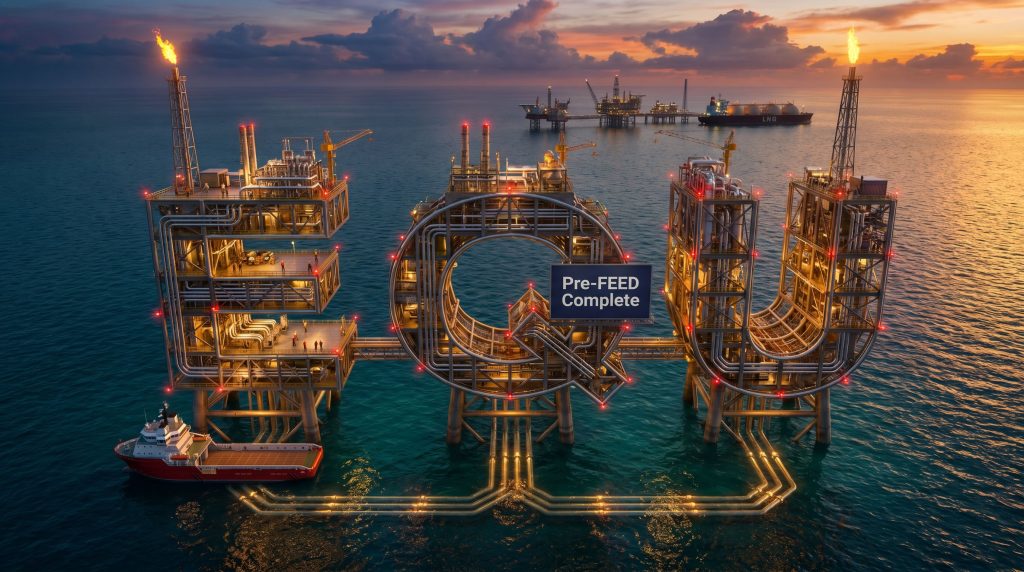
The Equus Gas Project has been designed around a permanently moored Floating Production, Storage and Offloading (FPSO) facility centrally located within the Equus field area, feeding from an initial suite of up to five subsea wells.
Production Capacity at Start-Up
- Gross production capacity of approximately 350 MMscf/d (~350 TJ/d)
- Up to ~50 TJ/d of domestic gas supply (~5% of current WA demand)
- Up to ~2 million tonnes per annum (Mtpa) of LNG
- Approximately 12,000 barrels per day of condensate production at start-up
- 15-year project life based on existing certified resources
Development Architecture – Seven Key Components Validated
-
Subsurface and Reservoir: Integrated reservoir models confirm deliverability sufficient to support design capacity of ~350 MMscf/d. Phased infill drilling supports long-term production sustainability, with early focus on high-productivity, high-condensate fields.
-
Drilling and Completions: Well designs completed for both dry gas and wet gas producers. The drilling environment is assessed as benign, supporting conventional offshore practices and low execution risk.
-
Subsea Production System (SPS): A multi-hub subsea architecture has been developed and is common to both the Pluto and Varanus Island tie-back options, optimised for hydrate management, operational simplicity, and reliability.
-
FPSO Facility: A permanently moored FPSO provides the centralised production hub for subsea well control, condensate storage and export, and upstream gas processing – delivering pipeline-quality dry gas to existing LNG and domestic infrastructure.
-
Export Pipelines and Tie-Backs: Export pipeline routes and specifications are defined for both development options, integrating with existing offshore infrastructure and utilising existing subsea pipelines to avoid near-shore construction complexities.
-
Gas Processing and Market Access: Processing capacity is available through existing LNG and domestic gas facilities. Economic modelling supports a globally competitive LNG cost of supply.
-
Regulatory and Approvals: State Government conditional consent has been received for 85% LNG export and 15% domestic gas supply. The Offshore Project Proposal (OPP) requirements have been reviewed with no material approval risks identified, and existing baseline environmental studies provide a solid foundation for OPP preparation and submission.
Understanding Pre-FEED: Why This Milestone Matters to Investors
What Is Pre-FEED?
Pre-Front End Engineering Design (Pre-FEED) is the engineering and technical study phase that sits between early concept selection and the full FEED process. It is where a project moves from a high-level development idea into a detailed, costed, and risk-assessed technical blueprint.
Why Does It Matter?
Pre-FEED completion is the threshold at which a project is deemed technically credible enough to attract serious commercial partners, lenders, and offtake customers. It answers the critical question that sophisticated investors and project financiers ask before committing capital: "Has the engineering been stress-tested, and does the project actually work?"
For the Equus Energy Equus Gas Project pre-FEED results on the North West Shelf, a successful Pre-FEED means:
- The development concepts are technically validated and de-risked
- Capital cost estimates carry greater confidence for financing discussions
- The project has a defined, achievable pathway to FEED and FID
- Conversations with upstream partners, infrastructure owners, and LNG buyers can progress on a substantiated technical foundation
Glossary of Key Terms
| Term | Definition |
|---|---|
| Pre-FEED | Pre-Front End Engineering Design – detailed technical scoping study before full engineering design commences |
| FEED | Front End Engineering Design – the full engineering phase that produces a project ready for construction bids and investment decisions |
| FID | Final Investment Decision – the formal decision by project partners to commit funding and proceed to construction |
| Contingent Resource | A volume of hydrocarbons estimated to be potentially recoverable, subject to commercial development conditions being met |
| FPSO | Floating Production, Storage and Offloading – a floating vessel used for processing and storing oil and gas at sea |
| Tie-Back | Connecting a new offshore development to existing infrastructure rather than building standalone new facilities |
| Tcf | Trillion cubic feet – a measurement of natural gas volume |
| Mtpa | Million tonnes per annum – a measure of LNG production capacity |
| MMscf/d | Million standard cubic feet per day – a flow rate measurement for gas production |
| DBNGP | Dampier to Bunbury Natural Gas Pipeline – WA's main domestic gas transmission pipeline |
| OPP | Offshore Project Proposal – a regulatory submission required under Australian offshore petroleum legislation |
The Market Backdrop: Timing Is a Strategic Asset
The Equus Gas Project is advancing into a global and domestic energy environment that increasingly favours new, reliable, low-risk LNG supply. Furthermore, both international and domestic market conditions align exceptionally well with what Equus has to offer.
Global LNG Fundamentals
- Asian LNG demand is expected to increase materially as economies transition away from coal
- Supply shortfalls and delays in new LNG developments have increased buyer reliance on proven, low-risk supply sources
- Australian LNG has emerged as a critical and reliable supply source for Asian energy security (per Rystad Energy analysis cited in the announcement)
Western Australian Domestic Gas Market
WA faces a tightening domestic gas supply outlook as legacy fields decline. New sources of supply are, therefore, required to maintain system reliability. Equus is designed to supply approximately 5% of current WA domestic gas demand, representing a meaningful contribution at a critical time.
This dual-market access capability – serving both Asian LNG buyers and the WA domestic market – is a genuine commercial differentiator that few undeveloped offshore resources on the North West Shelf can claim.
What Comes Next: The Road to FEED and FID
With the Equus Energy Equus Gas Project pre-FEED results on the North West Shelf successfully completed, Equus Energy has outlined four parallel workstreams that will define the project's near-term trajectory.
| Workstream | Description | Purpose |
|---|---|---|
| Upstream Partnering | Advancing discussions with potential operator partners and equity participants | Risk sharing, development execution support, and project funding |
| LNG Customers and Offtake | Engaging LNG buyers for long-term offtake agreements, plus domestic gas supply opportunities | Revenue certainty and commercial bankability |
| Infrastructure and Tolling | Discussions with Pluto and Varanus Island infrastructure owners on tolling, capacity access, and funding structures | Confirms and defines the development pathway |
| Project Financing | Engaging banks, export credit agencies, and other financiers on project financing solutions | Provides the capital structure to underpin FID |
These four workstreams are interconnected – progress in one area typically accelerates the others. Long-term offtake agreements, for instance, are a prerequisite for project financing, while confirmed infrastructure access informs the final engineering specifications that underpin partner and lender due diligence.
The Investment Thesis: A Capital-Efficient Gateway to a Tier-1 Resource
The completion of Pre-FEED sharpens the Equus Energy investment case considerably. The key pillars of that case can be summarised as follows.
Scale of the Resource Base: An independently certified contingent resource of 1.7 Tcf of gas and 38 MMbbl of condensate places Equus among the larger undeveloped offshore gas accumulations in Australia. This is not a marginal resource – it is a foundation for a 15-year producing development.
Capital Efficiency Through Infrastructure Leverage: The ability to tie back to either the Pluto or Varanus Island infrastructure – rather than building a standalone greenfield facility – materially reduces both the capital required and the execution risk. This makes the project more attractive to partners and financiers alike.
Dual-Market Optionality: Access to both LNG export markets and the WA domestic gas market means Equus can optimise commercial terms as market conditions evolve. The State Government conditional consent for 85% LNG / 15% domestic supply provides a clear regulatory framework for this approach.
Advancing Into a Favourable Market Cycle: The global LNG market is tightening. New supply sources with credible development pathways, established technical pedigrees, and proximity to Asian demand centres are increasingly in demand. Equus sits at the intersection of all three.
Defined, Achievable Pathway to Value Creation: The project now has a validated technical blueprint, a clear regulatory pathway with no material approval risks identified, and an active commercial engagement programme. The route from Pre-FEED to FEED to FID is well-defined.
The next major ASX story will hit our subscribers first
Why Investors Should Keep Equus Energy on Their Radar
The Equus Energy Equus Gas Project pre-FEED results on the North West Shelf have taken a large, certified offshore gas resource and – through disciplined engineering work – transformed it into a credible, technically validated development project with a clear commercialisation roadmap.
The company is not starting from scratch on commercial engagement. Discussions with upstream partners, LNG customers, infrastructure owners, and project financiers are already underway. The technical work that underpins those conversations is now complete and validated.
For investors seeking exposure to the LNG and domestic gas sector at a point in the development cycle where significant value can still be created, Equus Energy warrants close attention. The next series of milestones – upstream partnering agreements, offtake term sheets, and infrastructure access arrangements – will each represent material catalysts for the project and the company.
Managing Director Will Barker will host a live investor webinar on Friday, 15 May 2026 at 9:00am AWST / 11:00am AEST to discuss the Pre-FEED results and answer investor questions. Registration is available via the company's ASX announcement.
"Equus Energy has confirmed through rigorous Pre-FEED engineering that its Equus Gas Project is technically feasible, commercially robust, and capital-efficient – underpinned by 1.7 Tcf of independently certified contingent resources and two validated tie-back pathways to existing North West Shelf infrastructure. With active commercialisation workstreams now underway across partnering, offtake, infrastructure access, and project financing, investors should watch closely as the project advances toward FEED and a Final Investment Decision."
Want to Stay Ahead of the Next Major ASX Energy Discovery?
Discovery Alert's proprietary Discovery IQ model delivers real-time alerts on significant ASX mineral and energy discoveries, instantly empowering subscribers to identify actionable opportunities ahead of the broader market — explore the historic returns major discoveries have generated and begin your 14-day free trial at Discovery Alert to position yourself at the forefront of the next transformative find.