August 24, 2026
Deepwater's New Frontier: Why the Atlantic Basin Is Redefining Offshore Production
Across the global upstream landscape, a quiet but consequential shift has been underway for more than a decade. Ultra-deepwater exploration, once considered the riskiest and most capital-intensive segment of oil development, has matured into one of the most commercially compelling frontiers in the industry. The Atlantic Basin, stretching from the Gulf of Mexico to West Africa and into South America's northeastern coast, now hosts some of the world's most significant new production capacity. At the centre of this transformation sits a small South American nation that, until relatively recently, barely registered on global upstream maps: Guyana.
The delivery of the Errea Wittu FPSO at the Uaru field offshore Guyana marks a defining chapter in this story. It is not simply another vessel handover. It represents the convergence of advanced hull engineering, artificial intelligence integration, multi-reservoir co-development strategy, and a deepening national production capability that few observers predicted would arrive this quickly.
When big ASX news breaks, our subscribers know first
The Stabroek Block: South America's Most Consequential Deepwater Lease
The Stabroek Block has become the centrepiece of Guyana's upstream ambitions, and for good reason. Spanning approximately 6.6 million acres offshore the Demerara-Mahaica region, the block contains an estimated recoverable resource base that has been revised upward repeatedly since the Liza discovery in 2015. Industry analysts now place the block's total recoverable resource potential at more than 11 billion oil-equivalent barrels, placing it among the most significant deepwater discoveries of the past two decades globally.
What makes Stabroek particularly unusual is the density and quality of its resource accumulations. The Liza, Payara, Yellowtail, and now Uaru developments are not isolated pockets of hydrocarbons separated by barren geology. They form a series of interconnected, stacked turbidite sand reservoirs of Campanian and Santonian age, deposited in deep-water fan systems that produce high-quality, light crude. This reservoir architecture is rare in deepwater settings and is a key reason why successive development phases have been sanctioned with relative speed.
The Uaru development integrates three discrete accumulations: Snoek, Mako, and Uaru. This co-development approach reflects a deliberate capital efficiency strategy, consolidating subsea tiebacks and surface processing infrastructure rather than constructing separate production systems for each reservoir. The economics are compelling. Sharing an FPSO across multiple accumulations significantly reduces the per-barrel capital cost relative to standalone development, particularly in ultra-deepwater environments where infrastructure costs scale steeply with water depth and distance from shore.
Technical Breakdown: Engineering the Errea Wittu FPSO for Ultra-Deepwater Operations
Hull Architecture and Structural Design Innovations
The Errea Wittu is built on MODEC's proprietary new-build hull platform, which incorporates full double-hull construction throughout the vessel's length. This design choice is not merely a regulatory compliance measure; it is an engineering decision that provides meaningful structural advantages over single-skin or converted-tanker hull configurations that have historically been adapted for FPSO service.
The expanded topsides deck area is equally significant. By increasing the available deck footprint, MODEC's design team was able to integrate high-capacity processing modules without the spatial compromises that constrain converted-hull vessels. This becomes critical when you consider the throughput specifications demanded by the Uaru development programme.
Core Processing Specifications at a Glance
| Metric | Specification |
|---|---|
| Oil Production Capacity | 250,000 barrels per day |
| Associated Gas Treatment | 540 MMcfd |
| Water Injection Capacity | 350,000 barrels per day |
| Crude Oil Storage | ~2 million barrels |
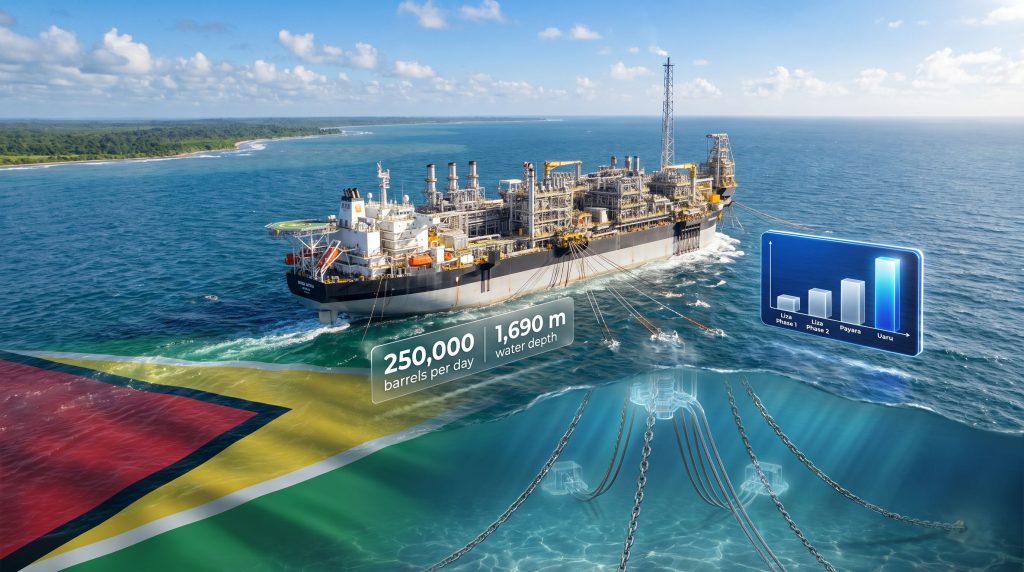
| Operating Water Depth | 1,690 metres |
| Distance from Shore | ~200 kilometres |
To place these numbers in context: a production capacity of 250,000 barrels per day places the Errea Wittu among the largest-capacity FPSOs currently operating globally. The 540 million cubic feet per day gas treatment capacity is particularly notable, as associated gas management has historically been a bottleneck in deepwater FPSO operations. Insufficient gas handling capacity forces operators to either curtail oil production or flare excess gas, both outcomes being operationally and commercially damaging.
The 350,000 barrel per day water injection capacity is also strategically important. Water injection is the primary mechanism for maintaining reservoir pressure in Stabroek's turbidite sand reservoirs as production proceeds. Under-injecting relative to withdrawal rates accelerates pressure decline and reduces ultimate recovery factors, making the water injection specification a direct determinant of long-term field economics.
Mooring System and Subsea Deployment Strategy
Deploying a vessel of the Errea Wittu's scale at 1,690 metres of water depth, approximately 200 kilometres from the Guyanese coastline, presents substantial engineering challenges. The vessel uses a SOFEC spread mooring system, a configuration that distributes mooring loads across multiple anchor points arranged in a pattern around the vessel rather than concentrating them through a single turret structure.
The spread mooring approach offers several advantages in the relatively benign metocean conditions of the Atlantic swell environment offshore Guyana:
- Eliminates the mechanical complexity and maintenance demands of a turret bearing assembly
- Distributes hull stress loads more evenly across the vessel structure
- Reduces the risk of single-point mooring failure cascades
- Simplifies subsea connector geometry for riser and umbilical arrangements
In environments with severe directional weather variability, a turret mooring system that allows the vessel to weathervane would typically be preferred. The selection of spread mooring for the Errea Wittu reflects an assessment that Guyana's offshore metocean conditions are sufficiently stable to make this trade-off favourable.
Gas Turbine Combined Cycle System: Efficiency and Emissions Architecture
One of the Errea Wittu's most technically distinctive features is its gas turbine combined cycle (CCGT) power generation system. In conventional offshore power configurations, gas turbines operate in open-cycle mode, exhausting waste heat directly to atmosphere. This is thermally inefficient, typically achieving energy conversion efficiencies in the range of 30 to 35 percent.
A combined cycle system captures that exhaust heat through a heat recovery steam generator, using the recovered energy to drive a steam turbine and produce additional electrical power. This raises effective thermal efficiency to the 50 to 55 percent range, a meaningful improvement that translates directly into reduced fuel gas consumption per unit of electricity generated and, consequently, lower CO₂ emissions intensity per barrel of oil produced.
For operators facing increasing scrutiny over Scope 1 emissions from offshore production facilities, the CCGT architecture represents a structural emissions reduction rather than an offset or mitigation measure. Furthermore, in the context of broader mining decarbonisation benefits and industrial emissions reduction, it is embedded in the vessel's energy balance from day one of operations.
What Does Errea Wittu Mean and Why Does It Matter?
The name Errea Wittu derives from an indigenous Guyanese language and translates to abundance. This naming decision carries more weight than it might initially appear. Across resource-producing nations, the naming of offshore assets has increasingly become a dimension of social licence management rather than mere branding.
When international oil companies operate in sovereign resource territories, the cultural relationship between the development programme and the host nation's identity matters to long-term operational stability. Adopting names from local indigenous heritage signals a form of cultural recognition that goes beyond contractual royalty arrangements or local content requirements. It is worth noting that the Stabroek Block partners have followed a consistent pattern of naming their Guyanese FPSO fleet after local cultural and natural references, reflecting the broader social context of operating in a nation where oil wealth is a relatively new and politically sensitive phenomenon.
How AI Integration Transforms FPSO Operations Aboard the Errea Wittu
Predictive Maintenance and Equipment Failure Prevention
The Errea Wittu's AI-enabled systems represent one of the more significant operational differentiators between this vessel and earlier-generation FPSOs in the Stabroek fleet. Traditional maintenance frameworks on offshore production vessels follow either fixed time-based schedules or reactive intervention after failure detection. Both approaches have limitations: scheduled maintenance generates unnecessary interventions on equipment that remains in good condition, while reactive maintenance allows failures to develop to the point of production impact before triggering a response.
AI-driven operations change this paradigm by analysing continuous sensor data streams from rotating equipment, pressure systems, heat exchangers, and process vessels to detect developing anomalies before they manifest as failures. The practical implications are significant:
- Early identification of bearing wear in gas compressors and pumps before mechanical failure occurs
- Detection of fouling trends in heat transfer equipment before thermal efficiency degrades to intervention thresholds
- Identification of valve seat deterioration patterns that precede process isolation failures
- Optimisation of maintenance scheduling to align interventions with planned production deferral windows
The shift from time-based to condition-based maintenance on an FPSO of this scale has the potential to reduce unplanned production deferral events substantially while simultaneously lowering the total maintenance cost per barrel across the vessel's operating life.
Shore-Based Remote Operations
The Errea Wittu's design explicitly supports future remote operations management from an onshore control centre. This capability is architecturally significant because it enables a progressive reduction in the offshore manning complement as operational confidence in the remote monitoring systems builds over time.
For an asset located 200 kilometres offshore, reducing crew rotation logistics translates into meaningful cost savings and safety risk reduction. Helicopter transport to and from an asset at that distance carries inherent risk, and minimising the frequency of personnel movements is a meaningful safety improvement in its own right. The connectivity infrastructure required for remote FPSO management, including high-bandwidth satellite links, redundant communication pathways, and hardened cybersecurity architecture, also positions the vessel for the next generation of offshore digitalisation frameworks. This aligns closely with broader mining innovation trends that are reshaping how industrial assets are managed remotely.
AI-Driven Emissions Monitoring and Process Safety
Beyond maintenance optimisation, the Errea Wittu's AI systems provide real-time emissions tracking and process safety envelope monitoring. In practical terms, this means the vessel's control systems can identify when operating parameters are approaching hazardous conditions and flag deviations before they escalate into process safety events.
This capability addresses one of the persistent challenges in offshore process safety management: the gap between what instrumentation detects and what human operators can effectively monitor across complex, simultaneous process streams. AI-powered efficiency effectively extends the surveillance capacity of the operations team without requiring proportional increases in staffing.
Who Owns the Stabroek Block: Joint Venture Structure and Operator Dynamics
Equity Interests and Operator Responsibilities
| Partner | Equity Interest | Role |
|---|---|---|
| ExxonMobil Guyana Ltd. | 45% | Operator |
| Hess Guyana Exploration Ltd. | 30% | Non-operating partner |
| CNOOC Petroleum Guyana Ltd. | 25% | Non-operating partner |
ExxonMobil's operator role carries responsibilities that extend well beyond equity ownership. As operator, ExxonMobil Guyana manages all aspects of project execution including contractor management, regulatory interface with Guyana's energy authorities, production optimisation, and FPSO commissioning oversight. The company's deepwater operational experience, built across the Gulf of Mexico, West Africa, and now Guyana, provides the technical foundation for managing the Uaru development's complexity.
CNOOC's 25% participation in Stabroek is worth examining in a broader context. Chinese national oil companies have been deliberately expanding their deepwater portfolio positions in Atlantic Basin assets over the past decade, and Stabroek represents one of the highest-quality deepwater equity positions outside of sovereign production-sharing arrangements. CNOOC's non-operating partnership structure in Guyana provides exposure to world-class resource quality and operational execution without bearing the full liability of operatorship.
MODEC's Contractual Scope Beyond Vessel Delivery
MODEC's involvement in the Errea Wittu extends significantly beyond the construction and delivery of the vessel itself. The company holds a 10-year operations and maintenance contract for the FPSO following handover to ExxonMobil Guyana. This long-term O&M arrangement reflects an important risk-sharing structure that has become increasingly common in deepwater FPSO projects.
Under this model, the FPSO contractor retains operational responsibility and accountability for vessel performance over an extended period, creating strong incentives for the construction team to design for maintainability and long-term reliability rather than simply optimising for delivery cost and schedule. From an operator's perspective, the arrangement transfers significant operational complexity to a specialist contractor while maintaining production accountability through contractual performance mechanisms.
The next major ASX story will hit our subscribers first
Guyana's Broader Production Growth Trajectory
From Liza to Uaru: Building a Multi-FPSO Production System
The Errea Wittu's deployment represents the fourth FPSO to enter production service on the Stabroek Block, following the Liza Destiny (Liza Phase 1), Liza Unity (Liza Phase 2), and Prosperity (Payara) vessels. Each successive vessel has added production capacity and demonstrated Guyana's ability to absorb the logistical, regulatory, and workforce demands of parallel deepwater developments.
The progression from approximately 120,000 b/d with Liza Phase 1 to a potential combined Stabroek production capacity exceeding 800,000 b/d once Uaru reaches plateau illustrates the scale of transformation that has occurred in Guyana's upstream sector within less than a decade. For a nation with a population of under one million people, the per-capita significance of this production growth is extraordinary by any global comparison.
The Snoek, Mako, and Uaru Resource Integration Rationale
Co-developing multiple reservoir accumulations through a single FPSO is an approach that requires careful subsurface engineering. The Snoek, Mako, and Uaru accumulations each have distinct reservoir characteristics in terms of pressure regimes, fluid properties, and productivity indices. Integrating them through a shared production facility requires the subsea architecture to manage potentially different wellhead flowing pressures and the topsides processing systems to handle blended crude streams with variable composition.
The capital efficiency argument for this approach is nevertheless compelling. Constructing a separate FPSO for each accumulation would multiply the fixed infrastructure costs without proportionally improving the aggregate production rate. By sharing surface infrastructure, the Uaru development programme effectively spreads the FPSO capital cost across a larger resource base, improving the break-even economics of each individual accumulation. This mirrors the energy transition in mining and energy sectors more broadly, where shared infrastructure increasingly underpins economic viability.
Key Milestones on the Path to First Oil
The pathway from FPSO delivery to sustained production involves a structured sequence of commissioning and verification activities:
- FPSO delivery from MODEC to ExxonMobil Guyana — vessel handover formally completed, initiating the offshore phase
- Offshore mooring installation — spread mooring system deployment and verification at 1,690 metres water depth
- Subsea connection and riser hookup — connecting the subsea production network to the vessel's risers and umbilicals
- Topsides systems commissioning — sequential verification of processing, utilities, safety, and power generation systems
- First oil production — initial hydrocarbon introduction into the processing train following commissioning sign-off
- Plateau ramp-up — progressive well tie-ins and production optimisation targeting the 250,000 b/d nameplate capacity
Each of these phases carries its own technical risk profile and critical path implications. Topsides commissioning on a vessel of the Errea Wittu's complexity, incorporating AI systems, CCGT power generation, and advanced process safety monitoring, typically involves extensive pre-startup safety reviews and system-by-system verification that cannot be meaningfully compressed without accepting elevated commissioning risk.
Frequently Asked Questions: Errea Wittu FPSO at the Uaru Field
What does Errea Wittu mean?
Errea Wittu translates to abundance in a local Guyanese indigenous language. The Stabroek Block partners have adopted a convention of naming their FPSO fleet after local cultural and linguistic heritage, reflecting the social context of operating in Guyana's sovereign resource territory.
How deep is the Errea Wittu FPSO deployed?
The vessel is moored at approximately 1,690 metres of water depth, positioned roughly 200 kilometres offshore Guyana, using a SOFEC spread mooring system engineered for the Atlantic swell conditions of this ultra-deepwater environment.
What is the production capacity of the Errea Wittu FPSO?
The Errea Wittu is rated for up to 250,000 barrels of oil per day, with gas treatment capacity of 540 MMcfd, water injection capacity of 350,000 barrels per day, and onboard crude storage of approximately 2 million barrels.
Which fields does the Errea Wittu develop?
The vessel integrates production from the Snoek, Mako, and Uaru accumulations within the Stabroek Block, enabling capital-efficient co-development through shared surface processing infrastructure.
Who built the Errea Wittu FPSO?
MODEC Inc. designed and constructed the vessel under contract to ExxonMobil Guyana Ltd. MODEC also holds a 10-year operations and maintenance agreement covering the vessel's post-delivery operational phase.
How does the Errea Wittu reduce carbon emissions?
The vessel's gas turbine combined cycle power generation system improves thermal efficiency relative to conventional open-cycle configurations, reducing fuel gas consumption and CO₂ emissions per unit of electricity generated. AI-enabled monitoring systems provide real-time emissions tracking and process optimisation capability throughout operations.
The Errea Wittu as a Blueprint for Next-Generation Deepwater FPSO Development
Taken together, the engineering choices embedded in the Errea Wittu's design — its CCGT power system, AI-enabled predictive maintenance and safety monitoring, remote operations readiness, new-build hull architecture, and multi-reservoir integration strategy — constitute a coherent vision of what a next-generation deepwater FPSO looks like in practice.
The vessel is not simply a larger or more capable version of its Stabroek predecessors. It represents a qualitative shift in how FPSO operators and contractors are thinking about the intersection of production efficiency, emissions management, and digital operations. The integration of AI from the vessel's operational architecture rather than as a retrofitted afterthought is particularly significant, as it positions the Errea Wittu FPSO at the Uaru field offshore Guyana to benefit from improving machine learning models and expanding sensor networks throughout its service life.
For Guyana as a nation, the Uaru development's advancement toward first oil carries implications that extend well beyond the upstream sector. The incremental production volumes will flow through to government revenue via the terms of the Stabroek production sharing agreement, funding infrastructure, healthcare, and education programmes in a country where the pace of economic transformation has already been dramatic. How Guyana manages the per-capita wealth concentration associated with successive FPSO startups will be one of the more closely watched resource governance stories of this decade.
For the broader deepwater industry, the Errea Wittu at the Uaru field offshore Guyana offers a practical reference point for what is achievable when advanced hull engineering, AI integration, and multi-reservoir development strategy are combined within a single project execution framework. The vessel's performance over its first years of operation will provide data points that will inform FPSO design decisions across the Atlantic Basin and beyond. Industry reporting via the Oil & Gas Journal provides ongoing coverage of upstream developments across the Stabroek Block and Guyana's broader offshore sector, and is a valuable resource for readers seeking additional context.
For further technical context on deepwater FPSO engineering and Atlantic Basin developments, the Society of Petroleum Engineers publishes peer-reviewed research covering subsea systems, reservoir management, and offshore production technologies relevant to projects of this scale.
Disclaimer: This article contains forward-looking statements and production projections based on publicly available information. Actual production outcomes, commissioning timelines, and field performance may differ materially from those described. This content does not constitute financial or investment advice. Readers should conduct independent research before making investment decisions related to any companies or projects mentioned herein.
Want to Track the Next Major Mineral Discovery Before the Broader Market Does?
Discovery Alert's proprietary Discovery IQ model delivers real-time alerts on significant ASX mineral discoveries, transforming complex geological data into actionable investment insights for both short-term traders and long-term investors — explore Discovery Alert's discoveries page to see the historic returns major finds have generated, and begin your 14-day free trial today to position yourself ahead of the market.