
August 21, 2026
The Hidden Cost of Keeping the Lights On: Why South Africa's Coal Exit Is Taking Longer Than Anyone Planned
Energy transitions rarely unfold on paper timelines. Across every major industrial economy that has attempted to phase out thermal coal generation, the distance between a policy commitment and an operational reality has proven wider than initially modelled. South Africa is no exception, and in many respects its situation is more structurally complex than most. The electricity system that underpins one of Africa's largest economies was built almost entirely around coal, and unwinding that dependency requires not just political will, but contracted megawatts, functioning transmission infrastructure, and viable replacement technologies that are actually ready to dispatch power when needed.
The pattern of Eskom coal plant closure delays now extends well beyond a single missed deadline. It reflects a systemic mismatch between the pace of energy transition ambition and the pace of energy transition delivery. Furthermore, these delays carry significant consequences for energy transition mineral demand, as South Africa's grid modernisation depends heavily on securing critical inputs for new generation technologies.
When big ASX news breaks, our subscribers know first
Understanding the Full Weight of South Africa's Coal Dependency
Before any decommissioning debate can be meaningfully evaluated, it is worth establishing what coal actually does for South Africa's grid. Eskom's coal fleet does not simply generate electricity. It provides dispatchable baseload power, meaning it produces electricity on demand regardless of weather conditions, time of day, or fluctuations in industrial consumption. This is categorically different from what solar and wind generation provide, which is variable and weather-dependent output that must be balanced by storage or dispatchable backup.
The consequences of this distinction are profound. Replacing a coal megawatt is not as simple as building an equivalent solar megawatt. It requires either storage capacity capable of shifting solar output into evening and industrial demand windows, or a separate dispatchable source, such as gas-fired generation, that can fill the gap when renewables underperform.
South Africa's grid currently lacks both the storage depth and the gas-to-power infrastructure to make large-scale coal retirement a technically safe proposition in the near term. This is not an ideological position held by coal interests. It is an engineering reality acknowledged by Eskom's own leadership.
The Eight Stations at the Centre of the Eskom Coal Plant Closure Delays Debate
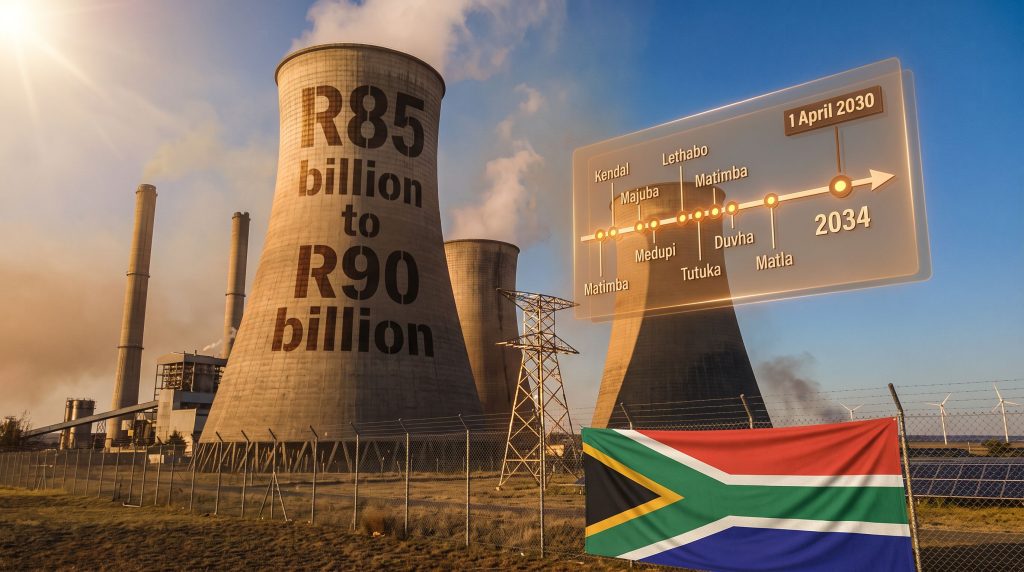
Eskom has secured minimum emission standards exemptions for eight of its coal-fired power stations, effectively permitting continued operation beyond the thresholds that environmental regulations would otherwise impose. These exemptions are time-bounded instruments tied to decommissioning commitments, not open-ended licences to pollute indefinitely.
| Power Station | Emissions Exemption Period | Decommissioning Status |
|---|---|---|
| Kendal | Until 1 April 2030 | Post-2030 (TBC) |
| Lethabo | Until 1 April 2030 | Post-2030 (TBC) |
| Majuba | Until 1 April 2030 | Post-2030 (TBC) |
| Matimba | Until 1 April 2030 | Post-2030 (TBC) |
| Medupi | Until 1 April 2030 | Post-2030 (TBC) |
| Tutuka | Until 1 April 2030 | Post-2030 (TBC) |
| Duvha | Until 2034 | Scheduled 2034 |
| Matla | Until 2034 | Scheduled 2034 |
Six stations have received five-year exemptions, while Duvha and Matla hold nine-year exemptions aligned to their 2034 decommissioning dates. The practical implication is that none of these eight stations faces imminent closure, regardless of what original transition blueprints envisaged.
What Has Actually Driven the Pattern of Repeated Closure Deferrals?
The Eskom coal plant closure delays cannot be attributed to a single point of failure. Three compounding structural forces have collectively made it impossible to execute the original decommissioning schedule without triggering a new supply crisis.
1. Replacement capacity has not materialised at the required pace.
Independent power producer procurement programmes, gas-to-power projects, and grid-scale battery storage installations have all advanced more slowly than the timelines embedded in South Africa's Integrated Resource Plan assumed. When the generation pipeline falls behind schedule, every coal closure date becomes a potential supply gap. These coal supply challenges are compounded by aging infrastructure and escalating maintenance demands across the existing fleet.
2. Transmission infrastructure has not kept pace with renewable ambitions.
Connecting large volumes of variable renewable energy from wind-rich regions in the Northern and Western Cape to industrial demand centres in Gauteng and Mpumalanga requires substantial grid expansion. Eskom's transmission division has faced capital constraints and planning delays that have throttled the pace at which new renewable capacity can be safely absorbed.
3. Extended operation of aging plant carries compounding financial costs.
Maintaining stations that were designed for operational lives of 30 to 40 years and are now operating well beyond those parameters requires escalating maintenance expenditure. The cost of extending coal operations has been estimated at between R85 billion and R90 billion in additional fuel and maintenance spending. This figure represents a direct burden on Eskom's balance sheet and, through electricity tariffs, on every industrial and residential consumer connected to the national grid.
The Cascading Effect of Early Deferrals
Prior to the current round of announcements, Eskom had already flagged Camden, Grootvlei, and Hendrina as stations where original decommissioning schedules were effectively unachievable. Arnot and Kriel were subsequently added to the delayed-closure group. In December 2024, Eskom confirmed that 17 coal units across five stations would continue operating beyond their original retirement dates, with authorisation granted for continued operation at existing emission limits through 31 March 2030.
Each deferral compounds the challenge of the next. When capacity that was supposed to be retired early in the decade keeps running, the window for contracted replacement generation to be built and connected narrows further, making post-2030 closures structurally harder to execute than pre-2030 closures ever were.
Eskom's Evidence-Based Framework: What the September 2026 Announcement Must Deliver
At the Coal and Energy Transition Day held in Johannesburg, Eskom CEO Dan Marokane articulated a position that reframes the decommissioning question as a system-adequacy problem rather than a calendar problem. The core argument is that a closure date unsupported by contracted and deliverable replacement capacity is not a transition plan. It is, in Marokane's framing, a timetable to a supply crunch.
Eskom has indicated that its proposed approach to coal station decommissioning beyond 2030 will be formally presented in September 2026, following completion of internal governance processes and engagement with the Energy Council of South Africa. For that announcement to carry credibility with grid operators, investors, and international climate finance partners, it must address four interdependent requirements:
- Contracted replacement generation with confirmed construction milestones and commercial operation dates.
- Committed transmission investment to absorb variable renewable energy at the scale required to offset retiring coal capacity.
- Just transition provisions for coal-dependent communities and workers in regions like Mpumalanga where the local economy is structurally anchored to power generation employment.
- An emissions compliance pathway demonstrating how South Africa meets its nationally determined contribution targets even with extended coal operations in the interim period.
Marokane has also been explicit that the pace of gas-to-power project development is a critical variable in the post-2030 equation. Gas-fired generation is positioned as a dispatchable bridging technology capable of providing the firm capacity that intermittent renewables cannot guarantee. However, South Africa's gas-to-power programme faces its own timeline and financing uncertainties, meaning the bridge itself is not yet structurally secure.
The Minimum Emission Standards Framework: What Exemptions Actually Mean
The minimum emission standards regulatory framework sets legally binding air quality thresholds for industrial facilities operating in South Africa. Securing an exemption from these standards is a formal regulatory process, not an administrative rubber stamp. Exemptions are typically granted on the basis that immediate compliance would compromise energy security or impose costs disproportionate to the public benefit achievable within the exemption period.
Eskom's leadership has argued that the cost and system implications of full compliance with minimum emission standards should be weighed against energy security, affordability, and industrial competitiveness. This is not framed as opposition to environmental responsibility but as an argument for a balanced approach that avoids trading one crisis for another.
What is less frequently discussed in public debate is the cumulative air quality burden that extended exemptions impose on communities in South Africa's Mpumalanga coal corridor, one of the most pollution-intensive regions on the planet by atmospheric measurement. Independent health researchers have identified elevated rates of respiratory and cardiovascular disease in communities surrounding these stations, with productivity losses and healthcare costs that are not captured in Eskom's operational cost estimates.
The R85 to R90 billion extended-operations cost estimate captures only the direct utility-side expenditure. Independent health economists argue that the true societal cost, once pollution-related mortality and morbidity are included, substantially exceeds this figure.
JET-IP Exposure: When Coal Delays Become a Climate Finance Risk
South Africa's Just Energy Transition Investment Plan, supported by international climate finance commitments from G7 nations and the European Union, includes specific carbon emission reduction targets tied to the retirement of coal generation capacity. Eskom has maintained that extended coal operations can be managed within the country's overall emissions trajectory, including the carbon targets linked to JET-IP funding disbursement.
However, the relationship between coal closure milestones and international funding creates a fiscal risk that extends well beyond Eskom's operational budget. Three specific exposure points merit attention:
- JET-IP funding tranches may be structured with progress-linked conditionalities tied to demonstrable decommissioning activity, meaning repeated delays could affect disbursement timing.
- South Africa's credibility in future climate finance negotiations is partly a function of its track record on transition commitments. Each revision to closure timelines creates a reputational cost that compounds over successive negotiating cycles.
- Private sector participation in South Africa's broader energy transition, including investment by international renewable energy developers and infrastructure funds, is sensitive to the perceived stability of the policy and regulatory environment.
In addition, the decarbonisation economics of delaying closures are increasingly difficult to justify when weighed against the long-term financial and reputational costs that accumulate with each revision. Initiatives such as green hydrogen in South Africa offer a potential pathway to accelerating the low-carbon transition, though these programmes remain at an early stage of commercial scale-up.
The next major ASX story will hit our subscribers first
How South Africa's Approach Compares Globally
South Africa's current framework most closely resembles what energy transition analysts describe as a security-contingent deferral model, in which the system operator retains discretion to extend operational life based on adequacy assessments rather than fixed legislative mandates.
| Transition Approach | Key Characteristics | Examples |
|---|---|---|
| Managed decline with firm replacement | Closures tied to contracted replacement capacity; grid operator sign-off required | Germany (post-2022 revision), United Kingdom |
| Policy-mandated fixed closure dates | Legislated end dates regardless of replacement readiness | Select EU member states |
| Demand-led retirement | Market economics drive closures as renewables undercut coal on cost | United States merchant markets |
| Security-contingent deferral | Closures deferred when system adequacy is not confirmed | South Africa (current approach) |
Germany's post-2022 experience is instructive. Following the energy security shock triggered by the Russian invasion of Ukraine, Germany temporarily reversed several coal closure decisions to protect winter supply adequacy. The episode demonstrated that even highly capitalised grid systems with mature renewable sectors can face moments where the pace of transition ambition outstrips the pace of replacement delivery.
South Africa is navigating a structurally more difficult version of the same problem, with fewer fiscal resources, a less developed gas infrastructure network, and a transmission system that requires substantial investment before it can reliably absorb the renewable capacity needed to replace retiring coal. Furthermore, the adoption of renewable energy solutions across South Africa's industrial and energy sectors will need to accelerate considerably if post-2030 closure targets are to be met without compromising grid stability.
Key Takeaways for Investors, Policymakers, and Industry Observers
- The R85 to R90 billion extended-operations cost estimate represents a real and growing liability on Eskom's balance sheet, ultimately borne by electricity consumers through tariffs.
- The September 2026 announcement will be a significant inflection point for South Africa's energy transition credibility, with implications for international climate finance relationships and private sector investment confidence.
- Gas-to-power development pace is the single most important variable determining whether post-2030 coal closures are technically executable without triggering a renewed supply crisis.
- The public health and environmental costs of Eskom coal plant closure delays are real, measurable, and concentrated in communities that have the least capacity to absorb them.
- Without accelerated delivery of contracted replacement generation and committed transmission investment, the structural barriers that have prevented pre-2030 closures will reassert themselves in the post-2030 planning period.
A pragmatic energy transition, as Eskom's leadership has framed it, is one that reduces emissions while building the technologies, infrastructure, and market mechanisms needed to support a lower-carbon future. The September 2026 announcement will reveal whether that pragmatism is backed by a credible delivery plan, or whether it represents another revision to a timeline that was never adequately resourced.
This article contains forward-looking analysis based on publicly available information and regulatory disclosures. Readers should not interpret any content herein as financial or investment advice. Energy transition timelines, cost estimates, and policy outcomes are subject to material uncertainty and may change significantly as new information becomes available.
Want to Capitalise on the Mineral Opportunities Driving South Africa's Energy Transition?
The infrastructure buildout required to replace coal generation — from battery storage to transmission grid expansion — depends heavily on critical minerals, and Discovery Alert's proprietary Discovery IQ model delivers real-time alerts the moment significant ASX mineral discoveries are announced, turning complex data across 30-plus commodities into clear, actionable insights. Explore how historic mineral discoveries have generated substantial returns and begin your 14-day free trial at Discovery Alert to position yourself ahead of the market.