European Raw Materials Revolution: Transforming Continental Battery Supply Chains
The global energy transition faces a critical bottleneck in securing sustainable lithium supplies for electric vehicle batteries. Vulcan Energy's lithium supply chain funding represents a pivotal moment in Europe's strategic response to reducing geopolitical supply chain vulnerabilities. While China dominates current supply chains and South American producers control traditional extraction methods, Europe's emerging framework addresses multiple challenges simultaneously: minimizing environmental impact through innovative extraction technologies and creating regional economic value through integrated industrial development.
This emerging framework demonstrates how European CRM facility development can integrate renewable energy production with mineral processing, offering a sustainable alternative to conventional lithium extraction methods.
What Does Vulcan Energy's €2.2 Billion Funding Signal for European Resource Independence?
Decoding the Strategic Investment Architecture
The financing structure represents unprecedented institutional commitment to European mineral self-sufficiency. European Investment Bank leadership of a 13-institution syndicate distributes €1.185 billion in senior debt across multiple financial institutions, creating shared risk exposure whilst demonstrating coordinated policy support.
Germany's state development bank KfW contributes €150 million for a 14% equity stake in the project company, signalling direct government participation in strategic resource development. This investment pattern reflects broader European Union critical materials policy implementation, where public institutions co-invest alongside private capital to accelerate domestic supply chain development.
The consortium including HOCHTIEF, Siemens Financial Services, and Demeter provides €133 million for a 15% project stake, introducing operational expertise from construction (HOCHTIEF) and industrial financing (Siemens) sectors. This multi-sector partnership creates technical knowledge transfer opportunities and reduces execution risk through experienced operator involvement.
Key Financing Components:
- Total package value: €2.2 billion (A$3.9 billion)
- Senior debt: €1.185 billion across 13 institutions
- Equity component: €528 million through share placement at A$4.00
- Share price discount: 35% below pre-halt trading at A$6.13
- Strategic investor retention: Hancock Prospecting maintains 6.49% stake
Green Financing Framework as Competitive Differentiation
S&P Global's "Dark Green" sustainability rating provides material financing advantages beyond traditional mining project assessment. This highest environmental classification enables access to ESG-mandated institutional capital pools that exclude conventional mining investments, expanding the available investor base substantially.
European Investment Bank participation specifically targets projects meeting EU Taxonomy Regulation requirements for sustainable investment classification. This regulatory alignment creates preferential financing terms and positions the project for additional green bond funding tranches during operational phases.
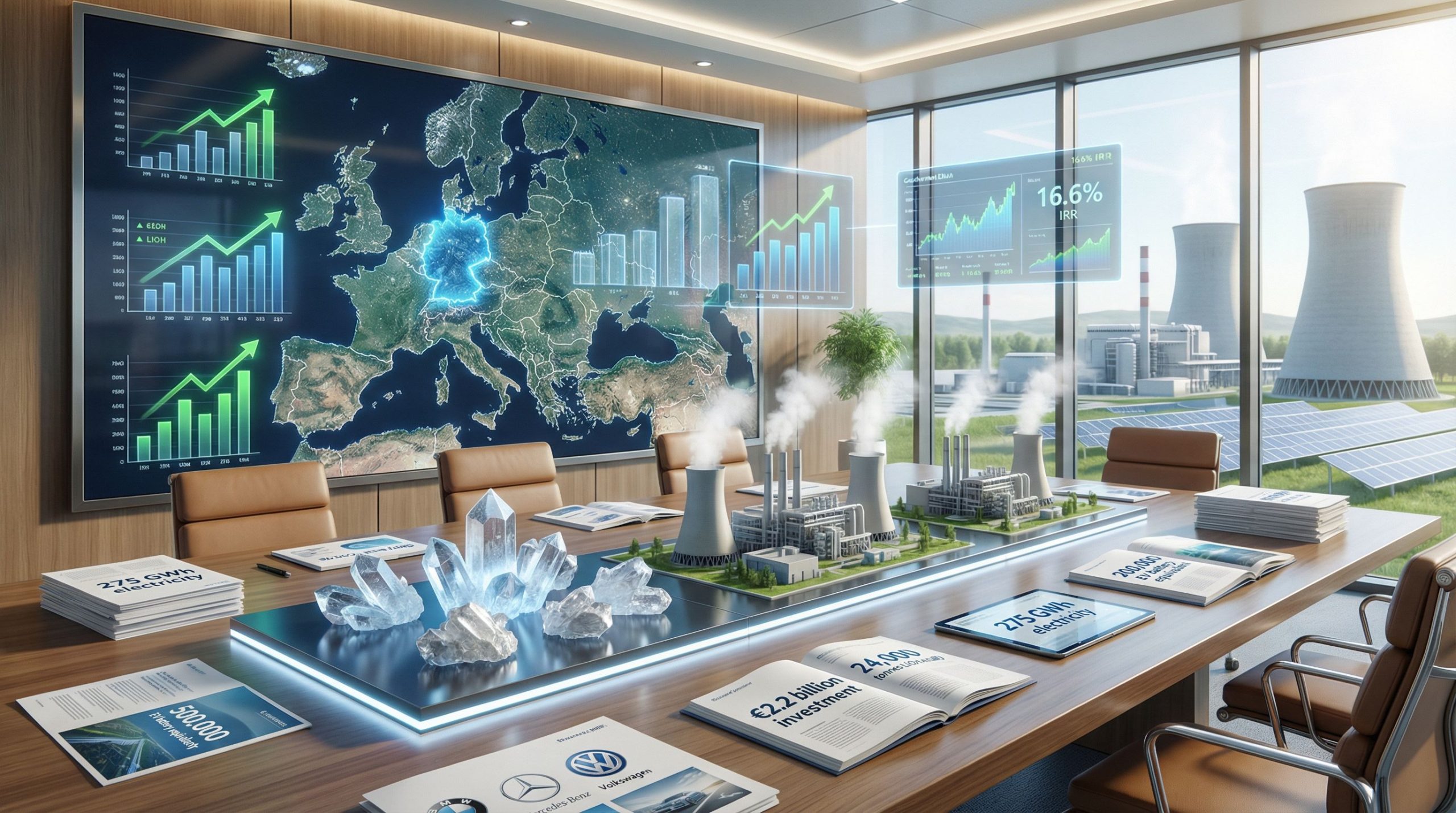
The renewable energy integration generating 275 GWh electricity and 560 GWh heat annually creates dual revenue streams that improve cash flow stability compared to commodity-only mining operations. Consequently, this energy co-production model reduces operational cost exposure and provides hedge against lithium price volatility through diversified income sources.
How Does Integrated Lithium-Geothermal Production Reshape Industry Economics?
VULSORB Technology's Commercial Scalability Assessment
Direct extraction from geothermal brines eliminates traditional evaporation pond requirements that consume 18-24 months processing time and extensive land footprints. The proprietary VULSORB system processes lithium-bearing brines continuously, compressing production cycles and reducing working capital requirements compared to conventional methods.
Traditional South American operations require 500,000 gallons water per ton lithium carbonate equivalent, creating environmental challenges in arid regions. Furthermore, geothermal brine recycling minimises freshwater consumption whilst maintaining processing throughput, addressing water scarcity concerns that limit conventional lithium expansion.
Technical Performance Specifications:
- Annual lithium hydroxide production: 24,000 tonnes
- EV battery equivalent capacity: 500,000 battery packs
- Renewable electricity generation: 275 GWh annually
- Heat co-production: 560 GWh annually
- Operational lifespan: 30 years
- Processing method: Continuous geothermal brine extraction
Revenue Diversification Through Energy Co-Production
The integrated model creates multiple value streams that conventional lithium operations cannot replicate. Geothermal electricity sales provide consistent revenue independent of commodity price cycles, whilst thermal energy supply serves industrial customers requiring process heat applications.
Carbon footprint reduction through renewable energy integration positions production for premium pricing from automotive manufacturers implementing supply chain decarbonisation requirements. Moreover, mining decarbonisation benefits demonstrate how European automotive OEMs increasingly prioritise low-carbon material sourcing to meet regulatory emissions targets and consumer sustainability demands.
Project economics demonstrate 75% operating margins generating €427 million average annual EBITDA, reflecting the operational cost advantages from energy co-production and streamlined processing compared to traditional mining operations requiring external power purchases and extended processing cycles.
What Market Positioning Advantages Does European Domestic Supply Create?
Offtake Contract Structure Analysis
Strategic partnerships with Stellantis, LG Energy Solution, Umicore, and Glencore provide 72% fixed/minimum pricing protection during construction and initial production phases. This contract coverage shields revenue realisation from lithium price volatility that has ranged from $73/kg peaks to $13-16/kg troughs within two-year cycles.
Ten-year supply agreements with major European automotive and battery manufacturers create demand certainty that reduces market sales risk whilst ensuring priority access to regional processing capacity. Fixed pricing arrangements protect against downside scenarios whilst maintaining upside participation through minimum price floors rather than absolute caps.
Strategic Partnership Benefits:
- Stellantis: Direct integration with European EV manufacturing platforms
- LG Energy Solution: Supply chain integration with European Gigafactory operations
- Umicore: Cathode active material conversion creating integrated value chain
- Glencore: Commodity trading expertise and marketing optimisation capabilities
Supply Chain Resilience Premium Valuation
European automotive manufacturers face increasing regulatory pressure to demonstrate supply chain security through the EU Critical Raw Materials Act, which establishes domestic sourcing requirements for strategic materials including lithium. In addition, domestic production provides compliance certainty that imported materials cannot guarantee.
Logistical advantages include reduced transportation timelines from German production sites to European battery manufacturing facilities, enabling just-in-time inventory management and reducing working capital requirements throughout the supply chain.
Regional production eliminates exposure to shipping disruptions, export restrictions, and geopolitical tensions that have affected international lithium trade. The 2023-2024 period demonstrated supply chain vulnerability when Chinese production adjustments created European battery material shortages despite global oversupply conditions.
How Should Investors Evaluate Construction Phase Risks vs. Strategic Value?
Financial Metrics and Valuation Framework
Project economics indicate €1,152 million post-tax net present value with 16.6% internal rate of return, exceeding typical mining project hurdle rates of 12-15% and current European government bond yields. These returns reflect premium pricing expectations for sustainable, domestically-produced lithium hydroxide.
Fully funded construction eliminates development finance risk that has prevented numerous lithium projects from advancing during weak commodity price environments. However, the 2.5-year construction timeline to 2028 first production provides clear milestone tracking and reduces execution uncertainty compared to projects lacking financial closure.
Investment Metrics Summary:
| Financial Measure | Value | Industry Context |
|---|---|---|
| Post-tax NPV | €1,152 million | Above-average mining valuations |
| Internal Rate of Return | 16.6% | Exceeds sector hurdle rates |
| Annual EBITDA | €427 million | 75% operating margins |
| Construction Timeline | 2.5 years | Shorter than conventional mining |
| Contract Coverage | 72% fixed pricing | Revenue protection during startup |
Equity Dilution Impact on Shareholder Returns
The A$4.00 share placement represents 35% discount to pre-halt trading levels, creating dilution for existing shareholders whilst providing attractive entry pricing for new investors. This discount reflects market conditions and construction financing requirements rather than fundamental project valuation adjustments.
Vulcan Energy's €2.2 billion funding package demonstrates unprecedented institutional commitment, with Hancock Prospecting's continued 6.49% ownership following capital raising signalling institutional confidence in project execution and long-term value creation.
The equity component (€528 million) within total financing represents reasonable leverage ratios that maintain financial flexibility during construction whilst providing adequate debt service coverage once operations commence.
What Broader Industry Implications Emerge from This Funding Success?
European Critical Minerals Policy Execution
Government grant allocation totalling €204 million demonstrates policy commitment beyond regulatory frameworks, providing direct financial support for domestic resource development initiatives. Consequently, this funding model may establish precedents for additional European mineral projects requiring strategic government backing.
KfW's strategic investment through Germany's raw materials fund represents systematic deployment of public capital to reduce import dependencies on critical materials. This approach aligns with broader energy transition strategies targeting technological sovereignty in energy transition sectors.
The multi-source funding model combining public development banks, private institutional investors, and export credit agencies creates replicable financing frameworks for similar projects across European jurisdictions seeking domestic mineral supply development.
Precedent Setting for Future Lithium Project Financing
European institutional participation in mining project finance represents sector evolution beyond traditional resource financing dominated by commodity traders and specialised mining banks. Furthermore, this broadened investor base may improve access to capital for sustainable resource projects meeting environmental criteria.
Green financing standards adoption demonstrates mining industry trends toward ESG compliance requirements that institutional investors increasingly mandate. Projects lacking environmental credentials may face restricted access to European capital markets.
Export Credit Agency involvement indicates government recognition of critical minerals as infrastructure investments deserving policy support similar to renewable energy and transportation projects.
Timeline Analysis: When Will Market Impact Materialise?
Construction Milestones and Production Ramp-Up
Construction commencement in December 2024 following Final Investment Decision enables milestone-based progress tracking through 2.5-year development timeline. Initial commissioning activities begin 2027 with full production targeted 2028, creating specific performance measurement periods.
First production timing coincides with European Gigafactory capacity expansion scheduled 2028-2030, providing synchronised supply and demand development within regional battery manufacturing ecosystem. This timing alignment improves market entry conditions and reduces inventory building requirements.
Development Timeline:
- December 2024: Construction commencement and Final Investment Decision
- 2025-2026: Construction phase with quarterly progress reporting
- 2027: Commissioning and initial testing phases
- 2028: First commercial production and customer deliveries
- 2028-2030: Production ramp-up to full 24,000 tonne capacity
Competitive Landscape Evolution Through 2028
European lithium supply gap analysis indicates substantial unmet demand during project development period, with regional Gigafactory capacity expansion outpacing domestic supply development. However, this supply-demand imbalance may support premium pricing for early domestic production.
Global lithium market conditions show oversupply during 2024, but European market dynamics differ due to supply chain security requirements and regulatory preferences for domestic sourcing. Regional pricing may maintain premiums despite global commodity weakness.
Market share capture potential within European EV battery supply chain depends on production timing relative to competitor projects and customer contract fulfilment capabilities during initial operational phases.
Investment Decision Framework for Retail Participants
Opportunity Assessment Criteria
Vulcan Energy's lithium supply chain funding eliminates primary development risk that affects most lithium exploration and early-stage development companies through fully funded construction status. This financial security provides visibility through operational commencement and reduces speculative investment characteristics.
Strategic partnerships with major automotive and battery manufacturers validate both technical approach and market demand, reducing commercial risk compared to projects lacking confirmed customer relationships.
ESG credentials through renewable energy integration and sustainable extraction methods align with institutional investment mandates and regulatory trends favouring environmentally compliant supply chains.
Risk Mitigation Strategies
Technology scale-up from demonstration to commercial production introduces execution risk requiring monitoring of commissioning progress and production ramp-up achievement against timeline targets.
Construction cost management becomes critical during inflationary periods affecting mining project development costs. Regular milestone reporting and budget variance analysis enable early identification of potential overruns.
Lithium price volatility impact on long-term returns requires assessment despite contract protection, as pricing reset periods may expose revenue to market conditions during operational phases.
Entry Point Evaluation for New Investors
The discounted share placement at A$4.00 provides favourable entry pricing for investors confident in European lithium market development and project execution capabilities. This 35% discount to pre-announcement trading levels may offer attractive risk-adjusted return potential.
Comparative valuation against peer lithium development projects indicates reasonable pricing considering advanced development stage, secured financing, and confirmed customer contracts relative to exploration-stage competitors.
Secondary market positioning following construction commencement may benefit from operational progress visibility and reduced development uncertainty premium currently reflected in mining sector valuations.
Frequently Asked Questions About Vulcan Energy's Funding Structure
How Does This Compare to Other Lithium Project Financing?
The €2.2 billion financing represents among the largest lithium project funding packages globally, exceeded only by major Australian hard-rock operations such as Greenbushes expansion projects. European lithium project financing remains nascent, making direct regional comparisons limited.
European institutional participation distinguishes this financing from traditional mining project funding dominated by commodity trading companies and specialised resource banks. The involvement of development banks and industrial partners creates broader stakeholder alignment beyond purely financial considerations.
Green financing premium quantification within critical minerals sector remains developing, but environmental credentials enable access to ESG-mandated capital pools that conventional mining projects cannot access, potentially reducing cost of capital significantly.
What Makes This Project Strategically Different?
Integrated renewable energy production creates operational model differentiation that conventional lithium operations cannot replicate. Dual revenue streams from mineral production and energy sales provide cash flow diversification and reduce commodity price sensitivity compared to traditional mining operations.
Domestic European supply chain positioning provides strategic value within geopolitical context of reducing critical material import dependencies. This positioning may command premium pricing and preferential regulatory treatment that international competitors cannot access.
Technology differentiation through geothermal extraction methodology offers environmental advantages over conventional evaporation pond methods, creating sustainability credentials that align with EV impact on mining requirements and European automotive industry supply chain frameworks.
Disclaimer: This analysis contains forward-looking projections based on company announcements and industry data. Construction projects involve execution risks, technology scaling challenges, and market condition changes that may affect actual outcomes. Commodity price volatility, regulatory changes, and macroeconomic factors could impact investment returns. Potential investors should conduct independent due diligence and consider professional financial advice before making investment decisions.
Ready to Discover the Next Major Mineral Breakthrough?
Discovery Alert's proprietary Discovery IQ model delivers instant notifications on significant ASX mineral discoveries, empowering subscribers to identify actionable trading opportunities before broader market awareness develops. Explore historic examples of exceptional returns from major mineral discoveries and begin your 30-day free trial today to secure your market-leading advantage in the evolving critical materials landscape.