EV Resources Ltd
EV Resources Tecomatlán Grinding Circuit Commissioning in Mexico Marks a Defining Milestone
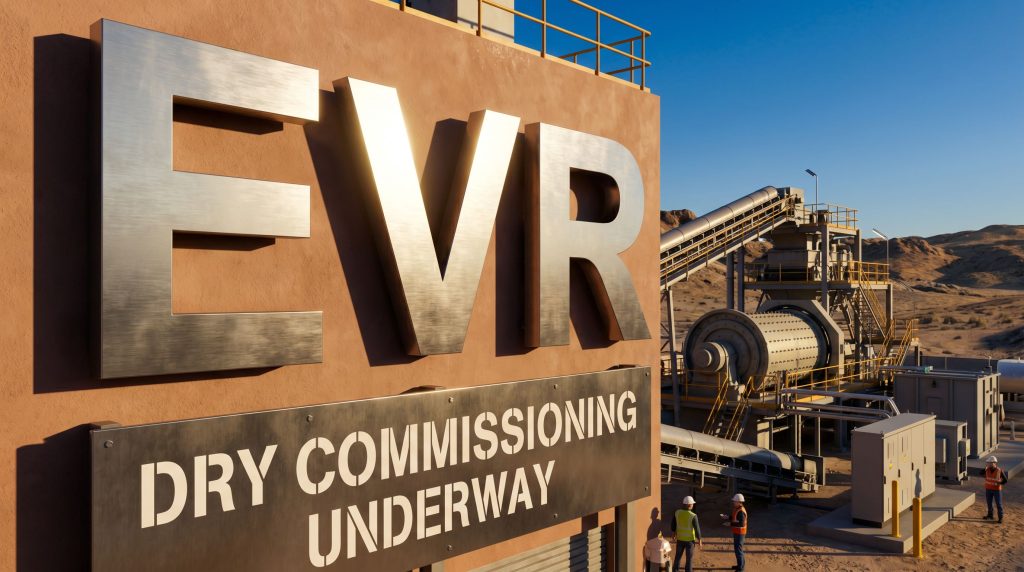
EV Resources Limited (ASX: EVR) has announced a landmark operational milestone, with dry commissioning now well advanced on the grinding circuit at its Tecomatlán Processing Plant in Mexico. The EV Resources Tecomatlán grinding circuit commissioning in Mexico marks a decisive shift in the company's trajectory — from refurbishment-stage developer to near-term antimony producer — arriving at a moment when global antimony supply remains critically constrained.
The grinding circuit is the central processing engine of the Tecomatlán plant. Its progression into active commissioning effectively activates the core of the facility, materially reducing execution risk and establishing a credible pathway to first production by end calendar year 2026.
"This is a defining moment for EVR. Bringing the grinding circuit — the heart of the Tecomatlán plant — into operational readiness marks our transition from refurbishment into execution. We now have the core production engine of the plant effectively online, which materially de-risks our pathway to first production," said Managing Director Mike Brown.
When big ASX news breaks, our subscribers know first
What Has Actually Been Achieved — And Why It Matters
The milestone is not merely symbolic. Dry commissioning confirms that mechanical systems are aligned, functional, and capable of operating under load — a critical validation step before live ore feed is introduced. Here is what has been completed and what remains on a near-term schedule:
| Milestone | Status |
|---|---|
| Mechanical refurbishment — Ball Mill 1 | Complete |
| Mechanical refurbishment — Ball Mill 2 | Complete |
| Mechanical refurbishment — Ball Mill 3 | In progress (one-mill-per-week schedule) |
| Variable Frequency Drive (VFD) electrical upgrade | Complete |
| Full grinding circuit dry commissioning | Targeted within 4 weeks |
| Phase 1 permitting requirement | None required |
| First production capability target | End CY2026 |
Two of three mills are now operationally available, with the third progressing on a structured completion schedule. Electrical upgrades — including integration of Variable Frequency Drives — are fully installed and operational, enabling staged, sequential commissioning of all three mills using a single VFD unit.
This approach is a deliberate capital management strategy, reducing upfront expenditure while maintaining full operational flexibility as throughput scales toward steady-state production.
Understanding Dry Commissioning — A Key Concept for Investors
What Is Dry Commissioning?
Dry commissioning refers to the process of running mechanical equipment — in this case, the ball mills forming the grinding circuit — without introducing any raw material or ore. The purpose is to verify that all mechanical, electrical, and structural systems are correctly installed, aligned, and functioning as designed before live processing begins.
Why Does It Matter to Investors?
Dry commissioning is a pivotal risk-reduction step in any processing plant restart. Completing it successfully means:
- Engineering integrity of the refurbished plant has been confirmed
- Equipment is aligned and drive systems are performing as expected
- The project can move into wet commissioning (introducing ore) with significantly reduced technical uncertainty
- The timeline to first production becomes measurable and near-term rather than speculative
For EVR, reaching this stage validates the company's staged restart strategy and signals that the project is no longer in the preparation phase — it is firmly in the execution phase.
Glossary of Key Terms
Grinding Circuit: The section of a processing plant where ore is crushed and ground into fine particles, enabling downstream separation of valuable minerals. It is the foundational step of most mineral processing operations.
Ball Mill: A rotating cylindrical drum containing steel balls used to grind ore into fine particles. Ball mills are standard equipment in mineral processing and are critical to throughput capacity.
Variable Frequency Drive (VFD): An electrical device that controls the speed of a motor by varying the frequency of power supplied. VFDs enable energy-efficient and flexible operation of heavy equipment such as ball mills.
Gravity Concentration: A processing method that separates minerals based on differences in density, without the use of chemicals or reagents. It is low-cost, environmentally friendly, and well-suited to antimony mineralisation.
Dry Tailings Filtration: A process that removes water from mine waste (tailings), allowing it to be stored in solid form rather than as a slurry — consequently reducing environmental risk and water consumption.
A Capital-Efficient Strategy Delivering Real Results
One of the more compelling aspects of this milestone is how it has been achieved. EVR has consistently emphasised capital discipline throughout the Tecomatlán refurbishment, and the results bear this out in concrete terms.
Key capital efficiency measures include:
- Off-site fabrication in Durango: Major mill component fabrication was completed off-site, reducing on-site labour and accommodation costs without affecting delivery timelines.
- Single VFD commissioning approach: Using one VFD unit to sequentially test all three mills avoids the need to procure multiple units upfront, deferring capital expenditure until throughput justifies it.
- Strategic deferral of contract addendums: During procurement constraints, the company deferred certain contract addendums, avoiding approximately USD $175,000 in unnecessary expenditure.
- No permitting required for Phase 1: Gravity concentration operations under Phase 1 require no additional permitting, eliminating a common source of delay and cost overrun for mining companies at this stage.
This combination of engineering pragmatism and financial discipline means the company is advancing toward production without excessive capital deployment — a meaningful consideration for investors assessing execution risk.
The Tecomatlán Flowsheet: Low Impact, High Efficiency
The Phase 1 processing design at Tecomatlán has been structured around simplicity, efficiency, and environmental responsibility. The flowsheet incorporates:
- Two-stage gravity concentrators for primary mineral separation
- Thickener and dry tailings filtration for low-impact waste management
- Reagent-free processing — no chemicals required, minimising environmental footprint
The metallurgical characteristics of the Los Lirios mineralisation — the flagship high-grade antimony project located approximately 50 kilometres from the plant — are reported to support high-quality concentrate production, with low impurity levels and favourable processing characteristics. Initially, furthermore, the plant will process third-party sourced ore, with Los Lirios material to follow as the project matures.
The Antimony Context: Why Timing Is Everything
EVR's commissioning progress does not occur in isolation. Antimony is a mineral that has attracted significant attention from governments and industry observers in recent years. The metal has been designated as a critical mineral by the United States, the European Union, and Australia, reflecting its strategic importance across multiple applications.
Understanding Antimony: A Critical Metal Primer
Antimony is a metalloid element primarily used in industrial applications where its unique properties provide essential performance characteristics. Unlike more familiar metals such as gold or copper, antimony's value lies in its specific industrial utility rather than as a store of value.
Key applications include:
- Energy storage and battery technology: Used in lead-acid battery grids and emerging battery chemistries
- Defence and military applications: Critical component in ammunition, armour-piercing projectiles, and military equipment
- High-technology manufacturing: Essential in semiconductors, flame retardants, and specialty alloys
- Industrial processes: Used in glass manufacturing, ceramics, and chemical catalysts
Global supply of antimony is heavily concentrated, creating structural vulnerability in Western supply chains. China dominates global production, accounting for approximately 80% of the world's antimony supply. This concentration has prompted Western governments to classify antimony as a critical mineral and seek alternative supply sources.
EVR's stated goal is to contribute to securing the North American antimony supply chain. The EV Resources Tecomatlán grinding circuit commissioning in Mexico positions the company to potentially benefit from this supply-demand dynamic if production is achieved as targeted.
As Mike Brown noted in the announcement: "At a time when global antimony supply remains critically constrained, positioning the plant at this stage of readiness represents a genuine inflection point for the Company."
What Comes Next: The Path to First Production
With dry commissioning of the full grinding circuit targeted within four weeks, the near-term operational roadmap for EVR is becoming increasingly defined:
| Stage | Timeline |
|---|---|
| Ball Mill 3 mechanical completion | Within weeks (one-mill-per-week schedule) |
| Full grinding circuit dry commissioning | Targeted within 4 weeks |
| Wet commissioning / ore introduction | Following dry commissioning completion |
| First production capability | End CY2026 |
Beyond Tecomatlán, EVR's broader asset portfolio adds further optionality to the investment case:
Los Lirios Antimony Project (Mexico): High-grade flagship project, 50km from the plant. First-pass drilling has confirmed a laterally extensive carbonate replacement deposit (CRD) system, with advancement toward a maiden JORC Resource delineation underway.
US Antimony Projects — Dollar and Milton (Nevada): 100%-owned assets positioned to support the US domestic critical minerals supply chain.
The next major ASX story will hit our subscribers first
Why Investors Should Be Watching EVR Closely
EVR has reached a point in its development that many small mining companies aspire to but few achieve on schedule and within capital constraints: the transition from refurbishment to active commissioning, with a defined and near-term production timeline.
The investment case rests on several distinct pillars:
Near-term production catalyst: Full grinding circuit dry commissioning targeted within four weeks, with first production capability targeted by end CY2026.
Capital efficiency: A low CAPEX strategy validated through off-site fabrication, single-VFD commissioning, and strategic cost deferrals — including USD $175,000 in avoided expenditure.
No permitting barrier for Phase 1: Gravity concentration operations can proceed without additional permitting, removing a key execution risk.
Antimony market positioning: Operating in a commodity facing structural supply constraints across Western markets.
Multi-asset portfolio: Processing plant, high-grade development project, and US-based exploration assets provide diversified exposure across the antimony supply chain.
EV Resources has reached a genuine inflection point, with the Tecomatlán Processing Plant's grinding circuit now in active commissioning and first production targeted by end CY2026. The company's disciplined capital management, permitting-free Phase 1 pathway, and positioning in the constrained global antimony market make EVR a company worth watching closely as it transitions from developer to near-term producer.
The EV Resources Tecomatlán grinding circuit commissioning in Mexico represents more than operational progress — it signals EVR's evolution from refurbishment phase into execution mode, with the core production infrastructure now effectively activated. For investors seeking exposure to critical minerals supply chain security and near-term production potential, EVR's progression deserves close attention as the company advances toward its stated production timeline.
This article is based on the ASX announcement released by EV Resources Limited (ASX: EVR) on 5 May 2026.
Ready to Learn More About EV Resources' Path to Production?
EV Resources Limited (ASX: EVR) is transitioning from refurbishment into active commissioning at its Tecomatlán Processing Plant, with first production targeted by end CY2026. With a capital-efficient strategy, a permitting-free Phase 1 pathway, and a growing portfolio of antimony assets across Mexico and the United States, EVR represents a compelling opportunity for investors seeking near-term production exposure in the critical minerals space. To learn more about the company and its projects, visit evresources.com.au.