Exultant Mining Ltd
Exultant Mining Hits Sulphide Mineralisation in Maiden Balerion Drilling, Focuses on Five High‑Priority Holes
Exultant Mining Ltd (ASX: 10X) has reported that its first drilling at the Balerion Prospect within the Peak View Project has intersected visible sulphide mineralisation in two of the first three holes, representing the Exultant Mining Balerion sulphide mineralisation drilling results the market has been awaiting, for a total of 632.5 metres drilled.
According to the ASX announcement dated 1 July 2026, drillholes BLRCDD001 and BLRCDD002 both intersected chalcopyrite, sphalerite and galena. These minerals are primary ores of copper, zinc and lead. Geological observations are reported to support the company's targeting model and have led Exultant Mining Ltd to refine the program to five remaining priority drillholes aimed at testing extensions of historical high‑grade mineralisation.
All completed holes are currently awaiting laboratory assay results.
"While laboratory assays remain pending, our maiden drilling program at Balerion has delivered exactly what we were hoping to see at this stage of the program. The drilling has intersected sulphide mineralisation in the first two holes and significantly improved our understanding of what we believe is a highly prospective mineralised system," said Brett Grosvenor, executive chairman of Exultant Mining Ltd.
"With five priority drillholes remaining and assays pending from the initial three holes, we believe the program is becoming increasingly focused on the most prospective parts of the Balerion system."
When big ASX news breaks, our subscribers know first
First Drilling Results: Three Holes, Two With Sulphides
The Balerion drilling program, within Exultant's 100% owned EL9411 tenement about 35 km northeast of Cooma in New South Wales, was originally designed as a 12‑hole reverse circulation (RC) program for 3,425 metres. It targeted a combination of induced polarisation (IP) chargeability, resistivity, gravity and magnetic anomalies supported by geochemical data.
Following initial results and operational conditions, Exultant Mining Ltd has completed three holes:
| Drillhole | Final depth | Key geological outcome |
|---|---|---|
| BLRCDD001 | 245.5 m | Intersected altered rhyodacitic lava, volcaniclastic sandstone, carbonate and interbedded siltstone/sandstone hosting disseminated and vein‑hosted Zn‑Pb‑Cu sulphides (sphalerite, galena, chalcopyrite). Interpreted to explain a coincident chargeability‑resistivity high. |
| BLRCDD002 | 189.4 m | Intersected disseminated and vein‑hosted Zn‑Pb‑Cu sulphides in the same rock package. Critically, intersected a 4 m vuggy quartz‑carbonate interval with coarse pyrite‑sphalerite‑galena at a key lithological contact at 152.5 m. Interpreted as an encouraging geological analogue to historical massive sulphide mineralisation along strike. |
| BLRC003 | 198.0 m | Targeted a western coincident gravity‑chargeability high. Intersected interbedded sandstone, siltstone and volcaniclastics plus a pyrite‑bearing dolerite unit. The iron‑rich dolerite with disseminated pyrite is interpreted to explain the geophysical anomaly. No significant sulphide intercepts were reported. |
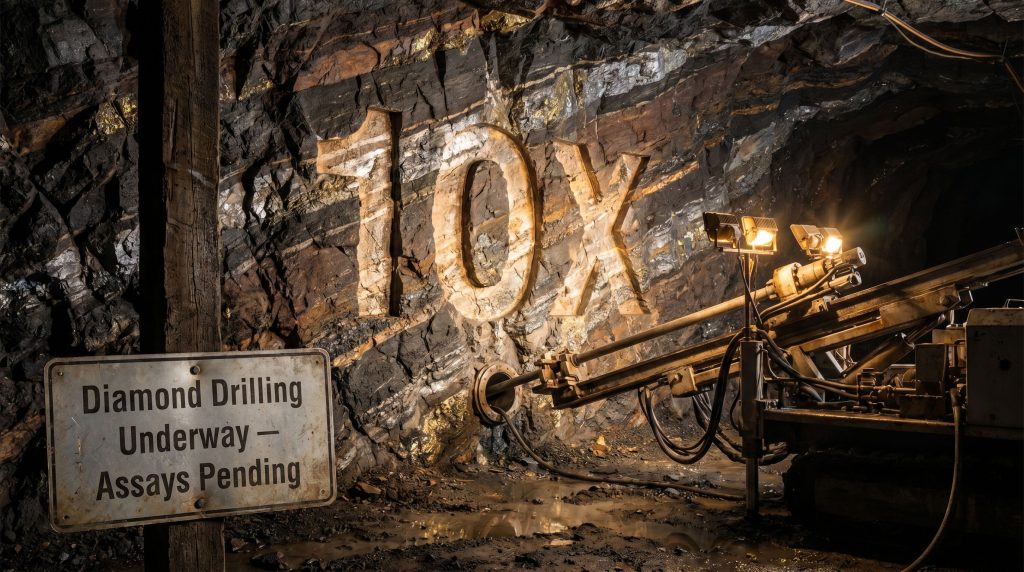
Drilling progress has been slower than originally anticipated. Excessive water inflows in BLRCDD001 and BLRCDD002 led Exultant Mining Ltd to change from RC to HQ diamond drilling, which is slower but provides improved geological and structural information and better sample quality.
Assays for all three completed drillholes are pending at ALS Orange.
Standout Hole BLRCDD002: Contact‑Hosted Sulphides at Depth
Among the maiden holes, BLRCDD002 is described in the ASX announcement as geologically important.
At 152.5 metres, BLRCDD002 intersected a 4 metre interval of vuggy quartz‑carbonate rock containing disseminated and banded, coarse‑grained pyrite‑sphalerite‑galena at the contact between overlying rhyodacitic lava and underlying volcaniclastics.
According to Exultant Mining Ltd, previous explorers have reported a similar rock type along strike from massive sulphide mineralisation on the same interpreted geological contact at Balerion. This suggests, furthermore, that the contact may be a favourable horizon for concentrating sulphide minerals.
Visual sulphide intervals in BLRCDD002, as logged, include:
- 152.5–158.3 m (5.8 m): Sphalerite‑galena dominant with pyrite and very minor chalcopyrite. Narrow bands of massive sulphide with an estimated 2–5% total sulphides.
- 158.3–160.1 m (1.8 m): Moderate to strong pyrite with sphalerite, chalcopyrite and possible galena, estimated 5–10% sulphides.
- 160.1–168.3 m (8.2 m): Moderate to strong pyrite with weak to moderate chalcopyrite and sphalerite, estimated 5–10% sulphides.
- 172.7–174.5 m (1.8 m): Disseminated and foliation‑parallel veinlets of pyrite with minor chalcopyrite and sphalerite, estimated 1–2% sulphides.
These percentages are described as visual estimates only and are not a substitute for laboratory assay results. The company has specifically cautioned that visual observations and portable X‑ray fluorescence (XRF) readings must not be treated as proxies for grade.
Geological Context: Understanding VMS‑Style Targets
The observations at Balerion are consistent with a volcanogenic massive sulphide (VMS)‑style exploration model, as outlined in Exultant Mining Ltd's targeting.
VMS systems are an important class of base and precious metal deposits globally. They commonly host copper, zinc, lead, silver and gold.
What Is Volcanogenic Massive Sulphide Mineralisation?
In simple terms, volcanogenic massive sulphide deposits form when:
- Hot, metal‑rich fluids circulate through the seafloor within volcanic regions.
- These fluids rise and exit at or near the sea floor.
- As they cool, metals drop out of solution and accumulate as layers or lenses of sulphide minerals.
Over geological time, these ancient sea floor environments are uplifted, folded and faulted, becoming part of land‑based rock packages that can be drilled today.
Typical features of VMS systems that are relevant to Balerion include:
- Altered volcanic and sedimentary rocks such as rhyodacitic lava and volcaniclastics.
- Hydrothermal alteration minerals like sericite, silica, carbonate and chlorite, often surrounding the mineralised zones.
- Vuggy quartz‑carbonate textures, where cavities indicate fluid pathways.
- Multiple sulphide minerals such as chalcopyrite (copper), sphalerite (zinc), galena (lead) and pyrite (iron sulphide).
- Strong geophysical responses (for example chargeability and gravity) caused by accumulations of metals and contrasting rock densities.
The Peak View Project sits in the Lachlan Fold Belt, a well‑known mineral province in New South Wales that already hosts various gold, silver, copper and base metals deposits. This regional setting is consequently considered favourable for VMS‑style and related mineral systems.
Key Minerals and Terms in Accessible Language
To make the Balerion results more accessible, some key geological terms used by Exultant Mining Ltd are summarised below.
| Term | Simple explanation |
|---|---|
| Chalcopyrite | A copper‑iron sulphide mineral and the main ore of copper. |
| Sphalerite | A zinc sulphide mineral and the main ore of zinc. |
| Galena | A lead sulphide mineral and the main ore of lead. Often contains silver. |
| Pyrite | An iron sulphide mineral, common in many deposits. Not an ore metal but important as an indicator of fluid pathways. |
| Vuggy quartz‑carbonate | Quartz and carbonate rock containing small cavities, which can indicate fluid flow zones where metals may be deposited. |
| Volcaniclastics | Broken pieces of volcanic rock that have been transported and deposited like sediment. These can be favourable hosts for VMS mineralisation. |
| Rhyodacitic lava | A silica‑rich volcanic rock type commonly seen in VMS settings. |
| IP chargeability | A geophysical method that measures how well rocks hold an electrical charge, often elevated where sulphides are present. |
| Resistivity | A measure of how strongly rocks resist electrical current. Low resistivity may indicate conductive materials such as clays, water or sulphides. |
For investors, the presence of multiple sulphide minerals in the right geological setting is often viewed as a key early indicator that a mineralising system has been intersected, even before grades are known.
Program Changes: Refining From 12 to 8 Drillholes
According to the ASX release, completion of the first three holes has given Exultant Mining Ltd enough geological information to revise the Balerion program.
The company has reduced the original 12‑hole plan to 8 holes, of which five holes remain to be drilled. The decision reflects the view that several geophysical targets have already been adequately tested, allowing focus to shift to the most prospective down‑dip positions relative to historical mineralisation.
Remaining Five High‑Priority Targets
The remaining drillholes are planned to test geophysical anomalies interpreted to lie down‑dip of historical high‑grade intercepts recorded by previous explorers:
| Target | Anomaly type | Historical context |
|---|---|---|
| PVRC_F | Coincident magnetic, weak chargeability and gravity low | Down‑dip of earlier holes PVD001 and PVD002. |
| PVRC_G | Resistivity low | New target, not directly tied to a historic intercept but consistent with the broader geophysical pattern. |
| PVRC_H | Resistivity low | Down‑dip of PVI006, which intersected 4.4 m @ 342.7 g/t Ag, 4.0% Pb, 1.1% Cu, 0.74 g/t Au, 0.84% Zn from 48.7 m. |
| PVRC_I | Coincident magnetic, weak chargeability and gravity low | Also down‑dip of PVI006, targeting potential extensions of the same interval. |
| PVRC_L | Resistivity low | Down‑dip of PVI008, which returned 0.8 m @ 22.0% Zn, 11.6% Pb, 1.2% Cu, 155 g/t Ag, 0.5 g/t Au from 152.6 m. |
These historical intercepts, reported by previous operators and referenced in Exultant Mining Ltd's announcement, demonstrate that very high grades of zinc, lead, silver and copper have already been encountered in parts of the Balerion system. The remaining drilling is, therefore, configured to test whether such high‑grade mineralisation extends at depth along interpreted geological structures and contacts.
Operational Considerations: RC to Diamond Drilling
The program at Balerion started as an RC program. However, significant water inflows in BLRCDD001 and BLRCDD002 affected sample quality and drilling rates.
In response, Exultant Mining Ltd switched to HQ diamond drilling:
- RC drilling uses compressed air to return rock chips up the hole and is generally faster and lower cost.
- Diamond drilling cuts a continuous rock core, which is slower but allows more precise logging of rock types, structures and mineralisation.
The change in method is reported to have improved geological control and structural information, which can assist in refining the interpretation of the mineral system and planning follow‑up drilling.
Near‑Term Catalysts: What Investors Can Monitor
From an investor perspective, the Balerion update highlights two main upcoming events:
-
Assay results from the first three drillholes
- BLRCDD001, BLRCDD002 and BLRC003 have all been sampled and dispatched to ALS Orange.
- Analytical work is reported to include multi‑element assays (ME‑MS61), gold fire assay (Au‑AA23) and, where required, ore‑grade checks for high values in copper, lead, zinc and silver.
- These results will quantify metal grades within the visually logged sulphide zones.
-
Execution of the remaining five priority holes
- Targets PVRC_F, PVRC_G, PVRC_H, PVRC_I and PVRC_L are directly associated with geophysical responses and, in several cases, with historical high‑grade intercepts.
- Each completed hole has potential to provide new information on the lateral and vertical extent of the system.
For Exultant Mining Ltd, these stages will clarify whether the visual sulphide mineralisation observed, particularly in BLRCDD002, corresponds to economically relevant metal grades.
Why the Balerion Results Matter for Exultant Mining Ltd
The Balerion Prospect is part of Exultant's Peak View Project in the Lachlan Fold Belt, a region recognised for hosting multiple gold and base metal deposits.
According to the announcement, several elements appear relevant for investors following Exultant Mining Ltd:
-
Confirmation of a polymetallic sulphide system — Visual logging of chalcopyrite, sphalerite and galena across BLRCDD001 and BLRCDD002 indicates that copper, zinc and lead are present together with associated sulphides such as pyrite. This supports the interpretation of a genuine multi‑metal sulphide system rather than isolated, single‑metal anomalies.
-
Support for the geological model — The fact that the first two mineralised holes intersected sulphides and alteration broadly matching the company's geophysical and geological targeting model suggests that the underlying exploration concept is being validated on a geological basis.
-
Proximity to historical high‑grade results — The remaining drillholes are deliberately positioned down‑dip of intersections such as 4.4 m @ 342.7 g/t silver and 0.8 m @ 22.0% zinc. If assays from Exultant's current program indicate comparable mineralisation, the potential continuity of these zones at depth will become a central focus.
-
100% ownership of tenure — The Peak View Project tenements, including EL9411, are held 100% by Peak View Exploration Pty Ltd, a wholly owned subsidiary of Exultant Mining Ltd. Any future discovery at Balerion would therefore be entirely attributable to the company.
-
Program discipline and refinement — The reduction from 12 to 8 holes, and the move to concentrate on five key targets, illustrates that Exultant Mining Ltd is actively using new data to refine its drilling strategy rather than simply following an initial template.
The next major ASX story will hit our subscribers first
Conclusion: An Early but Important Point in the Balerion Program
According to the 1 July 2026 ASX announcement, the Exultant Mining Balerion sulphide mineralisation drilling results represent an important early milestone: the company has moved from testing geophysical anomalies to confirming the presence of sulphide mineralisation within a geological setting that aligns with historical high‑grade results.
The upcoming laboratory assays for BLRCDD001, BLRCDD002 and BLRC003 will provide the first quantitative measure of metal content in the newly intersected sulphide zones. Depending on those outcomes, the remaining five holes targeting down‑dip extensions of known mineralisation will be watched closely by investors.
For those following Exultant Mining Ltd, the Balerion program now sits at a stage where geological evidence supports continued work, while laboratory data and follow‑up drilling are required to determine the scale and grade potential of the mineralised system.
Ready to Follow the Balerion Program as It Unfolds?
With sulphide mineralisation confirmed in maiden drilling, five high-priority holes remaining, and assay results imminent, Exultant Mining Ltd (ASX: 10X) is approaching a pivotal stage at the Balerion Prospect. Investors seeking to learn more about the Peak View Project, the company's exploration strategy, and upcoming catalysts can visit the Exultant Mining website for the latest updates and announcements.