August 24, 2026
The Phosphate Bottleneck Nobody Is Talking About
The global energy transition is frequently discussed through the lens of lithium, cobalt, and rare earth elements. Yet one material sits quietly at the centre of the fastest-growing battery chemistry on the planet, largely overlooked by mainstream investors and policy commentators alike. That material is phosphate, and the structural dynamics now forming around its supply chain may represent one of the most significant opportunities tied to the First Phosphate Nasdaq listing and LFP battery phosphate supply chain of the decade.
Lithium iron phosphate, universally abbreviated as LFP, has displaced competing battery chemistries across both electric vehicles and stationary energy storage at a pace few analysts predicted. Where nickel manganese cobalt (NMC) chemistry once dominated EV discussions, LFP now accounts for somewhere between 70% and 80% of all battery cells produced globally. Its advantages are practical: longer cycle life, superior thermal stability, lower raw material cost, and a cathode composition that avoids both cobalt and nickel entirely. What it does require, in substantial volumes, is high-purity phosphate.
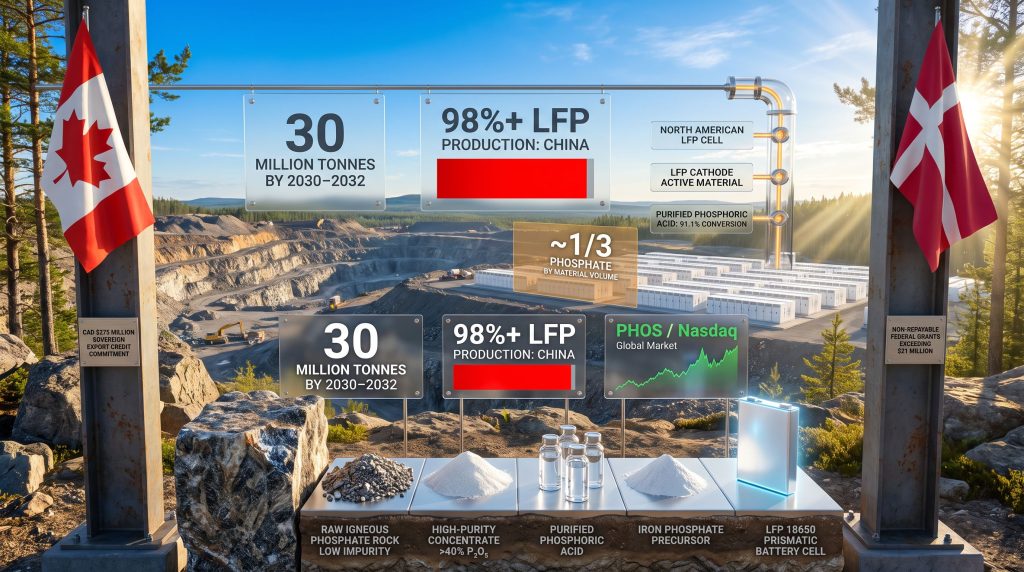
The arithmetic here is striking. The cathode represents approximately 50% of an LFP battery by value, and phosphate constitutes roughly 60% of that cathode by material weight. The net result is that phosphate accounts for approximately one-third of every LFP battery system by material volume. When utility-scale storage installations spanning the equivalent of multiple football fields are constructed, one-third of that physical mass traces directly back to phosphate rock. At the scale currently being deployed across China and now planned across Western markets, the phosphate demand curve becomes almost difficult to comprehend.
When big ASX news breaks, our subscribers know first
From One Million Tonnes to Thirty: The Demand Numbers Behind LFP Growth
Stationary energy storage is the demand vector that most investors have not yet fully internalised. Solar and wind generation are intermittent by nature: sunlight is only available during daylight hours, and wind generation is variable. Unlike hydroelectric power, which can be released from a dam at a controlled and consistent rate, renewable generation requires battery storage expansion to convert it into a dispatchable resource. This structural requirement is not cyclical. It is permanent, and it scales directly with renewable capacity additions.
In China, stationary energy storage is currently expanding at a rate of approximately 25% to 30% quarter over quarter. The phosphate demand implications of that single data point are profound.
| Metric | Historical Baseline | Current Estimate | 2030–2032 Projection |
|---|---|---|---|
| Chinese LFP phosphate demand (tonnes/year) | ~1 million | ~5 million+ | ~30 million |
| Stationary storage growth rate (China) | Baseline | 25–30% QoQ | Continued acceleration |
| LFP share of global battery production | ~50% (2020) | 70–80%+ | Dominant format |
| Phosphate content of LFP cathode | — | ~60% by weight | Stable |
A trajectory from one million tonnes annually to a projected thirty million tonnes by 2030 to 2032 represents a thirty-fold expansion in demand for a single input material within roughly a decade. The critical question for Western supply chain planners is not whether this demand will materialise, but where the phosphate will come from.
Beyond EVs and grid storage, emerging demand vectors are adding further pressure. Data centres requiring uninterruptible power supply, industrial robotics, and next-generation mobility applications are all progressively adopting LFP systems. Furthermore, the non-EV application base for LFP is expanding in ways that compound the demand picture considerably.
Why Igneous Phosphate Is Not the Same as Fertiliser Phosphate
Most phosphate produced globally is sedimentary in origin and destined for agricultural fertiliser markets. Battery-grade phosphoric acid has substantially different purity requirements, and not all phosphate rock is equally suited to meeting them.
The geological distinction between igneous and sedimentary phosphate deposits is directly relevant to battery applications. Sedimentary deposits form through biological and chemical accumulation in marine environments over geological timescales. This process concentrates not only phosphate but also trace contaminants including cadmium and, in some cases, uranium. Removing these impurities to battery-grade specifications requires additional processing steps, which increases both capital and operating costs while reducing conversion efficiency.
Igneous phosphate, by contrast, originates from volcanic activity. The phosphate is physically trapped at a specific density within the host rock, a process that naturally excludes most co-contaminants. The separation of phosphate from the surrounding mineralogy can be achieved through density-based, solventless processes, which are both environmentally cleaner and operationally simpler than the processing routes required for sedimentary ores. For instance, phosphate project development in regions with igneous geology demonstrates these processing advantages in practice.
| Characteristic | Igneous Phosphate | Sedimentary Phosphate |
|---|---|---|
| Typical P₂O₅ grade | 38–42%+ | 28–35% |
| Impurity profile | Very low | Higher (cadmium, uranium traces) |
| Battery-grade suitability | High | Requires additional purification |
| Environmental processing complexity | Lower (solventless separation feasible) | Higher |
| Conversion to purified phosphoric acid | ~91.1% | Lower efficiency |
A conversion ratio of 91.1% from phosphate concentrate to purified phosphoric acid is commercially significant. It means that very little of the extracted material is lost during processing, a factor that directly improves project economics and reduces the volume of raw material that needs to be mined to meet a given output target.
From Rock to Battery Cell: The Six-Stage Value Chain
Understanding the full production pathway from phosphate rock to LFP battery cell is essential for appreciating where value is created and where supply chain vulnerabilities exist. The process involves six distinct stages:
- Phosphate rock is mined and crushed at the mine site.
- Ilmenite and magnetite are removed from the crushed material using a solventless separation process, leaving behind a high-purity phosphate concentrate exceeding 40% P₂O₅.
- The concentrate is treated with sulfuric acid to produce both merchant-grade phosphoric acid and, through further purification, battery-grade phosphoric acid.
- Purified phosphoric acid is combined with iron powder to produce iron phosphate, the direct precursor to LFP cathode material.
- Lithium is added to the iron phosphate to produce lithium iron phosphate cathode active material.
- The cathode active material is integrated into a battery cell alongside a graphite anode to produce a functional LFP cell in prismatic or cylindrical format.
Each of these stages represents a separate margin layer in the value chain. A company that controls the upstream phosphate rock and can progressively integrate downstream through concentrate, purified acid, and cathode active material production is capturing compounding margin at each step. Critically, none of those downstream margin layers need to be priced into a mining company's equity valuation until the market becomes convinced the integration is achievable.
The Geopolitical Trigger: How Three Threats Changed Western Supply Chain Policy
In October 2025, a period of significant diplomatic tension between the United States and China produced a framework that has since reshaped how Western governments think about industrial supply chains. Three specific strategic threats were publicly articulated: restrictions on rare earth exports, semiconductor and chip supply, and LFP battery technology transfer. All three have since been acted upon in varying degrees.
The rare earth response moved first, with the US government deploying substantial subsidies to accelerate domestic processing capacity. Semiconductor supply chain onshoring has been underway for several years, including direct government equity participation in major chip manufacturers. LFP battery technology, identified as the third pillar of this strategic threat framework, remained the most underaddressed of the three as of mid-2026.
The historical irony embedded in this situation is considerable. LFP battery chemistry was originally developed and commercialised in North America. Over approximately two decades, manufacturing migrated to China through technology transfer and cost-driven outsourcing. With China's restriction on LFP technology exports now formalised, Western producers face the task of reconstructing a supply chain built on technology that originated in their own research institutions.
The June 2026 G7 Leaders' Summit held in Evian, France formally elevated LFP supply chain security to the status of a critical priority. The G7 framework established a concentration ceiling: no single country or geographic region should control more than 60% of any critical supply chain. With LFP cathode material and battery cell production currently concentrated at approximately 98% to 99% within China, the gap between the policy target and the current reality is wider for LFP than for any other critical supply chain identified under the G7 framework.
However, this policy pressure is accelerating the critical minerals energy transition agenda across Western governments, creating direct tailwinds for North American producers capable of filling the supply gap.
The Bégin-Lamarche Project: Building the Western Answer
Located in the Saguenay-Lac-Saint-Jean region of Quebec, approximately two and a half hours north of Quebec City, the Bégin-Lamarche phosphate project occupies a geological setting that produces some of the highest-purity igneous phosphate concentrates identified globally. The region already has industrial heritage in aluminium and forestry, providing existing infrastructure and a workforce familiar with large-scale resource operations.
The most recent resource expansion confirmed approximately a fourfold increase in indicated mineral resources compared to prior estimates. This does not translate directly into a planned production increase. Instead, the expanded resource base extends the projected mine life beyond the original 23-year estimate while keeping the planned production rate at 900,000 to approximately one million tonnes of phosphate per annum.
This production calibration reflects deliberate strategic thinking. The output level was designed to match existing off-take commitments, fit comfortably within the industrial capacity of the Saguenay region, and avoid the capital intensity associated with larger-scale operations. With capital requirements estimated at approximately $400 million to $450 million USD to reach first production, the project sits at a scale that is financeable through sovereign and export credit agency channels without requiring the multi-billion-dollar capital structures that have historically delayed or killed comparable projects.
Key project milestones and timeline:
- Feasibility study completion: targeted Q1 2027, with an accelerated internal target of Q4 2026
- Permitting phase: commences following feasibility completion
- Final investment decision: targeted end of 2027
- First production target: 2029
The next major ASX story will hit our subscribers first
The Non-Dilutive Capital Stack: How Sovereign Funding Changes the Equation
One of the least understood aspects of critical minerals project financing is the structural difference between sovereign or export credit agency capital and conventional commercial financing. Understanding this distinction is important for assessing how the Bégin-Lamarche project is being capitalised.
Commercial lenders and convertible debt providers are optimising for financial return. This typically results in warrant clipping, punitive interest rates, dilutive conversion mechanisms, and covenant structures that constrain operational flexibility. Sovereign export credit agencies and government grant programmes operate from an entirely different motivation: supply chain security, employment creation, and national strategic interest. Their capital is structurally friendlier to the equity holder.
The current non-dilutive capital commitments for the project include:
- $16.7 million non-repayable Canadian federal contribution for mine feasibility and concentrator study (March 2026)
- $4.8 million non-repayable Canadian federal contribution for road infrastructure and power transmission planning
- CAD $275 million letter of support from Denmark's Export Credit Agency, representing approximately 40% to 45% of the total project capital requirement
- Letters of interest from Italian government entities and the US Export-Import Bank
The disbursement model for federal contributions operates on a spend-and-recover basis, with 75% reimbursement on eligible expenditures. This creates accountability whilst preserving cash for deployment. Total project capital required is approximately CAD $650 million, with roughly 40% to 45% already de-risked through sovereign commitments.
Future capital pathways being developed include the Canada Growth Fund, Canada Infrastructure Bank, Export Development Canada, and a sovereign wealth vehicle currently under consideration by the Canadian government. The logic is sequential: demonstrate execution on current funded milestones, then return to the table with a track record that justifies the next tranche of support.
The Nasdaq ADR Listing: What the Capital Markets Move Actually Signals
The First Phosphate Nasdaq listing and LFP battery phosphate supply chain story reached a significant milestone when the company listed on the Nasdaq Global Market under the ticker PHOS, effective August 10, 2026, using an American Depositary Receipt structure. First Phosphate's Nasdaq debut represented a carefully considered capital markets strategy rather than a conventional fundraising event. The listing was self-sponsored, meaning no new shares were issued, no underwriter was engaged, and no capital was raised. The ADR ratio is 10:1, with ten common shares equating to one ADR.
The significance of this structure lies in what it communicates. Institutional investors in the United States frequently operate under compliance mandates that restrict or prohibit purchases of securities not listed on a major US exchange. By achieving Nasdaq Global Market listing status without diluting existing shareholders, the company removed the compliance barrier for a substantial class of potential investors whilst simultaneously signalling financial strength.
Approximately 200 companies per year achieve Nasdaq Global Market listing status. The listing requirements around governance, financial reporting, and minimum standards are materially higher than those of smaller exchanges, making the achievement itself a form of institutional credentialing.
The 10:1 ADR structure also creates a natural arbitrage dynamic. As demand for ADRs on Nasdaq increases, market participants must acquire common shares on the Canadian exchange to fulfil ADR creation requests. This mechanically links liquidity across both markets, creating a self-reinforcing dynamic as US institutional interest builds.
Trading volume in the ten days following the listing exceeded the total dollar volume transacted in much of the company's prior history, with daily dollar volume moving into the $5 million to $20 million USD range.
Capital Structure and Management Alignment
| Metric | Detail |
|---|---|
| Common shares outstanding | 189 million |
| ADR ratio | 10:1 (10 common shares = 1 ADR) |
| Warrants outstanding | ~4 million (majority held by management and board) |
| Corporate debt | None |
| Cash runway | 2.5 to 3 years |
| Available capital | $50 million+ |
| CEO ownership | ~10% |
| Management and board total | ~20% |
| Family, friends, and early investors | ~40% |
| Freely trading float | ~40% |
| Indigenous community | ~1% |
| Market capitalisation (CAD) | ~$400–$450 million |
The ownership structure communicates alignment in a way that is unusual among junior resource companies. The CEO receives compensation exclusively in shares and has personally purchased shares in the open market. During a period of market stress when a significant shareholder was forced to sell, board members collectively stepped in to absorb that supply rather than allow it to pressure the share price. This is the kind of behaviour that institutional investors monitor closely when assessing management credibility.
Risk Assessment: What Has Been Resolved and What Remains
| Risk Category | Current Status | Mitigation in Place |
|---|---|---|
| Geological continuity | Substantially resolved | ~400% resource expansion confirms deposit scale and continuity |
| Offtake security | Secured | Signed agreements for concentrate and purified phosphoric acid |
| Technology risk | Resolved | Commercial LFP cell production demonstrated using North American inputs |
| Capital availability | Substantially de-risked | $50M+ accessible; sovereign commitments at ~40–45% of total capex |
| Permitting | In progress | Active engagement at federal, provincial, and regional levels |
| Execution risk | Primary remaining variable | Management team with demonstrated delivery track record |
The reframing of execution risk as the primary remaining variable is worth examining carefully. In most junior mining projects, the dominant risks at the pre-feasibility stage involve geological uncertainty, technology uncertainty, offtake availability, and capital access. When those risks have been substantially resolved and execution becomes the dominant variable, the risk profile of the project changes qualitatively, not just quantitatively.
Execution risk is manageable. It responds to team quality, resourcing, process discipline, and accountability. It does not require geological luck or geopolitical fortune. For investors assessing the project on a risk-adjusted basis, this transition in the risk profile is significant.
Valuation Gap: What the Market Has Not Yet Priced
The current market capitalisation reflects, for the most part, only the value attributed to the mine-level asset. Trading at approximately 20% to 25% of the mine NPV alone, the equity does not yet reflect:
- The downstream processing asset optionality, including purified phosphoric acid plant development
- Potential integration into iron phosphate precursor production
- The possibility of LFP cathode active material production, which would capture the highest-margin layer of the value chain
- The additional phosphate properties held in the portfolio at preliminary economic assessment stage
- The strategic premium that would apply to a North American-based, battery-grade igneous phosphate producer in a world where Western governments are actively funding supply chain onshoring
Each downstream stage represents a separate and additive margin layer. The company's stated M&A philosophy focuses on acquisitions where the combination produces synergistic rather than simply additive value: not one plus one equals two, but one plus one equals five or more. A rising market capitalisation is itself a prerequisite for executing that kind of accretive downstream strategy, since the currency of equity is more valuable when the equity is more highly valued.
In addition, the Ammaroo phosphate project in Australia illustrates how comparable large-scale igneous phosphate assets are being valued globally, providing useful context for assessing where Bégin-Lamarche sits on an international project comparison basis.
Proof of Concept: The First North American LFP Cells in 25 Years
Perhaps the least widely appreciated development in the recent history of this project is the successful production of commercial-grade LFP 18650 battery cells using exclusively North American-sourced critical minerals. The material inputs included Quebec igneous phosphate concentrate, Nevada lithium, Quebec graphite, and iron sourced co-located with the phosphate deposit itself.
These represent the first LFP battery cells produced from North American critical minerals in approximately 25 years. The significance of that achievement extends beyond its symbolic value. It demonstrates that the full six-stage value chain, from phosphate rock in Quebec to a functional battery cell, can be executed without any Chinese material inputs and without any Chinese technology transfer.
Given that LFP battery technology is now formally restricted from export out of China, and given that the chemistry was originally developed in North America before migrating eastward, this proof of concept establishes that Western supply chain reconstruction is technically viable, not merely aspirational. Furthermore, it directly addresses concerns raised in relation to the lithium market downturn, demonstrating that LFP chemistry offers a more resilient and strategically secure alternative for Western battery producers.
The ability to produce a working LFP cell using North American inputs alone changes the conversation from one about supply chain vulnerability to one about supply chain reconstruction timeline. The technology exists. The materials exist. The remaining question is one of industrial scale and financing speed.
Details of the First Phosphate Nasdaq listing and LFP battery phosphate supply chain strategy, including commentary from company leadership, are outlined in the CEO interview with Ellis Martin, which covers the Nasdaq listing milestone and the broader North American LFP supply chain vision in detail.
Frequently Asked Questions
What role does phosphate play in an LFP battery?
Phosphate forms approximately 60% of the LFP cathode by composition, making it the largest single material input in the battery's positive electrode. Because the cathode represents roughly 50% of the battery by value, phosphate effectively constitutes around one-third of the total battery system by material volume.
Why does battery-grade phosphoric acid require igneous phosphate?
Sedimentary phosphate deposits contain impurities, including trace cadmium and uranium, that require additional purification steps before the resulting acid meets battery-grade specifications. Igneous deposits, formed through volcanic processes, produce phosphate with a naturally lower impurity profile, enabling higher conversion efficiency and simpler processing chemistry.
What is the ADR structure and why does it matter?
An American Depositary Receipt allows non-US companies to trade on US exchanges by having a depositary bank hold the underlying foreign shares and issue ADRs representing those shares in a fixed ratio. The 10:1 ratio means one PHOS ADR on Nasdaq represents ten First Phosphate common shares on the TSX Venture Exchange. This structure allows US institutional investors subject to major-exchange compliance requirements to access the investment.
What is the G7 60% concentration ceiling?
The G7 critical minerals framework established a policy target that no single country or region should control more than 60% of any critical supply chain. With LFP production currently concentrated at approximately 98% to 99% within China, the LFP supply chain represents the largest gap between the policy target and current reality of any material identified under the framework.
When is the feasibility study expected?
The feasibility study is targeted for completion no later than Q1 2027, with an internal accelerated target of Q4 2026. This milestone triggers the permitting phase, with a final investment decision targeted for end of 2027 and first production aimed for 2029.
Disclaimer: This article is for informational purposes only and does not constitute financial advice or a recommendation to buy or sell any securities. Projections, timelines, and demand forecasts referenced herein involve forward-looking statements subject to material risks and uncertainties. Readers should conduct their own due diligence and consult a qualified financial adviser before making any investment decisions. All financial figures are sourced from publicly available company disclosures and industry reporting and are subject to change.
Want to Stay Ahead of the Next Major Mineral Discovery Before the Market Catches On?
Discovery Alert's proprietary Discovery IQ model delivers real-time alerts on significant ASX mineral discoveries — including opportunities across the critical minerals and battery materials sectors reshaping the global energy transition — turning complex data into clear, actionable insights for investors at every level. Explore why historic mineral discoveries have generated exceptional returns and start your 14-day free trial today to position yourself ahead of the broader market.