Daly Resources Ltd
- ASX Code: DLY
- Market Cap: $9,310,500
Daly Resources Uncovers Expanding Fluorite Footprint at Huckitta as Geochemistry and Geophysics Align
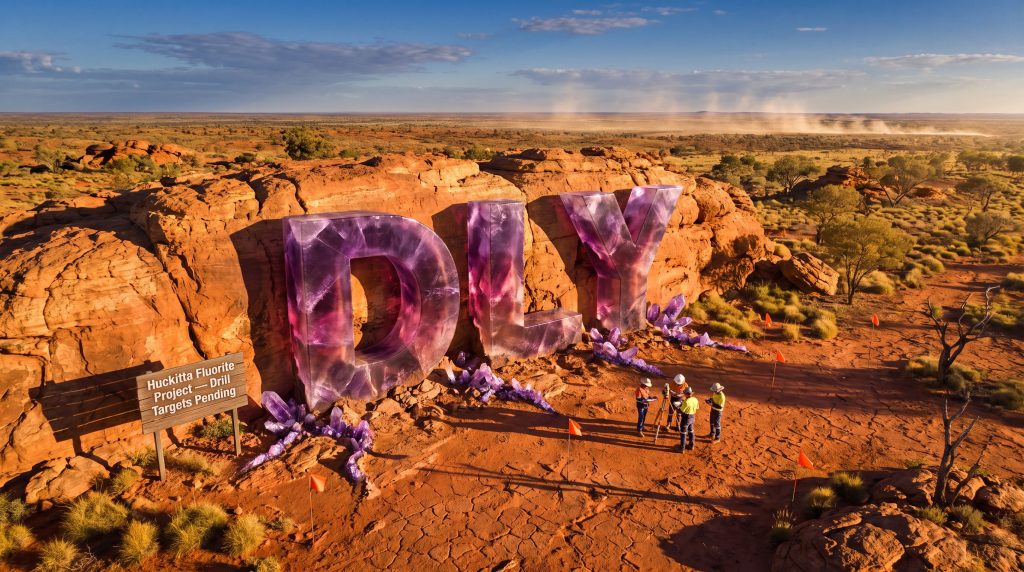
Daly Resources Limited (ASX: DLY) has reported new exploration results from its 100%-owned Huckitta Fluorite Project in the Northern Territory, with rock chip sampling, first-pass soil geochemistry and newly processed airborne geophysics all indicating that fluorite mineralisation may extend beyond currently mapped surface outcrops. According to the ASX announcement dated 18 August 2026, the emerging picture is of an eastern priority target area that is broader than previously understood and increasingly defined ahead of planned drill targeting.
The update matters for investors because the company is moving from isolated surface sampling toward a more integrated exploration model. At Huckitta, that means combining visible fluorite veins, geochemical anomalies in soil and high-resolution magnetic imagery to assess whether the mineralised system continues beneath shallow cover.
When big ASX news breaks, our subscribers know first
New Rock Chips Add to Evidence of High-Grade Fluorite at Huckitta
In the announcement, Daly stated that new rock chip sampling returned values of up to 73.98% CaF₂ from a previously unidentified outcrop within the eastern priority target area. These results build on historical work that had already outlined multiple fluorite-bearing veins exceeding 400 metres in strike length within an 8 km-long vein corridor, with historical rock chips of up to 95.1% CaF₂ and historical drill hole PH1 reported to have intersected 6.1 metres at 35.1% CaF₂.
The new results are selective surface samples, which means they are useful for confirming the presence of fluorite but do not represent the true width or average grade of the mineralised structure. Even so, the identification of additional high-grade outcrop in an area still being mapped can be important at this stage, as it may point to a larger surface footprint than previously recognised.
Selected assay results from the latest rock chip programme are shown below.
| Sample ID | CaF₂ (%) | SiO₂ (%) | CaO (%) | F (%) |
|---|---|---|---|---|
| 26DL0025 | 74.0 | 21.62 | 52.10 | 36.0 |
| 26DL0026 | 53.8 | 42.88 | 38.97 | 26.2 |
| 26DL0027 | 2.1 | 95.10 | 1.43 | 1.0 |
| 26DL0028 | 3.5 | 90.73 | 2.62 | 1.7 |
| 26DL0030 | <0.1 | 96.60 | 0.04 | <0.1 |
| 26DL0034 | 3.5 | 73.37 | 2.60 | 1.7 |
| 26DL0035 | 12.9 | 66.75 | 8.80 | 6.3 |
Samples 26DL0025 and 26DL0026 are the standout assays in this batch. According to the report, both came from a previously unidentified outcrop, which is relevant because it suggests the mapped fluorite system remains open to further refinement at surface.
For investors following early-stage mineral exploration, this kind of development often matters less for immediate economics and more for scale. If additional high-grade outcrops keep appearing outside the currently mapped zones, the case for a larger mineralised system can strengthen considerably.
Soil Geochemistry Points to Fluorite Beneath Cover
The most important result in the update may be the soil programme rather than the rock chips. Daly reported collecting 148 soil samples across two parallel east-west traverse lines, spaced about 400 metres apart, with the longer line running for around 5.8 km across the eastern priority target area.
According to the exploration update, the western end of the southern line defined a coherent, continuous zone of anomalous CaF₂-in-soil geochemistry extending over at least 1 km of strike. This is significant because the area has limited outcrop, and earlier fluorite rock chips had only been obtained where creeks cut through the surface cover.
The company also reported anomalous soil fluorine in several locations:
- Along the eastern part of the southern traverse
- On the northern traverse
- At locations more than 400 metres from the nearest mapped vein outcrop
This matters because soil surveys can help identify mineralisation hidden below shallow sediments or weathered cover. They do not prove grade or mineability, but they can indicate that a system continues beyond what is exposed at surface.
Field follow-up appears to support that interpretation. Daly stated that work in creek lines and drainage channels identified additional fluorite-bearing structures that are obscured away from those exposures by younger cover. In practical terms, surface cover may be masking parts of the vein system, while the soil chemistry is still detecting its signature.
"These results support our view of Huckitta's potential, with the soil geochemistry pointing to these fluorite veins potentially continuing north beneath cover, beyond what we can currently see at surface," said Mike Edwards, Executive Chairman.
Furthermore, a third soil line located 1 km north of the reported traverses has already been completed, with results pending. That pending dataset could be particularly important in testing whether the northern extension interpretation holds beyond the current lines.
What Is CaF₂ and Why Does Fluorite Matter?
Fluorite is the mineral form of calcium fluoride, written chemically as CaF₂. It is the main source of fluorspar, an industrial mineral used across several sectors including steelmaking, aluminium processing, chemicals, refrigerants and some battery-related applications.
For non-specialist investors, the purity of fluorite is important because different end uses require different CaF₂ concentrations. Higher-purity material may be suitable for higher-value markets, although commercial suitability still depends on factors such as impurities, metallurgy, mining conditions and processing requirements.
A simplified fluorspar quality guide is set out below.
| Grade | CaF₂ Content | Typical Use |
|---|---|---|
| Metallurgical grade | 60% to 85% | Steel and iron production |
| Ceramic grade | 85% to 96% | Glass, enamel and cement |
| Acid grade | Above 97% | Chemical, refrigerant and battery-related uses |
At Huckitta, historical surface sampling has returned up to 95.1% CaF₂, while the latest programme returned up to 73.98% CaF₂. Those numbers indicate that at least some parts of the system contain relatively high-purity fluorite, although rock chips are selective by nature and are not a substitute for drilling or metallurgical testwork.
Fluorite Exploration Terms Explained
A few technical terms in the announcement are worth clarifying for context:
- Rock chip sample: A sample taken from exposed surface rock. It helps confirm mineral presence but is selective and not representative of the broader deposit.
- Soil geochemistry: Chemical testing of soils to identify unusual concentrations of minerals or elements that may be linked to buried mineralisation.
- Strike length: The length of a mineralised structure measured horizontally along its main direction.
- Aeromagnetics: An airborne geophysical method that measures variations in the Earth's magnetic field to map buried structures and rock types.
- Cover: Younger sediments or weathered material that hide the underlying bedrock.
Understanding these terms helps explain why the latest Huckitta update is drawing attention. Daly is not yet reporting a resource. Instead, it is building the geological case for where drilling should be directed.
High-Resolution Geophysics Improves Structural Definition
The announcement also detailed progress from a recently completed aeromagnetic and radiometric survey across Huckitta. According to Daly, the processed data provides much sharper structural definition than previously available magnetic imagery.
This is important because vein-hosted mineralisation often follows geological structures such as faults, fractures or shears. If geophysics can better map those structural corridors, the company can improve its targeting, particularly in areas where the mineralised trend disappears under shallow cover.
Key geophysical outcomes reported by the company include:
- High-resolution magnetic imagery that resolves structural trends associated with mapped fluorite mineralisation.
- Better definition of the interpreted continuation of those structures beneath cover.
- Identification of additional structures that were not apparent in the older regional dataset.
Taken together, the geophysical and geochemical results appear to be complementary. Soil anomalies may indicate where fluorite-related chemistry continues into covered ground, while magnetics may help explain the structure controlling that mineralisation.
"The airborne geophysics is now adding another layer of information that complements what we're seeing in the geochemistry, helping us better understand how this mineralisation is distributed. Together, these results will help guide our next phase of exploration and the definition of targets for drilling," said Mike Edwards.
For investors, this integrated approach can be more meaningful than a single encouraging sample. It suggests the company is trying to define a coherent geological model before advancing to drilling.
Next Steps at Huckitta and What Investors Should Watch
In the report, Daly outlined a clear near-term work programme focused on refining the eastern priority target area and testing the potential northward extension of the fluorite vein system beneath cover.
The immediate programme includes the following activities:
| Activity | Status |
|---|---|
| Rock chip sampling in eastern priority target area | Ongoing |
| Soil sampling across current lines | Completed, results reported |
| Third soil line 1 km north | Completed, results pending |
| Geological mapping across broader project area | Ongoing |
| Aeromagnetic and radiometric interpretation | In progress |
| Drill target definition | Planned next phase |
The company stated that further mapping, rock chip sampling and soil sampling are continuing across the broader Huckitta Project area. This broader work matters because the headline eastern target sits within a much larger project position of approximately 3,812 km².
Daly also noted that additional fluorite prospects have been identified across the Huckitta Project, not just within the currently highlighted eastern target area. That broadens the exploration setting considerably, although the current data focus remains on the eastern priority area where geochemistry and geophysics are now appearing to align.
The Investment Case Emerging From This Exploration Update
Daly's latest Huckitta results do not establish a resource or development pathway. What they do provide, however, is a firmer exploration framework, which is often the key value driver at this stage of a junior explorer's lifecycle.
Several points stand out from the ASX announcement:
- Known mineralisation is being expanded through new outcrop discoveries and broader soil anomalies.
- Covered extensions are now a credible target, based on anomalous fluorine in soils and follow-up field observations in creek exposures.
- Geophysics is improving structural understanding, which may help the company convert early-stage anomalies into better drill targets.
- Daly retains 100% ownership of the Huckitta Project, giving shareholders full exposure to exploration outcomes on the asset.
- The company holds more than 6,500 km² of granted tenure across the Northern Territory, with Huckitta as one part of a larger exploration portfolio.
Regional context also adds interest. The announcement referenced exploration results at Tivan Limited's adjoining Sandover Fluorite Project for geological context only, noting that Daly has not independently verified those results. That regional activity does not change the company-specific facts at Huckitta, but it does indicate that fluorite exploration remains active across the broader corridor.
The next likely valuation inflection point is not simply another sample result. It is whether the pending soil data, ongoing mapping and full airborne survey interpretation can narrow the target set into a drill-ready programme with a coherent geological rationale.
The next major ASX story will hit our subscribers first
Why Huckitta Is Becoming a Closer Watchlist Story
The latest Huckitta update suggests Daly is moving beyond reconnaissance and into structured target generation. Surface fluorite is already known. The new question is whether those veins continue into larger concealed zones that have not yet been tested by modern drilling.
That is why the combination of high-grade rock chips, 1 km-scale soil anomalism and improved magnetic definition is relevant. Each dataset on its own provides a partial view. Integrated together, they may support a broader interpretation of the fluorite system in the eastern priority target area.
Near-term catalysts for investors to watch include:
- Pending assays from the third soil traverse north of the current lines
- Further rock chip and mapping results from the broader project area
- Full interpretation of the aeromagnetic and radiometric survey
- Definition of priority drill targets for the next phase of exploration
For now, according to the ASX announcement, Daly Resources is steadily building the geological case that Huckitta's fluorite mineralisation may extend well beyond present outcrop limits. If upcoming data continues to support that interpretation, the project could move into a more consequential phase centred on first-pass drill testing.
Want to Track the Next Major ASX Mineral Discovery Before the Market Does?
Discovery Alert's proprietary Discovery IQ model instantly scans ASX announcements across more than 30 commodities — including emerging critical minerals like fluorspar — delivering real-time alerts on significant discoveries so subscribers can act ahead of the broader market. Explore why major mineral discoveries have historically generated exceptional returns and begin your 14-day free trial at Discovery Alert to position yourself at the forefront of the next significant find.