
August 12, 2026
The Gold Standard Nobody Applies to Gold Itself
Sovereign wealth management operates under an unspoken assumption: that the assets underpinning national financial credibility are rigorously verified, independently confirmed, and transparently documented. For corporate balance sheets, pension funds, and even small private depositories, this assumption is enforced through mandatory auditing cycles, third-party verification, and publicly accessible records. Yet when it comes to the largest single concentration of gold reserves in the United States, a facility whose holdings are cited as foundational to American monetary credibility, those same standards simply do not apply. The Fort Knox gold audit debate is not a fringe conspiracy. It is a legitimate accountability gap hiding in plain sight.
When big ASX news breaks, our subscribers know first
What the U.S. Government Actually Holds in Gold Reserves
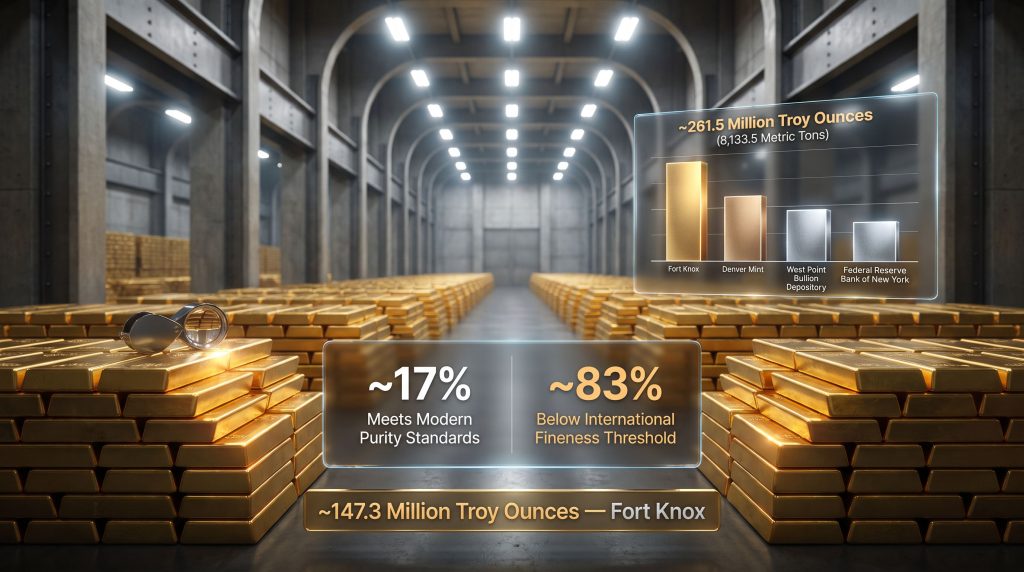
Understanding the scale of the issue begins with the numbers themselves. Total U.S. gold reserves are reported at approximately 261.5 million troy ounces, equivalent to 8,133.5 metric tons. These holdings are not concentrated in a single location but distributed across four storage sites.
| Storage Location | Approximate Holdings |
|---|---|
| Fort Knox Bullion Depository | ~147.3 million troy ounces |
| West Point Bullion Depository | Partial allocation |
| Denver Mint | Partial allocation |
| Federal Reserve Bank of New York | Partial allocation |
| Total U.S. Gold Reserves | ~261.5 million troy ounces (8,133.5 metric tons) |
Fort Knox alone holds just over half of the national total. At the standard reserve bar weight of 400 troy ounces, that figure translates to more than 300,000 individual gold bars. In reality, the number of physical bars is likely higher, because a significant portion of U.S. gold was formed by melting down pre-1933 coinage during the Roosevelt administration's gold confiscation programme. Those bars carry irregular weights and non-standard compositions, making exact bar counts more complex and the verification task considerably more demanding.
Furthermore, understanding central bank gold reserves globally provides important context for why the accountability standards applied to U.S. holdings matter so much to international monetary credibility.
The Purity Problem Most Commentary Ignores
Here is where the Fort Knox gold audit debate moves beyond simple questions of physical presence into something with deeper financial implications. Based on documents submitted during a 2011 U.S. House Committee on Financial Services hearing, only approximately 17% of gold bars held at Fort Knox meet contemporary international purity standards. The remaining 83% fall below the fineness threshold required for international gold settlement, typically set at a minimum of .995 fine.
| Gold Bar Category | Estimated Share of Fort Knox Holdings | International Settlement Eligible? |
|---|---|---|
| Meets modern purity standards | ~17% | Yes |
| Below international fineness threshold | ~83% | No |
This is not a minor technical footnote. It speaks directly to the practical utility of the reserve asset. Gold bars that cannot be delivered on global settlement markets are, in functional terms, significantly less useful as monetary instruments regardless of whether they physically exist in a vault. The question is not simply is it there, but what is it actually worth in operational terms.
Critical Distinction: Physical presence and financial utility are not the same thing. A vault full of gold that fails international purity standards cannot serve the same function as settlement-grade reserves, even if every bar is counted and verified.
In addition, the broader role of gold in the monetary system underscores precisely why purity standards are not bureaucratic technicalities but genuine determinants of reserve asset value.
Why a Brief Visit Cannot Substitute for a Real Audit
The recent sequence of events that reignited the Fort Knox gold audit debate follows a pattern that sound money advocates have seen before. Treasury Secretary Scott Bessent publicly confirmed that U.S. gold is fully present and accounted for, citing staff visits to the facility as the basis for that assertion rather than any independent verification process. Subsequently, a sitting U.S. Senator spent approximately one to two hours inside the Fort Knox depository before publicly declaring that approximately 147 million ounces of gold were confirmed to be present.
Sound Money Defense League Director Jp Cortez challenged the credibility of these declarations, noting that co-sponsoring legislation specifically designed to mandate a comprehensive independent audit, then publicly certifying reserves after a brief guided tour, represents a fundamental inconsistency. The senator in question had previously co-sponsored the Gold Reserve Transparency Act of 2025 alongside Senator Mike Lee, a bill designed precisely because existing oversight mechanisms were considered inadequate.
Stefan Gleason, CEO of Money Metals Exchange, expressed serious concern about the implications of declaring reserves verified after a short facility visit, pointing out that a precious metals depository twice the physical size of Fort Knox conducts proper independent audits as a routine operational standard. His argument was pointed: an institution with nothing to hide actively seeks verification, not avoids it.
The arithmetic alone makes the case. Verifying 300,000+ gold bars requires:
- Physical counting of every bar by an independent third party, not facility staff
- Serial number reconciliation matching each bar against official inventory databases
- Metallurgical assaying to confirm weight and purity to international standards
- Chain-of-custody review covering all transactions, loans, leases, swaps, and pledges
- Public disclosure of findings in a format accessible to Congress, institutions, and the public
None of those steps can be meaningfully completed in a few hours of guided observation. The distinction between walking through a facility and conducting a forensic audit is not semantic; it is the difference between an impression and evidence.
A Critical Review of Historical Audit Claims
Defenders of the status quo frequently point to prior government-conducted reviews as evidence that Fort Knox has already been audited. However, a closer examination of those historical processes reveals significant shortcomings.
The 1974 Congressional Visit
In 1974, the Treasury opened a single vault compartment, one of fifteen total at Fort Knox, for viewing by politicians and journalists. This exercise was presented as a transparency measure. Critics immediately and correctly identified it as a publicity effort rather than a forensic audit. No comprehensive assaying occurred. No independent third party was involved. Thirteen of fifteen compartments remained unopened and unexamined.
Post-1974 Treasury Inventory Process
Following the 1974 visit, the Treasury conducted a multi-year process of opening vault compartments, conducting internal inventories, and affixing tamper-evident seals. This process was conducted internally without independent oversight and did not meet external audit transparency standards. Critically, some documentation from this period has since been reported as missing or incomplete, and there is no publicly accessible record of comprehensive assaying or transactional history.
Annual Seal Reviews
Ongoing annual reviews of compartment seal schedules have been conducted and cited as evidence of continued oversight. However, evidence has emerged that vault seals have been broken and re-affixed on multiple occasions without triggering new auditing procedures. These reviews function as continuity checks rather than substantive verification exercises.
Audit Red Flag: In any private sector context, broken seals, missing documentation, and asset movements without corresponding audit trails would constitute material control failures requiring immediate independent investigation.
The Encumbrance Question Nobody in Government Is Answering
Perhaps the most underappreciated dimension of the Fort Knox gold audit debate is the encumbrance question. Physical presence of gold bars in a vault does not confirm unencumbered ownership. Central banks around the world routinely engage in gold lending, gold swap arrangements, and collateralisation agreements with counterparties in the commercial banking system.
The gold reserves in London vaults, for instance, illustrate how gold can simultaneously appear in custody records while being subject to complex lending and leasing arrangements that affect genuine ownership status.
Without a published encumbrance audit, the following questions remain entirely unresolved:
- Has any Fort Knox gold been loaned to commercial banks or foreign central banks?
- Has gold been used as collateral in currency intervention operations?
- Do third parties hold full or partial legal claims against bars physically stored at Fort Knox?
- Have any swap arrangements transferred effective ownership while leaving physical custody intact?
These are not theoretical concerns. Gold lending by central banks is a well-documented global practice. The Bank of England, for example, has facilitated gold lending markets for decades. The absence of a published encumbrance disclosure for U.S. reserves means that even a perfect physical count would leave the most financially significant questions unanswered.
The Core Issue: You can count every bar in every vault and still have no idea whether those bars are genuinely owned by the American public or whether claims against them have been extended to undisclosed counterparties.
What the Gold Reserve Transparency Act Would Have Required
The Gold Reserve Transparency Act of 2025, co-sponsored by Senators Rand Paul and Mike Lee, represented a serious legislative attempt to close the accountability gap. Had it been enacted, the bill would have mandated:
- A full independent physical audit of all U.S. gold reserve locations
- Mandatory repeat audits on a five-year cycle
- Public disclosure of complete audit findings
- Coverage of all storage sites, not just Fort Knox
The bill was introduced and referred to committee. It has not been enacted. The legislative gap it was designed to address remains open. The irony of co-sponsoring that legislation and then publicly certifying reserves based on a brief facility tour has not been lost on sound money advocates, who argue the two positions cannot be simultaneously coherent.
Moreover, the Basel III gold rules have introduced additional international pressure on institutions to maintain genuinely verifiable, unencumbered gold holdings, making domestic audit transparency an increasingly urgent concern.
The next major ASX story will hit our subscribers first
Why This Debate Keeps Resurfacing
The Fort Knox gold audit debate is cyclical not because of conspiracy thinking but because the structural conditions that generate it never change. Several reinforcing dynamics keep the issue alive:
- Monetary system stress: During periods of dollar weakness, elevated inflation, or geopolitical instability, the question of what physically backs U.S. financial credibility gains renewed urgency among institutional and retail investors alike.
- Political amplification: High-profile figures including former President Donald Trump and Elon Musk have publicly raised questions about Fort Knox holdings, introducing the audit debate to audiences far beyond traditional sound money circles.
- Private sector contrast: Responsible private gold depositories, including facilities smaller in physical scale than Fort Knox, conduct regular independent third-party audits as a standard client assurance measure. The absence of equivalent standards at the national level creates a credibility asymmetry that is difficult to explain away.
- Legislative stagnation: The repeated introduction of audit legislation that never reaches enactment signals that demand for formal verification exists at the policy level but has not translated into action.
What a Legitimate Audit Would Actually Require
Conducting a credible, independent audit of U.S. gold reserves is operationally complex but not impossible. The scope would need to encompass all four reserve locations, not Fort Knox alone. The process would require:
- Engagement of an independent auditing firm with demonstrable experience in sovereign asset verification
- Physical access protocols that balance legitimate security requirements with audit integrity, ensuring the auditors, not facility staff, control the counting process
- A timeline measured in months, not hours, to systematically work through more than 300,000 bars across multiple locations
- Assaying protocols to verify purity and weight of sampled and targeted bars
- Full encumbrance disclosure covering all arrangements that may create third-party claims
- Publication of a complete, publicly accessible audit report
The argument that national security concerns make this impractical does not survive scrutiny. Private depositories manage comparable processes routinely. The more honest framing of the resistance is not that an audit is impossible; it is that an audit has not been politically prioritised.
FAQ: Fort Knox Gold Audit Debate
Has Fort Knox ever been independently audited?
No comprehensive, independent, bar-level audit with full public disclosure has ever been completed. Past government-conducted reviews did not meet the standards of a credible external audit.
How much gold is stored at Fort Knox?
Approximately 147.3 million troy ounces, representing just over half of total U.S. gold reserves of approximately 261.5 million troy ounces (8,133.5 metric tons).
Why does gold purity matter in this debate?
Based on 2011 Congressional hearing documentation, approximately 83% of Fort Knox gold bars do not meet modern international settlement standards. Gold that cannot be delivered on global markets has significantly diminished practical utility as a reserve asset, regardless of its physical presence.
What is the Gold Reserve Transparency Act?
Legislation co-sponsored by U.S. Senators that would mandate a comprehensive independent audit of all U.S. gold reserves, repeated every five years, with public disclosure of results. Introduced but not enacted as of the time of writing.
What does encumbered gold mean?
Gold that has been loaned, leased, pledged, or swapped, meaning other parties may hold full or partial legal claims against it. Physical presence in a vault does not confirm unencumbered ownership.
Why does a guided tour fail as an audit substitute?
Verifying more than 300,000 bars requires systematic counting, serial number matching, metallurgical assaying, and encumbrance disclosure. Those processes cannot be meaningfully completed through observational visits lasting a few hours.
Transparency Is the Only Credible Resolution
The Fort Knox gold audit debate ultimately reduces to a straightforward institutional accountability question. In every comparable context, assets of this magnitude are subject to independent, publicly verifiable audit. Corporate treasuries, pension funds, commodity-backed financial products, and private depositories all operate under frameworks where third-party verification is a baseline expectation, not an optional exercise.
The concept of gold as ultimate money rests fundamentally on trust, and trust, in turn, rests on verifiable proof rather than assurances offered by the custodian of the asset itself.
The absence of equivalent standards for U.S. gold reserves is an anomaly, not a norm. A genuine audit would not resolve political disagreements about monetary policy or the role of gold in the financial system. What it would do is provide a factual foundation that currently does not exist: independent verification of bar count, weight, purity, serial number integrity, and encumbrance status across all storage locations.
Sound Money Perspective: Institutions with nothing to conceal typically welcome verification. The persistent deflection of audit calls, regardless of the political framing used to justify it, does not resolve the underlying accountability gap. It compounds it.
The fact that a private precious metals depository operating a facility larger than Fort Knox conducts regular independent audits as a matter of routine should make the absence of equivalent rigour at the national level more striking, not less. Opacity is never a sign of institutional health. In gold reserve management, as in every other domain of public accountability, verification is not an act of distrust. It is the foundation of trust itself.
This article is intended for informational and educational purposes only. It does not constitute financial or investment advice. Readers should conduct their own research and consult qualified professionals before making financial decisions. References to the Gold Reserve Transparency Act reflect its status as introduced legislation and do not imply enactment.
Want to Stay Ahead of Significant ASX Mineral Discoveries in Real Time?
Discovery Alert's proprietary Discovery IQ model instantly identifies high-potential ASX mineral discovery announcements across more than 30 commodities, delivering actionable insights directly to subscribers before the broader market reacts — explore historic discovery returns on the Discovery Alert discoveries page to understand what early positioning in transformative finds can mean for a portfolio. Begin your 14-day free trial today and gain a genuine market-leading edge.