
August 14, 2026
Sovereign Gold and the Auditing Blind Spot
Across centuries of monetary history, the credibility of a nation's financial system has rested not merely on the existence of reserves, but on the ability to verify them independently. When the Bretton Woods system collapsed in 1971 and the U.S. dollar severed its formal link to gold, the metal transitioned from active monetary instrument to strategic reserve asset. Yet paradoxically, the standards applied to verifying that asset actually weakened over subsequent decades, even as its market value climbed toward levels that would have been unimaginable to post-war economists.
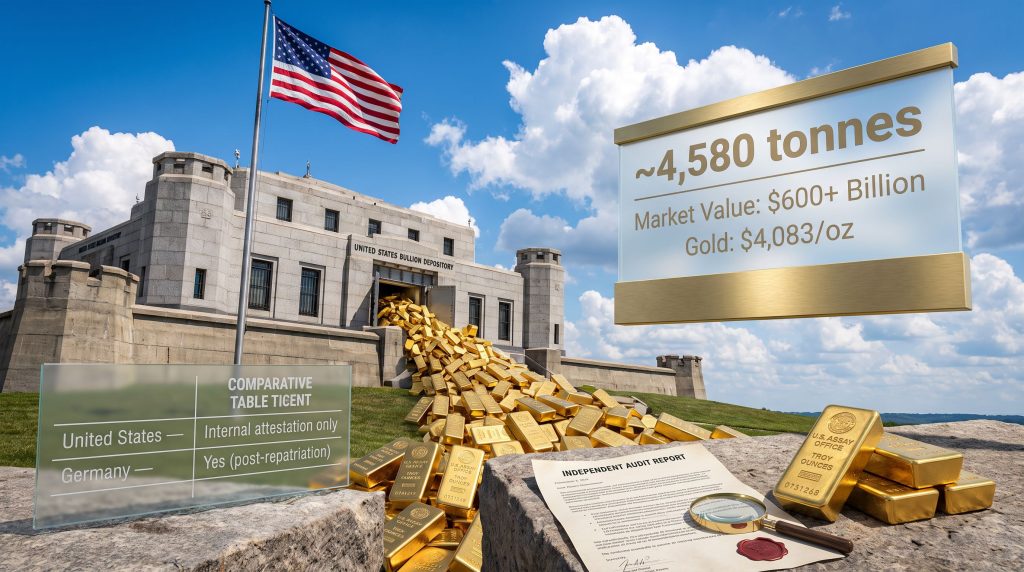
Today, with gold trading near $4,083 per troy ounce as of July 2026, the approximately 4,580 tonnes reportedly stored at Fort Knox carry a market value exceeding $600 billion. That figure alone raises an uncomfortable question that neither political affiliation nor institutional loyalty can easily dismiss: why does the most powerful economy in the world verify an asset of this magnitude using methods that would be rejected outright by any private sector auditor?
The Fort Knox gold audit debate is not, at its core, a conspiracy theory. It is a governance question, and a legitimate one.
When big ASX news breaks, our subscribers know first
What the Treasury Actually Claims Versus What Auditing Standards Require
When Treasury Secretary Scott Bessent stated publicly that U.S. gold reserves are present and accounted for, the basis for that claim was a review of vault compartment seals conducted by Treasury staff members. No vault compartments were opened. No bars were individually counted. No serial numbers were cross-referenced against historical inventory records. No independent third party was involved.
To understand why this falls short, it helps to understand what a genuine independent audit of a precious metals depository actually requires:
- Physical bar-by-bar count across every vault compartment, not limited to representative samples
- Serial number reconciliation against official Treasury records to detect potential substitutions or discrepancies
- Assay testing using fire assay or X-ray fluorescence methods, covering a statistically meaningful random sample of bars
- Encumbrance review disclosing any gold lending, leasing, or swap arrangements that would place third-party claims against physically present gold
- Public audit report with full methodology, auditor credentials, and signed attestation
Confirming that a vault door is sealed tells you nothing about what is behind it, how much of it there is, whether it matches the records, or whether anyone else holds a financial claim against it.
The London Bullion Market Association, which sets global standards for precious metals custodianship, requires that accredited vaulting operations undergo regular independent verification that includes physical bar counts and purity confirmation. Private depositories operating in the United States, including those serving retail precious metals investors, routinely meet these standards. The U.S. government's own gold holdings are held to a notably lower standard.
A Timeline of Fort Knox Gold Verification
Understanding what has and has not occurred helps frame the scale of the transparency gap. The table below summarises the key verification events in the documented history of U.S. gold reserve oversight:
| Year | Event | Independent Verification? | Bar-by-Bar Count? | Public Disclosure? |
|---|---|---|---|---|
| 1953 | Treasury inventory review | Partial | Partial | Limited |
| 1974 | Congressional and media tour | No | No | No |
| 1986-2008 | Ongoing GAO attestations | Internal only | No | Partial |
| 2010s | Treasury annual reconciliations | Internal only | No | Limited |
| 2025-2026 | Renewed political calls for audit | Pending | No | No |
The 1974 congressional visit is frequently cited as evidence that Fort Knox gold has been inspected, but the reality is far less reassuring. Elected officials and journalists posed for photographs with gold bars in a small number of vault compartments. There was no systematic inventory count, no serial number verification, no assay testing, and no public reporting of any financial transactions involving the reserves. It was, by any auditing standard, a media event rather than a verification exercise.
The Government Accountability Office has issued attestations regarding U.S. gold reserves over the decades, but these have relied on internal Treasury documentation and Mint personnel inspections rather than independent physical verification. The GAO itself has noted in various reports that its reviews of gold reserves do not constitute comprehensive physical audits.
How Much Gold Is at Fort Knox and What Is It Actually Worth?
The numbers involved in this debate are significant enough to warrant careful examination on their own terms:
| Metric | Figure |
|---|---|
| Total U.S. gold reserves (official) | ~8,133 tonnes |
| Gold held at Fort Knox | |
| Book value (statutory price) | ~$42.22 per troy ounce |
| Market value (at ~$4,083/oz, July 2026) | Exceeding $600 billion |
| Last publicly verified bar count | 1953 (disputed) |
The statutory book price of $42.22 per troy ounce was established under the Par Value Modification Act of 1973 and has never been updated to reflect market realities. At current prices, the gap between the book value and market value of U.S. gold reserves represents one of the most extraordinary accounting anomalies in modern government finance. The Treasury carries an asset worth more than $600 billion on its books at less than 1% of that figure.
This pricing discrepancy is not merely an accounting curiosity. It means that any discussion of U.S. gold reserve value in official government documents bears almost no relationship to the actual economic significance of the asset, obscuring both its strategic importance and the scale of the governance gap created by inadequate verification procedures.
The Encumbrance Question: Why Physical Presence Is Not Enough
Of all the transparency issues surrounding Fort Knox, the question of potential gold encumbrances through lending or swap arrangements represents the most analytically significant concern. Central bank gold demand is a well-documented practice globally, where gold is temporarily transferred to commercial banks or other institutions in exchange for interest payments, with a contractual obligation to return equivalent gold at a future date.
The physical presence of gold bars in a vault does not rule out the existence of financial claims held by third parties against those same bars. A gold bar can be simultaneously present and encumbered.
The mechanics of gold lending create a particularly challenging verification problem. When gold is lent, the borrower typically sells it into the market and replaces it with a contractual obligation. The lending institution continues to record the gold as an asset on its balance sheet, even though the physical metal has left its possession. If such arrangements exist within U.S. gold reserves, a simple bar count would confirm the gold's presence without revealing that another party holds a legal claim against it.
The U.S. Treasury has not provided comprehensive public disclosure of any gold lending, leasing, or swap transactions involving its reserves. This absence of disclosure does not confirm such transactions have occurred, but it equally cannot rule them out, which is precisely why an encumbrance review must form a mandatory component of any credible Fort Knox gold audit.
How Other Nations Handle Sovereign Gold Transparency
The international comparison provides both context and a practical roadmap for what genuine gold reserve transparency looks like:
| Country | Primary Storage | Independent Audit? | Public Reporting? |
|---|---|---|---|
| Germany | Bundesbank + NY Fed + Bank of England | Yes (post-repatriation) | Yes |
| Switzerland | Swiss National Bank | Yes | Annual |
| United Kingdom | Bank of England | Yes | Periodic |
| United States | Fort Knox + NY Fed + West Point | Internal attestation only | Limited |
Germany's gold repatriation is particularly instructive. When the Bundesbank announced a repatriation programme beginning in 2013, the process involved comprehensive independent audits of bars moved from New York and London, with public disclosure of bar counts, serial numbers, and purity verification results. Rather than undermining confidence in German monetary credibility, the transparency dividend strengthened public trust in the Bundesbank's reserve management. By 2017, Germany had completed its repatriation ahead of schedule, with all transferred bars independently verified and publicly accounted for.
Switzerland publishes annual reports through the Swiss National Bank detailing gold holdings by storage location, with independent verification and purity data. The contrast with U.S. practice is stark and intentional: Swiss monetary authorities have consistently treated gold reserve transparency as a tool for reinforcing public confidence rather than a risk to be managed through opacity.
The next major ASX story will hit our subscribers first
What a Credible Fort Knox Audit Would Look Like
A genuine independent Fort Knox gold audit would require systematic execution across six distinct phases:
- Appointment of independent auditors with no institutional affiliation to the Treasury, Federal Reserve, or Mint, selected through a competitive process with public disclosure of credentials
- Unrestricted physical access to all vault compartments at all gold storage facilities, including Fort Knox, the New York Federal Reserve, and West Point
- Bar-by-bar inventory count with serial numbers recorded for cross-referencing against the full historical Treasury inventory database
- Systematic assay testing using random sampling across all compartments, with purity results documented to four decimal places and published in the final report
- Complete encumbrance review requiring disclosure of any gold lending, leasing, swap, or other financial arrangements that create third-party claims against the reserves
- Public audit report with full methodology, statistical confidence intervals, auditor sign-off, and unrestricted public access
The logistical costs of such a process are modest relative to the asset being verified. Comprehensive precious metals audits of comparable scale conducted for private depositories typically involve teams of 20 to 30 specialist auditors over a period of 60 to 90 days. The cost would be negligible relative to the $600 billion in value being verified, and the institutional credibility dividend of a clean audit result would represent significant geopolitical value at a time when dollar reserve dominance faces genuine competitive pressure from emerging market central banks.
Market Context: Gold, Silver and the July 2026 Backdrop
The Fort Knox audit debate has resurfaced against a specific market backdrop that adds additional context to the transparency question:
| Metal | Price (July 2026) | Weekly Change |
|---|---|---|
| Gold | $4,083/oz | +1.4% |
| Silver | $59.47/oz | +5.0% |
| Platinum | $1,607/oz | +0.3% |
| Palladium | $1,272/oz | +0.5% |
Gold and silver experienced sharp declines of approximately 2–3% during Thursday's trading session in late July 2026 before recovering partially into the weekend. The catalyst for market volatility was a Houthi attack on two Saudi oil tankers in the Red Sea, prompting President Donald Trump to threaten significant military action against Iran and its proxies. Brent crude surged more than 7%, briefly reclaiming the psychologically significant $100 per barrel level for the first time since May.
Unusually, the dominant market response to geopolitical escalation flowed through energy markets rather than precious metals, reflecting a specific dynamic at play in mid-2026.
With futures markets assigning approximately an 80% probability of a September 2026 Federal Reserve rate hike, rising Treasury yields and a strengthening U.S. dollar have created structural headwinds for gold that are temporarily overriding conventional safe-haven demand.
Higher oil prices have reignited inflation concerns, redirecting investor attention toward the Federal Reserve's rate trajectory. Furthermore, gold's safe-haven role remains somewhat muted in this environment, as the interplay between geopolitical risk, energy prices, and monetary policy expectations illustrates the complexity of precious metals positioning.
The Fort Knox audit question intersects with this market context in a subtle but meaningful way. Long-term gold investors who hold the metal as a reserve asset and monetary hedge have a direct interest in the credibility of sovereign gold reserves globally, as institutional confidence in gold in the monetary system is partly contingent on the integrity of the verification frameworks surrounding the world's largest holdings.
Why Reserve Transparency Has Geopolitical Consequences
The case for a comprehensive Fort Knox gold audit extends beyond domestic governance concerns into the realm of geopolitical monetary strategy. Central bank gold reserves in emerging market economies, including those in China, India, Russia, and the broader BRICS bloc, have been growing rapidly over the past decade partly as a hedge against dollar reserve dependency. The dollar's reserve currency status derives substantial support from confidence in U.S. monetary institutions and the quality of U.S. government asset management.
If a fully independent audit confirmed that all 8,133 tonnes of U.S. gold reserves are physically present, unencumbered by third-party claims, and accurately reflected in official records, the resulting transparency dividend could meaningfully reinforce global confidence in U.S. monetary credibility at a strategically significant moment. Conversely, continued resistance to independent verification provides adversarial actors with a persistent narrative tool, regardless of whether that narrative has factual basis.
The institutional precedent set by refusing independent verification is also worth examining carefully. In any other domain of U.S. government asset management, the absence of independent audit would be considered a material governance failure. The Internal Revenue Service audits taxpayers. The Securities and Exchange Commission requires independent audits of public companies. The Federal Deposit Insurance Corporation mandates independent verification of bank assets. The sole major exception appears to be the gold reserves held in the nation's own vaults, as documented by the U.S. Mint in its own historical records.
Frequently Asked Questions: Fort Knox Gold Audit
Has Fort Knox ever been fully audited?
No comprehensive, independent, bar-by-bar physical audit with full public disclosure has been conducted since at least the early 1950s. The 1974 congressional visit involved no systematic bar counting, serial number verification, or assay testing, and did not meet any recognised definition of an independent audit.
Who owns the gold at Fort Knox?
The gold stored at Fort Knox belongs to the U.S. Treasury and forms part of the nation's official monetary gold reserves, which total approximately 8,133 tonnes across multiple storage facilities.
What is the Fort Knox gold worth in 2026?
At approximately $4,083 per troy ounce as of July 2026, the estimated 4,580 tonnes held at Fort Knox carries a market value exceeding $600 billion. The Treasury officially records gold at the statutory price of $42.22 per troy ounce, creating a vast gap between book value and market reality.
What is the difference between an attestation and an independent audit?
An attestation is a statement by an internal or affiliated party confirming that records appear consistent with known information. An independent audit, however, involves external verification by a third party with no institutional connection to the entity being audited, using physical examination rather than documentation review alone.
Could U.S. gold have been lent or swapped without public disclosure?
Gold lending and swap arrangements are legal instruments used by central banks globally. The U.S. Treasury has not provided comprehensive public disclosure of any such transactions involving its gold reserves. Physical presence of bars does not rule out the existence of financial claims held by third parties against those bars.
What would a full audit cost relative to the value being verified?
Independent precious metals audits of comparable scale typically cost between $500,000 and $1.5 million. Against a reserve value exceeding $600 billion, this represents a negligible fraction, making cost an unconvincing reason to avoid conducting one.
The Governance Imperative
The Fort Knox gold audit question is not fundamentally about conspiracy theories or political point-scoring. It is about applying the same governance standards to sovereign gold reserves that any responsible institution applies to assets of significant public value.
Private depositories routinely undergo independent audits that include physical bar counts, serial number verification, purity testing, and full public disclosure. Central banks in Germany, Switzerland, and the United Kingdom have demonstrated that sovereign gold transparency is both operationally feasible and institutionally beneficial. The United States, holding the world's largest official gold reserves, remains a notable outlier.
If the gold is genuinely present, unencumbered, and accurately recorded, an independent audit would confirm that fact and deliver a credibility dividend far exceeding its modest cost. The persistent institutional resistance to that verification is, in itself, the most compelling argument for why the Fort Knox gold audit debate will continue to demand attention until the question is conclusively resolved.
This article is for informational purposes only and does not constitute financial advice. Precious metals prices referenced reflect market conditions as of late July 2026 and are subject to change. Forward-looking statements regarding Federal Reserve policy, interest rate trajectories, and geopolitical developments involve inherent uncertainty and should not be relied upon as investment guidance.
Want to Know When Major Gold Discoveries Hit the ASX?
While sovereign gold reserves remain shrouded in opacity, the world of ASX mineral discovery operates in real time — and Discovery Alert's proprietary Discovery IQ model instantly identifies significant gold and precious metals discoveries as they are announced, turning complex data into actionable investment opportunities that have historically delivered extraordinary returns. Begin your 14-day free trial at Discovery Alert today and position yourself ahead of the broader market.