
June 11, 2026
The Hidden Crisis Inside America's Gold Vaults
Gold has served as the backbone of monetary systems for millennia, yet the mechanics of how nations actually store, verify, and mobilise their reserves remain surprisingly opaque to most observers. While financial headlines focus on price movements and central bank buying trends, a far more consequential question has quietly moved from the fringes of monetary policy debate into mainstream political discourse: does the United States actually know what it has in its gold vaults, and more importantly, could it use that gold if it needed to?
The Fort Knox gold audit debate, reignited in 2025 with renewed political energy, is not simply a conspiracy theory dressed in legislative clothing. It raises legitimate questions about transparency, reserve quality, and the strategic readiness of the world's largest officially reported gold hoard.
When big ASX news breaks, our subscribers know first
Why the Fort Knox Audit Debate Resurfaced in 2025
The Political Catalyst and the Shift From Spectacle to Substance
Public attention returned to Fort Knox in May 2025 when President Trump publicly raised the possibility of personally verifying whether the United States still holds its reported gold reserves. While the optics leaned toward political theatre, the underlying concern resonated with a growing chorus of monetary policy critics, precious metals professionals, and legislators who have spent years arguing that the existing audit framework is functionally meaningless.
The conversation has since shifted from a media curiosity into a serious legislative push. Senator Mike Lee introduced the Gold Reserve Transparency Act, with four House members sponsoring companion legislation. The bill would require far more than a simple inventory check.
The Gold Reserve Transparency Act proposes a complete physical inventory and independent assay of all U.S. gold holdings, full public disclosure of all transactions conducted using U.S. gold reserves, a structured multi-year plan to upgrade non-standard bars to current good delivery purity standards, and ongoing audit continuity requirements rather than a one-time review.
This legislative push reflects a recognition that the status quo audit framework has never come close to meeting the standards expected of private sector precious metals depositories. For further context on why Trump and Musk went silent on this issue, independent commentary has continued to surface compelling questions about political motivation.
What Does a Real Fort Knox Gold Audit Actually Mean?
Paperwork Reviews vs. Independent Physical Verification
When Treasury officials point to annual audit processes as evidence that U.S. gold is accounted for, they are describing something that bears little resemblance to what professionals in the precious metals industry would recognise as an audit. The current annual review is essentially an examination of vault seal schedules, a paperwork process that does not involve physical inspection of bars, independent assay testing, or third-party verification.
Operators of large private precious metals depositories, including some that exceed Fort Knox in total vault footprint, conduct audits under an entirely different standard. Every seal breach triggers a mandatory re-audit of all contents within that container, conducted under continuous camera surveillance with multi-party sign-off. The U.S. Mint's historical record, by contrast, shows repeated instances between 1974 and 2008 where seals were broken, bars relocated, and new seals affixed without any corresponding re-audit — a practice that would invalidate the entire prior audit chain under private sector standards.
A Step-by-Step Framework for a Credible Audit
A genuinely credible audit of U.S. gold reserves would require the following elements:
- Independent third-party oversight with no government-affiliated auditors conducting self-reviews
- Physical bar-by-bar inventory cross-referenced against historical serial number records
- Metallurgical assay testing to confirm purity of each bar, not merely its physical presence
- Seal integrity verification confirming no compartments were opened without triggering a re-audit
- Transaction history disclosure accounting for all leases, swaps, or other mobilisations
- Dual-control documentation with multi-party sign-off under camera surveillance at every stage
- Ongoing audit continuity structured as a repeating cycle, not a single event
How Long Would a Genuine Audit Take?
| Audit Scope | Estimated Duration | Key Constraint |
|---|---|---|
| Paperwork/seal schedule review (current method) | Ongoing annually | No physical verification |
| Partial physical inspection | 6 to 12 months | Limited to accessible compartments |
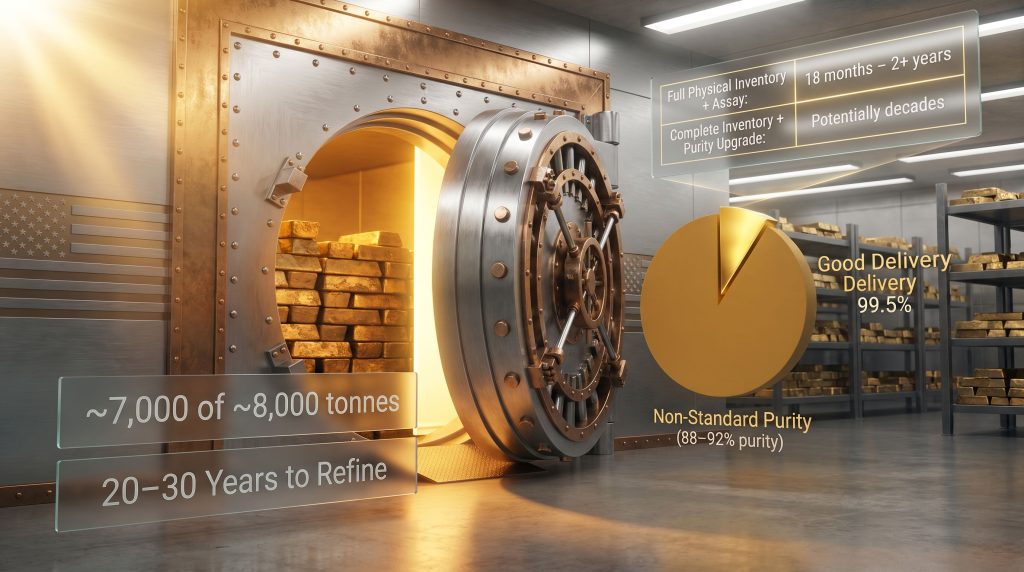
| Full physical inventory and assay | 18 months to 2+ years | Staffing, logistics, refinery capacity |
| Complete inventory, transaction audit, and purity upgrade | Potentially decades | Refining bottleneck |
The Broken Seal Problem: Why Prior Audits May Be Legally Worthless
The broken seal issue is arguably the most technically damaging aspect of the Fort Knox audit record. Under professionally accepted depository standards, any disruption of a sealed container, regardless of reason, immediately invalidates all prior audit confidence in that container's contents. A new seal without a new audit provides zero assurance.
Research into the Mint's own records has identified multiple unexplained episodes over several decades where compartment seals were broken, bars were moved between locations, and replacement seals were applied without any documented re-audit process. Consequently, the historical audit trail for U.S. gold reserves is, by any rigorous private-sector standard, effectively worthless as a chain of custody document.
The Hidden Problem Nobody Is Discussing: Gold Purity
Why Most U.S. Gold Would Be Rejected on Global Markets
This is perhaps the least understood dimension of the entire Fort Knox debate, and it has significant implications for U.S. financial preparedness. Approximately 7,000 of the roughly 8,000 tonnes of U.S. gold reserves are estimated to consist of non-standard purity bars, with gold content ranging from approximately 88% to 92%. Modern international good delivery standards require a minimum purity of 99.5%, often referred to as four-nines or 4N gold.
This means the overwhelming majority of U.S. reserves — bars that existed long before modern refining standards were established — would not be readily accepted on global markets today without significant processing. Furthermore, this purity gap creates a strategic vulnerability that extends well beyond accounting concerns.
The Refining Bottleneck: A Decades-Long Problem
| Metric | Detail |
|---|---|
| Estimated non-standard U.S. gold holdings | ~7,000 of ~8,000 tonnes |
| U.S.-based good delivery refineries | 2 (both foreign-owned, operating domestically) |
| Estimated refining time at full capacity | 20 to 30 years |
| France's recent approach | Sold approximately 119 to 129 tonnes of non-standard gold held at the New York Fed and replaced it with 4N pure gold domestically |
| Germany's approach (~10 years ago) | Repatriated gold and upgraded to 4N purity standard |
Conversations between precious metals industry professionals and officials at the U.S. Treasury and U.S. Mint have revealed a striking lack of awareness about the practical implications of this purity gap. Officials have reportedly pointed to a small 1978 gold sale of approximately 300,000 ounces as evidence that mobilising reserves is manageable. That framing, however, ignores three critical realities:
- The 1978 sale involved a 10% discount due to non-standard purity
- Good delivery standards have evolved substantially in the intervening 47 years
- The scale difference between 300,000 ounces and the potential mobilisation of hundreds of millions of ounces is enormous
There are only two refineries in the United States currently operating at good delivery standard, and both are foreign-owned. At full capacity, with no other client work, those two facilities would require an estimated 20 to 30 years to refine U.S. reserves to the current international standard. Efforts to develop additional domestic refining capacity, including a proposed facility in Tennessee, remain in early stages. Meanwhile, refining capacity globally is heavily concentrated in China, introducing a strategic vulnerability that becomes particularly acute in any scenario involving geopolitical disruption.
What Good Delivery Actually Means and Why It Matters
Good delivery gold refers to bars that meet the specifications set by the LBMA and COMEX gold markets, including minimum 99.5% purity, specific weight tolerances, and approved refinery markings. Any bar failing to meet these criteria cannot be freely traded on major international markets without a discount or reprocessing. Nations actively accumulating gold today, particularly central banks in Asia, are almost exclusively purchasing 4N-pure good delivery bars.
The divergence between this global standard and the condition of U.S. reserves represents a significant and underappreciated strategic asymmetry. In addition, understanding central banks influencing gold prices helps contextualise why purity standards have become increasingly consequential in global reserve strategy.
Is the Gold Actually There? The Ownership and Encumbrance Question
Physical Presence vs. Unencumbered Legal Ownership
The more consequential audit question may not be whether gold physically exists in U.S. vaults. It may be who legally owns it. Gold that is physically present in a vault can simultaneously be encumbered through leasing arrangements, swap agreements, or forward sales — meaning it exists in storage but is effectively already committed to a counterparty.
There has been no public disclosure of any transactions involving U.S. gold reserves in recent decades. The Exchange Stabilisation Fund, one of the most opaque instruments in the U.S. financial system, has the legal authority to engage in gold transactions without congressional approval or public reporting. Industry professionals who have engaged senior financial officials on this topic have noted that responses, while carefully worded, have at times implicitly acknowledged U.S. government involvement in gold market transactions, particularly in the context of dollar defence operations.
This raises a scenario that many gold market observers consider more likely than an outright physical shortfall: that U.S. gold is physically present but legally encumbered in ways that have never been disclosed to the public or to Congress. Comparable concerns about gold reserves in London vaults have likewise prompted questions about the true ownership and availability of internationally held reserves.
The next major ASX story will hit our subscribers first
Scenario Analysis: What a Real Audit Might Find
| Scenario | Market Impact | Policy Consequence | Dollar Confidence Effect |
|---|---|---|---|
| Full transparency, gold confirmed intact | Short-term gold price dip; long-term credibility gain | Validates reserve system; reduces reform pressure | Moderate positive |
| Encumbrance discovered through leases or swaps | Significant gold price spike | Forces legislative overhaul of ESF and reserve policy | Severe negative |
| Physical shortfall identified | Historic gold price surge | Constitutional and financial crisis trigger | Catastrophic |
| Audit launched but inconclusive | Prolonged uncertainty premium | Ongoing legislative pressure | Persistent negative |
How the U.S. Compares to International Reserve Standards
France, Germany, and the New Global Benchmark
France's recent handling of its non-standard gold holdings at the New York Federal Reserve is instructive. Rather than seeking to repatriate impure bars and arrange domestic refining, France sold those holdings and used the proceeds to purchase 4N pure gold within its own borders. The transaction simultaneously repatriated reserves and upgraded purity in a single step. Germany undertook a comparable repatriation and quality upgrade approximately a decade earlier.
Both decisions reflect a clear-eyed recognition that modern reserve strategy requires not just holding gold, but holding gold that is immediately usable on international markets. The United States has not undertaken a comparable upgrade, and official communications suggest limited awareness that this is even a pressing concern.
Central bank gold reserves globally have been accumulating at historically elevated rates in recent years. The nations driving this accumulation are overwhelmingly acquiring 4N-pure good delivery bars, reinforcing the international standard while the U.S. sits on decades-old impure stock. Furthermore, independent analysis of the economic impact of a Fort Knox audit suggests that such a review could have far-reaching consequences for global gold pricing and dollar credibility.
How the Retail Gold and Silver Market Is Responding in 2025
Demand Patterns and Emerging Buyer Demographics
Retail precious metals demand surged significantly during January and February 2025 before moderating through the spring. The pullback in transaction volume appears linked to a combination of price consolidation following a major rally and a broader sense of complacency among U.S. investors, particularly given the resilience of equity markets.
A notable demographic shift has emerged in buyer patterns. While traditional retail sellers have been returning silver to the secondary market in elevated volumes, a meaningful increase in gold purchasing activity has been observed among Asian-American buyers, sometimes in substantial amounts. This trend may reflect a cultural familiarity with gold as a savings vehicle combined with heightened awareness of economic pressures affecting Asian economies.
Silver Premiums: A Buyer's Opportunity
The elevated secondary market supply of silver has pushed premiums on several product categories to historically low levels, creating what market participants consider a favourable entry point for physical silver accumulation. Investors weighing their options may also find it useful to consider the differences between physical gold vs ETFs when deciding how to position their portfolios.
| Product Type | Current Premium Status | Buyer Opportunity |
|---|---|---|
| 10 oz silver bars | At or near spot | Strong buy opportunity |
| 100 oz silver bars | At or near spot | Strong buy opportunity |
| 1 oz silver rounds | Low premium | Good value |
| 90% junk silver | At spot or slight discount | Excellent value |
| Silver Eagles | Elevated but declining | Monitor for further compression |
| Gold (all forms) | Consistently low premium | Standard entry point |
Gold premiums have remained consistently stable regardless of market conditions, reflecting the deeper liquidity and larger market size that gold commands relative to silver.
Frequently Asked Questions: Fort Knox Gold Audit
Has Fort Knox Ever Been Fully and Independently Audited?
No. The United States has never conducted a full, independent, bar-by-bar physical audit with metallurgical assay testing conducted by third parties with no government affiliation. The annual Treasury review is a paperwork process examining vault seal schedules, not physical contents.
How Much Gold Does the U.S. Government Hold and What Is It Worth?
The United States officially reports holding approximately 8,133 tonnes of gold, making it the world's largest reported national gold reserve. At current market prices, this is valued at approximately $700 billion, though that figure is based on market gold prices and not the official book value the Treasury uses for accounting purposes.
Why Does Gold Purity Matter for National Reserves?
Purity determines whether gold can be freely traded on international markets. Non-standard bars would face discounts or require processing before they could be mobilised in a financial emergency. With the U.S. holding an estimated 7,000 tonnes in sub-standard purity, the practical liquidity of American gold reserves is far lower than face value suggests.
Could a Fort Knox Audit Move Gold Prices?
Yes, significantly. Any scenario involving disclosed encumbrances, undisclosed transactions, or physical discrepancies would likely trigger a substantial upward repricing of gold globally. Even an inconclusive Fort Knox gold audit could sustain a prolonged uncertainty premium in gold markets.
What Is Good Delivery Gold?
Good delivery refers to gold bars meeting the London Bullion Market Association's specifications, principally a minimum purity of 99.5% and approved weight and marking standards. The majority of U.S. reserves do not currently meet this standard.
Key Takeaways: What the Fort Knox Debate Reveals About U.S. Monetary Policy
The Fort Knox gold audit question is ultimately a proxy for a broader inquiry into the credibility and transparency of U.S. monetary institutions. Whether the issue is the chain of custody for physical gold, the potential encumbrance of reserves through undisclosed transactions, or the strategic unpreparedness exposed by the purity gap, each dimension points to systemic accountability deficits that have accumulated over decades.
The Gold Reserve Transparency Act represents the most concrete legislative response to these concerns yet introduced in Congress. Whether it advances will depend on whether the political will to demand real answers outlasts the news cycle that created it.
For investors, the debate reinforces several durable themes: the strategic premium increasingly placed on physically allocated, independently verified precious metals holdings; the growing divergence between official reserve accounting and practical market readiness; and the possibility that the full picture of U.S. gold reserve management has never been publicly disclosed.
This article contains forward-looking analysis and scenario projections that are speculative in nature. Nothing in this article constitutes financial or investment advice. Readers should conduct their own research and consult qualified financial professionals before making investment decisions.
Want to Stay Ahead of Significant ASX Mineral Discoveries in Real Time?
While the debate over U.S. gold reserves highlights the critical importance of transparency and verified physical assets in precious metals markets, Discovery Alert's proprietary Discovery IQ model delivers real-time alerts on significant ASX mineral discoveries, instantly translating complex data across 30+ commodities into actionable insights — explore the historic returns major discoveries have generated and begin your 14-day free trial today to position yourself ahead of the broader market.