
June 3, 2026
When Bulk Tonnage Meets Brownfield Advantage: The Economics Behind Large-Scale Heap Leach Gold Projects
The global gold mining industry has spent decades grappling with a fundamental tension: the world's easiest-to-find, high-grade gold deposits are largely exhausted, yet technological and processing advances have made previously uneconomic, lower-grade bulk-tonnage systems commercially viable. Heap leach processing, in particular, has quietly transformed the economics of open pit gold mining across Latin America. Furthermore, understanding gold exploration trends helps contextualise how enabling operations can extract value from ore bodies that conventional milling economics would render marginal or unviable.
It is within this framework that the updated Galantas Andacollo Oro mineral resource estimate in Chile takes on broader significance, not merely as a corporate milestone but as a window into how brownfield assets with proven operating histories are being repositioned in a gold market increasingly shaped by resource scarcity and rising development costs.
When big ASX news breaks, our subscribers know first
A Project Defined by Its Operating History
The Andacollo Oro project sits approximately 55 kilometres southeast of La Serena in the Coquimbo Region of central Chile, a jurisdiction with a long and well-documented history of both gold and copper extraction. What makes this asset structurally different from the majority of gold development-stage projects globally is not its size alone, but the evidence base behind it.
The project operated as a large-scale open pit heap leach gold mine from 1998 through to 2018, generating cumulative historical gold output of approximately 1.12 million ounces across its 20-year lifespan. Peak annual production reached roughly 125,000 ounces of gold per year, a throughput rate that places it within the upper tier of heap leach gold operations in South America during that period.
Why Operational History Matters
This production history matters in ways that are not immediately obvious to investors unfamiliar with mining project economics. A two-decade operational record generates an extraordinary volume of technical data: drill core databases, assay libraries, metallurgical test work results, geotechnical assessments, hydrological studies, and mine reconciliation data. Consequently, this information reduces the geological uncertainty embedded in any resource estimate and compresses the timeline required to advance a project toward feasibility study completion.
Beyond technical data, the project retains existing site infrastructure and valid environmental approvals, which represent a tangible competitive advantage. Environmental permitting for open pit mining operations in Chile, while more structured and transparent than many Latin American jurisdictions, is nonetheless a time-intensive and capital-consuming process. The retention of existing permits eliminates a regulatory pathway that greenfield developers must navigate from the beginning.
Brownfield re-entry projects with retained operational infrastructure and permits occupy a structurally lower-risk position in the mining development spectrum compared with greenfield exploration assets of equivalent resource scale. The value of existing permits is rarely fully captured in per-ounce resource valuations but is material to development timeline and capital intensity analysis.
Breaking Down the Galantas Andacollo Oro Mineral Resource Estimate
Resource Figures and Classification Framework
The updated Galantas Andacollo Oro mineral resource estimate carries an effective date of February 1, 2026, with formal filing completed on May 4, 2026. Resources are reported on a pit-constrained basis using a marginal cut-off grade of 0.08 grams per tonne (g/t) of gold (Au).
The key figures from the 2026 MRE are as follows:
| Resource Category | Tonnage | Grade (g/t Au) | Contained Gold |
|---|---|---|---|
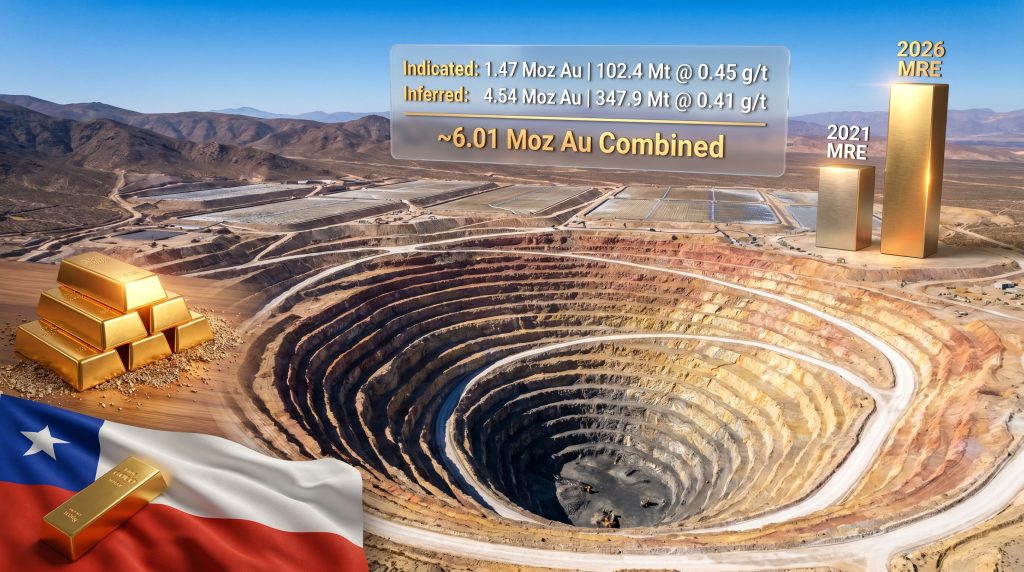
| Indicated | 102.4 million tonnes | 0.45 g/t | 1.47 Moz |
| Inferred | 347.9 million tonnes | 0.41 g/t | 4.45 Moz |
| Combined | 450.3 million tonnes | ~0.42 g/t | ~5.92 Moz |
Note: Inferred mineral resources are reported exclusive of indicated mineral resources, in accordance with standard CIM (Canadian Institute of Mining, Metallurgy and Petroleum) resource classification conventions. The combined total of approximately 5.92 million ounces reflects the corrected inferred figure of 4.45 Moz as reported by Mining Weekly (May 5, 2026).
How the 2026 MRE Compares to the 2021 Historical Estimate
| MRE Version | Category | Tonnage | Grade (g/t Au) | Contained Gold |
|---|---|---|---|---|
| 2021 Historical | Measured + Indicated | 130 Mt | 0.48 g/t | 2.02 Moz |
| 2021 Historical | Inferred | 358 Mt | 0.45 g/t | 5.06 Moz |
| 2026 Updated | Indicated | 102.4 Mt | 0.45 g/t | 1.47 Moz |
| 2026 Updated | Inferred | 347.9 Mt | 0.41 g/t | 4.45 Moz |
Several observations emerge from this comparison that are worth understanding in detail:
- The grade profile remains broadly consistent across both estimates, with the 2026 Indicated grade of 0.45 g/t Au matching the 2021 Measured category exactly. This geological grade continuity is a positive indicator of the reliability of the underlying geological model.
- The Measured category is absent from the 2026 estimate. This reflects a reclassification under updated estimation parameters, with previously Measured tonnes now falling within the Indicated category under revised pit constraint modelling and cut-off grade assumptions.
- Inferred tonnes have modestly declined from 358 Mt to 347.9 Mt, with the grade slipping slightly from 0.45 g/t to 0.41 g/t. This adjustment is consistent with refinements in pit shell optimisation and updated economic assumptions applied to the pit constraint model.
The Technical Significance of a 0.08 g/t Cut-Off Grade
The marginal cut-off grade of 0.08 g/t Au is a figure that deserves explanation for readers unfamiliar with resource estimation methodology. In conventional milling operations, cut-off grades typically range from 0.30 g/t to 0.50 g/t Au or higher, reflecting the higher processing costs per tonne associated with grinding and flotation circuits.
Heap leach processing operates at fundamentally lower per-tonne processing costs because ore is simply crushed, stacked on impermeable pads, and percolated with a leaching solution rather than being ground to fine particle sizes and processed through intensive chemical circuits. This cost advantage allows heap leach operations to economically process ore at grades that would be subeconomic under conventional milling, which is why the 0.08 g/t cut-off is appropriate and not unusually optimistic for this type of operation.
The pit-constrained methodology means all reported resources are contained within an optimised open pit shell modelled using assumed gold prices, pit wall slope angles, mining and processing costs, and metallurgical recovery factors. Resources reported within this shell are economically relevant to open pit extraction, not merely geological estimates of metal in the ground.
What a 5.92-Million-Ounce Resource Base Actually Means for Mine Planning
Scale, Throughput, and Implied Mine Life
A combined resource of approximately 5.92 million ounces across 450.3 million tonnes positions Andacollo Oro as a genuinely large-scale gold asset by global standards. To put this in perspective, the majority of producing open pit heap leach gold mines globally operate on resource bases of 1 to 3 million ounces. Assets with resources exceeding 5 million ounces are comparatively rare and typically attract attention from mid-tier and major mining companies seeking long-duration production platforms.
At the historical peak production rate of approximately 125,000 ounces per year, and assuming a conservative 65% resource-to-reserve conversion rate (which is typical for brownfield open pit operations), a simplified mine life calculation suggests:
- Economically mineable gold: ~3.85 Moz (65% of 5.92 Moz)
- Implied mine life at 125,000 oz/year: approximately 30 years
- At higher production rates (150,000 oz/year): approximately 25 years
These figures are illustrative only and are subject to the outcomes of formal feasibility studies, actual reserve conversion rates, and production rate decisions. They should not be interpreted as forecasts or commitments. However, they establish that the asset has the resource scale to support multi-decade mine planning, which is a meaningful differentiator when securing project financing or attracting strategic partners.
Why Bulk Tonnage and Low Grade Are Not Contradictions
A persistent misconception among retail mining investors is that lower-grade gold deposits are inherently less attractive. This view misunderstands the economics of large-scale, bulk-tonnage heap leach operations, where the relevant metric is cost per ounce recovered, not grade per se.
At 0.42 g/t Au average grade across 450 million tonnes, the total ore mass is extraordinary. Heap leach operations processing 50,000 to 100,000 tonnes per day across this resource base would be operating within the upper tier of Latin American heap leach producers in terms of annual throughput. The key economic drivers in this scenario are:
- Strip ratio: the ratio of waste tonnes to ore tonnes mined, which determines haulage and blasting costs
- Heap leach recovery rate: typically 60% to 80% for oxide gold ores in heap leach operations
- Leach cycle duration: the time required for gold dissolution and recovery, affecting working capital requirements
- Operating costs per tonne processed: the combined mining, crushing, stacking, and solution management costs
Without published prefeasibility or feasibility study data, precise cost modelling is not possible. However, analogous heap leach gold operations in Chile and Peru with similar grade profiles have demonstrated All-In Sustaining Costs (AISC) in the US$900 to US$1,400 per ounce range, which compares favourably against current gold prices well above US$3,000 per ounce. This cost structure context is illustrative based on industry analogues and has not been confirmed for Andacollo Oro through formal technical studies.
The Copper Dimension: A Strategic Optionality Layer
One aspect of Andacollo Oro that distinguishes it from single-commodity gold development projects is the identified potential for copper resource discovery. CEO Mario Stifano specifically noted that significant exploration potential exists for discovery of substantial copper resources, including potential extensions of adjacent porphyry copper mineralisation. In addition, reviewing copper market trends highlights just how strategically valuable this copper optionality could become.
This is not a speculative add-on. The Coquimbo Region sits within one of the world's most copper-endowed geological terranes. Porphyry copper-gold systems are the dominant deposit type in the Chilean Andes, and the Andacollo district itself has a documented porphyry copper history. The nearby Andacollo copper operation demonstrates that the geological architecture for large-scale porphyry systems exists at shallow depth in this precise district.
The convergence of a gold heap leach resource with adjacent porphyry copper potential introduces several strategic scenarios:
- Sequential development: Gold heap leach operations generate early cash flow that could internally fund copper exploration and resource definition
- Concurrent processing: If copper mineralisation is laterally adjacent and geometrically compatible, dual-commodity extraction could be evaluated
- Asset attractiveness to major miners: Large copper-gold porphyry assets in Chile are increasingly scarce; furthermore, the Chile copper outlook suggests majors are seeking to build copper exposure ahead of long-term demand growth driven by electrification
The copper upside at Andacollo Oro is currently unquantified in resource terms. Any statements about copper potential remain exploratory and speculative until supported by a formal mineral resource estimate for copper mineralisation. Investors should treat the copper narrative as prospective rather than defined.
How Galantas Gold Structured the Acquisition
Galantas Gold Corporation, dual-listed on the TSX Venture Exchange (TSX-V) and the AIM market of the London Stock Exchange, entered into a share purchase agreement on January 6, 2026, to acquire a 100% ownership interest in the Andacollo Oro project for a total consideration of US$32 million.
The share purchase structure is the standard mechanism for transferring mining project ownership in Latin America. By acquiring the shares of the entity that holds the project rather than the project assets directly, Galantas takes on all existing environmental permits, community agreements, infrastructure ownership, and technical data archives as a seamlessly continuing legal entity.
From a valuation standpoint, US$32 million for approximately 5.92 million ounces of gold in resource implies a cost basis of roughly US$5.40 per ounce of contained gold in the MRE. Brownfield gold assets with proven production history and retained permits in Latin America have historically transacted in the US$3 to US$15 per ounce range depending on resource confidence, jurisdiction, infrastructure status, and commodity price environment. At US$5.40 per ounce for a past-producing, permitted, infrastructure-equipped asset in a stable jurisdiction, the acquisition pricing appears positioned at the lower end of comparable brownfield transaction valuations.
The next major ASX story will hit our subscribers first
The Development Pathway: From Updated MRE to Restart Decision
Staged Technical Workstreams
The completion of the updated MRE represents the first formal milestone in a structured development pathway. The logical sequence of workstreams from this point follows a well-established mine development protocol:
- Updated MRE completion (achieved, effective February 1, 2026)
- Preliminary Economic Assessment (PEA): evaluates project economics under multiple gold price scenarios using order-of-magnitude cost estimates
- Pre-Feasibility Study (PFS): detailed engineering, capital cost estimation, and mine scheduling at approximately +/- 25% accuracy
- Permitting alignment: review of existing environmental approvals against updated mine plan parameters and production rates
- Definitive feasibility study: bankable-level technical and financial analysis at approximately +/- 15% accuracy
- Project financing and construction decision: capital markets activity, debt structuring, or partner engagement
- Restart of heap leach operations: phased production ramp-up leveraging existing infrastructure
The availability of existing infrastructure and retained environmental approvals has the practical effect of compressing the timeline between Steps 2 and 7. For a comparable greenfield gold project of this scale in Chile, the timeline from resource definition to production decision would typically span 8 to 12 years. For Andacollo Oro, this timeline could be materially shorter, though formal timeline commitments have not been made by management.
Exploration Upside Beyond the Current Resource
The 2026 MRE defines resources within a pit-constrained shell and does not capture any gold or copper mineralisation beyond the current model boundaries. Management has identified meaningful exploration potential both for expanding the gold resource and for defining new copper resources in adjacent porphyry systems. Interpreting gold drill results from any infill or extensional drilling programme will be essential, as any resource expansion would require updated resource estimates and potentially revised pit optimisation.
Chile's Mining Jurisdiction: What Investors Should Understand
Chile's position as the world's largest copper producer by annual output reflects the depth and quality of its geological endowment and the maturity of its mining regulatory framework. The country operates under a mining code that provides clear title and operational rights to concession holders, with environmental permitting administered through SERNAGEOMIN (the National Geology and Mining Service) and the SEA (Environmental Assessment Service).
The Coquimbo Region specifically has hosted gold and copper mining operations for several decades, creating an established relationship between the mining industry, regulatory bodies, and local communities. This institutional familiarity generally reduces permitting uncertainty for experienced operators, though each new mine plan or production restart scenario requires its own regulatory assessment and community engagement process.
Chile's regulatory environment is among the most structured in Latin America and is generally regarded by international mining companies as lower sovereign risk than several peer jurisdictions in the region. This jurisdictional quality premium is reflected in the valuations commanded by Chilean mining assets in M&A transactions relative to assets in higher-risk jurisdictions with comparable resource size. Notably, the formal acquisition announcement underscores the growing appetite for high-quality Chilean gold assets.
Frequently Asked Questions: Galantas Andacollo Oro Mineral Resource Estimate
What is the total gold resource at Andacollo Oro?
The 2026 updated MRE defines an Indicated Mineral Resource of 1.47 million ounces (102.4 Mt at 0.45 g/t Au) and an Inferred Mineral Resource of 4.45 million ounces (347.9 Mt at 0.41 g/t Au), for a corrected combined total of approximately 5.92 million ounces across both categories, as reported by Mining Weekly on May 5, 2026.
What cut-off grade applies to the 2026 resource estimate?
The MRE uses a marginal cut-off grade of 0.08 g/t Au within a pit-constrained resource shell, reflecting the economics of open pit heap leach gold extraction where lower per-tonne processing costs justify inclusion of lower-grade material.
How long did Andacollo Oro historically produce gold?
The project operated continuously from 1998 to 2018, a 20-year operational span that generated approximately 1.12 million ounces of cumulative gold production at peak annual rates of roughly 125,000 ounces.
How much did Galantas Gold pay to acquire the project?
Galantas entered into a share purchase agreement dated January 6, 2026, acquiring 100% of the project for US$32 million, equating to approximately US$5.40 per ounce of contained gold resource.
Is there copper potential at Andacollo Oro?
Management has identified potential extensions of adjacent porphyry copper mineralisation as a significant exploration target. However, this copper potential is currently unquantified in resource terms and remains exploratory. No formal copper mineral resource estimate has been published for the project.
What exchange is Galantas Gold listed on?
Galantas Gold Corporation is dual-listed on the TSX Venture Exchange (TSX-V) and the AIM market of the London Stock Exchange.
Key Project Metrics at a Glance
| Factor | Detail |
|---|---|
| Project Location | Coquimbo Region, Chile (~55 km SE of La Serena) |
| Ownership | Galantas Gold Corporation (100%) |
| Acquisition Cost | US$32 million |
| MRE Effective Date | February 1, 2026 |
| Indicated Resource | 1.47 Moz Au (102.4 Mt @ 0.45 g/t) |
| Inferred Resource | 4.45 Moz Au (347.9 Mt @ 0.41 g/t) |
| Combined Resource | ~5.92 Moz Au (450.3 Mt @ ~0.42 g/t) |
| Cut-Off Grade | 0.08 g/t Au (pit-constrained) |
| Processing Method | Open pit heap leach |
| Historical Production | ~1.12 Moz Au (1998 to 2018) |
| Peak Annual Production | ~125,000 oz Au per year |
| Exploration Upside | Gold resource expansion and porphyry copper potential |
Disclaimer: This article contains forward-looking statements and projections based on publicly available information and industry analogues. Mine life estimates, cost projections, and development timeline discussions are illustrative only and do not constitute forecasts, investment advice, or commitments by Galantas Gold Corporation. Mineral resources are not mineral reserves and do not have demonstrated economic viability. Inferred mineral resources are subject to greater uncertainty than Indicated resources. Investors should conduct their own due diligence and consult licensed financial advisers before making investment decisions.
Want to Be First When the Next Major Gold Discovery Hits the ASX?
Discovery Alert's proprietary Discovery IQ model scans ASX announcements in real time, instantly identifying significant mineral discoveries across gold and beyond — the kind of large-scale, high-potential opportunities explored in this article — and delivers actionable alerts directly to subscribers. Explore how historic discoveries have generated extraordinary returns on the Discovery Alert discoveries page, then begin your 14-day free trial to position yourself ahead of the broader market.