Geological Foundations and Resource Assessment of Middle East Unconventional Development
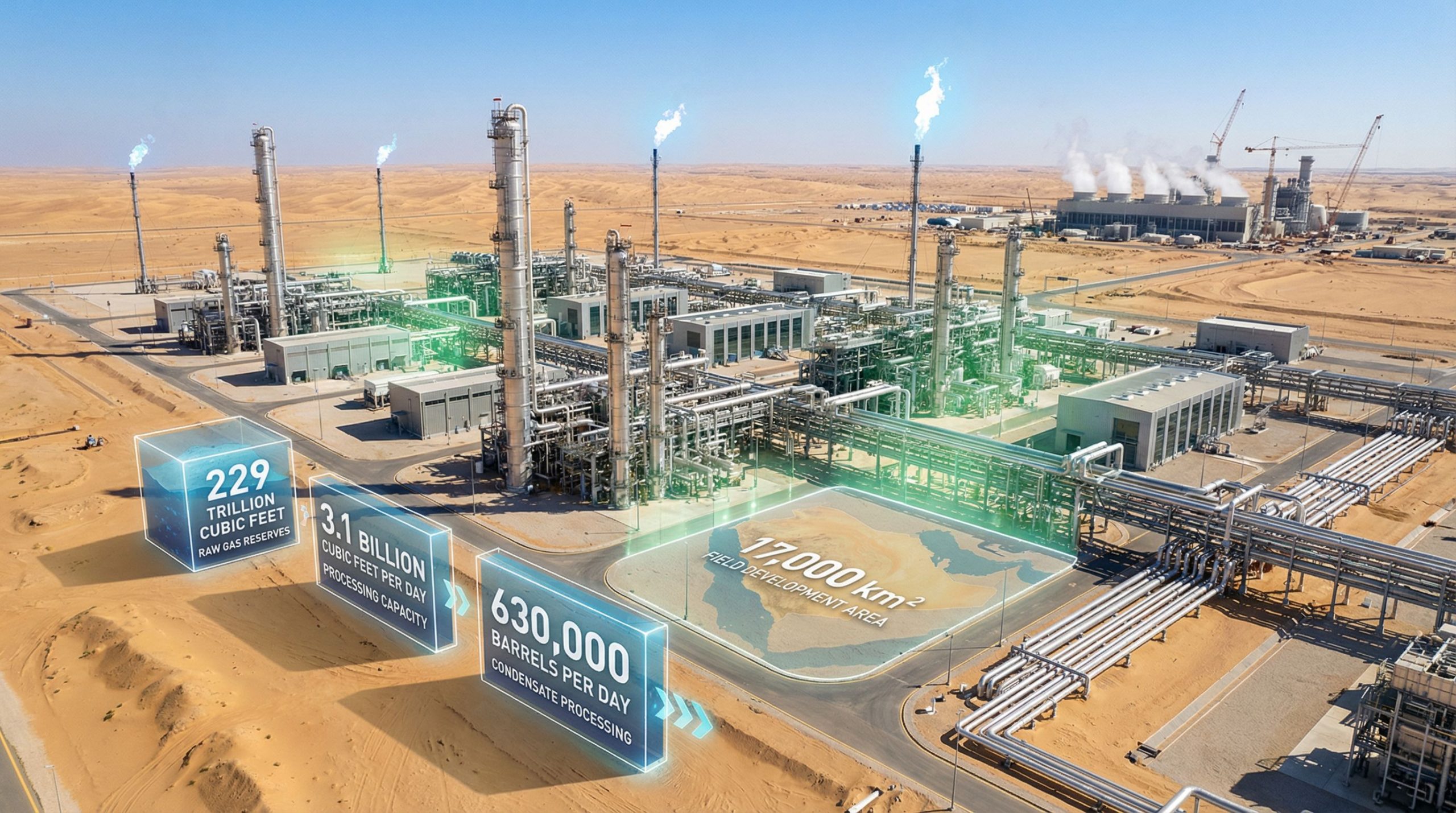
The Eastern Province of Saudi Arabia contains some of the most technically challenging shale formations outside North America, with geological characteristics that distinguish these deposits from conventional gas reservoirs. Aramco's Jafurah gas plant represents the culmination of decades of geological assessment across a 17,000 square kilometer development area, encompassing what industry analysts consider the largest unconventional gas project outside the United States.
The resource base supporting this infrastructure development contains an estimated 229 trillion standard cubic feet of raw gas reserves, according to Saudi Finance Ministry statements reported in December 2025. Furthermore, this resource estimate places Jafurah among the world's largest unconventional gas accumulations, comparable in scale to major North American shale plays like the Marcellus or Permian Basin formations.
Shale Formation Characteristics and Technical Challenges
Unlike conventional gas reservoirs where hydrocarbons flow naturally through porous rock, unconventional shale formations require hydraulic fracturing and horizontal drilling technologies to create artificial permeability. The Jafurah formation presents unique geological challenges distinct from North American equivalents, including:
• Higher hydrogen sulfide concentrations requiring advanced sulfur removal technologies
• Elevated formation pressures demanding specialised wellhead equipment and safety systems
• Complex mineralogy affecting drilling fluid design and completion strategies
• Temperature variations across the extensive development area impacting processing requirements
The geological assessment process for unconventional resources involves sophisticated seismic imaging, core analysis, and pressure testing to determine optimal well spacing and completion designs. Moreover, industry estimates suggest that successful unconventional development requires drilling densities of 4-8 wells per square mile, significantly higher than conventional gas fields.
Comparison with Global Unconventional Gas Developments
International benchmarking reveals that Jafurah's resource density and technical complexity position it among the most challenging unconventional developments globally. While North American shale plays benefit from established service infrastructure and regulatory frameworks developed over two decades, Middle Eastern unconventional projects must overcome additional technical hurdles related to:
• Limited local drilling expertise in horizontal well completion
• Extreme climate conditions affecting equipment performance and worker safety
• Water sourcing challenges for hydraulic fracturing operations
• Environmental monitoring requirements in sensitive regional ecosystems
Consequently, these challenges require innovative approaches that integrate lessons learned from established shale plays with solutions tailored to regional conditions. Saudi exploration licenses demonstrate the Kingdom's strategic approach to addressing these technical complexities through international partnerships and technology transfer agreements.
Processing Technology and Engineering Specifications
The transformation of raw shale gas into commercial products requires processing facilities capable of handling complex hydrocarbon mixtures while removing impurities that would otherwise damage pipeline infrastructure or violate product specifications. Aramco's Jafurah gas plant utilises multi-train processing systems designed to handle 450 million cubic feet per day in its initial phase, with expansion plans targeting 2 billion cubic feet per day by 2030.
Raw Gas Processing and Impurity Removal
The processing sequence begins with inlet separation systems that remove free liquids and solid particles from the raw gas stream. Subsequently, acid gas removal units extract hydrogen sulfide and carbon dioxide using specialised solvents, typically amine-based systems capable of achieving sulfur specifications below 4 parts per million for pipeline-quality gas.
The engineering complexity increases with the integration of multiple processing trains, each designed for optimal efficiency across varying feed compositions. Key processing specifications include:
| Processing Stage | Capacity (Initial Phase) | Technology Application |
|---|---|---|
| Raw Gas Inlet | 450 million cubic feet/day | High-pressure separation |
| Acid Gas Removal | 95%+ H₂S extraction | Amine treatment systems |
| Dehydration | <7 pounds water/million cubic feet | Molecular sieve technology |
| NGL Recovery | Variable based on composition | Turbo-expander systems |
Natural Gas Liquids Extraction and Fractionation
Beyond basic gas processing, the facility incorporates advanced natural gas liquids recovery systems designed to extract valuable ethane, propane, and heavier hydrocarbon components. The ethane recovery optimisation targets 420 million cubic feet per day output, providing critical feedstock for Saudi Arabia's expanding petrochemical industry.
The fractionation process utilises distillation towers operating under precise temperature and pressure conditions to separate individual NGL components. Condensate processing capabilities reaching 630,000 barrels per day add significant value to the overall project economics, as condensate typically commands premium pricing relative to dry natural gas.
Integration with the Riyas NGL fractionation facility creates operational synergies that optimise product recovery across the broader gas processing network. This integration represents a strategic approach to maximising value extraction from unconventional gas streams while minimising transportation costs for intermediate products.
Production Milestones and Capacity Development Timeline
The phased development approach for Jafurah reflects industry best practices for large-scale unconventional gas projects, balancing capital deployment with technical risk management. Phase 1 operations achieved completion in December 2025, with the Saudi Finance Ministry confirming production commencement at 450 million cubic feet per day capacity.
Current Operational Status and Performance Metrics
Aramco CEO Amin Nasser characterised the Phase 1 completion as on schedule during earnings calls in late 2025, describing Jafurah as a central component of the company's natural gas expansion strategy. The initial production phase demonstrates the technical feasibility of processing unconventional gas at commercial scale within the challenging Middle Eastern operating environment.
Current operational parameters include:
• Raw gas processing: 450 million cubic feet per day
• Sales gas production: Targeting 200 million cubic feet per day
• Operating efficiency: Meeting design specifications
• Safety performance: Zero major incidents reported
Full-Scale Development Projections Through 2030
The expansion timeline envisions systematic capacity increases aligned with reservoir development and infrastructure construction schedules. Phase 2 development scheduled for 2027 targets 3.1 billion cubic feet per day raw gas processing capacity, representing nearly a seven-fold increase from current operations.
Production scaling timeline:
2025-2026 Operations:
• Phase 1: 450 million cubic feet per day operational
• Infrastructure optimisation and efficiency improvements
• Workforce training and operational procedures refinement
2027-2028 Expansion:
• Phase 2: 3.1 billion cubic feet per day raw gas capacity
• Sales gas output: 1.2 billion cubic feet per day
• Major infrastructure expansion completion
2029-2030 Full Capacity:
• Ultimate target: 2 billion cubic feet per day sales gas
• Complete integration with national gas network
• Export infrastructure evaluation and development
The 2030 production target of 2 billion cubic feet per day represents approximately 4% of global natural gas trade volumes, positioning Saudi Arabia as a significant player in international gas markets. This production level could displace substantial crude oil volumes currently used for domestic power generation, freeing additional export capacity valued at several billion dollars annually.
Infrastructure Systems and Transportation Networks
Large-scale gas processing operations require extensive supporting infrastructure, from high-pressure pipeline networks to specialised power generation facilities. The Jafurah development incorporates 1,500 kilometres of main transfer pipelines designed to transport raw gas from wellheads to central processing facilities while maintaining optimal pressure and flow characteristics.
Pipeline Network Design and Expansion Plans
The pipeline infrastructure utilises high-strength steel specifications capable of handling the elevated pressures and corrosive gas compositions characteristic of unconventional shale production. Additional 4,000 kilometres of pipeline construction planned through 2028 will connect satellite processing facilities and provide redundancy for critical transportation corridors.
Key infrastructure specifications:
• Main transfer lines: 1,500 kilometres operational
• Expansion network: 4,000 kilometres by 2028
• Operating pressures: Up to 1,440 pounds per square inch
• Corrosion protection: Advanced coating and cathodic protection systems
Gas compression stations positioned at strategic intervals maintain optimal pressure profiles across the extensive pipeline network. These facilities incorporate variable-speed electric drives and backup power systems to ensure continuous operations during peak demand periods or equipment maintenance schedules.
Power Generation and Utility Systems
The 320 MW cogeneration plant provides electrical power and process steam for gas processing operations while demonstrating the integration potential between gas production and power generation. Steam generation capacity of 314 tonnes per hour supports various processing requirements, from acid gas treatment to NGL fractionation operations.
The cogeneration approach optimises overall energy efficiency by capturing waste heat from gas turbines for steam production, reducing overall fuel consumption by approximately 15-20% compared to separate power and steam generation systems. In addition, this efficiency improvement becomes increasingly important as environmental regulations emphasise carbon intensity reductions across industrial operations.
Utility infrastructure components:
• Primary power: 320 MW gas turbine cogeneration
• Steam production: 314 tonnes per hour
• Backup systems: Redundant power and emergency generators
• Environmental controls: Emissions monitoring and abatement
Integration with Saudi Arabia's national gas grid creates opportunities for optimised dispatch based on regional demand patterns and seasonal variations. The connection infrastructure includes pressure regulation stations and emergency isolation capabilities to maintain grid stability during operational transitions or emergency conditions.
Investment Structure and Financial Engineering Innovation
The $100 billion Jafurah project represents one of the largest energy infrastructure investments globally, utilising sophisticated financial structures to optimise capital efficiency and risk allocation. The $11 billion lease-and-leaseback arrangement with Global Infrastructure Partners, a BlackRock subsidiary, demonstrates innovative approaches to infrastructure monetisation while maintaining operational control.
Lease-Leaseback Transaction Mechanics
The financial structure allows Aramco to realise immediate cash proceeds from midstream infrastructure assets while retaining long-term operational flexibility through lease agreements. Global Infrastructure Partners' consortium acquired processing facility assets and immediately leased them back to Aramco under 20-year operational agreements, creating a stable income stream for the infrastructure investors.
Transaction structure highlights:
• Asset sale value: $11 billion
• Lead investor: Global Infrastructure Partners (BlackRock)
• Lease term: 20 years with extension options
• Operational control: Retained by Saudi Aramco
This financing approach provides several strategic advantages for Aramco, including improved balance sheet efficiency, accelerated capital recovery, and risk sharing with experienced infrastructure operators. The transaction structure also demonstrates international institutional investor confidence in Saudi Arabia's long-term energy development plans.
Capital Deployment and Return Expectations
The remaining $89 billion investment requirement involves a combination of Aramco internal funding, project finance debt structures, and potential additional strategic partnerships. The phased development approach allows for capital deployment optimisation based on technical performance validation and market demand evolution.
Investment allocation estimates:
• Processing facilities: $35-40 billion
• Drilling and completion: $30-35 billion
• Pipeline infrastructure: $15-20 billion
• Power and utilities: $8-12 billion
Return projections for the overall project depend on natural gas pricing, production efficiency, and export market development. Industry analysts estimate internal rates of return in the 12-15% range for integrated gas developments of this scale, assuming long-term Henry Hub pricing above $4.00 per million BTU.
However, capital raising strategies for projects of this magnitude require careful consideration of market conditions and investor appetite for long-term energy infrastructure commitments.
Energy Portfolio Transformation and Strategic Impact
Jafurah's development fundamentally alters Saudi Arabia's energy mix by providing domestic natural gas supply that displaces crude oil consumption in power generation and industrial applications. This substitution effect creates significant economic value by freeing premium export crude for international markets rather than domestic consumption at subsidised prices.
Crude Oil Displacement Economics
Saudi Arabia currently consumes approximately 500,000-600,000 barrels per day of crude oil for electricity generation, representing $10-15 billion annually in foregone export revenue at current oil prices. The 2 billion cubic feet per day gas production from Aramco's Jafurah gas plant could displace 300,000-400,000 barrels per day of this domestic crude consumption.
Economic impact calculations:
• Crude displacement: 300,000-400,000 barrels per day
• Annual export value increase: $8-12 billion
• Natural gas supply cost: $2-3 billion annually
• Net economic benefit: $5-9 billion per year
The displacement strategy aligns with Saudi Vision 2030 objectives for economic diversification and energy efficiency improvement. Natural gas combustion for power generation produces 40-50% lower carbon emissions than crude oil burning, supporting environmental sustainability goals alongside economic optimisation.
Furthermore, this development supports broader energy transition security objectives by diversifying the domestic energy portfolio and reducing dependence on a single hydrocarbon source.
Industrial Feedstock and Petrochemical Integration
Beyond power generation applications, Jafurah's ethane production capacity of 420 million cubic feet per day provides critical feedstock for Saudi Arabia's expanding petrochemical industry. Ethane serves as the primary raw material for ethylene production, which forms the basis for plastics, chemicals, and synthetic materials manufacturing.
Petrochemical value chain integration:
• Ethane feedstock: 420 million cubic feet per day
• Ethylene production potential: 1.5-2.0 million tonnes annually
• Downstream products: Polyethylene, chemicals, fertilisers
• Export value creation: $3-5 billion annually
The Saudi Arabian Basic Industries Corporation (SABIC) and other petrochemical manufacturers benefit from secure, competitively priced ethane supplies that reduce dependence on imported feedstock or liquid petroleum gas alternatives. This feedstock security enhances the competitiveness of Saudi petrochemical exports in global markets.
Technical Challenges in Unconventional Gas Development
Shale gas extraction presents unique engineering challenges that differ significantly from conventional reservoir development, particularly in the Middle Eastern geological and climatic environment. Horizontal drilling techniques must navigate complex geological structures while maintaining wellbore integrity across 2-3 kilometre horizontal sections.
Drilling and Completion Technology Requirements
The drilling process begins with vertical sections extending 2,000-3,000 metres before transitioning to horizontal trajectories that follow optimal geological zones. Hydraulic fracturing operations require 8-12 million gallons of water per well along with specialised proppant materials and chemical additives designed for high-temperature, high-pressure conditions.
Technical specifications for Jafurah drilling:
• Average well length: 3,000-5,000 metres total
• Horizontal section: 2,000-3,000 metres
• Fracturing stages: 25-40 per well
• Proppant volumes: 2,000-4,000 tonnes per well
Well spacing optimisation requires careful analysis of reservoir pressure interference and fracture connectivity to maximise recovery while minimising drilling costs. Industry best practices suggest 400-600 metre spacing between parallel horizontal wells, though optimal spacing depends on specific geological characteristics and completion designs.
High H₂S Content Management and Safety Systems
The elevated hydrogen sulfide concentrations in Jafurah gas streams present significant safety and processing challenges requiring specialised equipment and emergency response procedures. H₂S levels exceeding 1,000 parts per million demand continuous monitoring systems and automated shutdown capabilities to protect personnel and equipment.
Safety and processing requirements:
• H₂S monitoring: Continuous real-time detection
• Emergency shutdown: Automated response systems
• Personnel protection: Specialised breathing apparatus
• Corrosion management: Advanced metallurgy and coatings
Sulfur removal technologies utilise amine-based absorption systems operating at elevated temperatures and pressures to achieve pipeline specifications below 4 parts per million H₂S. The recovered sulfur requires additional processing into elemental sulfur products suitable for industrial applications or safe storage.
Environmental monitoring systems track air quality, groundwater protection, and waste stream management to ensure compliance with Saudi environmental regulations and international best practices. Waste stream management involves treatment and disposal of drilling fluids, produced water, and solid waste materials generated during drilling and completion operations.
Global Gas Market Positioning and Strategic Implications
Aramco's Jafurah gas plant's 2030 production target of 2 billion cubic feet per day positions Saudi Arabia among the world's top 10 natural gas producers, fundamentally altering regional and global gas supply dynamics. This production level represents approximately 2.5% of global gas production and creates opportunities for Saudi Arabia to become a significant player in international LNG markets.
Production Capacity in International Context
Current global natural gas production exceeds 400 billion cubic feet per day, with leading producers including the United States (100+ bcf/d), Russia (60+ bcf/d), and Iran (25+ bcf/d). Jafurah's full-scale production would rank Saudi Arabia among countries like Norway, Qatar, and Canada in terms of daily gas output.
Global production comparison:
| Country | Daily Production (bcf/d) | Primary Sources |
|---|---|---|
| United States | 100+ | Shale gas, conventional |
| Russia | 60+ | Conventional fields |
| Iran | 25+ | Conventional, offshore |
| Saudi Arabia (2030) | 15-20* | Conventional + Jafurah |
| Qatar | 18+ | Offshore fields, LNG |
*Including existing production plus Jafurah output
The strategic significance extends beyond production volumes to energy security and economic diversification objectives outlined in Saudi Vision 2030. Domestic gas supply security reduces dependence on energy imports while creating opportunities for value-added processing and export revenue generation.
Export Potential and Regional Market Development
Saudi Arabia's geographic position provides advantageous access to high-value Asian LNG markets through existing shipping infrastructure and emerging pipeline connections. LNG export potential depends on domestic demand growth and infrastructure development for liquefaction and export terminals.
Regional market opportunities:
• Asian LNG markets: Premium pricing potential
• European supply diversification: Strategic partnerships
• Regional pipeline exports: Egypt, Jordan, Iraq
• Petrochemical feedstock: Value-added processing
The development of cross-border pipeline infrastructure could create regional gas trading hubs similar to European models, with Saudi Arabia serving as a central supplier to neighbouring countries seeking to reduce crude oil consumption and improve environmental performance.
Consequently, this positioning aligns with broader market trends analysed in the US natural gas forecast and oil price rally analysis, demonstrating the interconnected nature of global energy markets.
Technology leadership in unconventional gas development positions Saudi Arabia to export technical expertise and project management capabilities to other Middle Eastern and North African countries with similar geological formations. This knowledge transfer creates additional revenue opportunities beyond physical gas sales.
Long-Term Strategic Implications for Saudi Vision 2030
Jafurah's development aligns directly with Saudi Vision 2030 economic diversification goals by creating new industrial sectors, reducing hydrocarbon export dependence, and establishing technological capabilities in advanced energy production. The project demonstrates Saudi Arabia's commitment to becoming a global energy leader across multiple fuel types rather than relying solely on crude oil exports.
Economic Diversification and Industrial Development
The gas processing infrastructure creates multiplier effects throughout the Saudi economy, from specialised equipment manufacturing to advanced technical services and environmental monitoring. Job creation estimates suggest 15,000-20,000 direct positions across drilling, processing, and transportation operations, with additional indirect employment in supporting industries.
Economic impact categories:
• Direct employment: 15,000-20,000 positions
• Indirect jobs: 30,000-50,000 positions
• Industrial development: Equipment manufacturing, services
• Technology transfer: Advanced drilling and processing capabilities
Local content requirements mandate substantial Saudi participation in construction, operations, and maintenance activities, creating opportunities for domestic company development and skills transfer from international partners. These requirements support Vision 2030 localisation objectives while ensuring long-term operational sustainability.
Environmental Sustainability and Carbon Management
The transition from crude oil to natural gas for domestic energy consumption supports carbon intensity reduction goals aligned with Saudi Arabia's net-zero emissions commitments by 2060. Natural gas combustion produces approximately 50% lower carbon emissions than crude oil burning for equivalent energy output.
Environmental benefits:
• Carbon reduction: 40-50% lower emissions than crude oil
• Air quality improvement: Reduced particulate and sulfur emissions
• Energy efficiency: Combined cycle power generation
• Waste heat recovery: Cogeneration applications
Carbon capture and storage research initiatives associated with Jafurah development explore long-term emission reduction technologies that could be applied across Saudi Arabia's energy infrastructure. These technological developments position the Kingdom as a leader in sustainable hydrocarbon production and carbon management solutions.
The integration of renewable energy systems for drilling and processing operations demonstrates commitment to hybrid energy approaches that combine conventional and alternative energy sources for optimal environmental and economic performance. Solar power integration for remote operations and waste heat recovery systems exemplify innovative approaches to energy optimisation.
Furthermore, the Jafurah Gas Plant operations demonstrate how advanced processing technologies can minimise environmental impact while maximising economic value extraction from unconventional resources.
Investment decisions in energy infrastructure projects involve substantial technical, financial, and regulatory risks that may affect project timelines, costs, and returns. Prospective investors should conduct independent due diligence and consult qualified professionals before making investment commitments. Production forecasts and economic projections represent current estimates based on available geological and market data, which may change significantly due to operational experience, regulatory modifications, or market condition variations.
Interested in the Next Major Energy Discovery?
Discovery Alert's proprietary Discovery IQ model delivers real-time alerts on significant ASX mineral discoveries, instantly empowering subscribers to identify actionable opportunities ahead of the broader market. Explore why major mineral discoveries can lead to substantial returns by visiting Discovery Alert's dedicated discoveries page, showcasing historic examples of exceptional outcomes.