
July 20, 2026
Understanding the Geopolitical Risk Premium in Energy Markets
The impact of U.S. and Iran tensions on oil prices has demonstrated how geopolitical risk premiums become the dominant force shaping global energy markets as traditional supply-demand fundamentals increasingly give way to crisis-driven volatility. When strategic chokepoints face disruption threats, oil prices respond with amplification ratios that far exceed the actual physical supply at risk, creating cascading effects throughout interconnected global energy systems.
The Strategic Chokepoint Theory
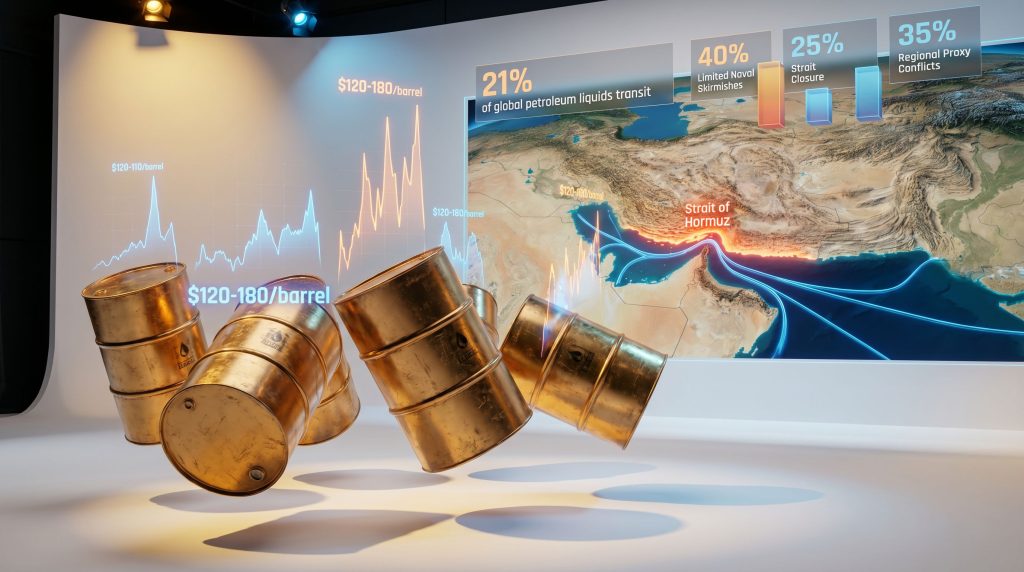
The Strait of Hormuz represents the most critical vulnerability in global petroleum logistics, with approximately one-fifth of world oil flows transiting this narrow waterway daily. Current market conditions demonstrate this vulnerability starkly, as the ongoing oil price rally has surged roughly 50% following the February 28, 2026 U.S. and Israeli military action against Iran, which prompted Iran to close the strategic waterway.
Historical precedents reveal consistent patterns in chokepoint disruption impacts:
• 1980s Iran-Iraq War (1984-1988): The "Tanker War" period saw systematic attacks on commercial vessels, creating sustained price volatility as insurance premiums spiked and alternative routing became necessary
• 2019 Aramco Drone Attacks: September attacks on Saudi facilities temporarily removed 5.7 million barrels per day from global supply, triggering immediate $10-15 per barrel price increases despite rapid production restoration
• Current Iran Crisis: The complete closure of Hormuz has eliminated access to roughly 16-17 million barrels per day of normal transit capacity, creating the most severe chokepoint disruption in modern energy market history
The impact of U.S. and Iran tensions on oil prices operates through multiple transmission mechanisms. Physical supply disruption represents only the immediate trigger, while market psychology amplifies price movements through anticipatory positioning by traders who price in extended disruption scenarios before actual barrel losses materialise.
Market Psychology vs. Physical Supply Disruption
Energy market specialists recognise a fundamental distinction between actual supply loss and risk premium pricing. Robert Rapier's analysis of current market conditions reveals how traders respond to geopolitical threats: prices immediately incorporate risks of prolonged outages, shipping delays, and potential escalation rather than waiting for physical barrel shortfalls to develop.
This anticipatory pricing mechanism creates amplification effects where relatively small supply threats generate disproportionate price responses:
• Immediate Response: Futures markets react within hours of geopolitical developments
• Physical Market Lag: Actual supply adjustments follow with days-to-weeks delays
• Secondary Effects: Options markets create additional volatility through hedging demand
• Behavioural Cascades: Algorithmic trading systems amplify initial price moves through technical signal responses
The current crisis demonstrates these dynamics clearly. Analysis indicates that presidential decisions during geopolitical crises can meaningfully shift global supply through three primary mechanisms: Strategic Petroleum Reserve releases, petrol tax modifications, and Middle East military engagement. The February 2026 Iran attack represents the clearest example of direct presidential policy impact on fuel prices in recent memory, particularly considering the tariff economic implications affecting global markets.
When big ASX news breaks, our subscribers know first
What Economic Mechanisms Amplify Oil Price Shocks During Middle East Tensions?
The Inventory-Price Feedback Loop
Strategic petroleum reserve systems globally contain approximately 1.5 billion barrels, equivalent to roughly 90 days of Middle East export capacity. However, release rates remain constrained to 4-6 million barrels per day maximum, limiting the ability of emergency stockpiles to fully offset major supply disruptions.
Historical Strategic Petroleum Reserve utilisation demonstrates both the potential and limitations of inventory-based market intervention:
| Release Period | Volume Released | Market Impact | Recovery Timeline |
|---|---|---|---|
| 2022 Biden Administration | Hundreds of millions of barrels | Marginal relief during supply shortfall | 6-12 months for market rebalancing |
| Current Crisis Response | Emergency protocols activated | Unable to replace Hormuz throughput | Ongoing evaluation required |
The inventory feedback mechanism operates through commercial stockpile dynamics rather than government reserves alone. When supply disruptions occur, commercial inventories face immediate drawdown pressure as refiners attempt to maintain production rates. This creates secondary price acceleration as available inventory commands premium pricing.
Emergency release protocols typically activate when prices exceed predetermined thresholds, though specific trigger mechanisms vary by country and remain confidential for strategic reasons. The effectiveness of such releases depends heavily on crude oil type compatibility with existing refinery infrastructure.
Refinery Configuration Constraints
Refinery processing limitations create structural bottlenecks during supply crises that extend far beyond simple volume replacement. U.S. Gulf Coast refineries exemplify this challenge, being specifically configured for heavy, high-sulfur crude oil processing. When Russian heavy crude supplies faced embargo restrictions, refiners struggled to process lighter, sweeter crude alternatives efficiently.
Heavy vs. Light Crude Processing Constraints:
• Heavy Crude Requirements: Lower API gravity oils require specialised processing equipment including coking units and hydrocracking capabilities
• Light Crude Limitations: Refineries optimised for heavy crude cannot efficiently process light crude without operational modifications
• Product Mix Disruption: Crude type substitution creates diesel-petrol crack spread explosions as product yields shift
The diesel imbalance phenomenon represents a critical vulnerability in refined product markets. When refineries receive inappropriate crude types, diesel production suffers disproportionately, creating supply shortages in transportation fuel markets that cascade through logistics networks globally.
These constraints mean that crude oil availability alone cannot resolve supply disruptions. Refinery infrastructure must match crude characteristics, creating geographic and technical bottlenecks that persist regardless of alternative supply source development. Furthermore, the broader US economy and tariffs create additional complexity in managing supply chain adjustments during crisis periods.
How Do Different Conflict Scenarios Shape Oil Market Outcomes?
Strategic scenario modelling reveals distinct probability-weighted pathways for U.S.-Iran tension resolution, each carrying different implications for global energy markets:
Scenario 1: Limited Naval Skirmishes (Probability: 40%)
| Parameter | Range | Key Characteristics |
|---|---|---|
| Duration | 2-6 weeks | Intermittent shipping delays, elevated insurance premiums |
| Price Impact | $85-110/barrel | Regional supply rerouting, 5-10% global flow disruption |
| Recovery Timeline | 3-6 months | Diplomatic intervention, alternative route utilisation |
This scenario assumes periodic confrontations without complete chokepoint closure. Insurance markets would drive significant cost increases for tanker transit, while shipping companies develop alternative routing through longer Red Sea and Suez Canal pathways.
Scenario 2: Complete Strait of Hormuz Closure (Probability: 25%)
| Parameter | Range | Key Characteristics |
|---|---|---|
| Duration | 1-6 months | Total chokepoint blockade, maximum SPR releases |
| Price Impact | $120-180/barrel | 20% global supply loss, emergency rationing protocols |
| Recovery Timeline | 12-24 months | Military intervention required, infrastructure reconstruction |
Complete closure represents the most severe scenario, requiring coordinated international response including military escort operations and massive strategic reserve deployments. Current market conditions suggest movement toward this scenario given Iran's retaliatory closure following the February 28 attack.
Scenario 3: Extended Proxy Conflict (Probability: 35%)
| Parameter | Range | Key Characteristics |
|---|---|---|
| Duration | 6-18 months | Asymmetric infrastructure attacks, persistent uncertainty |
| Price Impact | $95-140/barrel | Chronic risk premium, regional investment freeze |
| Recovery Timeline | 2-5 years | Comprehensive security framework, infrastructure hardening |
This pathway involves sustained low-intensity conflict with periodic infrastructure targeting, creating persistent market uncertainty that prevents normal investment and operational patterns from resuming. The relationship with US policy on Venezuela becomes particularly relevant in this scenario as alternative supply sources gain strategic importance.
Which Global Regions Face the Greatest Economic Vulnerability?
Import-Dependent Economies Under Stress
Energy import dependency creates asymmetric vulnerability patterns across global regions. Asian economies face particularly acute exposure due to their heavy reliance on Middle Eastern crude oil supplies:
Regional Vulnerability Assessment:
• Japan: 80%+ Middle East dependency, limited strategic reserves relative to consumption
• South Korea: Similar dependency profile with concentrated refining capacity
• India: Rapidly growing energy demand amplifies import vulnerability
• European Union: Faces exposure through refined product import channels despite crude diversification efforts
China presents a unique case, maintaining substantial strategic reserves whilst experiencing continued industrial demand growth. Chinese stockpiling policies during crisis periods can amplify global supply tightness as state-controlled entities compete for available crude.
Energy-Intensive Industries at Risk
Aviation sector vulnerability operates through jet fuel price elasticity mechanisms. Route profitability calculations become unstable when fuel costs exceed 30-40% of operational expenses, forcing carriers to suspend marginal routes and reduce capacity.
Petrochemical manufacturing faces feedstock cost pass-through challenges. When crude oil and natural gas prices spike simultaneously, petrochemical producers cannot immediately adjust pricing for downstream products, creating margin compression throughout chemical supply chains.
Transportation logistics systems experience cascading impacts through diesel price volatility. Trucking, maritime shipping, and rail transport all face immediate cost pressures that ripple through global supply chains within weeks of crude price spikes. Additionally, oil market trade impacts create secondary effects across international commerce.
What Alternative Supply Sources Can Offset Middle East Disruptions?
U.S. Shale Production Surge Capacity
American tight oil production theoretically possesses the capability to increase output by 1.5-2 million barrels per day within 6-12 months during sustained high-price periods. However, this surge capacity faces significant practical constraints:
Infrastructure Bottlenecks:
• Pipeline capacity limitations from Permian Basin to refining centres
• Takeaway capacity constraints during rapid production increases
• Port facility limitations for export market access
Capital Allocation Constraints:
• Producer focus on shareholder returns over growth
• Service sector capacity limitations during rapid drilling increases
• Supply chain bottlenecks for critical drilling and completion materials
Current market dynamics suggest that U.S. shale responsiveness has decreased compared to previous cycles, as operators prioritise capital discipline over opportunistic production increases. Moreover, the Iran conflicts' energy shocks are becoming increasingly apparent in global markets.
Strategic Reserve Coordination Mechanisms
International Energy Agency emergency response protocols provide the framework for coordinated strategic reserve releases during major supply disruptions. These mechanisms include:
• Multilateral Release Agreements: Synchronised drawdowns across major consuming nations
• Bilateral Coordination: Direct supply sharing between allied nations
• Commercial Inventory Incentives: Policy measures encouraging private sector stockpile releases
However, the effectiveness of these mechanisms during the current crisis remains constrained by the absolute scale of Hormuz-related supply loss, which exceeds historical precedents for coordinated response capacity. Furthermore, research indicates that oil prices could reach $200 per barrel if tensions escalate significantly.
Non-OPEC Production Flexibility
Brazilian pre-salt offshore production offers medium-term supply enhancement potential, though technical complexity and environmental factors limit rapid output increases. Current production optimisation efforts could yield additional 500,000-800,000 barrels per day over 12-18 months.
Norwegian North Sea capacity provides some spare production capability, particularly from mature fields with established infrastructure. However, production increases face technical limitations and seasonal weather constraints.
Canadian oil sands optimisation during price spikes can enhance output from existing facilities, though environmental regulations and transportation bottlenecks limit rapid expansion potential.
How Do Financial Markets Amplify or Dampen Oil Price Volatility?
Commodity Trading Fund Positioning
Managed money positioning in oil futures markets creates pro-cyclical volatility during geopolitical crises. Current market structure shows:
• Long Position Concentration: Speculative funds increase bullish positions during crisis periods
• Algorithmic Response Systems: Automated trading amplifies initial price moves through technical signal triggers
• Options Market Dynamics: Volatility premiums spike as hedging demand increases dramatically
The financialisation of oil markets means that price discovery increasingly occurs through paper markets rather than physical supply-demand balance, creating potential for extended periods of disconnection between futures prices and underlying fundamentals.
Currency and Credit Market Interactions
Dollar strength during crisis periods creates additional pressure on oil-importing emerging market economies. As oil prices rise in dollar terms, countries with weakening currencies face double impacts through both higher commodity costs and exchange rate deterioration.
Credit Market Implications:
• Reduced capital availability for energy infrastructure investment during uncertainty
• Sovereign debt stress in oil-importing developing nations
• Banking sector exposure through energy sector lending portfolios
These interactions create feedback loops where financial market stress amplifies physical energy market disruptions, potentially extending recovery periods beyond the resolution of underlying geopolitical conflicts.
The next major ASX story will hit our subscribers first
What Long-Term Structural Changes Result from Persistent Tensions?
Energy Security Investment Acceleration
Persistent geopolitical volatility drives structural shifts in energy system investment priorities:
Renewable Energy Deployment receives additional impetus as a geopolitical hedge rather than solely environmental policy. Countries recognise energy independence benefits from domestic renewable resources that cannot face foreign supply disruption.
Strategic Reserve Expansion programmes emerge across major consuming economies. Current reserve adequacy calculations prove insufficient for extended Middle East supply disruptions, driving investment in larger stockpile capacity.
Domestic Production Incentives in import-dependent regions gain political support despite higher costs compared to traditional import sources. Energy security considerations increasingly outweigh pure economic optimisation.
Supply Chain Diversification Imperatives
Alternative Shipping Route Development becomes strategically critical. Arctic shipping routes, despite seasonal limitations and environmental concerns, receive increased attention as Hormuz alternatives.
Regional Refining Capacity Expansion reduces import dependence on refined products. Countries previously reliant on Middle Eastern refining output invest in domestic processing capability to reduce vulnerability.
Technology Investment in energy efficiency and substitution accelerates as high prices create economic incentives for demand reduction technologies across transportation and industrial sectors.
How Should Investors and Policymakers Prepare for Extended Volatility?
Portfolio Risk Management Strategies
Energy Sector Exposure Optimisation during prolonged uncertainty requires sophisticated approach balancing upside potential against operational risks for energy companies facing supply chain disruption.
Currency Hedging Strategies become essential for oil-importing economy investments. Exchange rate volatility amplifies energy price impacts, requiring active currency risk management.
Infrastructure Resilience Investments in alternative energy systems offer both portfolio diversification and inflation hedging characteristics during energy price volatility periods.
Policy Response Framework Development
Emergency Fuel Allocation Protocols for critical sectors require advance preparation. Healthcare, emergency services, and food distribution systems need guaranteed fuel access during severe shortage periods.
International Cooperation Mechanisms for crisis response need strengthening beyond current IEA frameworks. Bilateral and multilateral agreements should address extended disruption scenarios exceeding current response capacity.
Long-term Energy Independence Pathway Planning must balance security objectives with economic efficiency. Transition timelines and investment priorities require careful calibration to avoid economic disruption whilst achieving security goals. The impact of U.S. and Iran tensions on oil prices will likely continue shaping these strategic decisions for years to come.
Frequently Asked Questions
How quickly do oil prices typically respond to Middle East tensions?
Oil futures markets demonstrate immediate response capacity to geopolitical developments, with significant price movements occurring within hours of major events. Physical market impacts follow with typical lags of days to weeks as shipping routes adjust and inventory positions shift throughout the supply chain. However, the impact of U.S. and Iran tensions on oil prices has proven particularly severe due to the strategic importance of the Strait of Hormuz.
Can strategic petroleum reserves fully offset Middle East supply disruptions?
Global strategic reserves contain approximately 1.5 billion barrels, representing roughly 90 days of Middle East export equivalent. However, release rates face technical limitations of 4-6 million barrels per day maximum, insufficient to fully replace Hormuz throughput during complete closure scenarios.
What historical precedents exist for current U.S.-Iran tension impacts?
The 1980s Iran-Iraq War, 1990-91 Gulf War, and 2019 Aramco attacks provide analytical frameworks. However, current global oil market structure, strategic reserve systems, and alternative supply sources differ significantly from historical periods, requiring careful adaptation of lessons learned.
How do refinery constraints amplify supply disruption impacts?
Refinery configuration for specific crude types creates bottlenecks beyond simple volume replacement. Gulf Coast facilities designed for heavy crude cannot efficiently process lighter alternatives, creating product mix disruptions and diesel shortages even when crude oil remains available.
Disclaimer: This analysis involves forecasts and speculation about future market conditions during geopolitical crises. Oil market dynamics are highly complex and subject to rapid change based on diplomatic, military, and economic developments. Investors should conduct independent research and consider professional advice before making investment decisions based on geopolitical scenario analysis.
Looking for Investment Opportunities in Energy Market Volatility?
Discovery Alert's proprietary Discovery IQ model delivers real-time alerts on significant ASX mineral discoveries, enabling subscribers to identify actionable opportunities across energy and resources sectors before they hit mainstream investor attention. With geopolitical tensions creating unprecedented energy market volatility, begin your 14-day free trial today to position yourself ahead of the market and capitalise on the next wave of resource discoveries.