
August 4, 2026
The Structural Paradox at the Heart of African Oil Economies
Across Sub-Saharan Africa, a quiet contradiction shapes the economics of oil-producing nations: countries that extract crude from their own territorial waters often find themselves spending hard-earned foreign currency to buy back that same oil for domestic use. This is not a simple inefficiency. It is a deeply embedded structural feature of how global commodity markets were designed, and why breaking free from it requires more than political will.
Ghana's current policy debate over whether domestic refineries should pay for locally produced crude in cedis rather than U.S. dollars cuts directly to this systemic issue. Understanding why Ghana cedi payments for local crude are both logical and legally complex requires unpacking how dollar dependency became so entrenched in the first place, and what it would truly take to dismantle it.
When big ASX news breaks, our subscribers know first
Why Oil Producers Pay for Their Own Crude in Dollars
The global crude oil market has operated on a dollar-denominated pricing standard since the post-World War II Bretton Woods era. Even today, with the global financial architecture significantly evolved, Brent crude, West Texas Intermediate, and virtually every internationally traded crude benchmark are quoted exclusively in U.S. dollars. This convention persists regardless of where the oil is extracted, who refines it, or what currency the end consumer pays in.
For Ghana, this creates an economically counterintuitive cycle. The country produces crude oil from offshore fields including the Jubilee field, exports a portion of that production, earns dollars from those exports, and then spends dollars again to purchase domestically allocated crude for refining. The Tema Oil Refinery processes that crude into petroleum products that are sold in cedis to Ghanaian consumers.
At every point in the domestic portion of this chain, the underlying economic activity is local. Yet the pricing convention insists on a foreign currency intermediary at the procurement stage. This dynamic reflects a broader pattern in which trust in the U.S. dollar as the default settlement currency continues to shape commodity trade — even where no cross-border exchange of value actually occurs.
Production-sharing agreements with international oil companies compound the problem. When a consortium of international operators develops Ghana's offshore reserves, their contractual invoicing occurs in dollars. This structure was not designed to disadvantage Ghana; it reflects the universal language of global oil commerce. However, its downstream effect is that even the government's allocated share of crude, destined entirely for domestic consumption, carries a dollar price tag.
Ghana's Foreign Exchange Crisis and the Energy Sector's Role
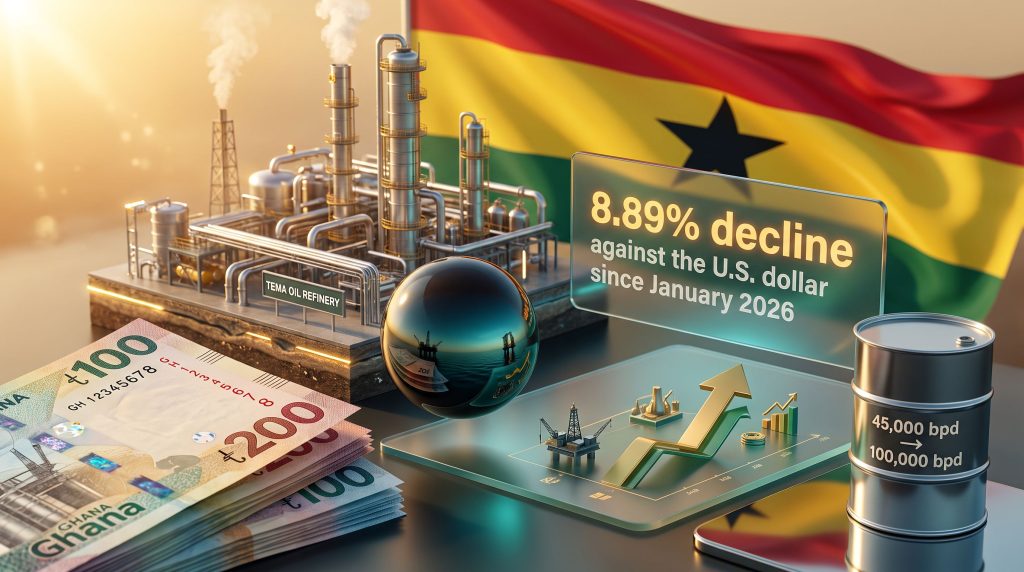
The cedi has lost approximately 8.89% of its value against the U.S. dollar since January 2026, according to reporting by YEN.com.gh. While multiple macroeconomic factors contribute to currency depreciation in developing economies, Ghana's energy sector has been specifically identified as one of the primary structural drivers of dollar demand.
The numbers are striking. In June 2026 alone, the Bank of Ghana injected $2.01 billion into the foreign exchange market to defend the cedi, according to JoyBusiness. This level of intervention signals not a temporary market dislocation but a persistent structural imbalance where dollar demand consistently exceeds available supply.
Energy sector participants are buying dollars for two primary purposes:
- Crude oil procurement for domestic refining operations
- Fuel inputs for electricity generation
Both of these activities are fundamentally domestic in nature. The electricity powers Ghanaian homes and businesses. The refined fuel is sold to Ghanaian motorists and industries. The dollar demand they generate serves no productive economic purpose for Ghana; it is purely a function of the pricing conventions embedded in existing legislation and international contracts.
The deeper issue is that Ghana simultaneously earns foreign exchange from crude oil exports and spends foreign exchange buying crude for domestic refining. Addressing this circular dollar drain is precisely what the proposed reform targets.
The Ghana Cedi Payments for Local Crude Proposal Explained
President John Dramani Mahama directed Energy Minister John Jinapor to conduct a formal review of Ghana's legal requirements governing crude payment mechanisms, with specific attention to whether domestic refineries can legally settle transactions in cedis rather than dollars. The directive emerged from a high-level meeting that included both the Governor of the Bank of Ghana and the Finance Minister, signalling that this is being treated as a cross-institutional economic priority rather than a narrow energy sector matter.
The economic logic articulated at the presidential level is straightforward: a refinery that purchases crude oil, processes it into petroleum products, and sells those products to local consumers in cedis is operating an entirely domestic value chain. Furthermore, the requirement to convert cedis into dollars at the procurement stage introduces a currency risk and transaction cost that benefits no party within Ghana.
The Bank of Ghana's governor endorsed the economic rationale of the proposal, noting that purchasing dollars to pay for domestically produced crude generates unnecessary pressure on the national currency and inflates operational costs across the supply chain.
The Refineries at the Centre of the Debate
Two facilities sit at the operational heart of this policy discussion:
| Refinery | Current Capacity | Post-Expansion Target | Status |
|---|---|---|---|
| Tema Oil Refinery (TOR) | 45,000 barrels/day | 100,000 barrels/day | Active, expanding |
| Sentuo Oil Refinery | Not publicly disclosed | Expansion underway | Active |
Together, TOR and Sentuo are projected to satisfy approximately 70% of Ghana's domestic demand for refined petroleum products once their respective capacity expansions are complete, according to Energy Minister Jinapor's remarks at the Ghana International Petroleum Conference 2026 in July.
TOR has already demonstrated renewed operational momentum. Since May 2026, the refinery has received three cargo deliveries of one million barrels each of Bonga, Baleine, and Jubilee crude, with two million barrels already processed. At the planned expansion capacity of 100,000 barrels per day, the dollar cost of crude procurement would roughly double compared to current levels, making the cedi payment reform proportionally more impactful as capacity grows.
How the Payment Mechanism Would Change in Practice
| Step | Current Mechanism | Proposed Alternative |
|---|---|---|
| Crude sourcing | TOR/Sentuo buy domestically produced crude | Same crude purchased from same sources |
| Currency conversion | Refineries acquire USD on the forex market | No USD conversion required for domestic crude |
| Revenue cycle | Fuel sold in cedis, USD needed upstream | Full cedi-denominated domestic value chain |
| Forex market impact | Ongoing structural dollar demand from energy sector | Reduced pressure on Bank of Ghana reserves |
Legal and Contractual Obstacles That Must Be Resolved
The reform's economic logic is compelling. Its legal pathway is, however, considerably more complex.
Ghana's Petroleum Revenue Management Act (PRMA) and the Petroleum Holding Fund legislation both currently require that crude oil payments be denominated in foreign currency. This framework was not arbitrary. It was deliberately designed to protect the real value of petroleum revenue flows, ensuring that receipts from Ghana's hydrocarbon resources are held in currencies that maintain purchasing power on international markets. Any amendment must preserve this protective function.
Energy sector analysts have indicated that transitioning to cedi-based crude payments would require a formal amendment to the PRMA, a process that involves parliamentary debate, legislative drafting, stakeholder consultation, and eventual vote. This is a multi-stage process with no guaranteed timeline.
Policy Complexity: This reform is not simply a preference for one currency over another. It requires simultaneously reconciling domestic fiscal law, international commercial contracts, and central bank monetary policy within a single coherent framework.
The second obstacle is equally substantive. Crude oil produced from Ghana's offshore fields, including the Jubilee field, is invoiced in U.S. dollars by international operators under existing production-sharing and joint venture agreements. These contracts cannot be unilaterally altered by Ghana's domestic policy decisions. Any workable framework must therefore either:
- Ring-fence the government's domestically allocated crude from export-priced barrels and create a separate cedi settlement mechanism for that portion
- Establish a government intermediary structure that absorbs the currency conversion function at the sovereign level rather than passing it to refineries
- Negotiate transfer pricing adjustments with international oil company partners that effectively allow cedi settlement without breaching existing contractual terms
None of these approaches is without operational complexity, and each carries its own fiscal risk profile.
Ghana's Gold-for-Oil Precedent and What It Teaches
Ghana's interest in reducing dollar dependency in its energy sector is not new. The gold-for-oil barter programme, implemented in a previous policy cycle, attempted to substitute gold exports for USD payments in fuel import transactions. The initiative demonstrated that non-dollar energy procurement at a sovereign level is operationally feasible, but it also produced important cautionary lessons.
The programme encountered implementation disruptions, required significant coordination across multiple government agencies and commodity trading entities, and experienced policy reversals that undermined its long-term effectiveness. For the cedi crude payment proposal, these precedents argue strongly for a more thoroughly institutionalised design: one with clear legal foundations, defined accounting treatment, and contractually secure relationships with international counterparties from the outset.
The theoretical case for de-dollarising domestic energy transactions rests on a principle that resource economists have long articulated: when a commodity is produced, refined, and consumed entirely within a single national economy, dollar-denominated pricing introduces an artificial currency risk that serves no domestic economic interest. The conversion costs and exchange rate exposure are pure economic friction, redistributing value away from domestic actors without adding productive utility.
This debate also reflects a wider global monetary shift underway, in which resource-rich nations are reassessing the role of the dollar in commodity settlement frameworks that were originally structured around a different geopolitical and financial reality.
The next major ASX story will hit our subscribers first
Comparative Context: How Other Resource Economies Have Approached This Challenge
Ghana is not alone in confronting this structural issue. Several resource-rich developing economies have experimented with local-currency commodity settlement frameworks, with varying degrees of success. The role of gold in the monetary system and the emergence of alternative settlement mechanisms have, furthermore, provided an expanding reference set for policymakers considering de-dollarisation strategies.
The critical design variables that determine outcomes include:
- Currency stability: Whether the local currency is sufficiently stable to make local-currency pricing commercially viable for international counterparties
- Counterparty acceptance: Whether international oil producers and traders are willing to hold or convert local currency receipts without excessive hedging costs
- Hedging instrument availability: Whether sufficient financial market infrastructure exists to allow parties to manage local-currency price risk efficiently
- Institutional capacity: Whether the central bank and finance ministry have the operational capacity to administer a parallel settlement framework
Ghana's position on these variables is mixed. The cedi's recent depreciation trajectory of 8.89% year-to-date complicates the commercial viability argument, as international counterparties may demand currency risk compensation that offsets the transaction cost savings. At the same time, the depreciation itself strengthens the urgency argument: the current arrangement is actively accelerating the cedi's decline, creating a compounding problem that inaction will worsen.
Economic Implications If the Reform Succeeds
A successfully implemented cedi payment framework for Ghana cedi payments for local crude would generate economic effects across several dimensions:
Exchange rate stability: Reducing structural dollar demand from the energy sector would lower the frequency and scale of Bank of Ghana market interventions. This does not eliminate broader current account pressures or foreign-currency debt service obligations, but it removes one persistent and quantifiable source of demand that currently operates as a floor on cedi depreciation pressure.
Refinery economics: TOR and Sentuo operating with a cedi-denominated input cost for crude would face significantly reduced exposure to exchange rate volatility in their production economics. This could translate into more stable ex-refinery fuel prices and fewer cycles of retail pump price increases driven by currency movements rather than underlying commodity market shifts.
Petroleum revenue architecture: A well-designed reform could functionally separate two distinct activities currently conflated within the PRMA framework. Export revenue collection, where maintaining hard currency denomination makes fiscal sense, can remain dollar-denominated. Domestic procurement, where the entire economic activity occurs within Ghana, can operate in cedis. This separation preserves the fiscal protection rationale of the PRMA while eliminating the domestic inefficiency.
TOR's Expansion and Why Governance Reform Matters Equally
President Mahama's concurrent pledge to restructure TOR alongside the capacity expansion to 100,000 barrels per day adds an important institutional dimension to the policy picture. A refinery that operates with strong governance standards, transparent accounting, and insulation from political interference presents a materially different risk profile than one subject to operational interference.
For the cedi payment framework to function effectively, TOR must be a credible commercial counterparty. Its creditworthiness, its operational reporting standards, and its ability to maintain consistent throughput all affect whether the cedi settlement mechanism can function without generating new fiscal risks for the government.
The combination of capacity expansion and institutional reform is, consequently, not coincidental. It reflects a recognition that the commercial viability of cedi crude payments is partly dependent on the operational quality of the refineries that would operate within that framework. These considerations connect directly to the broader global trade tensions that are prompting resource-rich nations to revisit the structural arrangements underpinning their commodity economies.
Frequently Asked Questions: Ghana Cedi Payments for Local Crude
Why does Ghana currently pay for its own crude oil in U.S. dollars?
Ghana's Petroleum Revenue Management Act and Petroleum Holding Fund legislation both require crude oil transactions to be settled in foreign currency. This framework was designed to protect the real value of petroleum revenues and align with international oil market conventions, where crude is universally priced in USD regardless of origin.
What would change under the proposed cedi payment system?
Domestic refineries including TOR and Sentuo would pay for locally produced crude in cedis rather than first purchasing U.S. dollars. The full domestic petroleum value chain from crude procurement through to refined product sales would operate in local currency, eliminating the artificial foreign exchange conversion step.
Does implementing this reform require changes to Ghana's laws?
Yes. Energy sector analysts have assessed that cedi-based crude payments would require a formal amendment to the Petroleum Revenue Management Act, which currently mandates foreign currency settlement. This is a parliamentary legislative process requiring formal debate, drafting, and approval.
How much has the cedi depreciated in 2026?
The cedi has lost approximately 8.89% of its value against the U.S. dollar between January and early August 2026, with energy sector dollar demand identified as one of the primary structural drivers of that depreciation.
What is the connection between this proposal and Ghana's gold-for-oil programme?
Both initiatives reflect Ghana's broader strategic interest in reducing dollar dependency within its energy economy. The gold-for-oil programme substituted gold for USD in fuel import settlements, while the cedi crude payment proposal would substitute local currency for USD in domestic crude procurement. The earlier programme provides both proof of concept and cautionary lessons about implementation complexity. In addition, the experience with oil trading under sanctions in other national contexts has demonstrated that alternative settlement mechanisms, while complex, are operationally achievable.
When is a decision expected?
As of August 2026, the proposal remains in a review and consultation phase. The Finance Ministry, Bank of Ghana, and Ministry of Energy are expected to convene discussions to develop a viable alternative payment framework before any legislative amendment is formally proposed to parliament.
Three Conditions That Will Determine Whether the Reform Succeeds
For Ghana's cedi crude payment reform to move from policy concept to operational reality, three conditions must be met concurrently:
- Legislative amendment: A successfully passed revision to the PRMA that creates a legally secure pathway for cedi-denominated domestic crude procurement while preserving the fiscal protection rationale of the existing framework
- Contractual resolution: A negotiated arrangement with international oil producers operating in Ghana's offshore fields that accommodates local-currency settlement for domestically allocated crude without breaching the dollar-denominated terms of existing joint venture and production-sharing agreements
- Monetary credibility: Sufficient cedi stability and adequate Bank of Ghana institutional capacity to make local-currency crude pricing commercially viable and operationally sustainable for all parties in the settlement chain
Ghana's proposal does not exist in isolation. It is part of a wider continental conversation about whether African oil producers can structurally reduce the dollar dependency that amplifies their economic vulnerability to exchange rate volatility. If the legal and commercial review process produces a workable framework, it could serve as a replicable model for other Sub-Saharan African oil producers navigating the same structural contradiction. The outcome will be closely watched across the region.
This article contains forward-looking analysis based on publicly available information as of August 2026. Policy outcomes, legislative timelines, and economic projections involve inherent uncertainty and should not be construed as investment advice or predictions of specific government action.
Want to Stay Ahead of the Next Major Mineral Discovery on the ASX?
While Ghana's structural oil economy debate highlights the complexity of commodity markets, significant mineral discoveries on the ASX can move just as swiftly — and Discovery Alert's proprietary Discovery IQ model delivers real-time alerts the moment a major discovery is announced, turning complex data across 30+ commodities into clear, actionable insights. Explore Discovery Alert's dedicated discoveries page to understand how historic ASX discoveries have generated substantial returns, and begin your 14-day free trial today to position yourself ahead of the broader market.