June 2, 2026
How Did Global Copper Market Dynamics Drive Record Mining Profits in 2025?
The global copper market experienced an extraordinary transformation during 2025, creating unprecedented value generation opportunities that fundamentally reshaped mining economics across the sector. The Antofagasta profit increase on copper prices represents a pivotal example of how structural shifts in commodity markets can generate exceptional returns for well-positioned operators. This transformation reflects deeper industrial realignments as electrification initiatives accelerate worldwide and traditional supply chains face mounting constraints.
The convergence of accelerating energy transition demands with constrained supply capacity created market conditions that enabled exceptional profitability across copper mining operations. Major producers capitalised on this environment through operational excellence and strategic positioning, with some achieving margins that exceed historical precedents by substantial margins.
Understanding the Copper Price Surge Behind Mining Windfall Gains
The copper pricing environment in 2025 reflected fundamental supply-demand imbalances that had been building for several years. Energy transition initiatives across major economies created unprecedented demand for copper-intensive infrastructure, while new mine development failed to keep pace with consumption growth.
Mining companies that maintained low-cost positions benefited dramatically from this pricing environment. The combination of higher realised prices and operational efficiency improvements created powerful leverage effects, where incremental revenue flowed almost entirely to operating profit due to the relatively fixed cost structure of large-scale mining operations.
Furthermore, understanding global copper supply dynamics reveals how supply constraints contributed to the exceptional pricing environment that enabled record profitability across the sector.
Key Market Drivers:
• Global renewable energy installations requiring copper-intensive transmission infrastructure
• Electric vehicle production exceeding forecasted penetration rates across major automotive markets
• Grid modernisation projects creating sustained industrial demand patterns
• Data centre proliferation driving specialised copper alloy requirements
What Macroeconomic Forces Created the Perfect Storm for Copper Miners?
The exceptional profit performance achieved by copper miners during 2025 reflects the intersection of multiple macroeconomic trends that created sustained price appreciation throughout the year. These forces operated simultaneously across different time horizons, from immediate supply disruptions to long-term structural demand growth.
Energy Transition Investment Cycles
The accelerating pace of renewable energy deployment created substantial incremental copper demand that existing supply capacity struggled to satisfy. Wind turbine installations, solar panel manufacturing, and battery production facilities all require significant copper inputs, creating demand patterns that differ markedly from traditional industrial consumption cycles.
Transportation electrification added another layer of demand growth, with electric vehicle production requiring approximately four times the copper content of conventional vehicles. This transition occurred faster than many forecasting models anticipated, creating supply shortfalls that contributed to price appreciation.
Consequently, copper-uranium investments have gained particular attention as investors seek exposure to metals critical for energy transition infrastructure.
Supply-Side Constraints and Market Tightening
Simultaneously, copper supply capacity faced multiple constraints that limited the industry's ability to respond to accelerating demand. New mine development timelines typically span 10-15 years from discovery through production, meaning that supply responses to current demand conditions will not materialise until the early 2030s at the earliest.
Existing mining operations also confronted declining ore grades at many facilities, requiring higher processing costs to maintain production volumes. These structural challenges created a supply-constrained environment that enabled price appreciation throughout 2025.
When big ASX news breaks, our subscribers know first
How Do Record EBITDA Margins Reflect Operational Excellence in Volatile Markets?
The achievement of record EBITDA margins during 2025 demonstrates how operational excellence can amplify the benefits of favourable commodity pricing environments. Mining companies that successfully optimised their cost structures while maintaining production efficiency captured the maximum value from elevated copper prices.
Analysing Peak EBITDA Performance
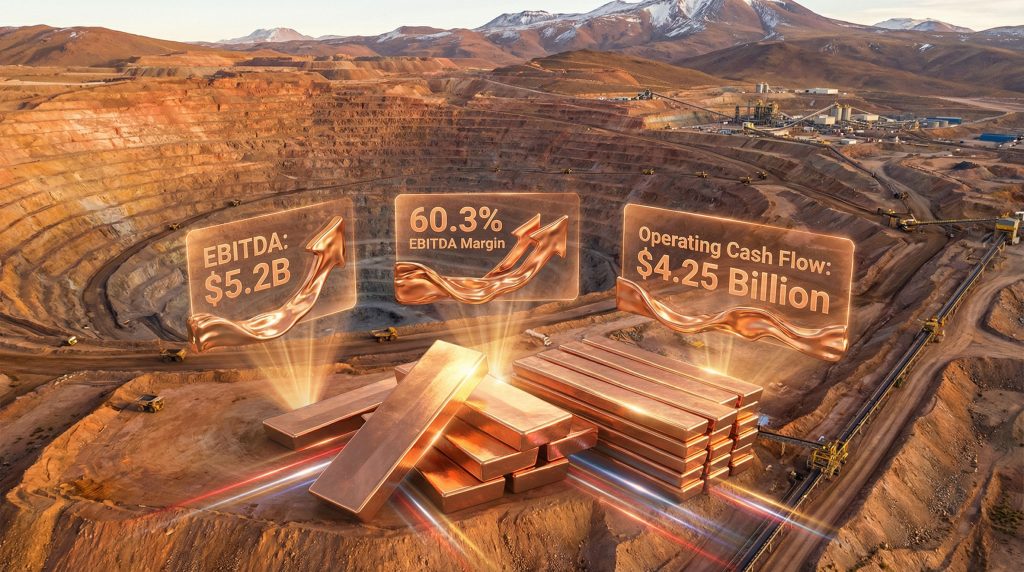
The copper mining sector achieved unprecedented profitability during 2025, with leading producers demonstrating that exceptional margins are achievable through disciplined operational management. The Antofagasta profit increase on copper prices exemplified this trend, with the company achieving a 60.3% EBITDA margin that represents a substantial improvement from previous years.
Table: EBITDA Performance Analysis
| Performance Metric | 2024 | 2025 | Improvement |
|---|---|---|---|
| EBITDA Value | $3.43B | $5.2B | +52% |
| EBITDA Margin | 51.8% | 60.3% | +8.5pp |
| Revenue Generation | $6.63B | $8.62B | +30% |
| Cost Optimisation | – | 27% reduction | Significant |
Cost Management Excellence During Price Volatility
The achievement of record margins during a period of significant price appreciation required sophisticated cost management capabilities that many mining operations struggle to implement effectively. The most successful companies demonstrated ability to reduce unit costs while simultaneously benefiting from higher realised prices.
Net cash cost reductions of 27% to $1.19 per pound represent exceptional performance given the inflationary pressures that affected most mining operations during 2025. This cost optimisation occurred through multiple channels, including process improvements, supply chain optimisation, and operational efficiency gains that exceeded industry benchmarks.
Cost Reduction Strategies:
• Automation implementation reducing labour costs per unit produced
• Energy efficiency improvements lowering processing costs
• Supply chain optimisation reducing input material expenses
• Maintenance scheduling optimisation extending equipment lifecycles
The competitiveness programmes implemented by leading miners delivered results that exceeded initial projections, with savings of $115 million achieved through systematic operational improvements. These programmes focused on eliminating operational inefficiencies while maintaining production quality and environmental compliance standards.
What Does $4.25 Billion in Operating Cash Flow Signal for Mining Sector Capital Allocation?
The generation of $4.25 billion in operating cash flow represents exceptional cash generation capacity that creates multiple strategic options for capital deployment. This 30% increase in cash flow generation demonstrates how operational excellence during favourable commodity cycles can create substantial financial flexibility.
Cash Generation Capacity Analysis
Operating cash flow of this magnitude substantially exceeds typical mining company requirements for sustaining capital expenditure, which generally ranges from 10-15% of revenue for mature operations. The excess cash generation creates opportunities for strategic investments, shareholder returns, and balance sheet strengthening that position companies for long-term success.
The maintained 50% dividend payout policy reflects management confidence in sustainable cash generation while preserving capital for strategic investments. This balanced approach enables simultaneous value distribution to shareholders and reinvestment in operational capabilities that support continued competitiveness.
Strategic Capital Deployment Options:
• Exploration programmes targeting resource expansion opportunities
• Technology adoption initiatives improving operational efficiency
• Sustainable mining infrastructure supporting environmental compliance
• Strategic acquisitions enhancing operational scale or geographic diversification
In addition, the success of this major copper system has highlighted the importance of strategic resource development in emerging markets.
Shareholder Value Distribution Models
The 106% dividend increase reflects strong cash position while maintaining disciplined capital allocation practices. The final dividend of 48 cents per share demonstrates commitment to shareholder returns without compromising strategic investment capacity.
This dividend policy balances immediate shareholder value distribution with long-term operational investment requirements. The maintained 50% payout ratio ensures that sufficient capital remains available for strategic initiatives while providing meaningful returns to investors.
Dividend Policy Framework:
• Minimum 35% payout commitment providing predictable returns
• 50% target payout balancing distribution with reinvestment
• Flexible adjustment capability based on market conditions
• Strategic reserve maintenance for countercyclical investments
How Do Production Efficiency Gains Offset Volume Declines?
The achievement of record financial performance despite a modest 2% production decline to 653,700 tonnes demonstrates the strategic value of efficiency optimisation over pure volume growth in commodity markets. This performance illustrates how operational excellence can create value even when production volumes remain relatively stable.
Production Volume vs. Value Creation Analysis
The relationship between production volume and financial performance in mining operations is not linear, particularly during periods of elevated commodity prices. Companies that optimise their operational efficiency can achieve superior financial results even with modest production levels, as demonstrated by the exceptional profitability achieved during 2025.
By-product credit optimisation played a significant role in enhancing unit economics, enabling mining operations to capture additional value from secondary minerals recovered during copper processing. This optimisation requires sophisticated metallurgical expertise and market timing capabilities that distinguish leading operators from average performers.
Value Optimisation Strategies:
• Grade selectivity maximising copper content per tonne processed
• Processing efficiency improvements reducing unit production costs
• By-product recovery enhancement capturing additional revenue streams
• Market timing optimisation maximising realised prices
Operational Flexibility Enabling Margin Maximisation
The ability to maintain high margins while managing modest production declines requires operational flexibility that enables rapid adjustment to changing market conditions. This flexibility encompasses multiple operational dimensions, from mine planning optimisation to processing capacity allocation across different ore bodies.
Mining operations that demonstrated superior margin performance during 2025 typically possessed sophisticated ore reserve management capabilities that enabled selective mining of higher-grade materials during periods of elevated prices. This approach maximises revenue per tonne processed while minimising processing costs per unit of copper produced.
What Are the Forward-Looking Implications for Copper Market Dynamics?
The exceptional performance achieved during 2025 provides important insights regarding future copper market dynamics and the sustainability of elevated pricing environments. Understanding these implications is crucial for evaluating long-term investment prospects and operational strategies within the copper mining sector.
2026 Production Guidance and Market Positioning
The maintained production guidance of 650,000-700,000 tonnes with projected net cash costs between $1.15-$1.35 per pound suggests continued focus on operational optimisation rather than aggressive volume expansion. This positioning enables companies to capitalise on sustained copper demand while maintaining cost competitiveness across different price scenarios.
This guidance reflects management confidence in their ability to sustain low-cost operations while maintaining production flexibility. The cost range provides buffer against potential input price inflation while positioning operations to remain profitable across various copper price environments.
Structural Demand Drivers Supporting Long-Term Growth
The demand drivers that contributed to exceptional 2025 performance appear likely to persist through the remainder of the decade, creating sustained support for copper pricing. These structural trends operate independently of short-term economic cycles, providing foundation for continued market strength.
Infrastructure Modernisation Requirements
Global electrical grid expansion necessitates copper-intensive installations that will require sustained production capacity over multiple years. The modernisation of existing grid infrastructure to accommodate renewable energy sources creates additional demand beyond new capacity additions.
Data centre proliferation driven by artificial intelligence and cloud computing adoption creates specialised copper demand patterns that differ from traditional industrial applications. These facilities require high-performance copper alloys and extensive cooling systems that increase copper intensity per unit of computing capacity.
However, US copper production faces unique challenges in meeting domestic demand, creating opportunities for international suppliers.
Supply Chain Security Considerations
Geopolitical tensions have prompted major consuming nations to prioritise supply chain diversification, creating premium pricing for copper from politically stable jurisdictions. This trend supports sustained pricing power for producers in low-risk jurisdictions while creating challenges for operations in politically sensitive regions.
Regional production capacity development aimed at reducing transportation costs and supply chain risks creates opportunities for domestic premium pricing in major consuming markets. Strategic stockpiling programmes by government entities provide additional demand support that operates independently of immediate industrial consumption patterns.
How Does This Performance Compare to Broader Mining Sector Trends?
The exceptional profitability achieved during 2025 reflects broader mining sector trends toward operational excellence and disciplined capital allocation. Companies that demonstrated superior cost management during commodity price cycles typically sustain competitive advantages through market volatility.
Sector-Wide Margin Expansion Patterns
The mining sector experienced widespread margin expansion during 2025, with companies across different commodities achieving improved profitability through operational optimisation and favourable pricing environments. This trend reflects both cyclical commodity price appreciation and structural improvements in operational efficiency.
Leading miners distinguished themselves through superior cost discipline and operational flexibility that enabled them to capture maximum value from favourable market conditions. These competitive advantages typically persist through commodity price cycles, creating sustainable differentiation within the sector.
Furthermore, copper exploration insights reveal how systematic exploration programmes contribute to long-term competitive positioning within the sector.
Capital Efficiency Benchmarking
The combination of strong cash generation and disciplined capital allocation positions leading companies favourably within the mining sector for sustained value creation. This performance model provides framework for evaluating operational excellence across commodity producers.
Performance Benchmarking Metrics:
• EBITDA margin expansion during price appreciation periods
• Cash cost reduction achievement despite inflationary pressures
• Operating cash flow growth relative to production volume changes
• Capital allocation balance between returns and reinvestment
The next major ASX story will hit our subscribers first
What Investment Implications Emerge from This Financial Performance?
The substantial profit increases achieved during 2025 demonstrate the leverage inherent in well-managed mining operations during favourable commodity cycles. However, investors must consider the cyclical nature of commodity markets when evaluating sustainable return expectations and long-term value creation potential.
Risk-Adjusted Return Considerations
Mining investments require careful evaluation of risk-adjusted returns given the inherent volatility of commodity markets. The exceptional performance achieved during 2025 provides important data points regarding the upside potential of well-positioned operations during favourable cycles.
Investment Risk Factors:
• Commodity price volatility affecting revenue predictability
• Operational risks including geological uncertainties and equipment failures
• Regulatory changes impacting operational costs and market access
• Environmental compliance requirements affecting capital expenditure needs
Portfolio Diversification Benefits
Copper exposure through established producers offers portfolio diversification benefits, particularly given the metal's essential role in global infrastructure development and energy transition initiatives. These structural demand drivers provide foundation for long-term value creation potential.
The performance achieved during 2025 demonstrates how operational excellence can amplify returns during favourable commodity cycles while providing downside protection through superior cost positions. This combination creates attractive risk-adjusted return profiles for investors seeking commodity exposure.
"While the exceptional performance achieved during 2025 demonstrates the potential returns available from well-managed copper mining operations, investors should consider the cyclical nature of commodity markets and evaluate positions as part of diversified portfolios rather than concentrated bets on commodity price appreciation."
The Antofagasta profit increase on copper prices serves as a compelling case study for how operational excellence combined with favourable market conditions can generate exceptional returns. The forward-looking production guidance and maintained cost discipline suggest that leading copper miners remain well-positioned to generate sustainable returns across different market environments.
Consequently, these companies represent attractive considerations for investors seeking exposure to structural demand growth in the energy transition sector. The record earnings performance achieved during 2025 provides clear evidence of the sector's potential during favourable commodity cycles.
Are You Positioned to Capitalise on the Next Major Copper Discovery?
Discovery Alert's proprietary Discovery IQ model delivers instant notifications when significant copper discoveries are announced on the ASX, enabling subscribers to identify trading opportunities before broader market awareness develops. Start your 14-day free trial today and discover why major mineral discoveries can generate exceptional returns by exploring our dedicated discoveries page showcasing historic examples of substantial market gains.