Understanding Global Financial Infrastructure Evolution
Financial markets operate within an intricate web of geographic, regulatory, and technological constraints that evolve continuously. The precious metals trading landscape exemplifies how these forces reshape market structure, with recent developments highlighting the tension between traditional financial centres and emerging hubs. When major institutions consider relocating core operations, such as a JP Morgan trading desk move to Singapore, the implications extend far beyond simple cost calculations to encompass regulatory strategy, market access, and long-term positioning within global commodity flows.
Singapore's emergence as a precious metals hub reflects broader shifts in international finance, where Asian markets increasingly challenge Western dominance. This transformation occurs against a backdrop of evolving investor behaviour, technological disruption, and changing regulatory landscapes that collectively redefine how precious metals trading operates on a global scale.
Strategic Drivers Behind Cross-Border Trading Operations
The mechanics of precious metals trading have undergone fundamental changes as traditional market structures face pressure from multiple directions. Trading desks once anchored to specific geographic locations now possess greater flexibility to optimise their operational footprint based on regulatory environment, cost structure, and market volatility hedging considerations.
Critical Note: Recent market speculation regarding JP Morgan's precious metals trading operations moving from New York to Singapore remains unconfirmed. Industry sources have been unable to verify this claim, and no official statements from JP Morgan Chase or relevant regulatory bodies have substantiated these reports. Any analysis must therefore focus on the broader strategic considerations that would drive such decisions rather than assuming the accuracy of unverified claims.
Regulatory Environment Optimisation
Financial institutions evaluate regulatory frameworks across multiple dimensions when considering operational changes. The United States maintains intensive oversight of precious metals markets through the Commodity Futures Trading Commission (CFTC) and Securities and Exchange Commission (SEC), particularly following high-profile enforcement actions against major banks for market manipulation.
Singapore's regulatory approach, administered by the Monetary Authority of Singapore (MAS), offers a different operational environment characterised by streamlined compliance frameworks for established financial institutions. Furthermore, the regulatory intensity surrounding precious metals markets in the US has increased significantly following documented cases of manipulation.
Major banks have faced substantial penalties, creating operational pressure that extends beyond financial costs to encompass ongoing compliance monitoring and reputational management. However, when considering the broader economic context, US economy tariffs also influence operational decisions for international trading desks.
Cost Structure Analysis
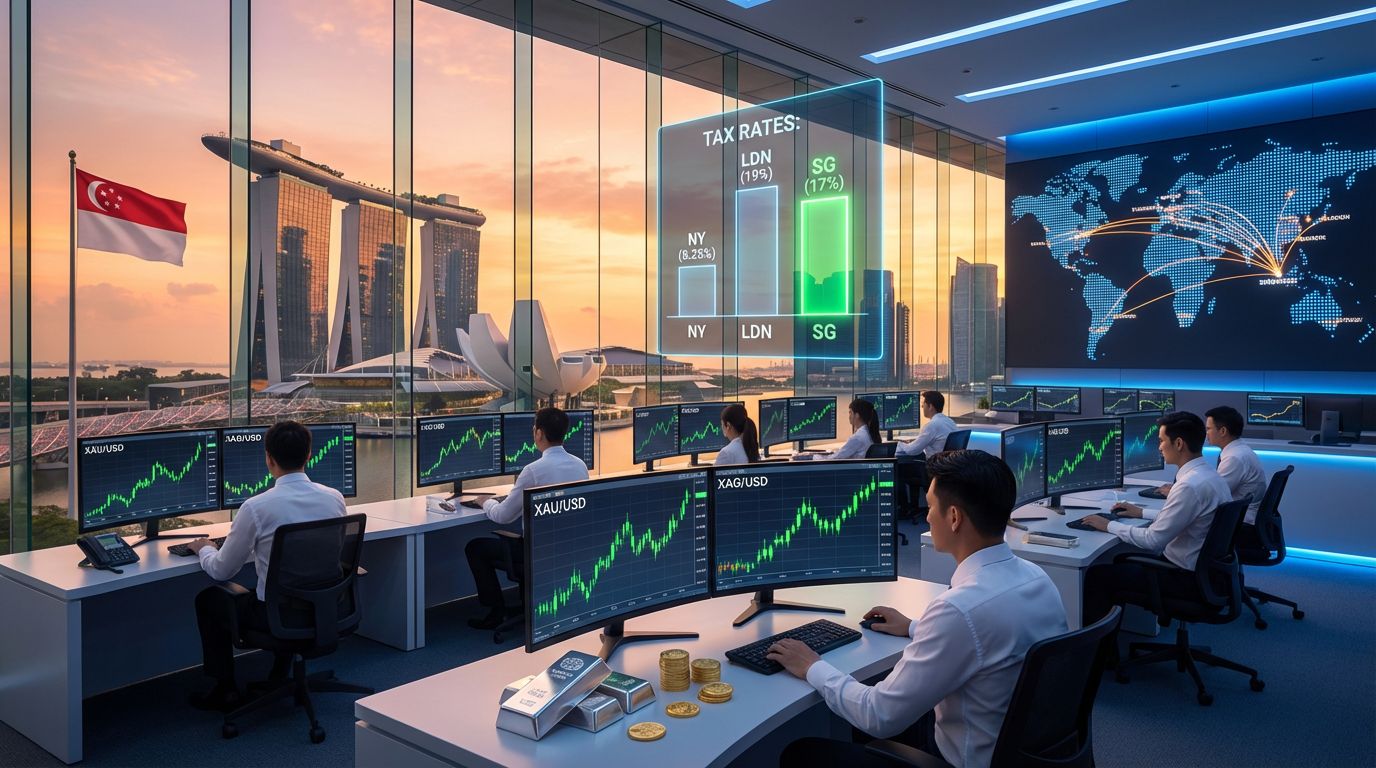
Operational expenses represent a fundamental driver in location decisions for trading operations. New York's tax environment includes multiple layers of taxation that impact trading desk profitability. The combined burden of federal, state, and local taxes creates meaningful cost differentials when compared to alternative jurisdictions.
Tax Environment Comparison:
| Location | Corporate Tax Rate | Additional Considerations |
|---|---|---|
| New York | 21% Federal + 6.5% State + NYC rates | High operational costs, regulatory intensity |
| Singapore | 5-17% depending on income brackets | Financial sector incentives, regional access |
| London | 19-25% Corporate | Brexit implications, regulatory alignment |
Beyond taxation, operational costs encompass technology infrastructure, talent acquisition, and real estate expenses. Singapore's position as a regional financial hub provides access to sophisticated trading infrastructure while maintaining cost advantages relative to established Western financial centres.
Market Access Considerations
The geographic positioning of trading operations influences market access patterns, particularly for Asian commodity flows. Singapore's location provides strategic advantages for precious metals trading that serves regional demand while maintaining connectivity to global markets.
Asian precious metals markets have experienced significant growth, driven by increasing wealth accumulation across Asian economies. In addition, central bank gold purchasing programs and growing industrial demand for silver and platinum contribute to this expansion.
Market Infrastructure and System Reliability
Trading system reliability represents a critical component of precious metals market infrastructure. Recent disruptions have highlighted vulnerabilities in electronic trading platforms that can impact market confidence and liquidity during volatile periods.
Technology Platform Vulnerabilities
Electronic trading systems face operational challenges that can significantly impact market function. The CME Group, which operates major precious metals futures markets, has experienced periodic technical difficulties that temporarily halt trading activities.
Circuit breaker mechanisms built into modern trading systems automatically halt trading under specific conditions to prevent market instability. These systems serve as safety mechanisms but can create frustration among traders during high-volatility periods when rapid price movements trigger automatic halts.
Common Trading System Disruption Factors:
- Software updates and maintenance procedures
- Hardware failures affecting critical system components
- Connectivity issues between trading platforms and market participants
- Overwhelming transaction volumes exceeding system capacity
- Cybersecurity incidents requiring system isolation
Market Resilience and Backup Systems
Modern precious metals markets operate with multiple layers of redundancy designed to minimise disruption impact. However, the concentration of electronic trading through limited platforms creates potential single points of failure that can affect global price discovery.
Alternative trading venues and over-the-counter markets provide backup liquidity during electronic platform disruptions. For instance, London's over-the-counter silver market continues to function independently of CME electronic trading systems, though supply chain constraints can still impact physical metal availability.
Singapore's Strategic Position in Global Precious Metals Markets
Singapore has systematically developed infrastructure and regulatory frameworks to attract precious metals trading and storage operations. This strategic positioning reflects broader economic development goals aimed at establishing Singapore as a comprehensive commodities hub.
Storage and Logistics Infrastructure
The physical infrastructure supporting precious metals trading requires sophisticated security, insurance, and logistics capabilities. Singapore has invested extensively in creating world-class precious metals storage facilities that serve both commercial and investment demand.
Key Infrastructure Elements:
- Secure vault facilities with international insurance coverage
- Efficient customs and import/export procedures for precious metals
- Advanced security systems and protocols
- Strategic location for serving Asian markets
- Established relationships with major international bullion banks
These infrastructure investments create network effects that attract additional trading activity as market participants benefit from concentrated liquidity and operational efficiency. Moreover, institutions considering a JP Morgan trading desk move to Singapore would find established support systems already in place.
Regulatory Framework Advantages
Singapore's approach to financial regulation emphasises market development while maintaining appropriate oversight standards. The MAS has created specialised frameworks for precious metals activities that balance investor protection with operational efficiency.
The regulatory environment offers several advantages for precious metals operations, including streamlined licensing procedures for established financial institutions. Furthermore, competitive tax treatment for trading revenues and flexible operational structures accommodate diverse business models.
Investment Strategy Implications
Changes in market structure and trading infrastructure create both opportunities and challenges for precious metals investors. Understanding these dynamics helps inform investment strategy components and risk management decisions.
Long-term vs. Short-term Investment Considerations
Market infrastructure changes affect different investment strategies in varying ways. Long-term precious metals investors focused on wealth preservation may benefit from improved global liquidity and storage options, while short-term traders must adapt to evolving market dynamics.
Strategic Investment Approaches:
Physical Precious Metals:
- Direct ownership provides independence from electronic trading systems
- Storage considerations become more complex with global infrastructure changes
- Insurance and security requirements may vary by jurisdiction
- Tax implications differ based on storage location and investor domicile
Exchange-Traded Products:
- Dependent on underlying market infrastructure reliability
- Benefit from improved global liquidity and price discovery
- Subject to counterparty risks associated with product structure
- May experience tracking differences during market disruptions
Futures and Derivatives:
- Directly impacted by exchange infrastructure changes
- Require sophisticated understanding of market structure evolution
- Offer leveraged exposure with associated amplified risks
- Benefit from improved global connectivity and extended trading hours
Risk Management During Market Transitions
Periods of market infrastructure change require heightened attention to risk management principles. Investors should consider multiple scenarios and maintain flexibility in their approach to precious metals allocation.
Diversification across different precious metals, storage locations, and investment vehicles can help mitigate risks associated with infrastructure changes. This approach provides resilience against disruptions affecting specific markets or trading platforms.
Economic Context and Market Fundamentals
Precious metals markets operate within broader economic contexts that influence both supply and demand dynamics. Current economic conditions create multiple forces supporting precious metals demand while simultaneously creating operational challenges for market participants.
Inflation and Currency Concerns
Rising costs across multiple sectors of the economy drive investor interest in inflation-resistant assets. Food prices, housing costs, and general living expenses have increased substantially, reducing purchasing power for many households and creating demand for alternative stores of value.
Historical Price Ratio Analysis:
Economic data suggests significant changes in affordability ratios over recent decades:
- 1985 Context: Average house price approximately $75,000, average income around $25,000 (3:1 ratio)
- Current Context: Average income approximately $70,000, average house price around $500,000 (7:1 ratio)
This deterioration in housing affordability reflects broader inflationary pressures that support precious metals as alternative investments. However, the current global recession outlook adds complexity to investment considerations.
Central Bank Policies and Market Impact
Federal Reserve policy decisions create significant implications for precious metals markets. Interest rate policies, monetary expansion, and regulatory approaches all influence investor behaviour and market dynamics.
The Federal Reserve's dual mandate of employment and price stability faces challenges in current economic conditions. Consequently, policy decisions must balance competing objectives while managing market expectations and maintaining financial system stability.
Technology and Future Market Evolution
Technological advancement continues to reshape precious metals trading infrastructure, creating both opportunities and challenges for market participants. Understanding these trends helps inform long-term investment strategy and risk management approaches.
Electronic Trading Platform Development
Modern precious metals trading increasingly relies on sophisticated electronic platforms that provide global connectivity and enhanced liquidity. These systems continue to evolve, incorporating advanced features such as real-time global price discovery across multiple markets.
The evolution of trading technology creates efficiencies while introducing new dependencies and potential failure points that market participants must understand and manage appropriately. Bankers' insights suggest that institutional knowledge often precedes public market movements.
Blockchain and Digital Innovation
Emerging technologies may eventually transform precious metals ownership verification, transfer processes, and trading mechanisms. While traditional physical markets continue to dominate, technological innovation could create new investment vehicles and trading opportunities.
Digital innovations in precious metals markets include blockchain-based ownership verification systems. In addition, enhanced supply chain tracking and authentication, along with digital storage receipt systems for physical metals, represent significant developments.
Risk Assessment and Investment Guidelines
Successful precious metals investing requires careful consideration of multiple risk factors and market dynamics. Current market conditions present both opportunities and challenges that demand thoughtful analysis and appropriate risk management.
Portfolio Allocation Strategies
Precious metals allocation within investment portfolios should reflect individual circumstances, risk tolerance, and investment objectives. Professional investment guidance becomes particularly valuable during periods of market structure change and economic uncertainty.
Key Allocation Considerations:
- Investment Capital Only: Use funds not needed for living expenses or emergency reserves
- Diversification Across Metals: Consider allocation across gold, silver, and platinum based on different demand drivers
- Storage Diversification: Evaluate geographic and custodial diversification for physical holdings
- Time Horizon Alignment: Match investment approach with specific time horizons and liquidity needs
Investment professionals emphasise the importance of sustainable allocation strategies that do not compromise basic financial security or family welfare. Furthermore, the gold price forecast suggests continued upward momentum based on geopolitical and economic factors.
Monitoring Market Development
Staying informed about market infrastructure changes, regulatory developments, and economic trends helps investors make appropriate adjustments to their precious metals strategies. Key monitoring areas include regulatory developments and market structure evolution.
Economic Indicators:
- Inflation trends and Federal Reserve policy responses
- Currency stability and international monetary developments
- Employment and economic growth patterns
- Central bank precious metals purchasing activities
Conclusion and Future Outlook
The precious metals market continues to evolve in response to technological advancement, regulatory change, and shifting global economic patterns. While specific claims about major bank relocations require verification, the underlying trends toward operational optimisation and geographic diversification reflect legitimate business considerations.
Investors benefit from understanding these structural changes while maintaining focus on fundamental investment principles. Precious metals can serve important portfolio functions, but success requires careful planning, appropriate risk management, and ongoing attention to market developments.
Key Takeaways for Investors:
- Verify information from reliable sources before making investment decisions
- Consider professional guidance for portfolio allocation and strategy development
- Maintain diversification across metals, storage options, and investment vehicles
- Stay informed about regulatory and market structure developments
- Focus on long-term objectives while remaining flexible in implementation approaches
The evolution of global precious metals markets will likely continue, driven by technological innovation, regulatory adaptation, and changing investor preferences. Understanding these trends while maintaining disciplined investment approaches provides the foundation for successful precious metals investing within broader portfolio management strategies.
However, discussions around a potential JP Morgan trading desk move to Singapore highlight how major institutional changes can reshape market dynamics and create both opportunities and uncertainties for individual investors.
Final Disclaimer: This analysis is for educational purposes only and does not constitute investment advice. All investment decisions should be made in consultation with qualified financial professionals and based on individual circumstances, risk tolerance, and investment objectives. Past performance does not guarantee future results, and precious metals investments involve risks including potential loss of principal.
Looking to Capitalise on Precious Metals Market Opportunities?
Discovery Alert's proprietary Discovery IQ model delivers real-time alerts on significant ASX mineral discoveries, instantly empowering subscribers to identify actionable opportunities ahead of the broader market. Understand why major mineral discoveries can lead to significant market returns by exploring Discovery Alert's dedicated discoveries page, then begin your 30-day free trial today to position yourself ahead of the market.