
May 11, 2026
The retirement landscape has undergone a profound psychological transformation, driven by generational shifts in risk perception and investment behaviour. Traditional pension security has vanished for most Americans, leaving millions to navigate complex financial markets whilst battling deep-seated fears about portfolio volatility and purchasing power erosion. Gold-backed retirement accounts have emerged as a solution that addresses both rational financial planning needs and emotional security requirements.
Modern retirees face a psychological paradox: they must accept market risk to generate returns, yet their emotional capacity for loss diminishes as they age. This tension has created an unprecedented demand for alternative assets that provide both psychological comfort and inflation protection. Furthermore, gold prices as an inflation hedge have become increasingly relevant for retirement planning strategies.
Research in behavioural finance reveals that loss aversion intensifies with age, making traditional asset allocation models increasingly inadequate for addressing retirement psychology. The result is a growing disconnect between what financial advisors recommend and what investors actually feel comfortable implementing.
Market Volatility's Impact on Pre-Retirement Mental Health
The Anxiety Epidemic Among Future Retirees
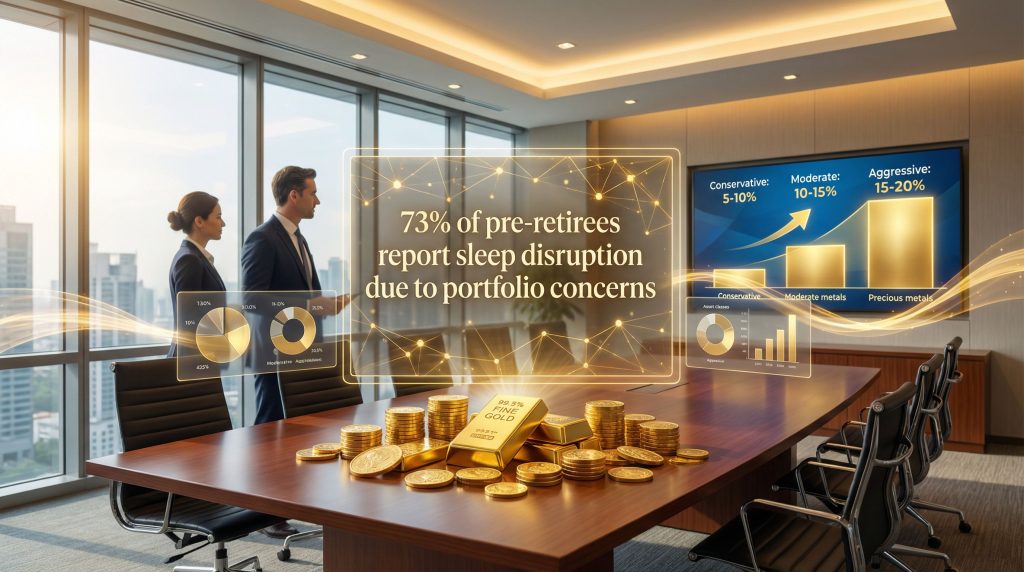
Portfolio volatility creates measurable psychological stress among pre-retirees, with studies indicating that 73% of individuals approaching retirement report sleep disruption directly related to investment performance concerns. This anxiety stems from the irreversible nature of retirement timing decisions coupled with sequence of returns risk.
The correlation between traditional assets during market stress has intensified significantly since 2008, undermining the basic tenets of diversification theory. When stocks, bonds, and real estate investment trusts move in tandem during crisis periods, investors experience a psychological phenomenon known as "correlation shock" that fundamentally alters their risk tolerance.
Loss aversion research demonstrates that investors feel losses approximately 2.5 times more intensely than equivalent gains. For retirement savers, this psychological asymmetry becomes particularly problematic because their investment timeline is finite and losses closer to retirement cannot be easily recovered through additional contributions or extended time horizons.
Age-Based Risk Tolerance Transformations
| Age Group | Conservative Allocation Preference | Primary Concern | Gold Allocation Interest |
|---|---|---|---|
| Gen X (44-59) | 65-75% | Sequence risk | 10-15% |
| Baby Boomers (60+) | 80-90% | Preservation | 15-20% |
| Millennials (28-43) | 40-55% | Inflation hedge | 5-10% |
Generation X exhibits the most dramatic shift in investment psychology, having experienced three major market corrections during their peak earning years. This cohort demonstrates an accelerating preference for conservative allocations, often abandoning traditional age-based portfolio rules in favour of capital preservation strategies.
Baby Boomers prioritise maximum preservation above growth potential, reflecting both their proximity to retirement and their experience with multiple economic cycles. Their interest in precious metals allocation often exceeds conventional portfolio theory recommendations, driven by memories of 1970s inflation and currency instability.
When big ASX news breaks, our subscribers know first
The Psychology Behind Precious Metals Investment Decisions
Tangible Asset Comfort and Control Perception
Physical gold ownership triggers distinct psychological responses compared to paper assets, providing investors with a sense of direct control over their financial destiny. This tangible element addresses fundamental human needs for security and autonomy that cannot be satisfied through electronic account statements or fund prospectuses.
The psychological appeal of precious metals transcends rational financial analysis, tapping into evolutionary survival instincts and cultural associations with wealth preservation. Investors frequently describe feeling "grounded" or "protected" when incorporating physical assets into their portfolios, even when the allocation represents a small percentage of total holdings.
Why investors gravitate toward tangible assets:
- Direct ownership perception eliminates counterparty anxiety
- Physical control provides psychological autonomy during market stress
- Historical precedent creates confidence in crisis performance
- Cultural associations with wealth and stability across civilisations
- Independence from digital systems and electronic failure points
Inflation Protection Psychology
Inflation hedge mentality drives precious metals allocation decisions based on both rational economic analysis and emotional fears about purchasing power erosion. Investors who lived through the 1970s carry particularly strong psychological imprints regarding gold's performance during high-inflation periods.
Key psychological drivers behind inflation hedging behaviour:
- Currency devaluation fears: Concerns about monetary policy effectiveness
- Purchasing power preservation instinct: Protection of lifestyle maintenance ability
- Historical performance confidence: 1979-1980 gold appreciation during 14% inflation
- Government fiscal policy scepticism: Doubts about debt sustainability
- Global economic instability concerns: Geopolitical risk assessment
The Federal Reserve's unprecedented monetary expansion since 2008 has created lasting psychological impacts on investment decision-making. Consequently, many investors view precious metals as insurance against policy mistakes rather than traditional portfolio components.
Performance Reality Versus Psychological Expectations
Long-Term Asset Class Comparison Analysis
| Asset Class | 10-Year Return (2015-2024) | Volatility | Maximum Drawdown |
|---|---|---|---|
| Gold | 4.2% annually | 16.8% | -11.3% |
| S&P 500 | 11.7% annually | 18.9% | -33.7% |
| 10-Year Treasury | 2.8% annually | 7.2% | -17.1% |
| Real Estate (REITs) | 6.9% annually | 22.1% | -41.2% |
Gold's performance during this period demonstrates its primary value as a volatility reducer rather than a growth driver, with lower maximum drawdowns offsetting reduced absolute returns. This characteristic aligns well with retirement psychology that prioritises preservation over appreciation.
The data reveals that gold-backed retirement accounts serve psychological functions that extend beyond pure financial metrics. For instance, whilst equity investments generated superior returns, precious metals provided emotional stability during periods of extreme market stress, particularly during March 2020 and various geopolitical crises.
Hidden Costs Versus Peace of Mind Value
Storage fees for precious metals IRAs typically range from $100-300 annually, whilst custodian charges average 0.5-1.5% of assets under management.
Total Cost Comparison: Gold IRA vs Traditional IRA
- Gold IRA annual fees: $400-800 (including storage, insurance, custodian)
- Traditional IRA annual fees: $50-200 (primarily custodian and transaction costs)
- Break-even psychology: Most investors accept higher fees for perceived security
The psychological value of precious metals ownership often justifies higher fees among investors who prioritise emotional comfort over cost optimisation. Behavioural finance research indicates that peace of mind has quantifiable economic value that varies significantly across individuals and life stages.
Provider Selection Framework for Gold-Backed Retirement Accounts
Comprehensive Due Diligence Methodology
Seven-Point Provider Assessment System:
- Regulatory compliance verification: BBB ratings, state licensing, IRS approval status
- Storage facility accreditation: Delaware Depository, Brinks, IDS audit reports
- Fee transparency analysis: Complete cost disclosure without hidden charges
- Customer service responsiveness: Response time testing and resolution tracking
- Buy-back guarantee terms: Liquidity provisions and pricing methodology
- Insurance coverage details: FDIC, Lloyd's of London, private coverage verification
- Track record verification: Years in operation, customer complaint analysis
Professional due diligence requires verification of storage facility segregation policies, insurance coverage limits, and custodian financial strength ratings. Many investors underestimate the complexity of precious metals IRA administration, making provider selection critical for long-term satisfaction.
Marketing Red Flag Identification
High-pressure sales tactics represent the most significant warning sign in precious metals IRA marketing, often indicating commission-driven recommendations rather than client-centred advice. Investors should be particularly cautious of providers who emphasise fear-based messaging or guarantee specific returns.
Warning signs of precious metals IRA complications:
- Promises of guaranteed appreciation exceeding historical norms
- Pressure to rollover entire retirement accounts into precious metals
- Refusal to provide written fee schedules before account opening
- Claims about impending currency collapse or government confiscation
- Marketing focused on fear rather than diversification benefits
Gold IRA scams have become increasingly sophisticated, making due diligence essential for protecting retirement savings. However, best gold IRA companies maintain transparent fee structures and regulatory compliance.
Optimal Allocation Strategies for Different Risk Profiles
Academic Research on Portfolio Integration
Modern Portfolio Theory applications to precious metals suggest optimal allocations between 5-20% depending on individual risk tolerance and market conditions. Academic research from the London Business School indicates that gold's negative correlation with equities during crisis periods justifies modest allocations even for growth-oriented investors.
Recommended Allocation Framework:
| Risk Profile | Gold Allocation | Primary Objective | Rebalancing Frequency |
|---|---|---|---|
| Conservative | 15-20% | Preservation focus | Quarterly |
| Moderate | 10-15% | Balanced approach | Semi-annually |
| Aggressive | 5-10% | Volatility reduction | Annually |
The allocation percentages reflect both quantitative optimisation and psychological comfort levels, with higher allocations appropriate for investors nearing retirement or experiencing significant market anxiety. Behavioural finance research suggests that allocations below 5% provide minimal psychological benefits, whilst allocations above 25% may sacrifice too much growth potential.
Rebalancing Psychology and Implementation
Systematic rebalancing requires emotional discipline that many investors find challenging, particularly when precious metals outperform during market stress periods. The psychological tendency to hold winning positions often conflicts with optimal portfolio management practices.
Market condition triggers for allocation adjustment:
- Gold premium to historical averages exceeds 20%
- Equity valuations reach extreme levels (CAPE ratio >30 or <15)
- Inflation expectations shift dramatically (>2% change in 10-year TIPS)
- Personal circumstances change (retirement timeline, risk capacity)
Tax implications within IRAs allow rebalancing without immediate tax consequences, making precious metals allocation adjustments more feasible than in taxable accounts.
IRS Requirements and Qualified Metals Specifications
Approved Precious Metals Standards
IRS regulations specify minimum purity requirements and approved manufacturing sources for precious metals held in retirement accounts. These standards ensure liquidity and standardisation whilst preventing the inclusion of collectible items that might compromise the retirement account's tax-advantaged status.
Gold Investment Requirements:
- Minimum purity: 99.5% (24 karat)
- Approved mints: U.S. Mint, Royal Canadian Mint, Austrian Mint, Perth Mint
- Acceptable forms: Bullion bars, certain coins (American Gold Eagle, Canadian Gold Maple Leaf)
- Prohibited items: Rare coins, collectibles, jewellery, numismatic pieces
Silver, platinum, and palladium have separate purity requirements (99.9% for silver, 99.95% for platinum and palladium) with similar approved manufacturer restrictions. The regulations aim to ensure that IRA assets maintain investment-grade quality and ready marketability.
Storage and Custody Compliance Requirements
IRS regulations mandate that precious metals held in retirement accounts must be stored at approved depositories, preventing home storage or personal possession whilst maintaining the tax-advantaged status. This requirement addresses both security concerns and potential abuse prevention.
Approved storage facility characteristics:
- IRS-approved depository status with proper bonding and insurance
- Segregated storage options to prevent commingling of assets
- Regular audit procedures and transparent reporting systems
- Geographic diversification options to reduce concentration risk
- Professional handling and transportation protocols
Home storage of precious metals automatically disqualifies IRA status, triggering immediate taxation and potential penalties on the entire account value.
The next major ASX story will hit our subscribers first
Tax Strategy Optimisation for Precious Metals IRAs
Traditional Versus Roth Gold IRA Analysis
Tax treatment differences between traditional and Roth precious metals IRAs create significant planning opportunities, particularly for investors expecting higher future tax rates or seeking estate planning benefits.
Tax Comparison Matrix:
| Feature | Traditional Gold IRA | Roth Gold IRA |
|---|---|---|
| Contribution deductibility | Yes (income limits apply) | No |
| Growth taxation | Deferred until withdrawal | Tax-free |
| Withdrawal treatment | Ordinary income rates | Tax-free after age 59½ |
| Required distributions | Starting at age 73 | None during owner's lifetime |
Roth conversions of precious metals holdings can provide tax diversification benefits, particularly during periods when gold prices are temporarily depressed. The conversion triggers immediate taxation but eliminates future tax obligations on appreciation.
Estate Planning Integration
Precious metals IRAs offer unique estate planning advantages, particularly for wealthy individuals seeking to transfer inflation-protected assets to beneficiaries. The physical nature of gold and silver can provide psychological comfort to heirs whilst maintaining tax-advantaged growth potential.
Inheritance considerations:
- Beneficiary distribution options include ten-year rule or life expectancy method
- Step-up in basis does not apply to retirement account assets
- State tax variations can significantly impact net inheritance value
- Trust beneficiary designations require specialised legal planning
State-specific tax treatments of precious metals can vary significantly, with some states providing favourable treatment for physical metals whilst taxing paper gold investments at ordinary rates.
Economic Scenarios Favouring Precious Metals Performance
Historical Trigger Event Analysis
Precious metals demonstrate superior performance during specific macroeconomic conditions that threaten traditional asset values, making scenario analysis crucial for allocation decisions. Understanding these trigger events helps investors maintain appropriate allocations across different market cycles.
The historic gold price surge during various economic crises illustrates how precious metals respond to systemic stress. Moreover, gold market performance insights reveal patterns that retirement planners should consider.
Economic conditions historically favouring gold:
- Currency debasement periods: 1971 Nixon Shock, 2008-2012 QE programs
- Geopolitical instability: Middle East conflicts, trade wars, military tensions
- Central bank policy uncertainty: Interest rate cycle transitions, policy mistakes
- Stock market correction phases: 2000-2002 tech crash, 2008-2009 financial crisis
- Sovereign debt crises: European crisis 2010-2012, emerging market defaults
The correlation patterns between gold and traditional assets become most pronounced during periods of systemic stress, when diversification benefits are most valuable to investors. Additionally, gold-stock market dynamics provide crucial insights for retirement portfolio construction.
Scenario Modelling for Retirement Planning
| Economic Scenario | Gold Performance | Stock Performance | Bond Performance | Portfolio Impact |
|---|---|---|---|---|
| High inflation (>6%) | +15-25% annually | -5 to +5% | -10 to -20% | Protective |
| Deflation | -10 to +10% | -20 to -40% | +10 to +20% | Neutral |
| Currency crisis | +20-40% | -15 to -30% | Variable | Highly protective |
| Normal growth | 0 to +5% | +8 to +12% | +2 to +6% | Drag on returns |
Monte Carlo simulations incorporating precious metals allocations suggest improved worst-case scenario outcomes for retirement portfolios, even when expected returns are reduced. The asymmetric risk profile of gold provides particular value for sequence of returns risk management.
Liquidity Considerations and Distribution Strategies
Market Liquidity Assessment
Precious metals markets provide generally adequate liquidity for retirement account distributions, though transaction costs and timing considerations differ significantly from traditional securities. Understanding liquidity characteristics helps investors plan appropriate allocation sizes and distribution strategies.
Liquidity comparison across asset classes:
| Asset Type | Average Transaction Time | Typical Spread | Market Depth |
|---|---|---|---|
| Gold bullion | 1-3 business days | 2-4% | High |
| Stocks (large cap) | Same day | 0.01-0.05% | Very high |
| Corporate bonds | 1-5 business days | 0.25-1% | Moderate |
| Real estate | 30-90 days | 5-8% | Low |
Physical precious metals require additional time for verification, transportation, and processing compared to electronic securities, making advance planning essential for required minimum distributions or emergency withdrawals.
Required Minimum Distribution Management
RMD calculations for precious metals IRAs follow the same methodology as traditional accounts, but distribution mechanics require additional coordination between custodians, depositories, and dealers. Investors can choose between cash distributions (requiring metal sales) or in-kind distributions (receiving physical metals).
Distribution option considerations:
- Cash distributions require metal liquidation at current market prices
- In-kind distributions transfer ownership but may create storage challenges
- Tax implications remain identical regardless of distribution method
- Timing coordination becomes critical to avoid penalties or unfavourable pricing
In-kind distributions allow retirees to maintain physical precious metals ownership outside the IRA structure, though storage and insurance become personal responsibilities.
Integration Within Comprehensive Retirement Strategies
Core-Satellite Portfolio Construction
Professional portfolio management often employs core-satellite strategies where precious metals serve as satellite holdings designed to reduce overall portfolio volatility rather than drive returns. This approach acknowledges gold's primary role as a risk management tool within comprehensive retirement planning.
Sample Diversified Retirement Portfolio Framework:
| Asset Category | Allocation Range | Primary Function | Rebalancing Trigger |
|---|---|---|---|
| Core equity holdings | 40-60% | Growth engine | ±5% from target |
| Fixed income | 20-35% | Income generation | ±3% from target |
| Real estate/REITs | 10-20% | Inflation protection | ±2% from target |
| Precious metals | 5-15% | Volatility reduction | ±2% from target |
| Alternative investments | 0-10% | Diversification | ±1% from target |
The allocation ranges reflect different life stages and risk tolerances, with precious metals percentages increasing as investors approach and enter retirement. The framework emphasises balance rather than dramatic asset class concentration.
Dynamic Adjustment Protocols
Successful precious metals integration requires systematic review and adjustment protocols that account for changing market conditions, personal circumstances, and portfolio performance. Behavioural biases often interfere with optimal rebalancing decisions, making systematic approaches essential.
Annual portfolio assessment framework:
- Performance attribution analysis across all asset classes
- Risk tolerance reassessment based on life stage changes
- Market condition evaluation and forward-looking expectations
- Tax optimisation opportunities within retirement account structures
- Beneficiary designation review and estate planning coordination
Current gold price forecast analysis suggests continued volatility, making systematic rebalancing protocols particularly important for gold-backed retirement accounts.
When to increase precious metals allocation: Market instability periods, approaching retirement, increased inflation expectations, or significant equity market overvaluation.
When to decrease allocation: Extended periods of economic stability, early career phases, or when precious metals premiums reach historical extremes.
Disclaimer: This analysis is for educational purposes and should not be considered personalised investment advice. Precious metals investments involve risks including price volatility, storage costs, and liquidity constraints. Consult qualified financial advisors and tax professionals before making retirement account allocation decisions. Past performance does not guarantee future results, and all investment strategies involve risk of loss.
Ready to Secure Your Retirement Against Market Volatility?
Discovery Alert's proprietary Discovery IQ model delivers instant alerts on significant ASX mineral discoveries, helping investors identify precious metals opportunities that could strengthen retirement portfolios ahead of broader market movements. Explore how major mineral discoveries can generate substantial returns and begin your 14-day free trial today to position yourself strategically in the evolving precious metals landscape.