What Defines a World-Class Gold-Copper Development in Today's Market?
Understanding what elevates a mining project to world-class status requires examining multiple technical and economic factors that distinguish exceptional developments from standard industry assets. Modern mining operations achieving this designation typically demonstrate superior ore grades, substantial resource bases, favourable metallurgical characteristics, and robust financial returns that place them within the industry's top performance quartiles.
The global mining sector has witnessed increasing consolidation around high-quality assets, with institutional investors and major mining companies prioritising developments that offer long-term production visibility, cost advantages, and operational scalability. These criteria have become more stringent as capital allocation frameworks emphasise projects capable of generating sustained free cash flow across various commodity price cycles.
Geological Characteristics That Drive Superior Economics
World-class gold-copper deposits exhibit specific geological advantages that translate directly into operational benefits and cost efficiencies. The Greatland Havieron feasibility study exemplifies these characteristics through its substantial ore reserve of 38.5 million tonnes grading 2.63 grams per tonne gold and 0.33% copper, containing 3.3 million ounces of gold and 128,000 tonnes of copper.
This grade profile positions Havieron significantly above industry averages for new development projects. The combination of gold‐copper exploration provides natural revenue diversification, with copper credits contributing approximately 15-20% of total project revenues based on current commodity pricing assumptions.
The deposit's location within Western Australia's Paterson Province leverages an established geological terrain known for hosting large-scale mineral systems. This geological setting supports confident resource estimation and provides exploration upside potential through systematic drilling programs targeting similar mineralisation styles within the broader project area.
Reserve Growth and Resource Expansion Potential
The recent feasibility study demonstrates significant reserve expansion, with tonnage increasing 55% and contained gold rising 36% compared to previous estimates. This progression reflects successful exploration drilling and improved geological understanding, typical of high-quality deposits where initial discovery results are systematically enhanced through focused development programmes.
Beyond the established reserves, Havieron's total mineral resource encompasses 131 million tonnes at 1.7 g/t gold and 0.21% copper, containing 7 million ounces of gold and 275,000 tonnes of copper. This resource base provides substantial potential for future reserve additions, indicating the deposit's capacity to support mine life extensions beyond the current 17-year planning horizon.
The resource-to-reserve conversion opportunity represents a critical value driver, offering potential operational flexibility and long-term production sustainability that distinguish world-class assets from shorter-life developments.
How Do Financial Returns Compare Across Australian Development Projects?
Financial performance metrics provide quantitative validation of project quality, with the Greatland Havieron feasibility study demonstrating returns that position the development within the upper tier of Australian mining investments. The project's economic foundation rests on robust cash flow generation potential and attractive return profiles across multiple commodity price scenarios.
Net Present Value Analysis and Return Profiles
| Financial Metric | Base Case (US$4,500/oz Au) | Spot Price Scenario |
|---|---|---|
| Post-tax NPV | US$2.9 billion | US$5.4 billion |
| Internal Rate of Return | 22.5% | 31.5% |
| Annual Free Cash Flow | US$550 million | US$870 million |
| Life-of-Mine Cash Flow | US$7.7 billion | – |
The 22.5% IRR at base case gold pricing of US$4,500 per ounce significantly exceeds typical project hurdle rates of 12-15% applied by institutional investors for mining developments. The uplift to 31.5% IRR under current spot pricing demonstrates substantial operating leverage to gold price forecast movements, a characteristic that enhances project attractiveness during periods of commodity price volatility.
Capital Structure and Funding Diversification
Total development capital requirements of US$1.065 billion incorporate comprehensive mine development, processing infrastructure upgrades, and contingency provisions. The funding strategy employs three distinct capital sources:
• US$750 million from existing cash reserves
• US$500 million committed debt facility from Tier 1 banking syndicate
• Ongoing operational cash flows from existing Telfer operations
The committed debt facility involves five major financial institutions (ANZ, HSBC, ING, NAB, and Westpac), demonstrating institutional confidence in project viability and providing access to competitive financing terms. This diversified funding approach reduces refinancing risk and ensures capital availability throughout the development phase.
All-In Sustaining Cost Positioning
Projected AISC of A$1,610 per ounce places Havieron within the lowest cost quartile of global gold production, providing significant operational margins even during periods of commodity price weakness. This cost advantage stems from several factors:
• Integrated processing through existing Telfer infrastructure
• High-grade ore reducing per-unit processing costs
• Copper by-product credits offsetting operational expenses
• Economies of scale from combined Havieron-Telfer operations
The cost structure provides defensive characteristics that protect cash flow generation during market downturns while maximising returns during favourable pricing environments.
What Production Targets Support Long-Term Value Creation?
Production planning for Havieron emphasises sustained output over an extended mine life, with operational parameters designed to optimise resource recovery while maintaining consistent cash flow generation. The production framework balances throughput optimisation with grade management to achieve superior unit economics throughout the operational period.
Steady-State Output Specifications
| Production Parameter | Annual Target | Total Reserve |
|---|---|---|
| Gold Production | 266,000 ounces | 3.3 million ounces |
| Copper Production | 9,600 tonnes | 128,000 tonnes |
| Ore Processing | 3.9 million tonnes | 38.5 million tonnes |
| Mine Life | 17 years total | 9 years steady-state |
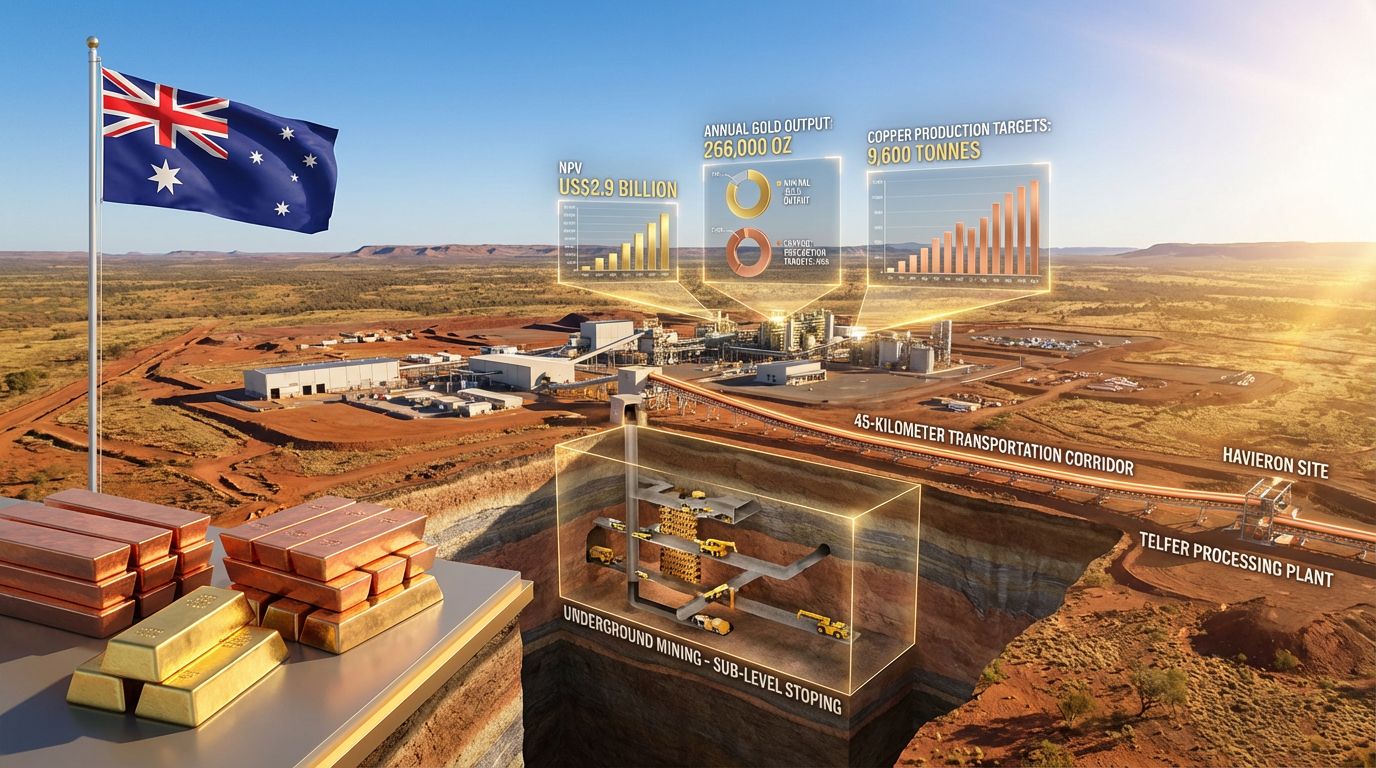
The 266,000 ounce annual gold production target positions Havieron among Australia's significant gold producers, whilst the copper production outlook indicates 9,600 tonnes of annual copper output provides meaningful exposure to copper market dynamics. Processing throughput of 3.9 million tonnes per annum optimises equipment utilisation while maintaining consistent production rates.
Production Profile and Mine Life Dynamics
The 17-year total mine life incorporates a 9-year steady-state period, indicating front-loaded production scheduling that prioritises higher-grade ore extraction during early operational years. This approach maximises early cash flow generation and accelerates capital recovery, reducing project risk while providing operational flexibility for future expansion programmes.
Production ramp-up typically requires 2-3 years to achieve nameplate capacity, followed by the steady-state period, then gradual production decline as ore reserves are depleted. This profile allows for systematic workforce development and operational optimisation during the ramp-up phase.
Resource Conversion and Mine Life Extension Potential
The substantial mineral resource base beyond established reserves provides multiple pathways for production enhancement and mine life extension. With 7 million ounces of gold and 275,000 tonnes of copper in total resources, conversion opportunities could potentially double the current reserve base through systematic exploration and feasibility studies.
Furthermore, gold exploration results from ongoing drilling programmes targeting resource conversion represent high-return investment opportunities, as successful resource-to-reserve conversion typically requires modest capital investment whilst generating significant value through extended operational cash flows.
How Does Telfer Integration Optimise Processing Operations?
The strategic integration of Havieron ore processing with existing Telfer infrastructure represents a capital-efficient development model that leverages proven processing capabilities while avoiding greenfield mill construction. This hub approach distributes fixed costs across larger combined throughput, reducing unit processing costs and enhancing overall project economics.
Processing Circuit Modifications and Recovery Rates
Telfer Plant Train 1 upgrades require US$200 million investment to accommodate Havieron ore characteristics and optimise recovery performance. The modification programme includes three specialised circuits:
• Magnetic separation removes magnetic iron minerals before flotation
• Flotation tails leach recovers additional gold from tailings streams
• Pyrite leach circuits extract gold from sulfide mineral concentrates
These circuit enhancements target recovery rates of 86.6% for gold and 84.4% for copper, performance levels that maximise metal extraction while minimising processing losses. The recovery specifications compare favourably with industry benchmarks for complex gold-copper ores.
Integrated Hub Development Benefits
Co-processing Havieron and Telfer ores creates operational synergies that benefit both operations through shared infrastructure and optimised throughput management. The integrated approach provides several advantages:
• Fixed cost distribution across larger combined processing volumes
• Operational flexibility through dual ore source management
• Maintenance scheduling optimisation across shared equipment
• Workforce utilisation efficiency through combined operations
The hub model reduces AISC for both operations whilst providing processing capacity utilisation that enhances asset productivity and extends equipment life through optimised operational scheduling.
Transportation and Logistics Framework
The approximate 55-kilometre distance between Havieron and Telfer enables cost-effective ore transportation while maintaining operational flexibility. Road transport infrastructure supports consistent ore delivery scheduling, allowing for inventory management and processing optimisation based on ore grade blending strategies.
Transportation costs represent a minor component of total processing expenses, whilst the logistics framework provides operational resilience through alternative routing capabilities and weather-related contingency planning.
What Development Timeline Milestones Drive Investment Decisions?
Project development scheduling balances construction complexity with operational readiness requirements, establishing milestone-driven progression that enables systematic risk management and capital deployment optimisation. The development pathway incorporates regulatory compliance, construction execution, and commissioning activities within an integrated timeline framework.
Critical Path Construction and Commissioning
| Development Phase | Target Timeline | Key Deliverables |
|---|---|---|
| First Ore Production | H2 2026 | Underground development completion |
| Initial Gold Production | H2 2027 | Processing circuit commissioning |
| Steady-State Operations | FY2028 | Full integration achievement |
| Full Production | FY2029 | Nameplate capacity operations |
The progression from first ore to full production spans approximately 3 years, reflecting the complexity of underground mine development and processing circuit integration. This timeline incorporates contingency provisions for construction delays and commissioning optimisation requirements.
Regulatory Approval and Permitting Status
Final development permits remain pending, representing the primary near-term risk factor for project advancement. The regulatory pathway includes environmental approvals, mining lease conditions, and community engagement requirements that must be completed before construction commencement.
Permitting timelines typically require 6-12 months for final approvals, depending on regulatory review processes and stakeholder consultation requirements. Project development planning incorporates these regulatory dependencies within the overall timeline framework.
Risk Mitigation and Contingency Planning
Development risk management addresses technical, regulatory, and market factors that could influence project timeline or economics. Primary risk mitigation strategies include:
• Technical risk controls through proven mining methods and processing technologies
• Regulatory compliance monitoring ensuring permit condition adherence
• Market risk hedging for commodity price protection during development
• Operational readiness programmes for workforce development and training
These risk management frameworks provide project resilience whilst maintaining development momentum toward production commencement.
How Does Havieron Position Within Australia's Resource Sector?
Australia's gold and copper production landscape encompasses numerous development projects competing for capital allocation and market positioning. Havieron's scale, grade characteristics, and strategic location provide competitive advantages that distinguish the project within the broader development pipeline whilst contributing meaningfully to national mineral production capacity.
Comparative Reserve Positioning
With 3.3 million ounces of contained gold reserves, Havieron represents the largest gold reserve held by a non-major mining company in Australia. This positioning provides strategic significance within the domestic gold sector whilst demonstrating the project's potential contribution to national production statistics.
In addition, the reserve scale places Havieron among the top 10% of Australian gold development projects by contained metal, whilst the copper component adds diversification benefits that enhance project resilience across commodity cycles.
National Production Contribution Analysis
Annual production targets of 266,000 ounces gold and 9,600 tonnes copper represent meaningful contributions to Australian mineral output. Based on current national production statistics:
• Gold production represents approximately 8-10% of annual Australian output
• Copper production contributes roughly 1-2% of national copper production
• Combined revenue generation exceeds A$800 million annually at current pricing
These production levels position Havieron as a significant contributor to Australia's mineral export economy whilst supporting regional employment and economic development in Western Australia.
Investment Market Implications
The project's financial metrics and production profile attract institutional investor attention within the Australian resources sector. Key investment considerations include:
• Revenue diversification through gold-copper production
• Long-term cash flow visibility over 17-year mine life
• Cost competitiveness within lowest quartile positioning
• Geographic stability within established mining jurisdiction
These characteristics support premium valuations relative to single-commodity projects whilst providing defensive investment qualities that appeal to conservative institutional mandates.
What Technical Mining Methods Optimise Resource Recovery?
Underground mining methodology selection balances resource recovery optimisation with operational safety and cost efficiency requirements. The technical approach for Havieron incorporates proven extraction methods adapted to the deposit's geological characteristics whilst maximising ore recovery and minimising operational complexity.
Sub-Level Stoping and Ground Support Systems
Sub-level stoping represents the primary extraction method, selected for its compatibility with Havieron's geological structure and grade distribution. This methodology provides several operational advantages:
• High recovery rates through systematic ore extraction
• Operational flexibility for varying ore widths and grades
• Safety optimisation through controlled extraction sequences
• Equipment efficiency using standard underground mining equipment
Cemented paste fill systems provide ground support and enable high recovery extraction by filling mined-out areas with tailings-based backfill material. This approach supports adjacent ore extraction whilst providing long-term ground stability.
Processing Technology and Circuit Design
Telfer processing modifications target complex gold-copper ore treatment through specialised circuit configurations. The technical approach addresses:
• Magnetic separation for iron removal before flotation
• Flotation optimisation for copper concentrate production
• Pyrite leaching for refractory gold recovery
• Tailings treatment for additional gold extraction
These circuits maximise metal recovery whilst producing marketable copper concentrates and gold doré products. Processing flexibility allows for ore blending strategies that optimise recovery rates and product quality specifications.
Infrastructure Development Requirements
Mine infrastructure development incorporates comprehensive systems supporting underground operations and surface facilities:
• Ventilation systems for underground air quality management
• Material handling including ore transport and waste management
• Power supply through grid connection and backup generation
• Water management for processing and environmental compliance
Infrastructure design emphasises operational reliability and environmental compliance whilst providing scalability for potential future expansion programmes.
Frequently Asked Questions About Project Development and Operations
When Will Commercial Production Begin?
Commercial production timeline targets H2 2027 for initial gold production, with full operational capacity achieved by FY2029. This schedule depends on successful permit acquisition, construction completion, and commissioning optimisation.
Development progression requires approximately 18 months for major construction activities, followed by 12 months for commissioning and ramp-up to steady-state production levels. Weather conditions and equipment availability may influence specific milestone timing.
What Market Conditions Support Project Viability?
Project economics demonstrate resilience across various commodity pricing scenarios, with positive returns maintained even under conservative price assumptions. Sensitivity analysis indicates:
• Gold price floor of approximately US$1,800/oz for positive returns
• Copper price sensitivity providing upside leverage to base metals markets
• Cost structure flexibility enabling production adjustments based on market conditions
The diversified revenue stream through gold and copper sales provides natural hedging against single-commodity price volatility.
How Does Processing Integration Affect Operations?
Telfer integration provides operational benefits through shared infrastructure and expertise whilst reducing capital requirements compared to standalone processing development. Integration advantages include:
• Capital efficiency through existing infrastructure utilisation
• Operational synergies from combined processing optimisation
• Technical expertise leveraging established processing knowledge
• Cost reduction through shared fixed expense distribution
The integrated approach enhances both operations whilst providing processing flexibility for ore blending and scheduling optimisation.
Strategic Corporate Transformation Through Large-Scale Development
The Greatland Havieron feasibility study represents fundamental corporate evolution from exploration-focused activities to large-scale mining operations. However, this transformation requires operational capabilities, management systems, and strategic frameworks that support sustained production and cash flow generation over extended operational periods, reflecting broader mining industry evolution trends.
Operational Capability Development
Transitioning to production operations necessitates comprehensive capability development across multiple functional areas:
• Mining operations through experienced technical teams and proven methodologies
• Processing expertise leveraging Telfer operational knowledge and system optimisation
• Safety management implementing comprehensive risk control frameworks
• Environmental compliance ensuring regulatory adherence and community engagement
These capabilities support operational excellence whilst maintaining competitive cost structures and safety performance standards throughout the mine life.
Platform Development for Regional Expansion
Havieron success establishes operational platforms supporting future development opportunities within the Paterson Province and broader regional exploration portfolio. Platform benefits include:
• Infrastructure utilisation for additional ore sources
• Processing capacity available for satellite deposits
• Technical expertise applicable to similar geological settings
• Regional presence supporting exploration and development activities
This platform approach enables capital-efficient development of future discoveries whilst maximising returns from existing infrastructure investments.
Shareholder Value Creation Framework
Large-scale production generates substantial free cash flows supporting multiple value creation pathways including dividend distributions, debt reduction, and growth investment funding. Cash flow deployment priorities typically emphasise:
• Debt service and balance sheet optimisation
• Dividend policy development reflecting cash flow sustainability
• Growth investment in exploration and development programmes
• Strategic acquisitions enhancing operational scale and geographic diversification
The robust cash flow generation provides financial flexibility whilst supporting long-term strategic objectives and shareholder return optimisation, showcasing world-class development potential that positions the project among Australia's premier mining investments.
This analysis is based on publicly available information and should not be considered investment advice. Potential investors should conduct independent research and consult qualified professionals before making investment decisions. Mining operations involve inherent risks including commodity price volatility, operational challenges, and regulatory changes that may affect project outcomes.
Ready to Capitalise on Australia's Next Major Mining Development?
Discovery Alert's proprietary Discovery IQ model delivers instant notifications on significant ASX mineral discoveries, helping subscribers identify exceptional development opportunities like world-class gold-copper projects before broader market recognition. Begin your 30-day free trial today and position yourself ahead of the market with real-time alerts that transform complex mineral data into actionable investment insights.