August 6, 2026
When Strong Employment Data Becomes Bad News for Gold
Precious metals markets operate on a logic that often seems counterintuitive to newer investors: good economic news can be deeply damaging to gold prices. Understanding this inversion is essential to decoding what happened during the first week of June 2026, when gold falls after strong May jobs report and fading Fed cut hopes collided simultaneously, producing a cascade of forced repricing across precious metals markets. The mechanism is not mysterious, but it is layered, and unpacking it reveals just how sensitive gold has become to the Federal Reserve's evolving interest rate calculus.
That collision pushed spot gold to its weakest level since late winter, with the largest single-session selloff in more than three months following a single data release from the Bureau of Labor Statistics.
When big ASX news breaks, our subscribers know first
The Mechanics Behind the Gold-Employment Relationship
Why Non-Yielding Assets Are Structurally Vulnerable to Rate Signals
Gold produces no income. It pays no dividend, no coupon, and no interest. In a world where government bonds offer meaningful real yields, the opportunity cost of holding gold increases substantially. This is not merely theoretical; it is a live pricing mechanism that traders and institutions monitor constantly, and it underpins why gold's relationship with bonds during economic cycles is so closely watched.
When employment data strengthens, markets infer that the central bank has less justification to lower borrowing costs. Higher rates, or even the expectation that rates will remain elevated for longer, push real yields upward and strengthen the U.S. dollar simultaneously. Both forces act as direct headwinds for gold, since a stronger dollar makes gold more expensive for international buyers, while higher real yields make bonds a more attractive alternative to a non-yielding asset.
The transmission chain works in a predictable sequence:
- Strong labor market data is released, exceeding consensus forecasts.
- Rate cut probability falls as markets reprice the Federal Reserve's easing timeline.
- The U.S. dollar strengthens in response to a hawkish rate outlook.
- Treasury yields rise, particularly on the short end of the curve.
- Real yields increase, lifting the opportunity cost of holding gold.
- Spot gold prices decline as institutional positioning rotates away from the metal.
This chain moved with unusual speed and force on Friday, June 5, 2026.
What the May 2026 Jobs Report Actually Revealed
A Print That Was More Than Double Market Expectations
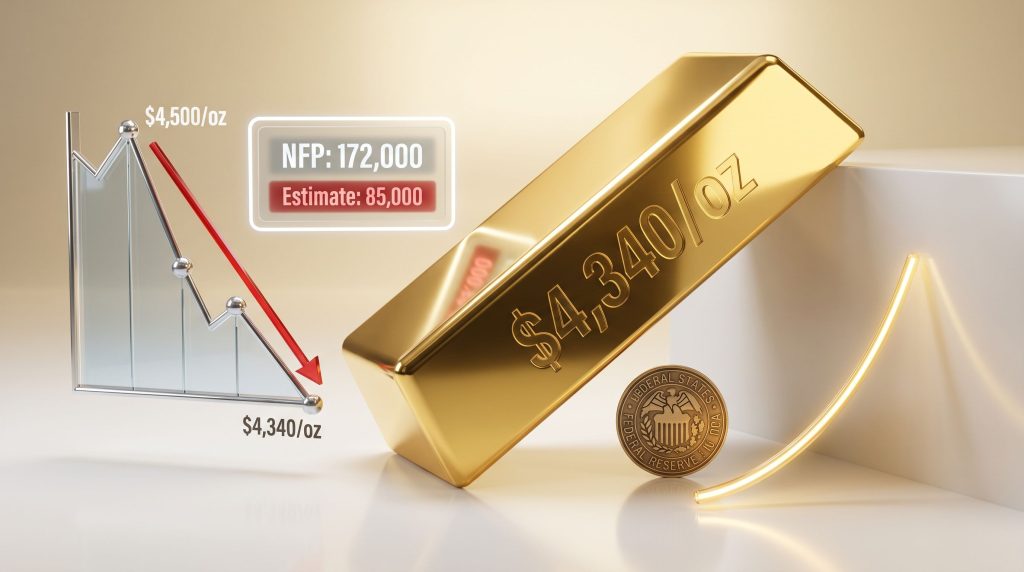
The May Non-Farm Payrolls report delivered a figure that left little room for ambiguous interpretation. The U.S. economy added 172,000 jobs during the month, against a consensus forecast calling for approximately 85,000. That gap of roughly 87,000 jobs above estimates represented a substantial beat by any historical standard. Furthermore, the Bureau of Labor Statistics simultaneously revised the prior month's count upward by more than 60,000 jobs, meaning the cumulative labor market picture was even stronger than the headline figure suggested.
Strong US jobs data has repeatedly demonstrated its power to shift gold markets, and this report was no exception. The table below captures the full scope of the market impact:
| Metric | Consensus Estimate | Actual Result | Market Impact |
|---|---|---|---|
| May NFP Job Additions | 85,000 | 172,000 | Gold fell ~$135/oz intraday |
| Prior Month Revision | Not estimated | +60,000+ upward | Amplified hawkish repricing |
| Gold Spot Price Range | ~$4,500/oz support | Low of ~$4,340/oz | Largest single-session drop in 3+ months |
| Weekly Gold Price Change | Not applicable | -$200+/oz from prior close | Multi-week low territory |
The intraday move was striking in its velocity. Spot gold shed more than $125/oz within the trading session, eventually printing a session low near $4,340/oz and recording a weekly loss exceeding $200/oz from the prior close. For context, that weekly decline represents one of the sharpest pullbacks in the current cycle.
"A jobs number more than double the forecast does not merely reduce rate cut expectations at the margin. It effectively removes them from the near-term conversation, forcing the market to reassess not just when the Fed might ease, but whether it might need to consider tightening further if labor strength persists alongside elevated inflation."
Why This Report Pushes the Fed Rate Cut Timeline Further Out
The Dual Mandate Dilemma Facing Policymakers
The Federal Reserve operates under a dual mandate: maintaining price stability and supporting maximum employment. When one leg of that mandate is running hot, the other becomes less of a justification for looser monetary policy. A labor market adding 172,000 jobs in a single month, against a backdrop of already-elevated inflation readings, signals that the economy may be generating the kind of demand that central bankers specifically want to cool.
From a monetary policy perspective, labor market resilience of this magnitude argues strongly against any pivot toward easier financial conditions. Reducing interest rates when employment is this robust would risk reigniting inflationary pressures, which the Fed has spent considerable institutional credibility attempting to contain. Consequently, the near-term implications for the rate cut timeline are significant:
- The June FOMC meeting, scheduled approximately ten days after the NFP release, is now widely expected to result in a hold, with no rate adjustment.
- The Kansas City Federal Reserve's Jackson Hole Symposium in August, often used as a platform to signal policy pivots, is now considerably less likely to deliver dovish messaging that gold markets had been partially pricing in.
- A higher-for-longer rate environment through at least the third quarter of 2026 appears to be the base case the market is adjusting toward.
The concept of "higher for longer" carries particular weight for gold. Prolonged elevated rates mean persistent real yield competition, sustained dollar strength, and reduced speculative appetite for non-yielding safe-haven assets outside of genuine crisis scenarios.
The Geopolitical Layer: How the US-Iran Ceasefire Compounded Gold's Weakness
Understanding the Two Types of Geopolitical Risk Premium
Gold does not respond to all geopolitical risk equally. Market participants price two distinct categories of geopolitical uncertainty into gold:
- Structural risk premium: Arising from long-duration conflicts with unresolved underlying causes, persistent supply disruption threats, and sustained inflation risk channels through energy markets.
- Tactical risk premium: Arising from short-term headline events such as ceasefire announcements, diplomatic negotiations, or temporary de-escalation that markets interpret as reducing immediate tail risk.
The 60-day extension of the US-Iran ceasefire announced over the weekend prior to the jobs report introduced precisely the latter category. Markets interpreted the development as a reduction in immediate conflict escalation risk, unwinding some of the geopolitical fear premium that had helped anchor gold near $4,500/oz through much of May and early June. However, as weak US data in prior periods has shown, geopolitical optimism can be rapidly overtaken by macro forces.
"It is important to recognise, however, that a 60-day ceasefire extension is not a resolution. The underlying tensions that drove crude oil prices higher, and through them inflation expectations, remain structurally intact."
The oil price channel matters here specifically because crude prices feed directly into headline inflation readings. If a fragile ceasefire collapses, energy prices could spike, reigniting inflationary pressures that complicate the Fed's path regardless of labor market conditions.
Kevin Warsh and the Policy Uncertainty Premium
Why a New Fed Chair Adds a Layer of Market Ambiguity
Among the less-discussed variables currently influencing gold pricing is the leadership transition at the Federal Reserve. Kevin Warsh, the newly installed Fed Chair, will preside over his first Federal Open Market Committee meeting approximately ten days after the May jobs report release. Markets have not yet had the opportunity to calibrate his communication style, his risk tolerance regarding inflation versus growth trade-offs, or his appetite for signalling forward guidance.
This uncertainty itself carries a modest but real risk premium in precious metals. Traders who might otherwise position aggressively around a known Fed Chair's likely messaging are operating with less conviction about what a Warsh-led FOMC statement will emphasise. Will his inaugural press conference lean hawkish given the labor market strength? The answers to these questions will shape gold's trajectory through the summer months, and in particular, the gold price forecast analysts are working with heading into the second half of 2026.
The next major ASX story will hit our subscribers first
The Pre-FOMC Macro Checklist for Gold Market Participants
Data Points That Will Shape Gold's Near-Term Direction
Before the June FOMC decision, several key data releases and market indicators deserve careful attention from gold investors and traders. The following checklist summarises the most consequential inputs:
- May CPI (Consumer Price Index) released Tuesday following the jobs report. If inflation prints above expectations, the combined signal of hot employment and rising prices would represent a genuinely hawkish double-shock for gold markets.
- Core PCE trends, the Federal Reserve's preferred inflation measurement, will be watched for any divergence from headline CPI that might soften or intensify the policy outlook.
- Dollar Index (DXY) movement following the NFP release. A sustained break higher in the dollar would confirm the hawkish repricing and add sustained directional pressure on gold.
- 10-Year Treasury yield trajectory. Rising real yields remain the single most consistent drag on gold in the current environment.
- Fed Funds Futures market implied probabilities. Shifts in the June and July cut probabilities will tell traders how aggressively the market is repricing the easing timeline.
- Crude oil price stability. Any renewed escalation in the Middle East that pushes oil higher would reintroduce the inflation-through-energy channel that could eventually support gold, even in a high-rate environment.
Gold Price Levels in Technical and Historical Context
What the Move Below $4,400 Means Structurally
Price levels in commodities markets carry both technical significance and psychological significance derived from round-number anchoring effects on institutional and retail positioning alike. The $4,500/oz level had served as a meaningful support zone through most of May and early June, reinforced by geopolitical risk bids and residual expectations that the Fed might ease later in the year.
The $4,400/oz level, a psychologically important round number, was breached intraday in the wake of the jobs report. The $4,340/oz session low marks the weakest gold has traded in more than three months. In addition, the role of central banks influencing gold prices adds another structural dimension to how these support levels are formed and defended.
| Price Level | Significance | Context |
|---|---|---|
| ~$4,500/oz | Key summer support zone | Held through most of May and early June |
| ~$4,400/oz | Psychological round number | Breached intraday post-NFP release |
| ~$4,340/oz | Post-NFP session low | Lowest bid price in over three months |
| ~$200+/oz weekly loss | Magnitude of the decline | Among the largest weekly pullbacks in the current cycle |
Historically, gold's response to NFP beats in high-rate environments follows a recognisable pattern often described by market practitioners as the sell-the-strong-data dynamic. In prior cycles, when labor market data significantly exceeded estimates while the Fed was already in a hold or restrictive posture, gold typically underperformed for one to three weeks following the release before finding stabilisation.
Recovery conditions tend to require at least one of the following: a softening in subsequent economic data, a shift in Fed communication toward more dovish language, or a geopolitical escalation serious enough to reignite safe-haven demand regardless of the rate environment.
FAQ: Gold, Jobs Reports, and the Federal Reserve
Does a Strong Jobs Report Always Cause Gold to Fall?
Not always, but it frequently does when the jobs report strength materially reduces expectations for near-term rate cuts. The transmission mechanism through rate expectations, dollar strength, and real yields is well established, though the magnitude of the response varies.
How Much Do Rate Cut Expectations Influence Gold?
Significantly. Gold's price is highly sensitive to the real yield environment. When markets price out rate cuts, real yields rise and the opportunity cost of holding gold increases. This is one of the most consistent relationships in commodities markets, and it directly shapes how gold performs as a safe haven during periods of monetary tightening.
What Is the Relationship Between the U.S. Dollar and Gold?
Gold is denominated in U.S. dollars globally, so a stronger dollar makes gold more expensive in other currencies, reducing international demand. Additionally, dollar strength typically accompanies the same macro conditions — tighter monetary policy expectations — that suppress gold demand from a yield perspective.
Why Do Treasury Yields Rise When Employment Data Beats Expectations?
Because strong employment suggests the economy does not need monetary stimulus. Markets reprice the Fed's likely path toward holding or tightening, which pushes bond prices lower and yields higher.
What Would Need to Happen for Gold to Reclaim $4,500/oz?
A meaningful softening in subsequent economic data, particularly CPI, a shift in Fed communication toward more accommodative language, or a significant geopolitical escalation that reignites safe-haven demand would all provide conditions for a recovery toward that level. Furthermore, understanding recession impacts on gold provides useful context for how quickly conditions can shift in gold's favour.
How Does the FOMC Meeting Affect Precious Metals Markets?
FOMC decisions and, crucially, the statement language and press conference that accompany them directly shape expectations for the rate path. For gold specifically, the tone of forward guidance often matters more than the decision itself.
Three Converging Forces Compressing Gold's Near-Term Upside
The current headwinds facing gold can be distilled into three distinct but reinforcing pressures:
- Labor market resilience far exceeding consensus forecasts, reducing the Federal Reserve's justification for near-term rate cuts and pushing the realistic easing timeline well beyond the August Jackson Hole window.
- Geopolitical risk premium erosion from a fragile but market-moving ceasefire extension, which reduced the upward support that conflict uncertainty had provided near the $4,500/oz level, even though the underlying structural risks remain unresolved.
- Policy uncertainty surrounding a newly installed Federal Reserve Chair entering his inaugural FOMC cycle, adding an additional layer of ambiguity to forward guidance expectations.
Traders and investors would be well served to pay closer attention to the language of the June FOMC statement than to the rate decision itself. In the current environment, a single sentence about the future pace of policy adjustment could matter far more than any hold or cut decision that is already widely anticipated. The medium-term trajectory for gold will likely be determined not by the moment gold falls after strong May jobs report and fading Fed cut hopes shook markets, but by the cumulative macro picture that assembles itself over the next several weeks.
Disclaimer: This article is for informational purposes only and does not constitute financial advice. Gold prices are subject to significant volatility and past price patterns do not guarantee future performance. Readers should conduct their own research and consult a qualified financial adviser before making investment decisions.
Want To Stay Ahead of the Next Major Mineral Discovery on the ASX?
While macroeconomic forces like jobs data and Fed policy shape gold's short-term trajectory, the real long-term wealth-building opportunities often emerge from significant new mineral discoveries — and Discovery Alert's proprietary Discovery IQ model delivers real-time ASX discovery alerts straight to subscribers, turning complex data across 30+ commodities into clear, actionable insights. Explore historic discovery returns on Discovery Alert's dedicated discoveries page to understand what's possible, then begin a 14-day free trial at discoveryalert.com.au to position yourself ahead of the broader market.