
August 22, 2026
The Economics of Scale: Why Gold M&A Is Reshaping Australia's Mining Sector
When commodity prices sustain elevated levels over an extended period, they do something counterintuitive to mining boardrooms: they make buying easier than building. The logic is straightforward. At high spot prices, producing assets carry inflated strategic value, greenfield development timelines look increasingly unattractive relative to acquisition payback periods, and the cost of financing deals becomes more palatable against a backdrop of strong cash generation. This dynamic is playing out across Australia's gold sector right now, with the Genesis bid for Vault Minerals serving as the clearest expression of a structural shift that has been building for several years.
Understanding why this deal matters requires more than reading the headline figures. It demands an appreciation of how scale economics function in gold mining, what the legal architecture of a contested scheme of arrangement actually looks like, and why the Western Australian Goldfields region sits at the centre of this consolidation story.
When big ASX news breaks, our subscribers know first
What Is Driving Consolidation in Australian Gold?
Three converging pressures are compressing the strategic options available to mid-tier Australian gold producers, and none of them are temporary.
Rising all-in sustaining costs (AISC) have eroded the margin advantage that smaller, high-grade producers once enjoyed. Labour shortages in Western Australia's mining regions, energy cost inflation, and the increasing capital intensity of reserve replacement have pushed AISC higher across the sector. Producers that cannot spread fixed infrastructure costs across a large enough ounce base face a structural disadvantage that no amount of operational efficiency can fully offset.
Institutional investor preference for scale has simultaneously shifted capital allocation patterns. Fund managers with large resource mandates increasingly favour producers offering operational diversification, multi-mine redundancy, and liquidity profiles that come with larger market capitalisations. Single-asset or dual-asset producers find themselves competing for a shrinking pool of institutional attention.
Gold price elevation has made the arithmetic of acquisition-led growth more compelling than at any point in the past decade. Furthermore, record gold prices have ensured that the implied net present value of producing assets rises, making it more capital-efficient to acquire existing production than to develop new resources through the three-to-seven-year greenfield pathway.
The current consolidation cycle is not a short-term opportunistic response to a price spike. It reflects a structural realignment in how Australian gold producers must be positioned to remain competitive across a full commodity cycle.
Breaking Down the Genesis Bid for Vault Minerals
Deal Architecture and Financial Terms
The Genesis bid for Vault Minerals is structured as a hybrid consideration scheme of arrangement, combining scrip and cash components in a design that serves multiple strategic objectives simultaneously.
| Deal Parameter | Genesis Minerals Proposal |
|---|---|
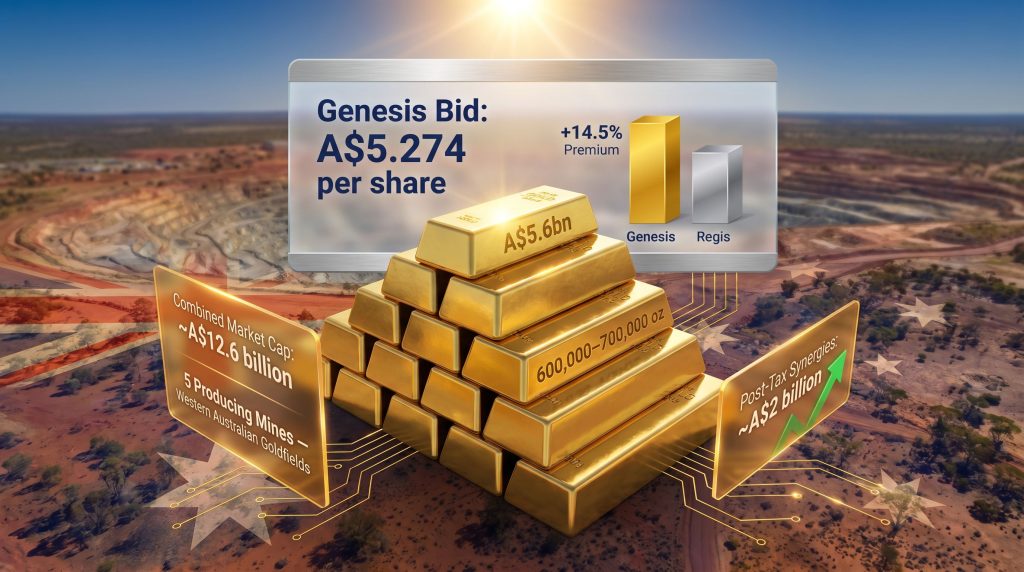
| Total Offer Value | A$5.6 billion (~US$3.8 billion) |
| Implied Per-Share Price | A$5.274 per Vault share |
| Consideration Structure | 0.7629 Genesis shares + A$0.475 cash per Vault share |
| Premium Over Rival Bid | 14.5% above the implied Regis Resources deal value |
| Financing Arrangement | A$1 billion credit facility secured from NAB and Westpac |
| Conditionality | Not subject to due diligence or financing conditions |
The cash component of A$0.475 per share is particularly significant from a deal credibility standpoint. In all-scrip transactions, target shareholders bear the risk that the acquirer's share price deteriorates between announcement and completion, eroding the implied offer value. The cash element eliminates a portion of that risk, making the offer more defensible under independent expert scrutiny.
The pre-arranged A$1 billion credit facility from NAB and Westpac removes what is often the most potent source of deal uncertainty: financing risk. By presenting a fully committed funding package alongside the proposal, Genesis has structurally strengthened the board case for superior proposal classification. According to reporting from Mining.com, this unconditional financing arrangement was a decisive factor in Vault's board assessment of the competing offers.
Why Scrip-Plus-Cash Structures Favour Both Parties
For Genesis, the hybrid structure preserves balance sheet flexibility. A fully cash-funded offer of this scale would require either significant debt, a dilutive equity raise, or both. By using its own shares as partial consideration, Genesis effectively uses its elevated market capitalisation as acquisition currency — a standard tool in M&A playbooks when acquirer share prices are high relative to historical norms.
For Vault shareholders, the structure delivers:
- Immediate liquidity through the cash component, reducing valuation uncertainty
- Ongoing participation in the upside of the combined entity through the scrip component
- A higher implied value per share than the competing Regis Resources arrangement
- The protection of a board-endorsed superior proposal classification
The Competing Bids: Genesis vs Regis Resources
A Structural Comparison
| Comparison Dimension | Regis Resources Deal | Genesis Minerals Proposal |
|---|---|---|
| Deal Type | All-stock merger | Scrip + cash hybrid |
| Implied Premium | Baseline | +14.5% |
| Board Classification | Original agreement | Superior Proposal |
| Financing Certainty | Conditional | Unconditional (pre-arranged) |
| Combined Market Cap | Smaller scale | ~A$12.6 billion |
The Superior Proposal Mechanism Explained
The term superior proposal carries precise legal meaning in Australian M&A. Under scheme of arrangement structures governed by the Corporations Act 2001 (Cth), a target company that has executed a binding implementation deed with an acquirer can still engage with a competing bidder if the board determines that the competing offer meets a defined threshold of superiority.
Vault's board unanimously determined that the Genesis proposal cleared that threshold. This triggered a matching rights period, during which Regis Resources was granted until 11:59pm AWST on 10 July 2026 to either match or improve its original deal terms. This is not an informal negotiation window; it is a contractually defined and legally enforceable process designed to protect both the original acquirer's invested negotiation costs and target shareholders' right to the best available outcome.
If Regis fails to submit a matching or improved proposal within the deadline, Vault's board becomes free to proceed toward binding documentation with Genesis. If Regis matches the offer, Vault's board is required to reassess under the same comparative framework, potentially triggering further competitive rounds. Indeed, the Gold Road takeover battle provides a useful precedent for how these contested processes can evolve in the Australian market.
The matching rights mechanism is one of the more misunderstood features of Australian M&A. It is not a veto power for the original acquirer. It is a time-limited opportunity to compete on improved terms, after which the target board's fiduciary obligations to shareholders take precedence.
What the Combined Entity Would Look Like
Scale, Production, and Western Australian Goldfields Concentration
If the Genesis bid for Vault Minerals proceeds to completion, the resulting entity would represent a genuinely new tier of scale among dedicated Australian gold producers.
| Metric | Combined Genesis-Vault Entity |
|---|---|
| Annual Gold Production | 600,000 to 700,000 ounces |
| Pro-Forma Market Capitalisation | ~A$12.6 billion (US$8.8 billion) |
| Post-Tax Synergy Estimate | ~A$2 billion |
| Producing Mines | 5 (Western Australian Goldfields) |
The geographic concentration of all five producing mines within Western Australia's Goldfields region is a critical detail that often receives insufficient analytical attention. The Goldfields is not simply a regulatory jurisdiction; it is one of the world's most geologically endowed gold-producing terranes, underpinned by the Yilgarn Craton, an Archaean granite-greenstone belt with a demonstrated capacity to host large, long-life orebody systems.
Why Geographic Clustering Amplifies Synergy Value
When producing operations are clustered within the same geological province and regional infrastructure corridor, the synergy calculus changes materially compared to geographically dispersed combinations. Specifically:
- Processing consolidation becomes feasible. Ore from multiple mines can potentially be directed toward the highest-capacity or lowest-cost processing facility in the network, improving mill utilisation rates and reducing per-tonne processing costs.
- Logistics cost compression is achievable. Shared reagent supply chains, equipment fleets, and maintenance contractor networks reduce duplication across the combined asset base.
- Technical talent concentration allows specialist geological, engineering, and metallurgical expertise to be deployed across multiple assets without relocation costs.
The A$2 billion post-tax synergy estimate, while substantial, is not implausible in this context. Research published by GEM Mining Consulting on district-level value creation supports the principle that treating nearby operations as integrated districts, rather than standalone assets, can unlock significant additional value. GEM's District Potential Value Index, derived from screening over 1,600 mines and projects globally, found that economic scale, shared infrastructure, and operational coordination deliver more value than geographic proximity to resources alone.
Vault's King of the Hills Operation: A Key Asset
Vault's flagship King of the Hills (KOTH) operation in the Goldfields region is a material component of the strategic rationale. KOTH is a large-scale open-pit and underground operation with meaningful production capacity, and its inclusion in the combined entity's portfolio adds geological and operational diversity that complements Genesis's existing Leonora-district asset base. Moreover, the completion of definitive feasibility studies across key assets in the portfolio has materially de-risked the combined entity's growth profile.
How Markets Interpreted the Announcement
Reading the Divergent Share Price Reactions
Market responses to contested takeover announcements follow well-documented behavioural patterns, and the reactions to the Genesis bid for Vault Minerals were textbook in their divergence.
- Vault Minerals shares advanced 11.6%, closing at A$5.09 following the announcement
- Genesis Minerals shares declined 4.1%, closing at A$6.03
The gap between Vault's trading price of A$5.09 and the implied offer value of A$5.274 is analytically significant. This spread, known in merger arbitrage as the deal spread, represents the market's probability-weighted assessment of deal completion risk. A smaller spread implies higher market confidence that the transaction will close on stated terms; a wider spread signals elevated uncertainty around regulatory, shareholder, or competitive risk factors.
In contested scheme situations, tracking the evolution of the deal spread over time provides a more accurate signal of deal completion probability than any single analyst commentary. Spread compression following the matching rights deadline would indicate the market has effectively priced out the Regis counter-bid risk.
Genesis's share price decline reflects the acquirer discount phenomenon that is well-documented in academic M&A literature. Markets frequently mark down acquiring companies at announcement, pricing in concerns about integration execution risk, synergy delivery uncertainty, and the dilutive effect of issuing new shares. Whether this discount persists or reverses depends heavily on the credibility of the synergy case and the quality of integration planning disclosed in subsequent documentation. The gold price impact on mining equities will also play a significant role in how the combined entity's share price evolves through the approval process.
The next major ASX story will hit our subscribers first
Regulatory and Shareholder Pathway to Completion
The Approval Gauntlet
Completing the Genesis bid for Vault Minerals requires clearing a multi-stage approval process with distinct risk characteristics at each gate.
- Matching rights deadline: Regis Resources must either improve its offer or allow the deadline to pass before Genesis can move toward binding documentation.
- Independent expert report: An independent expert must formally conclude that the scheme is in the best interests of Vault shareholders. Aggressive synergy assumptions or a deterioration in Genesis's share price between announcement and report completion could complicate this assessment.
- Shareholder vote: A minimum of 75% of Vault shareholders voting in favour is required for scheme approval. This is a higher bar than a simple majority and requires broad alignment across institutional and retail registers.
- Court sanction: Following shareholder approval, the scheme must receive judicial sanction under the Corporations Act before it becomes legally binding.
- FIRB consideration: Depending on the composition of Vault's foreign ownership, Foreign Investment Review Board notification may be required, adding a regulatory timeline variable.
Key Risk Factors Investors Should Monitor
- Regis counter-bid escalation: A higher Regis offer would force Vault's board into a fresh comparative assessment, potentially triggering a bidding war that inflates the acquisition price beyond Genesis's optimal return threshold.
- Gold price volatility: The scrip component's implied value is directly sensitive to Genesis's share price, which in turn reflects gold price movements. A material gold price correction before the scheme vote could reduce the effective offer value and complicate shareholder approval.
- Synergy scrutiny: The A$2 billion post-tax synergy estimate will face rigorous examination by the independent expert and institutional shareholders. Delivery credibility will be a central determinant of investor support.
- Integration complexity: Combining five producing mines with distinct operational cultures, workforce agreements, and processing configurations is inherently complex. Markets will assess management's track record in integration execution.
Positioning Within Australia's Broader Gold M&A Cycle
A New Benchmark for Scale
The Genesis bid for Vault Minerals, if completed, would establish a new reference point for what constitutes meaningful scale among Australian dedicated gold producers. A combined entity producing 600,000 to 700,000 ounces annually with a market capitalisation of approximately A$12.6 billion occupies a genuinely different competitive tier from either company on a standalone basis.
This scale creates compounding advantages that extend beyond the operational synergies already identified:
- Capital markets access: Larger market capitalisations attract index inclusion eligibility, broadening the institutional investor base and improving share price liquidity.
- Hedging capacity: Larger production volumes provide greater flexibility in gold hedging strategies, allowing the combined entity to selectively lock in pricing on a portion of output without constraining upside participation.
- Talent attraction: Scale and financial stability improve the combined entity's ability to attract and retain specialist technical talent in a competitive labour market.
The transaction also sends a signal to comparable-scale operators across the Australian gold sector. Furthermore, broader Australian gold M&A activity indicates that mid-tier producers that have not yet pursued strategic combinations face increasing pressure to either initiate consolidation or risk becoming acquisition targets themselves as the cycle matures.
Research on district-level mining value creation consistently demonstrates that integrated operational networks outperform collections of standalone mines on long-run return metrics, particularly when infrastructure sharing is achievable. The Genesis-Vault combination is structured precisely to capture this effect.
What This Means for the Sector's Competitive Landscape
The emergence of a A$12.6 billion dedicated Australian gold producer would alter competitive dynamics across the sector in ways that extend well beyond the two companies directly involved. Smaller producers in adjacent Goldfields tenements face potential shifts in land access negotiations, infrastructure pricing, and labour market competition. Larger global gold majors assessing Australian asset acquisition opportunities would encounter a more formidable locally-listed counterparty in any contested process.
Consequently, as reported by the Australian Financial Review, the consolidation logic that underpins the Genesis bid for Vault Minerals is not unique to these two companies. It reflects a sector-wide recalibration of what scale is required to remain competitive across a full commodity cycle, and that recalibration has only just begun.
This article is intended for informational purposes only and does not constitute financial advice. Readers should conduct their own independent research and consult qualified financial advisers before making investment decisions. Forward-looking statements, synergy estimates, and transaction timelines are subject to material uncertainty and may not be achieved.
Want to Spot the Next Major ASX Gold Discovery Before the Market Moves?
Discovery Alert's proprietary Discovery IQ model delivers real-time alerts on significant ASX mineral discoveries, cutting through complex data to surface actionable opportunities the moment they are announced — explore historic discoveries and the returns they generated, then start your 14-day free trial at Discovery Alert to position yourself ahead of the next major find in Australia's gold sector.