Adavale Resources Ltd
- ASX Code: ADD
- Market Cap: $14,184,761
Adavale Resources Extends Gold Mineralisation Across Full 1.5km Strike at London-Victoria Ahead of Resource Update
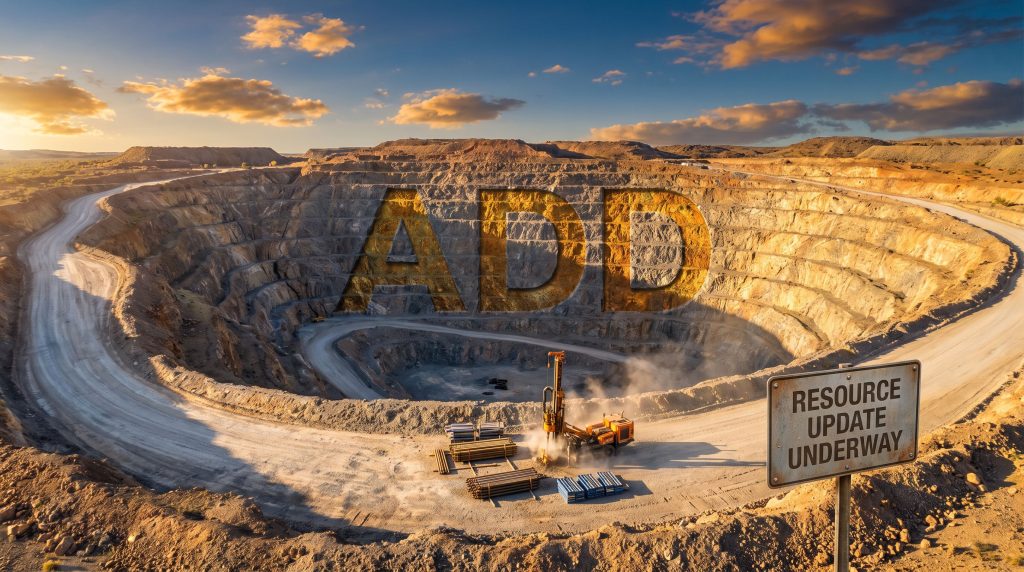
Adavale Resources Limited (ASX: ADD) has reported assay results from a further 11 reverse circulation (RC) holes for 2,394 metres at the London-Victoria Gold Mine in New South Wales, with results indicating consistent gold mineralisation beneath the existing 1.5km-long open pit. According to the ASX announcement, the latest drilling adds density across the northern, central and southern parts of the deposit ahead of a planned Mineral Resource Estimate (MRE) update this quarter, expected by mid-Q3 CY26.
The latest batch includes broad intercepts such as 31m at 1.29 g/t Au from 133m in ALRC070, 30m at 0.80 g/t Au from 137m in ALRC060, and 44m at 0.62 g/t Au from 128m in ALRC061. For investors, the key point is not one isolated high-grade result. The drilling pattern suggests continuity across multiple sections, which is the type of data that can strengthen a resource model and potentially support future upgrades in confidence.
When big ASX news breaks, our subscribers know first
Drilling Results Support Continuity Below the Open Pit
In the announcement, Adavale stated that most of the 11 holes returned reportable gold mineralisation across six drill sections spanning about 700 metres of northing. This matters because resource growth and classification upgrades depend on repeatable mineralisation across a deposit, not just localised higher-grade zones.
The company highlighted a mix of broad lower-grade intervals and narrower higher-grade zones. Together, these results are reported to support a persistent mineralised package beneath and along strike of the existing pit.
The most closely watched results from this batch are summarised below.
| Hole ID | From (m) | Width (m) | Grade (g/t Au) | Commentary |
|---|---|---|---|---|
| ALRC070 | 133 | 31 | 1.29 | Approximately 16m below pit floor |
| ALRC060 | 137 | 30 | 0.80 | Includes 7m at 1.46 g/t Au from 158m |
| ALRC061 | 128 | 44 | 0.62 | Includes 5m at 1.02 g/t Au from 128m |
| ALRC062 | 180 | 5 | 1.99 | Includes 3m at 2.92 g/t Au from 181m |
| ALRC068 | 144 | 3 | 3.52 | Higher-grade local zone |
| ALRC069 | 144 | 7 | 1.70 | Additional support for continuity |
Adavale also reported that assays for a further 10 drillholes are still being processed and are expected in the coming weeks. That means the current dataset is not yet complete, and the next results could add more detail ahead of the MRE update.
What Does the Managing Director Say?
"These latest results reinforce what the systematic drillout is showing us, gold mineralisation is consistently developed below the London-Victoria pit across multiple sections," said David Ward, Managing Director.
"Importantly, this is not dependent on a single standout hole. The repeated intersections across the whole 1.5km strike of the open pit are increasing drill density and strengthening our geological interpretation ahead of the planned Mineral Resource update."
Why Does the ALRC070 Result Stand Out?
The headline intercept in ALRC070 is important not only because of its width and grade, but because of where it sits. According to the announcement, the 31m at 1.29 g/t Au intersection begins just 16 metres below the pit floor.
That shallow position could matter in a development scenario. Adavale stated that this mineralisation could potentially be accessed early in a future pit cutback, which is an extension of an existing open pit rather than a completely new mining development.
In practical terms, this can be relevant because extending an established pit may involve a simpler pathway than starting from scratch, subject to future technical and economic work. Furthermore, if future studies support this view, mineralisation close to the pit floor may also provide a source of early plant feed.
At this stage, the company has not outlined a formal development plan, but it has confirmed that preliminary scoping studies are underway to assess development pathways.
What Does a Systematic RC Drillout Mean for Investors?
For investors less familiar with exploration and resource development, Adavale's reference to a systematic resource drillout is central to understanding this update.
Understanding Reverse Circulation Drilling
Reverse circulation drilling is a widely used method in mineral exploration. It collects rock chips from depth using air-driven drilling, producing samples that are suitable for assay and often used for resource definition work. RC drilling is generally faster and less expensive than diamond drilling, making it useful when a company wants broad coverage across a known deposit.
A systematic drillout means holes are drilled in a planned pattern to improve data spacing and geological confidence. The purpose is usually to support a resource estimate, not simply to test an unexplored target.
That matters because Adavale's current London-Victoria resource, reported in its 5 May 2025 ASX announcement, stands at 3.8 million tonnes at 0.95 g/t Au for 115,000 ounces of gold at a 0.25 g/t cut-off, classified as Inferred under the JORC Code. More drilling can potentially do two things:
- Add ounces if mineralisation extends beyond the current model
- Improve confidence in the resource through tighter drill spacing
A higher-confidence classification, such as Indicated, can be important because it is typically better suited to mine planning and economic studies.
Understanding the Geological Model at London-Victoria
The geological interpretation in the announcement provides useful context for why intercepts vary from one section to another. Adavale reported that gold mineralisation occurs within a shear zone associated with the London-Victoria Fault, where volcanic rocks on one side of the fault meet sediments and tuffs on the other side.
In simple terms, a shear zone is an area where rocks have been deformed and fractured by movement in the Earth's crust. These zones can act as pathways for mineral-rich fluids, which is why they are often associated with gold deposits.
How Does Plunging Geometry Affect the Results?
The company also stated that the mineralisation shows plunging geometry. This means the gold zones dip and extend into the ground at an angle rather than lying flat. As a result, a broad interval on one cross section may appear narrower on the next, even if the mineralised zone remains continuous in three dimensions.
According to Adavale, when the drilling is viewed in 3D, the intersections define coherent plunging trends beneath and along strike of the shear zone. The company additionally noted preliminary observations suggesting gold mineralisation may be hosted within a tight antiformal structure, which is a folded rock shape that arches upward. This interpretation is still being investigated.
Metallurgy and Development Studies Add Another Layer to the Story
Drilling results are only one part of the development picture. Adavale also outlined ongoing technical work that could influence how London-Victoria is assessed in future studies.
The announcement referenced earlier preliminary metallurgical sighter testwork completed by Fremantle Metallurgy on three RC drill reject composite samples. Those tests returned 24-hour cyanide leach recoveries of approximately 81% to 83% for high-grade composites and around 68% for a low-grade composite.
Metallurgical recovery measures how much gold can be extracted from the ore using a given processing method. In this case, the testwork suggests the higher-grade material responded reasonably well to standard cyanide leaching, however the company noted that the work is preliminary and based on a limited number of samples.
Adavale has stated that further metallurgical testwork on core samples is planned. This is relevant because core-based testwork can provide more detailed information on how recovery varies across different parts of the deposit.
Near-Term Catalysts Across London-Victoria and the Wider Parkes Project
The next few months appear active for Adavale based on the work programme outlined in the report. The MRE update remains the closest catalyst, but it sits within a broader set of technical and exploration activities.
| Activity | Project Area | Status / Timing |
|---|---|---|
| MRE update | London-Victoria | Expected mid-Q3 CY26 |
| Assays from 10 further holes | London-Victoria | Expected in coming weeks |
| Metallurgical testwork on core | London-Victoria | Planned |
| Preliminary scoping studies | London-Victoria | Underway |
| High-resolution geophysics | London-Victoria | Being evaluated |
| Magnetic survey review | Calarie ML739 | Planned |
| Drill target refinement | Calarie ML739 | Planned |
| RC and/or diamond drilling | Calarie ML739 | Follow-up stage |
| Magnetics and geochemistry extension | Ashes / wider Parkes | Planned |
| First-pass drilling | Regional greenfields targets | Planned |
For investors, the significance of the MRE update is straightforward. It should provide a measurable indication of whether the current drill programme has added tonnage, ounces, confidence, or a combination of the three.
Broader Project Context in the Lachlan Fold Belt
London-Victoria sits within Adavale's broader Parkes Project, which the company says covers about 610km² across 70km of contiguous strike in the Macquarie Arc of New South Wales' Lachlan Fold Belt. This is a well-known mining district with established gold and copper operations.
According to the company, the Parkes Project includes a combined historical resource of 166,000 ounces of gold across the London-Victoria Mine and the Calarie Mining Licence. The tenure also includes 10 additional granted exploration licences considered prospective for gold and copper.
The regional setting includes major operations such as:
| Nearby Operation | Owner | Reported Scale |
|---|---|---|
| Cadia-Ridgeway | Newmont | 35.1Moz Au and 7.9Mt Cu |
| Northparkes | Evolution Mining | 5.2Moz Au and 4.4Mt Cu |
| Tomingley / Peak Hill | Alkane Resources | Producing regional deposits |
Regional comparisons can help illustrate geological prospectivity, but they are not a guide to future outcomes at Adavale's tenure. However, what they do show is that the district has the geological setting capable of hosting large mineral systems.
The next major ASX story will hit our subscribers first
Why This Update Matters for ASX Gold Investors
This ASX announcement is important because it moves London-Victoria further from being a historical mine with a maiden resource and closer to being a more tightly defined brownfields gold project.
Several points stand out:
- Mineralisation has now been reported across the full 1.5km strike of the open pit
- Broad intercepts are recurring across multiple drill sections
- ALRC070 sits very close to the pit floor, which may be relevant for any future pit cutback scenario
- An updated MRE is due this quarter, giving the market a near-term benchmark
- Additional assay results are still pending, which could add more support to the geological model
The announcement does not confirm a development decision, production restart or resource upgrade. What it does provide is a larger and denser body of drill data that may strengthen the geological interpretation and feed directly into the upcoming resource update.
For investors tracking ASX gold exploration stocks, Adavale's next milestone is clear. The value of this drill campaign will be tested by the scale and quality of the forthcoming London-Victoria MRE update, alongside the remaining assay results expected over the coming weeks.
Want to Stay Ahead of Significant ASX Gold Discoveries Like This One?
Discovery Alert's proprietary Discovery IQ model delivers real-time alerts the moment significant mineral discoveries are announced on the ASX, translating complex exploration data into actionable insights for both short-term traders and long-term investors — explore historic examples of major discovery returns to understand what early positioning can mean, and begin your 14-day free trial at Discovery Alert to ensure you never miss the next significant find.