May 9, 2026
When Safe Havens Stop Behaving: The Paradox of Gold in an Energy Crisis
There is a widely held assumption among investors that gold and geopolitical instability move in lockstep. Buy bullion when the world looks uncertain, and the safe-haven premium will reward patience. That assumption, while historically grounded, has encountered a significant challenge in 2026. A conflict that began in late February has exposed a structural fault line in the gold-as-refuge thesis, one that depends not just on whether tensions exist, but on what kind of economic damage those tensions produce.
When geopolitical conflict disrupts energy supply chains rather than simply triggering generalised fear, the downstream consequences for monetary policy can actively work against gold's appeal. Understanding gold safe-haven dynamics is not just an academic exercise. For investors navigating precious metals markets right now, it is the single most important variable determining price direction.
When big ASX news breaks, our subscribers know first
Why Gold Rebounds as Oil Eases, But Inflation Concerns Linger
The headline from May 5, 2026 carries a compressed but important insight: gold rebounds as oil eases, inflation concerns linger. Each clause matters individually, and the relationship between them defines the current market structure.
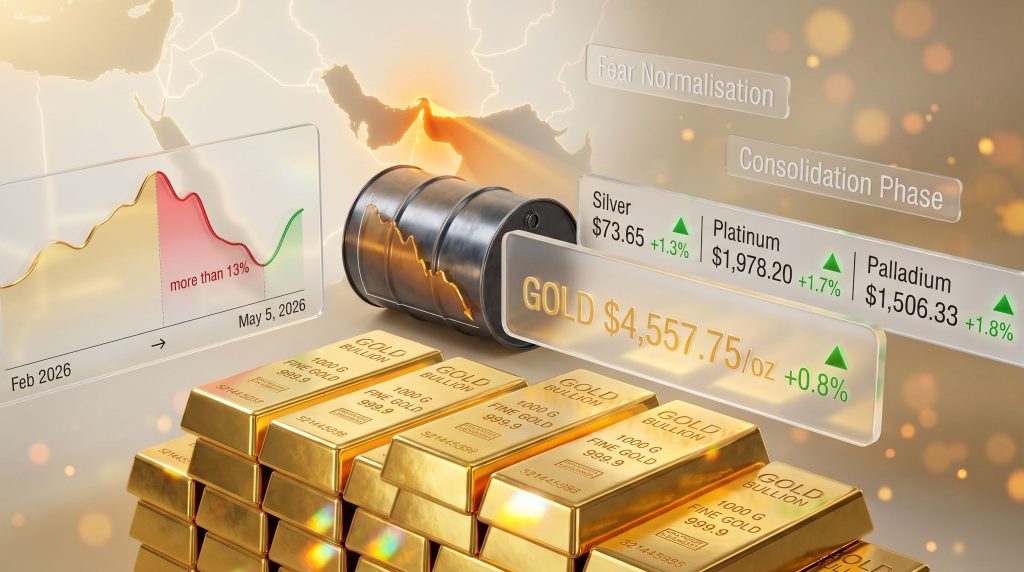
Spot gold rose 0.8 percent to $4,557.75 per ounce by 1138 GMT on May 5, 2026, recovering from a five-week low struck in the prior session, the lowest print since March 31, 2026. US gold futures for June delivery matched that move, gaining 0.8 percent to $4,568.50. The recovery followed a retreat in crude oil prices, which slipped after the United States launched an operation aimed at reopening the Strait of Hormuz to commercial shipping, though ongoing exchanges of fire between US and Iranian forces prevented a more substantial decline in crude.
The critical context is the broader trajectory. Since the US-Israeli military campaign against Iran commenced in late February 2026, gold has fallen more than 13 percent from its peak levels. That decline has occurred not in a vacuum of geopolitical calm, but in the midst of an active and intensifying regional conflict. This is the paradox at the core of the 2026 precious metals market.
The Energy-Inflation-Monetary Policy Transmission Chain
To understand why this is happening, the transmission mechanism needs to be traced step by step:
-
Military operations targeting the Strait of Hormuz create perceived and actual risk of oil supply disruption.
-
Crude prices spike as traders price in reduced global supply availability.
-
Higher energy costs propagate through the broader economy via transportation, manufacturing, and heating expenses, feeding into consumer price indices.
-
Elevated inflation readings increase the probability that central banks, including the US Federal Reserve, will maintain or extend restrictive monetary policy rather than pivoting to rate cuts. Furthermore, understanding central banks and gold prices helps illuminate why this dynamic exerts such meaningful pressure on bullion.
-
Gold, as a non-yielding asset, becomes relatively less attractive compared to interest-bearing alternatives in high-rate environments.
-
The very geopolitical event that should theoretically support gold simultaneously creates the inflationary conditions that suppress its appeal.
This chain explains why the inverse relationship between crude oil and gold has been a defining characteristic of commodity markets since late February 2026. When oil prices eased on May 5, step two reversed, which gradually unwound the downstream pressure on steps three through six, allowing gold to recover modestly from its five-week trough.
The Mechanics of Fear Normalisation in Commodity Markets
One of the more sophisticated concepts embedded in the current gold price environment is what market analysts have described as fear normalisation — the tendency for repeated geopolitical shocks to produce progressively smaller price reactions as market participants incorporate sustained uncertainty into baseline expectations.
Independent market analyst Ross Norman described the dynamic as one where a retreat in oil prices, even against a backdrop of intensifying Middle East tensions, was enough to provide a lift for gold, precisely because persistent conflict had eroded the marginal shock value of each new development. Fear, in other words, had become the default state rather than an incremental catalyst.
This phenomenon has a well-established behavioural dimension. In the early stages of a geopolitical crisis, each escalation generates sharp, outsized safe-haven demand. As the conflict extends over weeks and months, however, market participants adapt their models, adjusting their baseline assumptions to incorporate ongoing tensions as the new normal. The result is that each subsequent escalation requires a greater magnitude to produce the same price impact.
The implication for investors is significant: gold's geopolitical risk premium does not compound indefinitely. It plateaus, and in sustained conflict scenarios, it can actually compress even as underlying risks remain elevated or worsen.
The Conflict Timeline and Its Market Impact
The structural context shaping gold pricing in May 2026 involves several intersecting geopolitical threads:
-
The US-Israeli military campaign against Iran, initiated in late February 2026, remains active and contested.
-
The Strait of Hormuz, a critical artery for global seaborne oil flows, has become a focal point for competing US and Iranian military positioning, with both sides launching attacks and issuing competing claims about vessel passage rights.
-
A fragile ceasefire framework has repeatedly shown signs of breaking down, with renewed exchanges of fire periodically escalating tensions before temporary de-escalation returns.
-
Israel's military leadership has publicly indicated readiness to expand operations if required, adding an additional layer of uncertainty to the regional security calculus.
Each of these factors, in isolation, would historically be expected to generate sustained safe-haven demand for gold. Their collective presence, however, has produced the fear normalisation dynamic described above, with markets having largely priced in the ongoing conflict as a persistent rather than acute condition.
Gold's Extended Consolidation Phase: Accumulation or Capitulation?
Ross Norman characterised the current market state as an extended consolidation phase, in which the physical gold market is attempting to establish a price floor following the exceptional upward moves recorded in the first quarter of 2026. This framing carries meaningful implications for how investors interpret recent price weakness.
Consolidation, in technical market terms, is distinct from a trend reversal. It describes a period in which an asset that has moved sharply in one direction pauses, absorbs profit-taking and position adjustment, and establishes a new support level from which the next directional move can develop. The mechanism cited for establishing this floor is physical market demand — the buying behaviour of end-users, jewellery fabricators, central banks, and long-term holders who are less sensitive to short-term momentum signals than speculative traders.
This is an important distinction. Physical demand provides a fundamentally different type of support than paper market momentum buying. Physical buyers have a defined price sensitivity, entering the market when prices reach levels they consider attractive for their purposes, and this creates genuine absorption of selling pressure rather than reflexive trend-following.
| Market Phase | Dominant Driver | Gold Price Signal |
|---|---|---|
| Q1 2026 Rally | Safe-haven momentum + geopolitical shock | Epic upward moves |
| Late Feb to May 2026 | Energy inflation + rate cut delays | 13%+ decline from peak |
| May 2026 Consolidation | Physical demand floor building | Five-week low followed by modest recovery |
| H2 2026 (Projected) | Fed policy pivot + geopolitical resolution | Constructive fundamental outlook |
Norman's assessment explicitly noted that gold's fundamentals point to meaningful gains later in 2026, conditional on the policy and geopolitical variables resolving in a supportive direction. This is a forward-looking statement with significant conditionality attached, and investors should treat it as one analyst's view rather than a consensus forecast.
Federal Reserve Policy: The Most Powerful Near-Term Catalyst
While geopolitical variables dominate media coverage of the gold market, the Federal Reserve's policy trajectory arguably carries greater mathematical weight for near-term gold pricing. The interest rate environment directly determines the opportunity cost of holding non-yielding bullion, making employment and inflation data the most mechanically significant inputs for the precious metals complex in the current period.
In the days following May 5, 2026, investors were focused on a sequence of US labour market releases expected to materially influence Fed rate expectations. In addition, the interplay of gold and bond dynamics during this period underscores how closely fixed-income sentiment was tracking precious metals positioning:
-
Job Openings data providing a forward-looking signal of labour market tightness or loosening
-
ADP Employment Report offering a private-sector payroll benchmark ahead of the headline figure
-
April Non-Farm Payrolls representing the most comprehensive and market-sensitive monthly employment measurement
A stronger-than-expected labour market reading would reinforce the Fed's capacity and willingness to maintain restrictive policy, extending the period during which gold's yield disadvantage compounds. Conversely, softness in employment data would reignite market speculation about a policy pivot toward rate cuts, which would structurally benefit gold by reducing the opportunity cost of holding bullion.
This creates a near-term decision point where employment data, not geopolitical headlines, may determine whether gold's consolidation phase resolves to the upside or deepens further.
Gold's Conditional Inflation Hedge Properties
The 2026 experience has provided a valuable and somewhat uncomfortable data point for the conventional gold-as-inflation-hedge thesis. The relationship is real but conditional, and the conditions matter enormously:
| Inflation Type | Monetary Policy Response | Gold's Typical Reaction | 2026 Reality |
|---|---|---|---|
| Demand-pull (economic overheating) | Rate hikes, then eventual cuts | Initially negative, then recovers | Not the dominant driver |
| Supply-side energy shock | Extended restrictive policy | Mixed to negative | Primary 2026 headwind |
| Currency debasement concerns | Accommodative or passive policy | Strongly positive | Partially supportive |
| Geopolitical risk premium | Policy neutral | Strongly positive | Normalising and plateauing |
The 2026 environment is dominated by the second scenario — supply-side energy-driven inflation — which is the specific combination most damaging to gold's safe-haven premium because it simultaneously triggers inflationary concern and delays the monetary easing that would otherwise support bullion demand.
How Other Precious Metals Are Performing: Silver, Platinum, and Palladium
The May 5, 2026 session revealed an important structural detail: industrial precious metals outperformed gold on a percentage basis, a pattern with meaningful interpretive value. Consequently, the gold-silver ratio analysis for this period offers particularly instructive context for investors assessing relative value across the precious metals complex.
| Metal | Spot Price | Daily Change |
|---|---|---|
| Gold | $4,557.75/oz | +0.8% |
| Silver | $73.65/oz | +1.3% |
| Platinum | $1,978.20/oz | +1.7% |
| Palladium | $1,506.33/oz | +1.8% |
Silver, platinum, and palladium occupy a dual-demand position in commodity markets. They function simultaneously as monetary and safe-haven assets and as industrial inputs across sectors including automotive catalytic converters, electronics manufacturing, solar panel production, and medical device fabrication. Their stronger single-session performance relative to gold on May 5 may reflect several converging factors:
-
Relative valuation: Following a gold-led rally in Q1 2026, silver and the platinum group metals may have lagged and therefore offered more compressed catch-up potential.
-
Industrial demand resilience: Despite geopolitical headwinds, underlying industrial demand for these metals provides a demand floor independent of monetary policy expectations.
-
Supply chain sensitivity: Middle East conflict-related disruptions to shipping and refining logistics can tighten physical availability of platinum group metals, providing a supply-side premium distinct from safe-haven dynamics.
The gold-to-silver ratio and gold-to-platinum ratio are technical metrics that sophisticated precious metals investors monitor closely as relative value indicators. Periods where industrial precious metals outperform gold often signal either industrial demand acceleration or a rotation by investors seeking exposure to the precious metals complex at more attractive entry points.
The next major ASX story will hit our subscribers first
Scenario Framework: Three Pathways for Gold in H2 2026
Given the structural forces currently shaping gold markets, three broad scenarios present themselves for the second half of 2026. Each carries materially different implications for gold pricing, and none should be treated as a certainty.
Scenario One: Geopolitical De-escalation Combined With Federal Reserve Rate Cuts
A reduction in Strait of Hormuz tensions normalises oil prices, eases energy-driven inflation, and creates the conditions for the Federal Reserve to begin cutting rates. Gold breaks decisively out of its consolidation range and advances toward new highs. This scenario is possible but requires simultaneous resolution of multiple complex geopolitical variables.
Scenario Two: Sustained Conflict With Persistent Inflation (Base Case)
Tensions in the Strait of Hormuz continue at current levels, energy costs remain elevated, and the Federal Reserve maintains a cautious stance on rate cuts. Gold consolidates within a defined range, supported by physical demand from below but capped by monetary policy headwinds from above. This is the scenario most consistent with current observable conditions.
Scenario Three: Conflict Escalation and Stagflationary Shock
A major supply disruption triggers a simultaneous energy price spike and broader economic slowdown. Safe-haven demand overwhelms the rate headwind as investors seek capital preservation over yield optimisation. Gold surges. This represents a tail risk scenario — low probability but with significant magnitude consequences if it materialises.
Disclaimer: Scenario projections involve inherent uncertainty and do not constitute financial advice. Past performance of gold in geopolitical environments does not guarantee future results. Investors should conduct independent research and seek professional financial guidance before making investment decisions.
What the Current Gold Market Is Actually Telling Investors
Stripping away the competing narratives, the 2026 gold market is communicating something specific and nuanced. The asset's more than 13 percent decline from peak levels despite an active geopolitical conflict is not a failure of the safe-haven thesis. It is a demonstration of the thesis's conditionality — its dependence on the specific economic consequences that flow from geopolitical events rather than from the events themselves.
When conflict produces energy inflation that delays monetary easing, gold's two primary support mechanisms — safe-haven demand and rate-cut expectations — are working in opposition. The safe-haven component lifts prices from below; the monetary policy headwind pushes them from above. The net result is the sideways-to-slightly-lower consolidation pattern that has defined gold trading since late February 2026.
The recovery on May 5, where gold rebounds as oil eases following temporary moderation in crude, illustrates that the consolidation phase is not a one-way decline. Physical market demand is actively establishing support levels. However, the question of whether a more sustained recovery materialises depends on whether the energy-inflation-monetary policy feedback loop breaks in gold's favour — a development that hinges on both diplomatic and economic variables that remain genuinely uncertain at this stage.
Furthermore, the parallels with gold in recessionary periods are instructive here, as history consistently shows that the interplay between macro forces and safe-haven demand rarely resolves in a straightforward, linear fashion.
For market participants, the most productive framework is not asking whether gold will rise or fall in absolute terms, but understanding precisely which conditions would need to change — and in what sequence — to shift the balance of forces currently keeping bullion in its extended consolidation range.
Want to Identify the Next Major Mineral Discovery Before the Broader Market?
Discovery Alert's proprietary Discovery IQ model delivers real-time alerts on significant ASX mineral discoveries, transforming complex geological and market data into actionable investment insights for both short-term traders and long-term investors. Explore historic discoveries and their exceptional returns, then begin your 14-day free trial to position yourself ahead of the market.