
August 5, 2026
The Architecture of Gold Pricing: How the System Was Built and Why It's Fracturing
For most of the post-Bretton Woods era, the question of where gold was priced was barely worth asking. London opened, the fix was set, New York picked up the baton through COMEX futures, and the marginal ounce was priced within a tightly controlled Anglo-American framework. That arrangement suited a world where the largest pools of investable capital, the deepest derivatives markets, and the most influential central bank relationships all resided in the same time zones. Today, however, gold price discovery moving east in Asia is reshaping that entire architecture.
What's unfolding now is not simply a price rally. It is a structural reordering of who holds gold, where it changes hands, and which institutions are committing real capital to price it. Understanding why that matters requires first understanding what price discovery actually does.
What Price Discovery Actually Means and Why Location Is Everything
Price discovery is not merely the act of trading. It is the process through which dispersed information about supply, demand, risk tolerance, and future expectations gets aggregated into a single reference number that the entire world uses. The location of that process determines whose preferences, whose liquidity conditions, and whose institutional constraints shape the global benchmark.
"When price discovery migrates, it does not simply move a number from one time zone to another. It shifts the gravitational centre of the entire market, changing which participants have the most influence over where the marginal ounce is valued."
For decades, that gravitational centre was the London Bullion Market Association's twice-daily fix and the COMEX futures complex in New York. Global ETFs priced off the London fix. Central bank reserve valuations referenced London good delivery standards. Trading firms built their hedging infrastructure around COMEX liquidity. The system was self-reinforcing precisely because everyone used it.
That self-reinforcement is now being tested by forces that did not exist at the scale they do today: a sovereign wealth fund universe with an appetite for physical metal, a Chinese middle class increasingly channelling savings into gold financial instruments, and a generation of emerging market central banks that watched Russia's foreign exchange reserves get frozen in 2022 and quietly reassessed every assumption they had made about custody geography.
When big ASX news breaks, our subscribers know first
Is Asia Now Setting the Price of Gold? Examining the Evidence
Physical Demand as a Price Driver: When Tonnage Overrides Paper
The relationship between physical gold markets and paper derivatives markets has always been theoretically contentious. In practice, for most of the past three decades, the paper market set the price and the physical market followed. Recent data suggests that relationship is becoming more bidirectional.
India offers a striking case study. Investment demand in the country rose 54% in the first quarter of the year, with bar and coin purchasing closing the gap on jewellery demand to a degree that would have been difficult to predict even five years ago. Simultaneously, a five-week customs bottleneck prevented banks from importing gold and silver, creating elevated physical premiums that were gapping away from the spot price. When physical premiums consistently diverge from derivatives-implied prices, it signals that real metal in real markets is telling a different story from the futures complex.
The World Gold Council's position is that gold must be understood as genuinely global and genuinely physical at its core. Financial instruments like ETFs and futures matter enormously, but the movement of physical metal through major demand centres shapes the price in ways that a purely derivatives-focused analysis will consistently underestimate. Logistical constraints, such as those experienced in India, can push prices higher in ways that interest rate models alone cannot explain.
The Shanghai Gold Exchange, the SHFE, and the Rise of RMB-Denominated Benchmarks
The Shanghai Gold Exchange and the Shanghai Futures Exchange represent the most significant institutional challenge to the London-New York duopoly. Both platforms emphasise physical delivery, operate in renminbi, and have grown to a scale where major price moves are increasingly initiating during Asian trading hours. Furthermore, Shanghai's pricing power is now substantial enough that London and New York respond to signals originating in China rather than originating them.
This matters not just as a curiosity of market microstructure but as a genuine shift in price-setting power. When the first meaningful move of a trading session originates in Shanghai, the information content embedded in that move reflects Chinese investor sentiment, domestic monetary conditions, and physical demand signals from the world's largest gold consumer.
Singapore's Emergence as the Neutral Settlement Bridge
Singapore's role in this evolving architecture deserves particular attention. The relocation of JPMorgan's gold desk to Singapore is widely regarded by market participants as a defining institutional signal. When the world's most systemically important financial institution moves its precious metals infrastructure to a specific geography, it is making an operational decision based on where the flows are, where the counterparties are, and where the future of the market is being built. As a Singapore precious metals hub, the city-state sits between the Chinese physical market and the Western derivatives complex without belonging fully to either.
| Trading Hub | Key Structural Development | Price Discovery Role |
|---|---|---|
| Shanghai (SGE/SHFE) | RMB-denominated, physical delivery emphasis | Short-term price leadership; momentum initiation |
| Singapore | Physically settled futures launch; major bank desk relocation; 37% YoY investment demand growth | East-West bridge; growing benchmark relevance |
| Hong Kong | Connects SGE to global bullion system | Enhances physical clearing, reduces Western leverage dependency |
| Dubai / Russia | Rerouting of flows from traditional Western hubs | Expanding non-Western clearing infrastructure |
For trading firms navigating a world where custody geography has become a geopolitical variable, Singapore's neutrality has genuine operational value. Consequently, its appeal extends beyond any single transaction type.
What the Data Actually Shows: Quantifying the Eastward Migration of Gold Capital
ETF Flows Reveal a Structurally Fractured Market
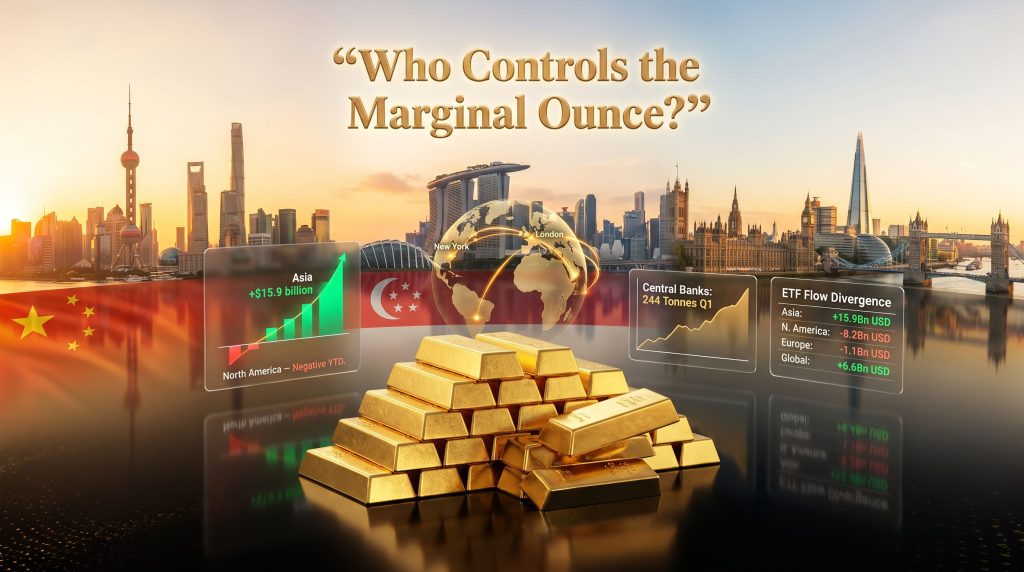
The divergence in regional ETF flows is perhaps the single clearest quantitative signal that the gold market is not behaving as a unified global entity. Global gold ETF flows attracted approximately $6.6 billion in April alone, a figure that masks a profound underlying split in investor behaviour.
| Region | ETF Flow (Year-to-Date) | Trend Interpretation |
|---|---|---|
| Asia | +$15.9 billion | Structural accumulation; adoption-driven |
| Europe | +$3.7 billion (April alone) | Tactical re-engagement after period of underallocation |
| North America | Negative year-to-date | Rate-sensitive outflows; opportunity cost-driven |
North America remaining negative year-to-date while Asia accumulates nearly $16 billion is not a temporary divergence. It reflects fundamentally different investor frameworks. Western institutional investors are responding to the opportunity cost of holding a non-yielding asset when cash and short-duration instruments offer meaningful real returns. Asian investors, particularly in China, are responding to domestic currency uncertainty, equity market volatility, and an evolving savings culture increasingly comfortable with gold as a financial instrument.
Why Asian ETF Adoption Is Structurally Different from Western ETF Behaviour
This distinction between Eastern and Western ETF behaviour is more than a geographic footnote. Western investors in gold ETFs have historically been reactive, moving in when fear spikes and moving out when rates rise. The emerging Asian ETF investor, however, appears to be motivated by longer-duration concerns. As the World Gold Council has noted, jewellery demand in China is slowing quite substantially while adoption of gold financial instruments is growing in a pronounced way.
That transition from physical adornment to financial allocation is a structural shift, not a tactical one, and it creates a more durable demand base. Euro-denominated gold moving toward record levels near €4,539 earlier in the year is a separate but related signal. European investors are re-engaging after a period in which allocations had lagged, partly reflecting a reassessment of risk asset valuations and a strengthened safe-haven diversification case for gold. Metals price discovery shifting east is, furthermore, driving new forms of volatility that European investors are increasingly factoring into their allocation decisions.
The Central Bank Dimension: Official Sector Demand and the Transparency Problem
How Central Banks Report Gold and What the IMF Data Misses
Central bank gold data operates on a structural lag that most retail investors do not fully appreciate. Countries may transfer gold between internal accounts, reclassify holdings, or accumulate through off-market transactions before any formal disclosure appears through International Monetary Fund channels. This creates a gap between what is officially reported in real time and what has actually changed hands.
The World Gold Council addresses this gap through a methodology that triangulates official disclosures with trade flow data, import-export statistics, destination analysis, and historical patterns of eventual true-up reporting. For the first quarter, this methodology produced a figure of 244 tonnes of net central bank gold purchases — incorporating both officially confirmed purchases and estimated unreported accumulation. Record central bank buying has consequently become one of the most important structural supports for the gold market.
China's Reported vs. Estimated Reserves: Navigating the Transparency Gap
China's gold reserve reporting is the most discussed transparency gap in the global gold market. The People's Bank of China has been adding gold consecutively for an extended period, but its official disclosures capture only publicly reported changes.
"Destination analysis distinguishes between gold flowing toward Shanghai, which tends to reflect retail and investment-oriented activity, and flows moving toward Beijing, which are more associated with government and sovereign-adjacent accumulation. This distinction allows analysts to make more granular inferences about the nature of Chinese demand than aggregate import figures alone would support."
The key message from market professionals is to focus on the trend and trajectory of central bank buying rather than becoming fixated on any single country's officially reported figures. The multi-year pattern of aggregate central bank demand remaining above 1,000 tonnes per year for three consecutive years is the signal. Individual country announcements are the noise.
Gold as Collateral, Not Just a Reserve: The Evolution of Official Sector Strategy
Turkey's Q1 Playbook and What It Reveals About Modern Reserve Management
Turkey's first-quarter activity provided one of the most instructive case studies in how sophisticated central banks now think about gold. The country was a net seller of approximately 60 tonnes while simultaneously deploying around 80 tonnes through gold swap arrangements to access liquidity. This reflects a two-speed strategy that treats gold not as a static reserve asset but as an active tool for managing domestic liquidity needs without permanently surrendering reserve holdings.
A useful framework for understanding this dynamic is to separate central bank gold holders into two broad categories:
- Long-term structural accumulators such as Poland, China, and India, which are building reserves as a de-dollarisation hedge and long-duration reserve diversification strategy
- Short-term tactical users such as Turkey and Azerbaijan, which are deploying gold as high-quality liquid collateral during periods of dollar liquidity stress
Both categories represent a sophisticated appreciation of gold's monetary utility. The critical variable is whether aggregate net flows remain positive, which they have for an extended period.
The Risk Investors Rarely Price: Official Sector Demand Can Reverse Into Supply
The World Gold Council's position on this risk is direct: net aggregate flows are the number that matters, and each individual central bank operates with different constraints and objectives at different points in time. Investors who treat central bank buying as a permanently one-directional flow are misreading the dynamics. Considering central bank gold custody arrangements adds another layer of complexity, as institutional flexibility that allows a central bank to use gold swaps for liquidity also allows it to become a net seller when domestic conditions demand it.
The London Paradox: Why the West's Clearing Hub Is Still Attracting More Gold
Canada's 24% Export Surge and What Raw Gold Flowing to London Actually Means
Statistics Canada recently reported a 24% spike in metal exports, with a significant portion consisting of raw gold moving directly to the United Kingdom. In practice, this reflects London's enduring function as the world's wholesale clearing hub — a role that is not being displaced by Asian price discovery but is evolving alongside it.
Gold flowing into London signals significant wholesale interest, whether from central banks seeking to hold metal within an established lending system, from trading firms managing inventory, or from ETF products that price off the London fix. Physical flows into London are not evidence that price discovery is staying in the West; they are evidence that London's clearing infrastructure remains indispensable even as its price-setting influence is diluted.
Custody Risk in a Post-Sanctions World
The freezing of Russia's foreign exchange reserves in 2022 permanently altered how central bank risk committees think about custody geography. Before that event, the question of where gold was physically held was largely treated as an operational matter. After it, custody geography became a geopolitical variable that every central bank's risk framework must now explicitly model.
"When a sovereign nation's gold is held in a foreign central bank vault, the asset remains technically accessible under normal conditions. Geopolitical events can redefine what 'accessible' means overnight. Post-2022, that scenario is no longer theoretical."
The World Gold Council's position is that holding gold at the Bank of England or the Federal Reserve remains a legitimate and functional arrangement. However, central banks that choose to repatriate holdings now do so with a more explicit understanding of the tradeoffs involved.
France's Reserve Model: Accounting Manoeuvre or Strategic Blueprint?
France's approach to its gold reserves offers a particularly nuanced case study. The Bank of France sold legacy Federal Reserve note bars held in New York, received dollars, and subsequently replaced those holdings with London good delivery bars, revaluing the reserves closer to current market prices. The accounting dimension is significant: central banks often carry gold at historic acquisition cost, meaning the longer the holding period, the more the book value understates actual reserve strength.
Whether this constitutes a blueprint for other central banks seeking to reduce US custody exposure without a politically visible repatriation is a question the market is actively debating. The timing, in the post-2022 environment where custody risk is being repriced everywhere, ensures that interpretation will remain contested.
The next major ASX story will hit our subscribers first
What Could Break the Gold Bull Market: Identifying the Structural Ceiling
Jewellery Demand Destruction and the Recycling Signal to Watch
Jewellery volume fell approximately 23% in the first quarter even as total consumer spending on gold jewellery rose around 31% in value terms. This divergence reflects consumers being priced out by volume while remaining willing to spend more in absolute terms on smaller quantities. The recycling rate is the most important leading indicator to monitor.
| Risk Factor | Current Status | Danger Threshold |
|---|---|---|
| Jewellery volume decline | Down 23% in Q1 | Sustained multi-quarter erosion with rising recycling rates |
| Gold price volatility | Declining from ~30-35% annualised toward ~20-22% | Volatility collapse reduces speculative participation |
| Western rate environment | Fed and G7 central banks holding or considering hikes | Rate cuts delayed beyond 2025 creates prolonged ETF outflows |
| Recycling rates | Elevated but not alarming | Sharp acceleration signals emerging market consumer stress |
| Geopolitical risk premium | Elevated due to Middle East conflict | Rapid de-escalation could reverse Western fear-driven inflows |
The Western Rate Environment as a Structural Brake
The World Gold Council's analysis of Western investor behaviour is direct: rate-sensitive outflows respond quickly and pronouncedly to changes in the opportunity cost of holding gold. The North American ETF market's negative year-to-date performance is a direct expression of this dynamic. Furthermore, with gold price discovery moving east in Asia providing a structural demand floor, the bull case depends heavily on whether Asian and official sector demand proves durable enough to absorb Western institutional headwinds. A broader assessment of gold's bull cycle risks suggests that near-term volatility, including oil shock risks, remains a live concern even within a structurally supportive environment.
The Silver Divergence: Decoupling From Gold's Monetary Narrative
From Correlated Safe-Haven Trade to Independent Structural Narratives
Silver's relationship with gold has historically been one of amplification: when gold moves, silver tends to move further in the same direction. That relationship appears to be evolving. The Silver Institute has flagged a six-year running structural deficit in silver, driven primarily by industrial demand from solar panel manufacturing and electric vehicle components.
| Dimension | Gold | Silver |
|---|---|---|
| Primary demand driver | Monetary reserve, safe haven, central bank buying | Industrial demand (solar, EVs), critical minerals narrative |
| Price discovery leadership | Shifting East (SGE, Singapore) | Still primarily Western futures-driven |
| Speculative positioning | Elevated but structurally supported | Cooling after 2024 euphoria peak |
| Structural deficit | Not applicable | Six-year running deficit per Silver Institute |
| Investor use case | Strategic portfolio hedge | Higher-beta monetary trade expression plus industrial play |
Gold and silver are consequently increasingly driven by different primary forces. Gold's bull case rests on reserve diversification and central bank accumulation; silver's structural story rests on industrial demand tied to the energy transition. These narratives can coexist, but they are no longer simply different expressions of the same thesis.
The Critical Minerals Policy Dimension: Gold's Elevating Strategic Status
Why Gold Is Not a Critical Mineral But Is Being Treated Like One
Gold does not appear on any official critical minerals list in the United States, Canada, or major allied economies. Yet conversations in Washington and other policy capitals are increasingly treating it with the seriousness usually reserved for lithium, cobalt, or rare earth elements. The policy agenda being discussed spans several dimensions:
- Developing domestic mining capacity and streamlining permitting processes
- Onshoring processing and refining infrastructure to reduce dependence on foreign facilities
- Reviewing trade relationships through a resource sovereignty lens
- Addressing artisanal and small-scale gold mining as an illicit finance and supply chain integrity concern
The fourth point is worth highlighting because it is rarely discussed in mainstream gold market commentary. Artisanal and small-scale gold mining represents a meaningful share of global gold supply, and governments are increasingly recognising that illicit financial flows associated with unregulated operations represent both a security concern and a market integrity issue.
The Three-Centre Model: How Global Gold Pricing Is Becoming Tri-Polar
New York, London, and Asia: A New Architecture of Influence
The evolution of gold price discovery is not a story of London and New York being replaced. It is a story of their dominance being diluted as a third centre of genuine pricing power emerges. The resulting architecture is best understood as a tri-polar system:
- New York retains primacy in derivatives, speculative positioning, and leveraged expressions of the gold trade
- London maintains its role as the global wholesale clearing hub, the chain of custody anchor for institutional and central bank holdings, and the reference point for ETF pricing
- Asia (principally Shanghai and Singapore) is accumulating physical settlement depth, structural demand dominance, and increasing short-term price leadership
This structure creates new arbitrage opportunities for sophisticated market participants who can operate across all three centres. It also creates new sources of volatility, because dislocations between physical premiums in Asia, futures positioning in New York, and wholesale clearing dynamics in London can produce price movements that no single analytical framework can fully anticipate.
Whether the Shanghai Gold Exchange's benchmark achieves genuine global reference status by 2027 depends on factors that remain uncertain, including the pace of renminbi internationalisation and the development of Singapore's physically settled futures market. The directional trajectory of gold price discovery moving east in Asia, however, is difficult to dispute.
Frequently Asked Questions: Gold Price Discovery Moving East
What does it mean for gold price discovery to move east?
It means that the institutions committing the most capital to physical gold, and the markets where the most metal actually changes hands, are increasingly located in Asia. When price-setting power follows physical flows, the time zone and institutional framework within which gold is valued begins to shift.
Why is the Shanghai Gold Exchange becoming more important than COMEX for physical gold pricing?
COMEX is primarily a derivatives market where most contracts never result in physical delivery. The Shanghai Gold Exchange emphasises physical delivery in renminbi, making it a more direct expression of real supply and demand conditions in the world's largest gold consuming nation.
How do central bank purchases in Asia affect global gold prices?
Central bank buying removes physical supply from the market and signals institutional confidence in gold as a reserve asset. When Asian central banks accumulate consistently over multi-year periods, it establishes a structural demand floor that influences prices independent of Western investor sentiment.
Is gold priced differently in Asia than in Western markets?
The benchmark price is global, but physical premiums can diverge significantly. When import bottlenecks, elevated domestic demand, or currency movements cause Asian physical prices to trade above the international spot price, it signals that the physical market is communicating something the derivatives complex has not yet fully reflected.
What role does Singapore play in the new global gold pricing architecture?
Singapore is emerging as a neutral settlement hub positioned between Chinese physical demand and Western derivatives markets. The development of physically settled futures and the relocation of major institutional gold trading infrastructure to Singapore reflects its growing importance as a bridge between the two systems.
Why are Western ETF investors responding differently to gold than Asian investors?
Western ETF investors are primarily responding to the opportunity cost framework, measuring gold against the return available from cash and bonds. Asian ETF investors appear more motivated by longer-duration concerns about currency stability and domestic savings preservation, making their demand less sensitive to Western interest rate cycles.
Can London maintain its role as the global gold clearing hub as Asia grows?
London's wholesale clearing function and good delivery standards remain deeply embedded in the global gold infrastructure. Its role is not disappearing, but it is becoming one node in a multi-polar system rather than the unchallenged centre of gravity it was for most of the twentieth century.
Strategic Implications: What the Eastward Shift Means for Investors
Reading the Signal Through Regional ETF Flow Data
Regional ETF flow data is most useful not as a predictor of near-term price direction but as a sentiment barometer for different categories of gold investor. North American outflows tell you about rate sensitivity. Asian inflows tell you about structural accumulation. European re-engagement tells you about geopolitical anxiety and risk asset revaluation. Reading all three together provides a more complete picture than any single regional number could convey.
The Portfolio Case in a World of Structurally Challenged Fiat Currency
The most durable argument for gold in a long-term portfolio is not that prices will rise because of fear. It is that the conditions which erode fiat currency credibility — sovereign debt accumulation, monetary policy uncertainty, and geopolitical fragmentation — are structural features of the current environment rather than temporary disruptions.
"The gold market is not experiencing a fear-driven price spike. It is undergoing a structural reordering of who holds it, where it is priced, and why it is held. Treating this as a tactical trade risks misreading one of the most significant monetary realignments of the past two decades."
Investors positioned to benefit from this shift are those who distinguish between the tactical volatility that rate environments and geopolitical cycles will continue to generate, and the structural accumulation trend that is being driven by Asian investors, official sector reserve managers, and institutions rethinking custody geography in a world where the rules governing reserve asset accessibility have demonstrably changed.
A Market Reordering, Not Just a Price Rally
The most important question in gold markets right now is not whether prices will go higher. It is who controls the marginal ounce. The answer to that question is shifting in ways that have not been seen since the collapse of the Bretton Woods system fundamentally reorganised the global monetary architecture.
The transition from a dollar-centric gold pricing system to a multi-polar one is happening gradually, unevenly, and with significant uncertainty about its eventual endpoint. London will not disappear. COMEX will not become irrelevant. However, the weight of physical demand, the institutional infrastructure being built in Singapore and Shanghai, the reserve diversification strategies being pursued by central banks across Asia and the emerging world, and the growing sophistication of Asian retail and institutional gold investors are collectively shifting the centre of gravity in ways that are measurable, directional, and unlikely to reverse.
For investors, policymakers, and institutions, the recalibration required is substantial. Analytical frameworks built around Western rate cycles and COMEX positioning will remain useful but insufficient. The gold market of the next decade will require fluency in Asian physical market dynamics, central bank reserve strategy, and the evolving geopolitics of custody and settlement — topics that were footnotes in gold market analysis a decade ago and are now among its central organising questions. Understanding gold price discovery moving east in Asia is consequently no longer optional for anyone seeking a comprehensive view of where this market is heading.
Disclaimer: This article is intended for informational and educational purposes only and does not constitute financial advice. All forward-looking statements, projections, and market assessments involve uncertainty and should not be relied upon as predictions of future performance. Investors should conduct their own due diligence and consult qualified financial advisers before making investment decisions. Past performance of any asset class, including gold, is not indicative of future results.
Want to Capitalise on the Next Major Mineral Discovery Before the Broader Market Does?
As gold's pricing architecture shifts eastward and structural demand dynamics reshape the global investment landscape, Discovery Alert's proprietary Discovery IQ model delivers real-time alerts on significant ASX mineral discoveries, transforming complex market data into clear, actionable insights for investors at every level. Explore historic discoveries and their extraordinary returns, then begin your 14-day free trial to ensure you're positioned ahead of the market when the next major discovery is announced.