
July 15, 2026
The Macro Forces Rewriting the Rules of Gold Ownership
The global reserve management landscape has undergone a quiet but profound transformation over the past several years. What was once a fairly predictable allocation category, dominated by sovereign bond holdings and currency reserves, has shifted in ways that few institutional frameworks anticipated. Gold has moved from a peripheral hedge to a core portfolio component for central banks worldwide, and that repositioning is now colliding head-on with one of the most complex and multi-layered volatility regimes the precious metals market has seen in decades.
Understanding why this is happening, and what it means for gold price volatility and central bank demand going forward, requires looking beyond the headlines and into the structural machinery driving sovereign accumulation decisions.
When big ASX news breaks, our subscribers know first
How Gold's Bull Market Created Its Own Vulnerabilities
From Momentum Trade to Mean-Reversion Risk
Gold's extraordinary run from 2022 into early 2025 was powered by a potent combination of macro tailwinds. Expectations of Federal Reserve rate cuts, a structurally weakening U.S. dollar narrative, and growing geopolitical risk appetite among institutional investors pushed gold prices more than 100% higher into early 2025. The asset had become one of the most crowded momentum trades in global markets.
Momentum-driven markets carry an inherent fragility. When the consensus that fuels a rally begins to fracture, the reversal can be sharp and disorderly. The nomination of a new Federal Reserve chair candidate at the end of January 2025, widely perceived by markets as signalling a substantially more hawkish monetary policy stance, acted as a catalyst for repricing. What had been a near-universal rate-cut thesis began unravelling across institutional portfolios simultaneously, and gold bore the brunt of that reassessment.
When Geopolitical Risk Becomes a Double-Edged Sword
The onset of conflict involving Iran introduced a variable that complicated gold's investment thesis in unexpected ways. Historically, geopolitical escalation is unambiguously constructive for gold through its gold safe-haven appeal demand channel. However, the specific dynamics of this conflict, most notably its impact on crude oil prices and the cascading inflationary pressures flowing through energy, logistics, and consumer goods, fundamentally shifted market expectations away from rate cuts and toward the possibility of rate hikes.
This created a genuine paradox. The very geopolitical event that should have driven investors into gold's safe-haven arms was simultaneously strengthening the case for tighter monetary policy, which historically weighs on non-yielding assets like gold. The result was a volatile, cross-cutting pressure environment that has persisted through 2026.
Gold's 2025-2026 volatility reflects a rare collision of three simultaneously active forces: monetary policy repricing, geopolitical risk escalation, and a momentum unwind of historic proportions. Understanding this distinction matters enormously for interpreting central bank behaviour.
Central Banks as Structural Buyers: Separating Tactics from Strategy
The Critical Distinction Institutional Investors Often Miss
When price volatility spikes, retail and even some institutional investors often interpret reduced buying activity as a sign of weakening conviction. For central banks, the dynamic is more nuanced. These institutions operate on fundamentally different time horizons and with different mandates than private investors, meaning that tactical hesitation during volatile periods should never be conflated with structural retreat.
The table below illustrates how different demand drivers translate into distinct central bank behavioural patterns:
| Demand Driver | Central Bank Response | Time Horizon |
|---|---|---|
| Geopolitical risk escalation | Accelerated structural accumulation | Long-term |
| High price volatility | Tactical purchase delays | Short-term |
| Price stabilisation signals | Reacceleration of buying programmes | Medium-term |
| De-dollarisation pressure | Sustained, policy-driven accumulation | Structural |
| Liquidity crises | Rare, situational net selling | Situational |
Goldman Sachs has characterised central banks as structural dip buyers, institutions that view price weakness as an opportunity to accelerate accumulation rather than a reason to reassess their underlying allocation thesis. This framing is consistent with the data coming out of Q1 2026. Furthermore, understanding central bank gold demand reveals just how deeply embedded this accumulation strategy has become across sovereign institutions.
Why the 2022 Russian Reserve Freeze Changed Everything
No single event did more to reshape the global gold accumulation calculus than the freezing of Russian sovereign dollar-denominated reserves following the 2022 conflict in Ukraine. For reserve managers in dozens of countries, this was not an abstract geopolitical event. It was a live demonstration that holdings once considered foundational to reserve management carried a confiscation risk that gold explicitly does not.
Gold cannot be frozen by a foreign government's policy decision. It cannot be devalued through someone else's monetary policy. It is physically portable, jurisdictionally neutral, and has no counterparty risk. These properties, always theoretically appealing, became immediately and practically relevant in 2022, and the resulting structural shift in reserve allocation has not reversed.
Gold has since surpassed the euro as the second-largest asset class held in global central bank reserves, trailing only the U.S. dollar. Its share of global reserve demand now exceeds 20%, compared to roughly 10% in the 2010s, a structural doubling that reflects a genuine policy shift rather than a cyclical preference. Consequently, gold in the monetary system has taken on renewed significance for sovereign reserve managers worldwide.
The Data Behind the Demand: Central Bank Gold Purchases in Numbers
A Decade-Long Accumulation Trend Accelerating Despite Volatility
The scale of the structural shift in central bank gold purchasing becomes starkly apparent when viewed across a longer time horizon:
| Period | Average Annual Net Purchases |
|---|---|
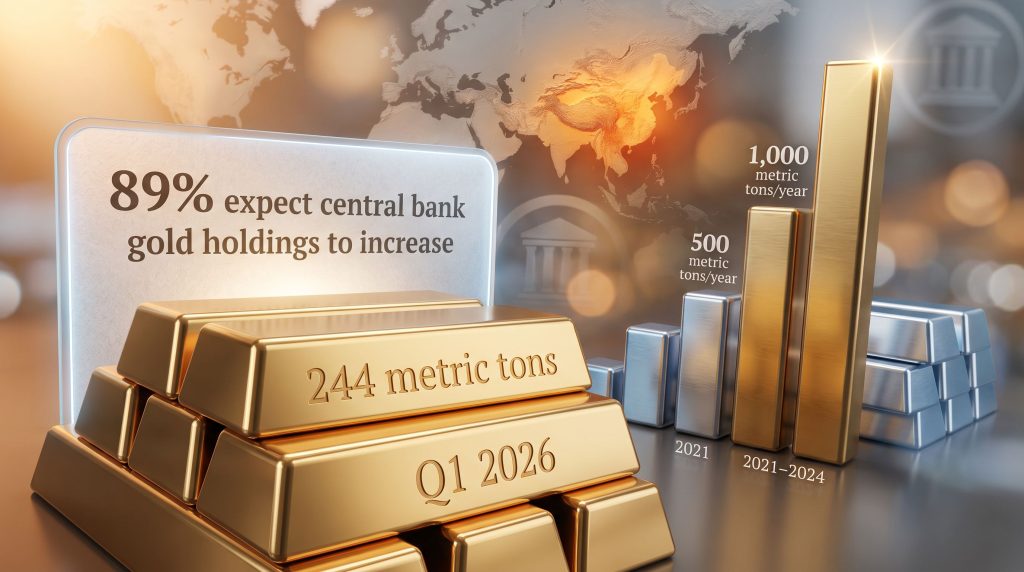
| Preceding decade (pre-2021) | ~500 metric tons per year |
| 2021-2024 | ~1,000 metric tons per year |
| 2025 (full year, volatility-impacted) | 863-900 metric tons |
| Q4 2025 | 230 metric tons (up 6% quarter-on-quarter) |
| Q1 2026 | 244 metric tons (annualising near fourth-highest since 1950) |
The Q1 2026 figure is particularly significant. Even during one of the most volatile and uncertain macro environments gold has navigated in years, central banks collectively purchased an estimated 244 metric tons in a single quarter. J.P. Morgan projects that central bank and broader institutional demand will average approximately 585 tonnes per quarter through the remainder of 2026, with buying expected to remain at or near 2025 levels. According to World Finance, this sustained institutional appetite reflects a fundamental reassessment of reserve asset priorities across sovereign portfolios.
China's Counter-Cyclical Signal
Among the more revealing data points in the global gold demand picture is the behaviour of China's central bank. The People's Bank of China extended its gold purchasing programme for 20 consecutive months through June 2026, with the most recent monthly addition representing approximately 480,000 ounces, its largest single-month increase in over two and a half years.
Counter-cyclical accumulation of this magnitude, buying aggressively during periods of price uncertainty rather than waiting for confirmation of a new uptrend, signals long-term strategic conviction rather than short-term opportunistic positioning. For other emerging-market central banks watching China's reserve management decisions, this behaviour functions as an implicit endorsement of continued accumulation.
A World Gold Council survey of reserve managers found that 89% expect central bank gold holdings to increase over the next 12 months, representing one of the strongest forward-looking consensus readings on record for any reserve asset.
The Four Pillars of Central Bank Gold Demand
According to World Gold Council survey data, the top four reasons reserve managers hold gold are:
- Crisis-period performance, gold's demonstrated ability to hold and gain value when other asset classes are under stress.
- Portfolio diversification, its low correlation to equities, bonds, and currency movements.
- Geopolitical risk insulation, its utility as a politically neutral store of value outside the reach of foreign policy decisions.
- Inflation hedging, its long-run track record of preserving purchasing power in inflationary regimes.
Each of these rationales has been reinforced, not undermined, by the macro environment that emerged in 2025 and has intensified through 2026. Real gold prices in 2024 surpassed their 1979 oil crisis peak, a milestone that underscores the asset's long-run store-of-value credentials across multiple generations of inflationary cycles. The Brookings Institution has also highlighted how the growing scale of central bank gold holdings is reshaping broader discussions around reserve adequacy and financial stability.
What Determines Gold's Trajectory in the Second Half of 2026?
The Private Investor Re-Entry Problem
Central bank demand, as structurally robust as it is, operates primarily as a price floor mechanism. It limits the depth of corrections and provides a persistent bid in the market, but it is insufficient on its own to drive the kind of sustained price appreciation that generates multi-year bull markets in gold. For that, private investor participation is required.
The same macro rationales driving central bank accumulation must become sufficiently compelling at the retail and institutional private investor level to catalyse meaningful inflows. The early evidence is modestly encouraging: weaker-than-expected inflation data has already triggered near-term price rebounds, confirming that the market remains highly sensitive to monetary policy signals. When the rate hike narrative softens, private investors have demonstrated a willingness to re-enter.
Key Variables Worth Monitoring
The four macro variables that will most directly shape gold's H2 2026 trajectory are:
- Federal Reserve policy trajectory: Whether the market reprices toward hikes or cuts remains the dominant short-term price driver for gold.
- Iran conflict developments: Escalation reinforces both safe-haven demand and inflationary pressure; de-escalation could reduce geopolitical risk premiums but also reduce inflationary headwinds.
- China's monthly PBoC gold data: Serves as a leading indicator of broader emerging-market central bank sentiment and accumulation momentum.
- ETF flow data: Gold ETF inflows and outflows provide a real-time gauge of private investor engagement and directional conviction.
Goldman Sachs' base case assumes that volatility will moderate in the absence of a new surge in speculative private-sector positioning. A calmer price environment would remove the primary tactical barrier deterring emerging-market central banks currently operating cautiously at elevated price levels.
The next major ASX story will hit our subscribers first
Silver's Structural Paradox: Industrial Powerhouse Caught in a Monetary Storm
Understanding Silver's Amplified Volatility
Silver's price correction in the first half of 2026 exceeded that of gold in percentage terms, a pattern consistent with silver's historically higher beta to gold price movements. This amplified volatility is a structural characteristic of the silver market, not necessarily a signal of deteriorating fundamentals. In addition, the gold-silver ratio during this period reached historically elevated levels, further highlighting the divergence between the two metals.
What makes silver's situation analytically distinct is the significant evolution in its demand composition. Industrial demand now accounts for approximately 59% of total silver demand, compared to 49% a decade ago. This structural shift means silver's price performance is now more tightly coupled to global manufacturing activity, energy transition investment, and semiconductor production cycles than at any prior point in its history.
However, this industrial demand base is not without its own ceiling dynamics. When silver prices exceeded $100 per ounce earlier in 2026, copper substitution in solar panel manufacturing began to emerge, introducing a demand elasticity constraint that acts as a natural price ceiling at extreme levels.
The Supply Deficit No One Is Talking About Loudly Enough
The most structurally significant, and arguably most underappreciated, feature of the silver market is its persistent supply-demand imbalance. According to the Silver Institute, total silver demand has exceeded total supply for five consecutive years, with 2026 projected to extend this streak to a sixth consecutive year of structural deficit. Furthermore, silver supply deficits of this duration have historically preceded meaningful upward price re-ratings once investment demand re-engages.
This is not a temporary or cyclical phenomenon. It reflects a decade of chronic underinvestment in silver mining capacity, a capital allocation failure that cannot be corrected quickly regardless of where prices trade. New mining capacity requires years of exploration, permitting, and construction to reach production, meaning today's supply shortfall is effectively locked in for the medium term.
The silver mining industry's underinvestment cycle stands in direct contrast to the aggressive capital deployment seen in AI infrastructure and data centre construction. Capital that might otherwise have flowed into resource extraction has been systematically redirected to technology sectors, creating a compounding supply constraint that price corrections alone cannot resolve.
Silver's Dual Identity as an Investment Framework
Silver's unusual position as simultaneously a monetary asset and an industrial commodity creates a more complex return profile than gold. Its investment demand draws on the same macro rationales that attract capital to gold, including inflation hedging, monetary store of value, and geopolitical risk insulation. But its industrial demand base provides a second, structurally independent demand driver.
This dual demand structure means that silver can benefit from two distinct macro environments that typically do not overlap: manufacturing expansion and geopolitical risk escalation. When both are active simultaneously, the demand impulse can be particularly powerful. The risk, as 2026 has demonstrated, is that monetary headwinds can temporarily overwhelm both demand channels simultaneously.
Frequently Asked Questions
Why are central banks continuing to buy gold despite elevated prices and volatility?
Central banks are long-term, structurally motivated buyers whose accumulation decisions are driven by reserve diversification policy, geopolitical risk hedging, and de-dollarisation imperatives rather than short-term price optimisation. Elevated prices and volatility may cause tactical timing adjustments but do not alter the fundamental policy rationale.
How significant was central bank gold demand in Q1 2026?
Estimated purchases of 244 metric tons in Q1 2026 placed quarterly demand at a pace that, if sustained annually, would represent the fourth-highest annual demand level recorded since 1950, underscoring the historically exceptional nature of the current accumulation cycle.
What role does the Iran conflict play in the gold price outlook?
The conflict has simultaneously reinforced multiple demand drivers for gold, including safe-haven allocation, inflation hedging, and geopolitical risk insulation, while also creating monetary policy uncertainty through elevated crude prices. The net effect is a contested short-term price environment layered over a structurally constructive long-term demand picture.
Why is silver experiencing a structural supply deficit?
A decade of underinvestment in silver mining capacity has created a supply constraint that demand growth cannot be matched against. The Silver Institute documents five consecutive years of demand exceeding supply, with 2026 projected to be the sixth. New supply cannot be brought online quickly, making this deficit a persistent rather than cyclical feature of the market.
Strategic Takeaways for Investors Watching Gold and Silver in 2026
The gold price volatility and central bank demand dynamics of 2025-2026 are not isolated market phenomena. They are symptoms of a deeper macro regime transition, from a low-rate, dollar-dominant, low-inflation environment to one defined by monetary uncertainty, geopolitical fragmentation, and accelerating reserve diversification across sovereign portfolios globally.
Several conclusions emerge clearly from this analysis:
- Central bank gold demand has structurally re-rated upward from its pre-2021 baseline, and the drivers sustaining this shift are not cyclical. They are embedded in policy.
- The critical variable for gold's second-half 2026 performance is not central bank behaviour, which remains firmly constructive, but the scale and timing of private investor re-engagement.
- Silver's structural supply deficit, combined with accelerating industrial demand from energy transition sectors, positions it as a potentially asymmetric opportunity relative to gold. Its greater price sensitivity amplifies both downside and upside catalysts.
- The capex void in silver mining, contrasting sharply with the torrent of capital flowing into AI infrastructure, creates a compounding supply constraint that is largely invisible in standard market commentary but may prove to be the most consequential long-term structural feature of the silver market.
This article contains forward-looking analysis and market projections sourced from institutional research and publicly available survey data. It does not constitute financial advice. Past performance of commodities is not indicative of future results. Investors should conduct independent due diligence before making investment decisions.
Want to Capitalise on the Next Major Mineral Discovery Before the Broader Market?
Discovery Alert's proprietary Discovery IQ model delivers real-time alerts on significant ASX mineral discoveries, instantly turning complex mineral data into actionable investment insights for both short-term traders and long-term investors. Explore historic discoveries and the returns they generated, then begin your 14-day free trial to position yourself ahead of the market.