
June 10, 2026
The Hidden Metric Most Gold Investors Are Getting Wrong
Most market participants watching gold prices today are fixated on the wrong number. When financial media reports rising Treasury yields, the instinctive conclusion is that gold becomes less attractive. This logic is incomplete, and for investors who understand the mechanics of real yields, that misunderstanding creates a structural opportunity.
The distinction between nominal interest rates and real interest rates is not merely academic. It is the single most important variable separating short-term gold price noise from the underlying structural trend. And right now, that structural trend is becoming increasingly gold bullish on lower real yields and inflation.
When big ASX news breaks, our subscribers know first
The Macro Framework: Why Real Yields Drive Gold More Than Headline Rates
Understanding the Nominal vs. Real Rate Divide
Nominal interest rates are the figures published by central banks and reported daily in financial news. They represent the stated return on fixed-income instruments before any adjustment for purchasing power erosion. Real interest rates strip out inflation entirely, revealing what an investor actually earns in terms of economic value.
The formula is deceptively simple:
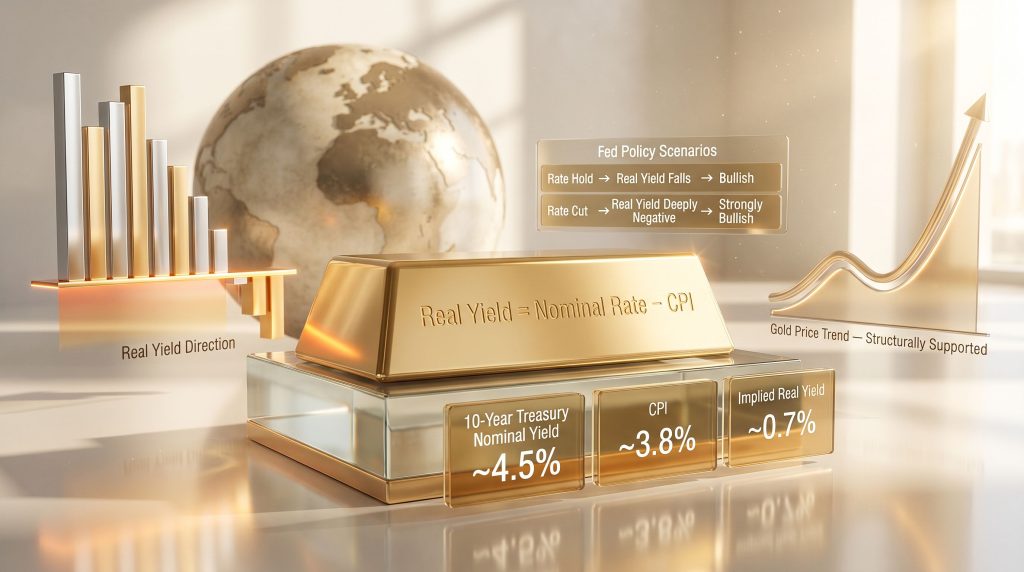
Real Yield = Nominal Rate minus CPI Inflation
This single calculation fundamentally changes how gold should be evaluated. Gold generates no coupon payment, no dividend, and no contractual yield. Its value proposition rests entirely on its role as a store of purchasing power. When real yields are high, bonds and cash instruments compete effectively against gold. When real yields compress, that competition disappears.
The opportunity cost of holding gold is not measured against nominal rates. It is measured against inflation-adjusted returns. When those real returns shrink, gold's structural appeal expands across institutional and retail portfolios alike.
Current Data: Where Real Yields Actually Stand
The numbers circulating in mid-2026 illustrate the case clearly. The 10-year US Treasury nominal yield sits at approximately 4.5%, a level that superficially appears restrictive for gold. However, CPI inflation is running at 3.8%, the highest reading since May 2023, driven in part by a rapid escalation in oil prices feeding through to consumer costs.
| Metric | Current Level (2026) |
|---|---|
| 10-Year Treasury Nominal Yield | ~4.5% |
| CPI Inflation Rate | ~3.8% |
| Implied Real Yield | ~0.7% |
| Gold Price Trend | Short-term pressure, structural support intact |
A real yield of just 0.7% on the benchmark US government bond is historically thin. It provides minimal compensation for the risk of holding a fixed-income asset in an environment where inflation could accelerate further. Framed correctly, 0.7% is not a compelling reason to abandon a 5,000-year store of value.
Nitesh Shah, Head of Commodities and Macroeconomic Research at WisdomTree, has noted that markets may be mispricing gold precisely because they are anchoring to nominal rate movements rather than properly accounting for real rate trajectories. Furthermore, Shah's view is that real rates carry significant downside potential, particularly if inflation continues rising while the Federal Reserve holds its position.
How Accelerating Inflation Compresses Real Yields Without Fed Cooperation
The Mechanism That Markets Are Underestimating
One of the most counterintuitive dynamics in monetary economics is that real yields can fall sharply even when the Federal Reserve is raising nominal rates. The mechanism works like this:
- Nominal rates rise in response to inflationary pressure, creating a surface-level impression of tighter monetary policy.
- CPI accelerates faster than the pace of rate increases, eroding the inflation-adjusted return on fixed-income assets.
- Real yields compress despite the upward movement in headline rates, sometimes even turning negative.
- Gold's opportunity cost declines, because the competition from bonds weakens in real terms.
- Institutional and central bank demand for gold strengthens, as portfolio hedging rationale intensifies.
This sequence has played out repeatedly across history, including during portions of the 1970s stagflation cycle, the post-2008 quantitative easing period, and the 2020–2022 COVID stimulus environment. Each time, investors who focused exclusively on nominal rates missed the real-yield compression that was simultaneously supporting gold.
Oil Prices as an Inflation Amplifier
The current inflation episode carries a particularly significant energy-price dimension. Oil price escalations transmit through the broader economy via transportation costs, manufacturing inputs, food production, and utility pricing. These second-round inflationary effects are notoriously slow to appear in CPI data but persistent once embedded.
When energy-driven inflation outpaces the Federal Reserve's rate response, the real yield gap narrows automatically, without requiring any policy pivot. The CPI reading reaching its highest level since May 2023 is not simply a cyclical data point. It signals that inflationary forces may be more deeply embedded in the cost structure than consensus forecasts have acknowledged.
The Federal Reserve's Policy Trap and What It Means for Gold
A Dilemma With No Clean Exit
The Federal Reserve currently occupies one of the more difficult policy positions in its modern history. Inflation is rising, which would traditionally justify rate hikes. However, the broader economic environment carries structural vulnerabilities that make aggressive tightening genuinely dangerous.
Shah has described this situation as a policy trap. On one side, cutting rates while inflation is accelerating would damage the Fed's credibility as an inflation fighter at a critical moment. On the other side, sustained rate increases create severe stress across debt-laden sectors of the economy, including sovereign balance sheets carrying historically elevated debt-to-GDP ratios.
When fiscal deficits remain structurally large and sovereign debt levels are elevated, central banks face an implicit ceiling on how aggressively they can raise rates. Debt servicing costs escalate, crowding out productive spending and amplifying recession risk. This dynamic, known as fiscal dominance, is a structural constraint that limits the Fed's real policy options.
The FedWatch Tool currently reflects roughly a 50-50 probability of an interest rate hike by late 2026. That uncertainty itself is informative. It suggests the market does not believe the Fed has a clear, credible path forward.
Three Scenarios, One Common Thread
| Fed Policy Scenario | Nominal Rate Outcome | Inflation Trajectory | Real Yield Direction | Gold Outlook |
|---|---|---|---|---|
| Aggressive Rate Hike | Rises sharply | Partially contained | Marginally positive | Near-term pressure, long-term neutral |
| Rate Hold (Status Quo) | Flat | Continues rising | Falls further | Bullish |
| Rate Cut (Recession Response) | Declines | Elevated or rising | Deeply negative | Strongly bullish |
What is striking about this scenario matrix is that two of the three plausible paths are structurally bullish for gold, and even the third generates only modest headwinds. The asymmetry consequently favours gold holders across the realistic policy spectrum.
Additionally, even under a rate hold scenario, Shah's analysis suggests that a rapid inflation spike would independently compress real yields, creating a setup consistent with being gold bullish on lower real yields and inflation without requiring any Fed action at all.
Why Inflation May Be More Entrenched Than Markets Are Pricing
Beyond Cyclical Noise: Structural Inflation Drivers
Consensus economic forecasting has repeatedly underestimated the persistence of the current inflationary cycle. The initial characterisation of post-pandemic inflation as transitory was the most high-profile example, but the pattern of systematic underestimation has continued. Several structural forces are sustaining inflationary pressure beyond what traditional monetary tightening cycles would normally resolve:
- Fiscal dominance: When governments run persistently large deficits, central banks face indirect pressure to keep borrowing costs manageable through monetary accommodation. This creates an inflationary bias that operates independently of explicit policy decisions.
- Supply chain fragmentation: The ongoing restructuring of global supply chains, driven by geopolitical tensions and reshoring initiatives, is inherently inflationary. Replacing optimised global supply networks with regionalised alternatives costs more.
- Energy transition costs: The capital expenditure demands of energy infrastructure modernisation are filtering through to consumer prices across multiple sectors.
- Labour market dynamics: Structural demographic shifts in major economies are tightening labour supply in ways that sustain wage growth above pre-pandemic norms.
Shah's view, based on his macroeconomic research, is that markets are systematically underestimating the probability of upside inflation surprises. His position is that elevated prices are becoming a persistent feature of the economic landscape rather than a temporary deviation.
The Federal Reserve has also been running operations to ease pressure on the Treasury market even during periods of stated tightening, a dynamic that further limits the effectiveness of nominal rate increases as an inflation suppressant.
Gold as a Recession Hedge: The Separate Bullish Case
Why Economic Deceleration Independently Supports Gold
Even setting aside the real yield compression argument, gold carries a structurally independent bullish case tied to recession risk. The recession impact on gold is well documented — when economic activity decelerates, investors historically rotate toward defensive assets, and gold has consistently demonstrated its capacity to preserve value during contractionary periods.
| Recession Period | Gold Performance | Real Yield Behaviour | Primary Driver |
|---|---|---|---|
| 2001 Dot-Com Bust | Moderate gains | Fell sharply | Rate cuts, safe haven demand |
| 2008–2009 GFC | Strong post-shock recovery | Deeply negative | QE, dollar weakness |
| 2020 COVID Recession | All-time highs reached | Deeply negative | Massive fiscal and monetary stimulus |
Shah has noted directly that economic deceleration represents an additional independent catalyst for gold price appreciation. In recessionary environments, the central bank would almost certainly cut rates, regardless of prevailing inflation levels, collapsing real yields and simultaneously weakening the US dollar. Both dynamics are mechanically bullish for gold.
WisdomTree's current debt sustainability concerns are also relevant here. Shah has stated that elevated gold prices reflect growing market anxiety about whether current debt levels across major economies are genuinely sustainable over the long term. That structural concern does not resolve quickly, regardless of near-term monetary policy decisions.
The next major ASX story will hit our subscribers first
Additional Structural Supports Beyond Real Yields
The Multi-Driver Investment Case
While real yield compression remains the primary mechanical engine behind the gold bullish thesis, several additional forces are reinforcing the structural case. For instance, central bank gold demand has been sustained at historically elevated levels, with central banks collectively purchasing approximately $95 billion in gold during recent periods, reflecting a strategic shift in reserve management away from US dollar-denominated assets.
In addition to this, the following forces further strengthen the case:
- US dollar dynamics matter significantly, because gold is priced in dollars globally. Dollar depreciation driven by fiscal deterioration and monetary accommodation directly amplifies gold returns for international holders.
- Geopolitical risk premiums have increased meaningfully, with ongoing conflicts and strategic competition between major powers elevating safe-haven demand structurally rather than episodically.
- Sovereign debt sustainability concerns represent a long-duration tail risk that gold hedges effectively, as historically periods of fiscal stress have coincided with currency debasement.
The real yield compression story is the proximate driver of gold's current structural setup. But the deeper investment thesis is layered across debt dynamics, geopolitical instability, central bank strategy, and dollar credibility. These forces do not resolve on a quarterly calendar.
Furthermore, the relationship between gold and bonds during economic cycles demonstrates that as bond returns deteriorate in real terms, institutional capital consistently seeks the relative stability that gold provides.
Is the Current Gold Correction an Opportunity or a Warning?
Separating Cyclical Pullbacks from Structural Reversals
Gold has experienced meaningful price pressure since early 2026, primarily driven by the nominal rate environment and a shift in market expectations toward monetary tightening. Shah's assessment is that this correction is temporary and cyclical, rather than indicative of a structural trend reversal. The analytical key is distinguishing between two very different scenarios:
- A correction driven by genuine real yield improvement, where inflation falls faster than nominal rates, legitimately reducing gold's relative attractiveness.
- A correction driven by nominal rate anxiety, where headline rate movements create superficial pressure while underlying real yields remain compressed or deteriorating.
The current environment clearly fits the second category. With CPI at multi-year highs and real yields sitting at just 0.7%, the correction reflects sentiment and positioning rather than any fundamental deterioration in gold's macroeconomic backdrop.
Shah's characterisation of the current gold price as representing a bargain aligns with historical patterns where nominal rate-driven corrections have preceded strong subsequent rallies as the real yield reality reasserts itself. However, understanding the broader gold price forecast requires keeping this real yield framework firmly in view rather than reacting to surface-level rate movements.
Frequently Asked Questions: Gold, Real Yields, and Inflation
Why does gold go up when real yields fall?
Gold is a non-yielding asset that competes directly with inflation-adjusted returns on fixed-income instruments. When real yields compress, the relative cost of holding gold declines, making it more attractive as both a store of value and a portfolio hedge. The lower the real yield on competing assets, the stronger gold's competitive position becomes.
Can gold rise even if the Federal Reserve raises interest rates?
Yes. If CPI inflation accelerates faster than nominal rate increases, real yields can fall even during a tightening cycle. This dynamic has been observed during multiple historical tightening episodes, including portions of the 1970s cycle, and represents the core scenario that commodity research analysts are highlighting in the current environment. Consequently, falling real yields supporting gold prices remains a credible thesis regardless of whether the Fed is actively hiking.
What real yield level is most bullish for gold?
Historically, gold has performed most strongly when real yields are negative or near zero. Even modest positive real yields below 1% have been associated with structurally supportive conditions, particularly when inflation expectations remain elevated and upside inflation surprise risk is material.
How does government debt affect gold prices?
Elevated sovereign debt constrains central banks' ability to raise rates aggressively because higher borrowing costs amplify fiscal stress across government balance sheets. This limits the practical ceiling on real yields and increases the probability of eventual monetary accommodation, both of which are structurally positive for gold over medium and long time horizons. In this context, the gold safe-haven investment case becomes increasingly compelling as fiscal constraints tighten globally.
Is gold a reliable inflation hedge across all environments?
Gold's inflation-hedging properties are most powerful over medium-to-long time horizons and most effective when inflation is accelerating or unexpected. Over shorter periods, real yields, the US dollar, and broader risk sentiment can temporarily override the inflation-hedge relationship. Notably, gold extending its run as falling real yields offset hot inflation data illustrates precisely this dynamic at work, creating the kind of tactical corrections that long-term investors have historically used as accumulation opportunities.
Key Takeaways: The Structural Bull Case for Gold
- Real yields, not nominal rates, are the primary mechanical driver of gold's directional bias in any monetary environment
- CPI at its highest level since May 2023 is actively compressing real returns on fixed-income assets, reducing the opportunity cost of gold ownership
- The Federal Reserve faces a genuine policy trap, with both hiking and cutting carrying significant economic and credibility risks
- Fiscal dominance and structural supply factors may sustain real yield compression well beyond what consensus forecasts currently anticipate
- Recession scenarios independently support gold through safe-haven demand and forced rate cuts, regardless of inflation outcomes
- Central bank accumulation, dollar depreciation risk, geopolitical instability, and sovereign debt concerns provide additional structural layers to the bullish case
- The current price correction reflects nominal rate anxiety rather than any fundamental deterioration in the real yield environment that actually drives gold
This article is intended for informational and educational purposes only and does not constitute financial advice. Investing in precious metals and commodities involves risk, including the possible loss of principal. Past performance of gold during historical periods is not a guarantee of future results. Readers should conduct their own due diligence and consult a licensed financial adviser before making any investment decisions.
Want to Capitalise on the Next Major Mineral Discovery Before the Broader Market?
While understanding macroeconomic drivers like real yields is essential for gold investors, Discovery Alert's proprietary Discovery IQ model takes the complexity out of acting on ASX mineral discoveries — delivering real-time alerts the moment significant announcements hit the exchange, so subscribers can identify actionable opportunities ahead of the crowd. Explore historic discoveries and their exceptional returns, then begin your 14-day free trial to secure your market-leading edge.