July 28, 2026
When the Ground Gives Way: Mining Governance, Informal Labour, and the Price of Weak Oversight in the Pacific
Across resource-rich but institutionally under-resourced nations, a predictable pattern repeats itself. A large-scale mining operation arrives, transforming a remote landscape into an industrial zone. Formal employment absorbs a fraction of the surrounding population. Royalties and revenue flows remain opaque or contested. And gradually, uninvited, informal miners begin to filter onto the site — drawn not by recklessness, but by economic logic. When that pattern collides with inadequate perimeter security, disputed land rights, and a regulatory framework without the teeth to enforce it, the conditions for tragedy are already in place long before any physical slope begins to move.
The Solomon Islands Gold Ridge mine landslide of 28 July 2026 did not emerge from nowhere. It arrived as the latest and most lethal expression of a governance deficit that has been accumulating at this site for more than a decade. Furthermore, understanding this incident requires examining the broader context of mining claims and Indigenous rights that shape community relationships with large-scale operations across the Pacific.
When big ASX news breaks, our subscribers know first
What Gold Ridge Represents: More Than a Single Mine
Located approximately 25 kilometres southeast of Honiara on the island of Guadalcanal, the Gold Ridge Mine holds an outsized significance in the Solomon Islands' economic landscape. It is the nation's only large-scale gold extraction operation, meaning disruptions at the site carry national-level consequences for export revenue and formal employment. For a country where gold has historically represented one of the most valuable export commodities, the mine is not simply a private commercial enterprise — it functions as a piece of critical national economic infrastructure.
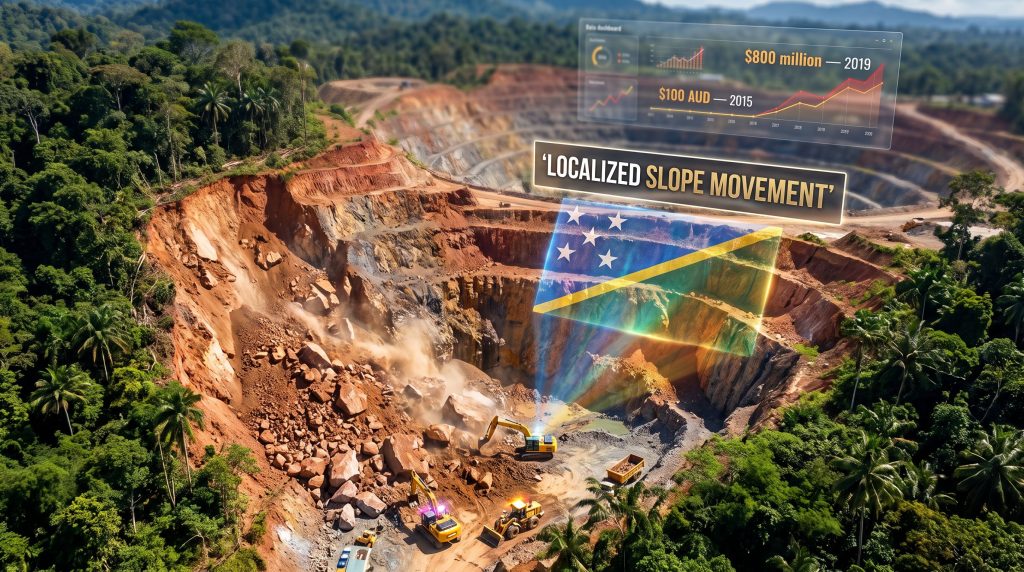
The mine's ownership history is as turbulent as its safety record. Australian miner Saint Barbara once operated the site, but suspended production and ultimately exited following flash flood damage in 2015 that created a credible risk of tailings dam failure. The asset was transferred to a local landowner group for the remarkable sum of $100 AUD — a transaction that reflected a distressed exit rather than any commercial valuation.
That $100 price tag became one of the most unusual asset transfers in Pacific mining history, and it set in motion a governance structure that has struggled to manage a technically complex operation ever since. Consequently, questions around mine closure and rehabilitation became central to the site's troubled legacy from that point forward.
By 2019, the mine had attracted the attention of the China State Railway Group, with an $800 million redevelopment proposal tabled that included port and road infrastructure. The majority ownership eventually consolidated under Hong Kong-listed Wanguo International Mining, with the local landowner company retaining a minority equity stake in the operating entity, Gold Ridge Mining Limited (GRML).
Ownership Timeline at a Glance
| Period | Owner / Operator | Key Development |
|---|---|---|
| Pre-2015 | Saint Barbara (Australia) | Production suspended; tailings dam flood risk identified |
| 2015 | Local landowner group | Asset acquired for $100 AUD following Saint Barbara exit |
| 2016 | Landowner group | Arsenic contamination fears following tailings dam spill |
| 2019 | Transition period | $800M China State Railway Group redevelopment proposal |
| Present | Wanguo International Mining (majority) + landowner group (minority) | Operational under GRML; ongoing community tensions |
The Landslide: What Happened on 28 July 2026
A slope failure occurred at the northwest edge of Open Pit 1 at Gold Ridge early on Monday morning, 28 July 2026. GRML's initial statement to the market and public characterised the event as a "localized slope movement" — language that frames the incident in minimising terms. The company simultaneously confirmed that mining operations and construction activities were continuing without disruption, and that no casualties or equipment damage had been identified.
Within hours, that position was contradicted by police. Acting Commissioner James Aitorea confirmed the recovery of a man's body — identified as Ashley Olo — whose remains were returned to his family for burial. Aitorea noted it remained too early to determine whether additional individuals remained buried beneath the collapsed material.
Local media reports, circulating alongside social media footage showing crowds gathered near the pit, suggested that as many as 10 informal miners may have been trapped. A relative of the deceased, speaking on footage supplied to ABC Pacific Beat, described narrowly surviving the collapse himself and confirmed his brother had been buried at the site.
Prime Minister Matthew Wale stated publicly that the government had not received notification of any fatalities before media reporting broke the story — a disclosure that raises direct questions about the adequacy of mandatory incident reporting obligations under existing Solomon Islands mining law.
The Reporting Gap: Corporate Communication vs. Ground Reality
The divergence between GRML's initial statement declaring no casualties and the confirmed recovery of a body within hours represents more than a communications failure. It points to a structural accountability gap where the operating company's public disclosures are not independently verified in real time by any regulatory authority with the technical capacity to do so.
This gap matters beyond the immediate tragedy. When operators control the initial narrative of a safety incident — and when no independent inspectorate is present on-site to provide a parallel account — the public record becomes unreliable at the precise moment it matters most. Effective mining risk communication frameworks could help address this systemic failing.
Why Informal Miners Enter Active Open-Cut Pits
Perhaps the most revealing dimension of the Gold Ridge landslide is not the collapse itself, but who was present when it occurred. The individuals believed to be buried were not GRML employees operating under safety protocols. They were informal or illegal gold panners — a category of worker that exists in a legal grey zone across much of the developing world's mining sector.
Understanding why informal miners enter dangerous active mine sites requires looking beyond the immediate security failure and examining the structural economic conditions that make such entry rational from a community perspective.
Key drivers of informal mining at large-scale operations:
- Economic exclusion from formal employment within the mining operation itself
- Benefit-sharing arrangements that concentrate returns within narrow landowner structures rather than distributing them broadly across affected communities
- Customary land connections that create cultural expectations of access to ancestral territory, even after formal alienation through mining leases
- Limited alternative livelihood options in geographically isolated, resource-dependent economies
- Perceived legitimacy gaps in the licensing system, particularly where communities dispute the fairness of original land access agreements
This is not unique to the Solomon Islands. Across West Africa, South America, and Southeast Asia, the phenomenon of artisanal and small-scale mining (ASM) operating in the shadow of large-scale licensed operations is well-documented. The International Labour Organization estimates that ASM engages between 40 and 100 million people globally, making it one of the largest informal employment sectors in the world.
The critical distinction is that in many jurisdictions, ASM has been formalised through licensing regimes that provide legal pathways, basic safety training, and defined working zones. No such framework appears to be operating effectively at Gold Ridge.
January 2026: The Warning That Was Not Heeded
Six months before the Solomon Islands Gold Ridge mine landslide, the site experienced a different but equally revealing crisis. Local landowners set fire to dozens of pieces of heavy equipment at the mine following a police crackdown on illegal miners operating within the site. The arson was not a spontaneous act of vandalism — it was a visible expression of deteriorating relations between GRML and the surrounding community.
When a community resorts to equipment destruction rather than dialogue, it indicates that formal grievance mechanisms have either failed or never existed in a functional form. The January 2026 arson should have triggered an immediate review of access controls, community engagement protocols, and benefit-sharing arrangements at Gold Ridge. That the landslide occurred six months later with informal miners present inside an active pit suggests no such review produced meaningful change.
The Regulatory Architecture: Where the System Fails
The Solomon Islands operates under the Mines and Minerals Act as the primary legislative framework governing extraction rights, environmental obligations, and operational safety. However, the practical capacity to enforce this framework is constrained by a combination of limited government resources, geographic isolation, and institutional gaps that are common across small Pacific Island states.
There is no equivalent in the Solomons to the state-based mine safety inspectorates that operate in Australia — bodies such as the New South Wales Resources Regulator, which maintains technical staff with geological and engineering expertise, conducts unannounced site inspections, and has the authority to suspend operations pending safety reviews. In the absence of such an institution, enforcement of operational safety standards at remote mine sites defaults almost entirely to the operator's own internal management.
Comparative Safety Governance: Solomon Islands vs. Regional Benchmarks
| Safety Governance Dimension | Solomon Islands (Gold Ridge) | Australian Standard |
|---|---|---|
| Independent mine safety regulator | Absent in effective form | State-based inspectorates with technical expertise |
| Mandatory fatality notification | Unclear timeline; PM not notified | Legally mandated immediate notification to regulator |
| Perimeter security enforcement | Demonstrated failure at Gold Ridge | Strict exclusion zone requirements around active workings |
| Tailings dam oversight | Historically weak (2015-2016 failures) | ANCOLD guidelines with mandatory periodic safety reviews |
| Artisanal mining policy | No effective formalisation pathway | Defined small-scale mining licence categories in most states |
| Community benefit-sharing | Contested; minority landowner structure | Native title agreements; community benefit frameworks |
Prime Minister Wale's public statements following the landslide indicated that the government itself regards existing regulations as potentially inadequate and has flagged the need for strengthening. That the head of government is publicly questioning the sufficiency of his own country's mining safety framework in the immediate aftermath of a fatal incident reflects the scale of the institutional gap that must be addressed.
Offshore Ownership and the Accountability Vacuum
The governance structure of GRML introduces a layer of complexity that compounds the regulatory challenge. Majority ownership sits with Wanguo International Mining, listed in Hong Kong. While Hong Kong listing standards carry disclosure obligations, they do not extend to operational safety enforcement at remote Pacific mine sites.
The practical implication is that ultimate accountability for what happens at pit face level in the Gold Ridge operation rests with GRML's on-site management, overseen by a majority shareholder operating from a jurisdiction that has no mandate to intervene in Solomon Islands mine safety matters. The Solomon Islands government, armed with legislation whose enforcement capacity is limited, is left as the primary — and largely under-resourced — check on operator behaviour.
This ownership-accountability mismatch is not a design flaw unique to Gold Ridge. It is a structural feature of how resource extraction in small Pacific Island states has historically been organised, with majority control frequently held by foreign entities and domestic regulatory systems never adequately resourced to provide meaningful independent oversight. In addition, considering natural capital in mining frameworks has become increasingly important in highlighting the true costs of such governance deficits.
The next major ASX story will hit our subscribers first
A Decade of Unresolved Incidents: The Pattern Behind the Crisis
The July 2026 Solomon Islands Gold Ridge mine landslide cannot be understood in isolation. It sits at the end of a documented chain of safety, environmental, and community governance failures stretching back more than a decade:
- 2015: Flash flooding creates credible tailings dam failure risk; Saint Barbara exits for $100, leaving the asset in the hands of a landowner group without independent technical mine management capacity
- 2016: A tailings dam spill generates arsenic contamination fears in surrounding waterways; environmental liability questions remain unresolved in public documentation
- 2019: An $800 million redevelopment proposal involving Chinese state capital is announced without transparent public regulatory review, according to available reporting
- January 2026: Landowners destroy dozens of pieces of heavy equipment following a police crackdown on illegal miners — a clear signal of social licence collapse
- July 2026: A slope failure buries an unknown number of informal miners; at least one confirmed fatality; operator initially reports no casualties
Each of these incidents represents a point at which stronger regulatory intervention, clearer community engagement, or better-resourced oversight could have interrupted the trajectory toward the current crisis.
What Effective Reform Looks Like: A Policy Framework
Immediate Priorities
- Independent technical investigation into the geotechnical cause of the slope failure, with findings made publicly available rather than remaining internal to GRML
- Mandatory victim accounting through a government-led process, removing dependence on the operator for casualty reporting
- Assessment of whether adjacent pit areas are safe to continue operating while recovery efforts proceed
Medium-Term Regulatory Changes
- Introduction of legally binding incident notification timelines, with direct government notification required within a defined period of any fatality or serious injury
- Engagement of regional technical assistance, potentially through Australia's development cooperation programs, to build mine safety inspectorate capability within Solomon Islands government agencies
- Development of a formal artisanal mining policy that creates legal access pathways for small-scale gold recovery in defined areas, combined with strict enforced exclusion zones around active open-cut workings
Structural Long-Term Reforms
- Reform of benefit-sharing arrangements between GRML, the landowner group, and the broader surrounding community to reduce the economic exclusion that drives informal mining behaviour
- Introduction of social licence to operate assessments as a condition of mining lease renewal, requiring demonstrated community consent rather than assuming it
- Exploration of a regional multilateral minimum standard framework for Pacific Island mining safety, potentially coordinated through the Pacific Islands Forum
Broader mining sustainability transformation principles offer a useful template for how such reforms can be structured and implemented effectively across resource-dependent developing economies.
Frequently Asked Questions
How many people died in the Gold Ridge mine landslide?
At least one fatality has been officially confirmed. Police identified the deceased as Ashley Olo, whose body was recovered from the site and returned to his family. Early local media reports suggested that as many as 10 informal miners may have been buried, with search and recovery operations ongoing at the time of reporting. The total number of casualties had not been officially confirmed.
Who owns the Gold Ridge mine?
Gold Ridge Mining Limited operates the mine. The majority stake is held by Hong Kong-listed Wanguo International Mining, with a minority interest held by a local Solomon Islands landowner group. The site was previously operated by Australian miner Saint Barbara, which sold the asset for $100 in 2015 following the suspension of production and concerns about tailings dam integrity.
Were the victims employees of the mine?
Available reporting indicates the individuals present at the time of the collapse were informal or illegal gold panners, not licensed employees of GRML. This distinction carries significant implications for corporate liability, community relations, and the regulatory response framework.
What is the history of safety incidents at Gold Ridge?
The mine has experienced a sequence of significant failures including a tailings dam flood risk in 2015, arsenic contamination concerns following a tailings dam spill in 2016, and the destruction of heavy equipment by local landowners in January 2026 following a police crackdown on illegal miners at the site.
Key Takeaways
- The Solomon Islands Gold Ridge mine landslide is the latest in a documented series of safety, environmental, and governance failures at the same site, not an isolated or unpredictable event
- The gap between the operator's initial statement claiming no casualties and the subsequent police confirmation of a fatality reflects a transparency and mandatory reporting deficit that requires structural regulatory reform
- The presence of informal miners inside an active open-cut pit at the time of the collapse reflects systemic failures in both physical access control and community benefit-sharing that enforcement alone cannot resolve
- Offshore majority ownership combined with limited domestic regulatory capacity creates accountability gaps that place community members and informal workers at elevated risk across Pacific Island resource operations
- Regional partners with capacity and longstanding Pacific engagement have both the expertise and the relationships to support meaningful mine safety governance reform in the Solomon Islands and across the broader Pacific Island region
This article is based on publicly reported information available as of 28 July 2026. Search and recovery operations were ongoing at the time of writing. Casualty figures and operational details may be subject to revision as the situation develops. Nothing in this article constitutes legal, investment, or policy advice.
Want to Stay Ahead of Significant ASX Mineral Discoveries Before the Broader Market?
Discovery Alert's proprietary Discovery IQ model delivers real-time alerts on major ASX mineral discoveries, transforming complex geological data into clear, actionable investment insights for both short-term traders and long-term investors — start your 14-day free trial today and explore how historic discoveries have generated exceptional returns for those who acted early.