May 18, 2026
The Fiat Currency Illusion: Why Nominal Wealth Is Not Real Wealth
Most investors measure financial success in the wrong unit. They count dollars, track balances, and benchmark returns against nominal figures, all while the underlying purchasing power of those dollars quietly erodes. This distinction between nominal wealth and real wealth sits at the heart of one of the most important long-term investment debates: gold and silver versus the dollar.
Understanding this debate requires stepping back from short-term price charts and examining a structural reality that has played out across centuries of monetary history. Fiat currencies are politically managed instruments. Precious metals are not. That single difference explains almost everything about their long-run performance relative to each other.
When big ASX news breaks, our subscribers know first
Why the Dollar's Structural Position Makes It Uniquely Vulnerable
The Reserve Currency Paradox
The U.S. dollar's status as the world's reserve currency is commonly interpreted as a position of strength. In reality, it creates a concentration of systemic risk that no other major currency faces. Because global commodities, trade flows, and sovereign debt are denominated in dollars, any sustained erosion in confidence in U.S. fiscal policy carries consequences that ripple far beyond American borders.
Other major currencies compete on a spectrum of relative weakness. The dollar's potential decline, however, would represent something qualitatively different: a structural shift in the global monetary order, not simply a cyclical correction. That asymmetry is rarely priced into conventional financial planning.
Why the "Cleanest Dirty Shirt" Argument Falls Apart
A popular framing among dollar bulls suggests that even if the dollar depreciates, it depreciates less than its alternatives. This view misses a critical distinction that experienced investors understand well.
Relative currency performance is not the same as preserved purchasing power. Outperforming a basket of weakening fiat currencies still results in purchasing power loss if inflation is running faster than the currency's relative strength.
This framing was challenged directly at the Vancouver Resource Investment Conference, where the argument was made that while many currencies share the dollar's fundamental problems, the dollar carries a unique additional risk because of its reserve status. The very feature that gives the dollar its global dominance also means that any loss of that status would be uniquely catastrophic. Investors who assume the dollar wins by default are, in this view, misunderstanding the nature of the risk.
The crucial reframe: it does not matter how many dollars you hold if those dollars cannot maintain their purchasing capacity. What counts is not the nominal quantity of dollars accumulated, but what those dollars can actually buy over time.
What Purchasing Power Erosion Looks Like Over Five Decades
A Concrete Case Study: 1971 to Today
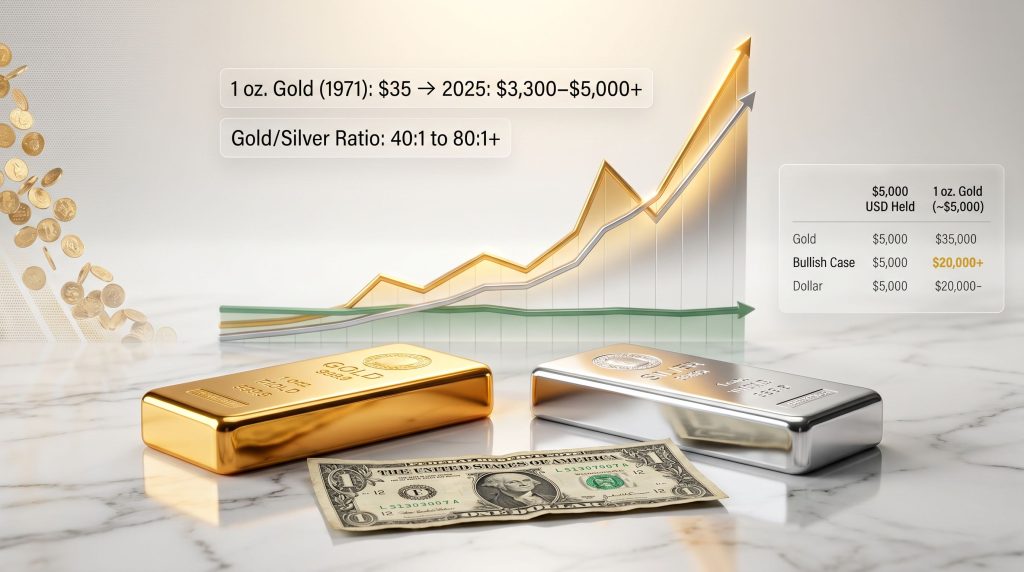
When the United States abandoned the 1971 gold standard end, an ounce of gold was priced at approximately $35. A person who buried $35 in cash that year and retrieved it today would still have $35 in nominal terms, but its purchasing power would be a fraction of what it once was.
By contrast, that same ounce of gold, retrieved today, would command prices in the range of $3,300 to over $5,000 depending on market conditions at the time of writing. The gold did not become intrinsically more valuable. The dollar became intrinsically less powerful.
| Scenario | 1971 Value | 2025 Approximate Value | Real Outcome |
|---|---|---|---|
| $35 USD held in cash | $35 | $35 (nominal) | Severe purchasing power loss |
| 1 oz. gold (priced at $35 in 1971) | $35 | $3,300–$5,000+ | Significant real wealth preserved |
This is not a trading observation. It is a multi-decade structural divergence between a politically managed fiat instrument and a finite monetary asset.
Projecting the Next Decade: Forward-Looking Scenarios
The same logical framework can be applied prospectively. If gold were to reach $20,000 per ounce over the next ten years, a person who held $5,000 in cash would still have $5,000 in nominal terms. A person who converted that $5,000 into gold would hold an asset worth four times as much in dollar terms.
| Scenario | $5,000 USD Held in Cash | 1 oz. Gold Purchased at ~$5,000 |
|---|---|---|
| Conservative gold appreciation | $5,000 | $8,000–$10,000 |
| Base case gold appreciation | $5,000 | $12,000–$15,000 |
| Bullish case (accelerating dollar debasement) | $5,000 | $20,000+ |
The asymmetry becomes more pronounced the longer the holding period extends. Dollar holders face mathematically guaranteed purchasing power erosion through inflation. Gold holders face price volatility, but historical evidence consistently supports long-run preservation and expansion of real purchasing power.
Disclaimer: Forward-looking scenarios are speculative projections, not financial forecasts. Past performance of gold or any asset class does not guarantee future results.
How Dollar Dynamics Drive Gold and Silver Prices
The Mechanical Inverse Relationship
Gold and silver are globally priced in U.S. dollars, which creates a mechanical inverse relationship between dollar strength and metals prices. When the dollar weakens, the same ounce of gold costs more dollars to purchase, lifting the nominal USD price. When the dollar strengthens, nominal metals prices face downward pressure even if underlying demand is unchanged. You can track these movements in real time using live gold and silver price charts to observe how dollar fluctuations translate directly into metals pricing.
This short-term dynamic is frequently misread by investors as metals becoming expensive or cheap in absolute terms, when in reality the dollar's movement is doing the heavy lifting.
Three Core Variables Driving the Metals-Dollar Relationship
-
Dollar strength trend measured by the DXY index; sustained DXY weakness provides a structural tailwind for metals prices expressed in USD terms.
-
Real interest rates calculated as nominal interest rates minus prevailing inflation. When real rates turn negative, the opportunity cost of holding non-yielding gold and silver disappears, dramatically increasing their relative attractiveness.
-
Geopolitical and macroeconomic uncertainty which historically triggers capital rotation toward safe-haven assets, with gold's safe-haven role serving as the primary beneficiary and silver capturing secondary flows.
Featured Snippet: Gold and silver rise against the dollar primarily because the dollar's purchasing power declines over time. Short-term, metals prices are mechanically sensitive to dollar strength. Long-term, the relationship reflects the cumulative erosion of fiat currency value against finite monetary metals.
Gold vs. Silver: Comparing the Two Metals as Dollar Hedges
Key Differences Investors Need to Understand
Gold and silver share the same macro thesis but behave quite differently in practice. Understanding these differences allows investors to construct positions that match their risk tolerance and return objectives.
| Attribute | Gold | Silver |
|---|---|---|
| Volatility | Lower | Higher |
| Primary demand driver | Monetary/reserve | Industrial + monetary |
| Safe-haven demand | Primary | Secondary |
| Industrial demand share | Minimal | Approximately 50% of total demand |
| Price sensitivity to dollar moves | Moderate | Amplified |
| Long-run purchasing power track record | Established | Strong but more variable |
Is the Gold-to-Silver Ratio a Reliable Valuation Signal?
The gold-silver ratio measures how many ounces of silver are required to purchase one ounce of gold. Historically, this ratio has averaged between 40:1 and 60:1. When the ratio rises above 80:1, it suggests silver is historically undervalued relative to gold. When the ratio contracts, silver is outperforming, often signalling a risk-on phase within the broader precious metals cycle.
Experienced investors use ratio extremes to time rotations between the two metals, reducing gold positions and increasing silver exposure when silver appears historically cheap, and rotating back into gold when silver becomes relatively expensive. Furthermore, monitoring current silver price data alongside the ratio can help refine these rotation decisions.
Silver's Dual Nature: Unlike gold, silver carries substantial industrial demand from sectors including solar photovoltaic manufacturing, electronics, and medical devices. This dual role means silver can decouple from gold during periods of supply tightness or industrial demand shocks, introducing additional upside potential but also additional volatility not present in gold.
Which Metal Should Dollar-Concerned Investors Prioritise?
-
Gold functions as the primary monetary reserve, offering lower volatility, deeper market liquidity, and a longer institutional track record as a dollar alternative and store of value.
-
Silver provides leveraged exposure to the same macro thesis, historically amplifying gold's percentage moves in both directions during precious metals cycles.
-
A combined allocation allows investors to access gold's stability while retaining exposure to silver's potential for outsized gains during the most bullish phases of the cycle.
Mining Stocks vs. Physical Metals: Understanding the Risk Spectrum
Two Different Functions Within One Macro Thesis
Physical gold and silver represent direct monetary exposure. There is no counterparty risk, no management execution risk, and no operational leverage. An ounce of gold is an ounce of gold. When comparing physical gold vs ETFs, however, investors must also weigh convenience, liquidity, and counterparty considerations.
Mining equities introduce a fundamentally different dynamic. Operational leverage means that a 20% rise in gold prices can translate into a 40–80% rise in a well-positioned mining company's earnings, because costs are largely fixed while revenues rise with the metal price. This leverage cuts in both directions.
At the Vancouver Resource Investment Conference, the view was expressed that mining stocks remain deeply mispriced because Wall Street has spent years assuming gold prices would revert lower. Consequently, analyst valuation models have consistently used conservative long-run gold price assumptions that no longer reflect market reality. When those models are updated to reflect sustained elevated gold prices, the resulting earnings upgrades could trigger significant re-rating events across the mining sector.
This is not a guaranteed outcome, but it represents a compelling structural opportunity for investors with the appropriate risk tolerance.
The Mining Equity Risk Spectrum
| Asset Class | Risk Level | Upside Potential | Dollar Hedge Quality |
|---|---|---|---|
| Physical gold | Low-Medium | Moderate | High (direct) |
| Physical silver | Medium | Moderate-High | High (direct) |
| Royalty and streaming companies | Medium | High | Indirect |
| Senior producing miners | Medium-High | High | Indirect |
| Junior mining stocks | High | Very High | Indirect |
| AI and technology stocks | High | Variable | Low |
| Cryptocurrency | Very High | Speculative | Contested |
Within mining equities, royalty and streaming companies occupy a particularly interesting position. They provide exposure to metals prices without the operational risks of actually running a mine, making them a more conservative entry point into the sector. Junior miners sit at the opposite end of the spectrum, offering the highest potential returns but also the highest probability of capital loss.
Furthermore, understanding how gold and mining equities interact during different phases of the metals cycle is essential for structuring a well-balanced portfolio across both direct and leveraged exposure.
Portfolio Construction Principle: Physical metals and mining stocks serve fundamentally different functions. Physical metal is a monetary savings instrument designed to preserve purchasing power. Mining equities are growth investments with commodity price leverage. Both can coexist in a well-structured portfolio, but treating them as interchangeable would be a significant analytical error.
The next major ASX story will hit our subscribers first
Building a Precious Metals Position: A Practical Framework
Why Dollar-Cost Averaging Removes the Hardest Problem
Short-term price movements in gold and silver are driven by dollar index fluctuations, real interest rate shifts, and geopolitical developments, all of which are notoriously difficult to predict consistently. Attempting to time entry points introduces a significant source of behavioural error for most investors.
Dollar-cost averaging (DCA), purchasing fixed dollar amounts of metals at regular intervals, eliminates the need to forecast short-term moves. It smooths out volatility and ensures investors are accumulating across different price levels over time.
Step-by-Step: Constructing a Dollar Hedge Using Precious Metals
-
Assess your time horizon. Physical metals are most appropriate for long-term savings of five years or more. Short-term liquidity requirements should remain in accessible cash instruments.
-
Determine your allocation. Financial planning frameworks commonly suggest between 5% and 15% of a long-term portfolio in precious metals, calibrated to individual risk tolerance and macro outlook.
-
Choose your metals mix. Gold for monetary stability and purchasing power preservation; silver for additional leverage to the same thesis.
-
Select your investment vehicle. Physical bullion (coins or bars) for direct ownership without counterparty risk; ETFs for liquidity and ease of management; mining stocks for growth-oriented exposure.
-
Implement a dollar-cost averaging schedule. Set a recurring purchase cadence to remove emotional timing decisions from the process.
-
Monitor the gold-to-silver ratio. Use ratio signals to periodically rebalance between gold and silver, rotating toward whichever metal appears historically undervalued.
Why Gold Occupies a Different Category Than Any Currency
The Fundamental Distinction Most Investors Miss
Discussions about gold and silver versus the dollar are often framed as a currency competition. This framing is misleading. Gold is not competing with the dollar as a currency. It operates in a fundamentally different category of asset.
Most major fiat currencies share the dollar's core vulnerability: they are issued by governments with structural incentives to expand money supply over time. The relative question of which currency is "less impaired" is relevant for short-to-medium-term positioning but does not resolve the long-run purchasing power problem.
Gold's supply grows at approximately 1–2% per year through mining activity, broadly aligned with long-run economic growth rates. It cannot be printed, digitally created, or politically expanded. This makes it a monetary anchor rather than a currency competitor — a finite and politically neutral asset that exists entirely outside the fiat monetary system. In addition, gold's safe-haven role reinforces its appeal precisely during periods when confidence in fiat systems is most strained.
Key Distinction: Comparing gold to the dollar is not a currency-versus-currency debate. It is a comparison between a finite, politically neutral monetary asset and a politically managed, infinitely expandable fiat instrument. These are categorically different instruments with categorically different long-run properties.
Frequently Asked Questions: Gold and Silver Versus the Dollar
Does gold always rise when the dollar falls?
Not always, but a strong inverse correlation exists in the short term. A weaker dollar makes gold cheaper in other currencies, typically lifting global demand and pushing USD prices higher. Over long periods, the relationship reflects cumulative fiat currency debasement rather than daily dollar fluctuations.
Is silver a better investment than gold against the dollar?
Silver offers higher volatility and greater percentage upside during precious metals bull markets, but carries more downside risk. Gold provides more stable monetary hedging. Most long-term investors hold both, using gold as a foundation and silver for additional leverage to the macro thesis.
What is the gold-to-silver ratio and why does it matter?
The ratio measures how many ounces of silver are required to buy one ounce of gold. Elevated readings above 80:1 historically suggest silver is undervalued relative to gold. Investors use this signal to time rotations between the two metals within their overall precious metals allocation.
How much of my savings should be in gold and silver?
Financial planning frameworks typically suggest 5–15% of a long-term portfolio in precious metals, depending on risk tolerance and investment horizon. Physical metals are most appropriate as long-term savings instruments rather than short-term liquidity vehicles. This is not personal financial advice.
Are mining stocks a better dollar hedge than physical metals?
Mining stocks provide leveraged exposure to metal prices rather than direct monetary exposure, and they carry operational, management, and financing risks that physical metals do not. For pure purchasing power protection, physical metals are more direct. For growth-oriented investors comfortable with higher risk, mining equities may offer superior return potential if the macro thesis plays out as expected.
Key Takeaways: The Strategic Case for Precious Metals Over Dollar Savings
-
The dollar's reserve currency status creates unique systemic downside risk, not additional protection, because any erosion of that status carries outsized global consequences.
-
Gold and silver have preserved purchasing power across multi-decade periods where dollar-denominated savings suffered significant real-value erosion.
-
The 1971 case study is instructive: $35 buried in cash versus one ounce of gold buried in the ground illustrates the compounding divergence between fiat currency and monetary metals over 50 years.
-
Silver offers amplified exposure to the same macro thesis as gold, with additional industrial demand dynamics that create both opportunity and additional volatility.
-
The gold-to-silver ratio provides a relative value signal for allocating between the two metals and timing rotations within a precious metals portfolio.
-
Physical metals serve as a monetary savings instrument; mining equities function as leveraged growth investments within the same macro framework.
-
Dollar-cost averaging removes the hardest problem in precious metals investing: timing short-term price movements driven by dollar and interest rate dynamics.
-
Wall Street's historical underpricing of mining stocks, based on conservative gold price assumptions, may represent a structural rerating opportunity if gold prices remain elevated or continue rising.
This article is intended for informational and educational purposes only. Nothing contained herein constitutes financial, investment, or legal advice. Readers should conduct their own research and consult qualified financial professionals before making any investment decisions. All forward-looking scenarios and projections are speculative in nature and carry no guarantee of outcome.
Want To Know Which ASX Mining Stocks Could Benefit From Rising Gold Prices?
Discovery Alert's proprietary Discovery IQ model scans ASX announcements in real time, instantly identifying significant mineral discoveries and turning complex geological data into actionable investment insights — explore historic discovery returns to understand what's possible, then begin your 14-day free trial at Discovery Alert to position yourself ahead of the broader market.