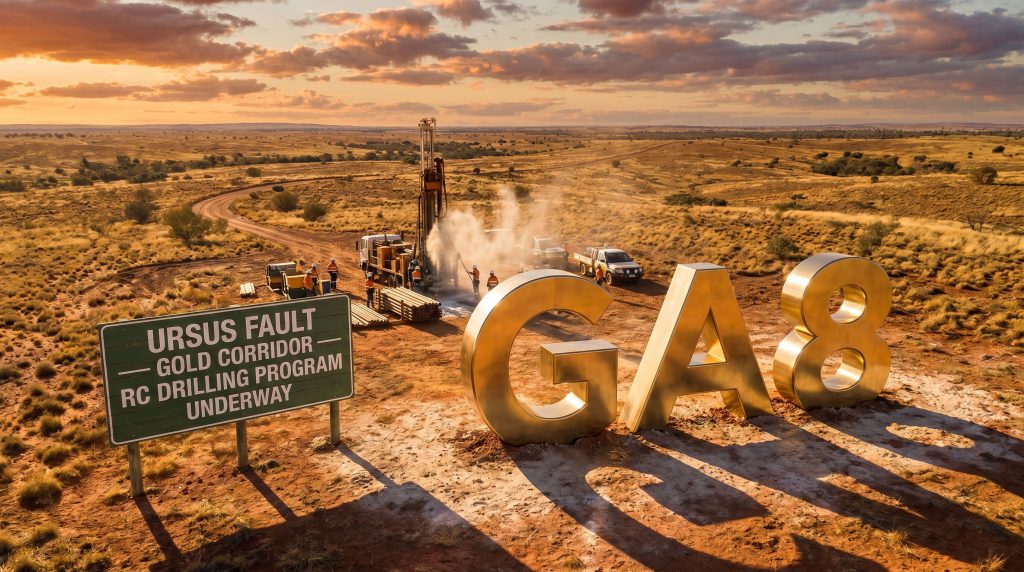
Goldarc Resources Ltd
GoldArc Resources Raises A$7.2 Million to Unlock 9km of Untested Gold Country at Leonora North
GoldArc Resources (ASX: GA8) has secured firm commitments for a A$7.2 million placement to fund an aggressive GoldArc Resources Leonora North drilling campaign funding and gold exploration at Mt Stirling — targeting a structure where only 3 of 12 kilometres along a proven gold-bearing fault have ever been drilled. Backed by institutional investors across four countries, this raise signals genuine international confidence in the company's Leonora assets.
When big ASX news breaks, our subscribers know first
The Capital Raise in Brief
GoldArc Resources has received firm commitments to raise up to A$7.2 million (before costs) through the issue of up to 102.9 million fully paid ordinary shares at A$0.07 per share. The placement drew support from new and existing institutional investors alongside high-net-worth individuals across Australia, New Zealand, Hong Kong, and the United Kingdom — a geographically broad investor base that signals genuine international interest in the company's Leonora assets.
Strategic partner BML Ventures Pty Ltd (BMLV) has subscribed for A$1.5 million as part of the raise, with A$1.0 million of that amount set off against the principal advanced under the existing Profit Cash Advance Facility. Directors have also committed to subscribing for A$135,000, subject to shareholder approval, directly aligning the board's interests with those of shareholders.
Settlement is anticipated on 21 May 2026, with new shares allotted on 22 May 2026 (excluding director shares, which are subject to a General Meeting expected in July 2026). Bell Potter Securities Limited and GBA Capital Pty Ltd acted as Joint Lead Managers, with Leeuwin Wealth as Co-Manager.
Placement Pricing Summary
| Metric | Value |
|---|---|
| Issue Price | A$0.07 per share |
| Last Closing Price (12 May 2026) | A$0.072 |
| Discount to Last Close | 2.78% |
| Discount to 5-Day VWAP (A$0.0792) | 11.6% |
| Discount to 10-Day VWAP (A$0.0868) | 19.3% |
| New Shares Issued | Up to 102.9 million |
| Gross Proceeds | Up to A$7.2 million |
Managing Director Paul Stephen commented on the raise, stating: "This Placement reflects strong investor conviction in GoldArc's strategy and the quality of our Leonora ground. Our focus over the next 12 months is clear; we own 100% of Leonora North, the Ursus Fault has delivered 152,000 ounces in the ~3km we've tested, and we have ~9km of this structure yet to drill. That's a genuinely significant exploration corridor in one of the world's best gold addresses. Importantly, our BMLV partnership means Mt Stirling is already on a production pathway — so every exploration dollar we deploy is building on a company that already has a funded path to cash flow."
The Core Opportunity: 12 Kilometres, Only 3 Tested
The strategic rationale behind this raise centres on a compelling geological opportunity. GoldArc holds 100% of the Leonora North Gold Project, which sits across approximately 12 kilometres of the Ursus Fault Line — a structure that has already yielded a combined JORC Mineral Resource of 152,000 oz at 1.7 g/t Au across the Mt Stirling and Stirling Well deposits within just the first ~3 kilometres of tested strike.
That leaves ~9 kilometres of fault strike largely untested.
Critically, systematic soil sampling across Leonora North has defined five gold anomalies (S1–S5). The S4 anomaly — which lies directly along the untested portion of the Ursus Fault — exhibits a stronger geochemical signature than the soil anomaly that originally led to the Mt Stirling discovery. Furthermore, it has never been drilled, and it sits at the top of the priority list for the upcoming campaign.
The 100% ownership structure represents a meaningful differentiator. There is no joint-venture dilution on new discoveries; every ounce found accrues entirely to GoldArc shareholders. This provides direct exposure to resource growth without partnership complexities.
Understanding RC Drilling — What Does It Mean for Investors?
Reverse Circulation (RC) drilling is one of the most commonly used methods in gold exploration. A rotating drill bit crushes rock underground and blows the material back to the surface as chips using compressed air. These chips are then sampled and analysed for gold content.
RC drilling is favoured for its speed, cost efficiency, and reliability in producing high-quality samples — making it well suited to systematic testing of large fault corridors like the Ursus Fault.
Why Does This Matter Here?
The upcoming RC campaigns represent the first systematic testing of several high-priority targets along the Ursus Fault that have never previously been drilled. Each campaign has the potential to define new mineralised zones and expand the overall resource base.
The S4 anomaly, described as showing a stronger geochemical signal than the soil anomaly behind the Mt Stirling discovery, represents the clearest near-term catalyst for a new discovery announcement.
Glossary of Key Terms
| Term | Definition |
|---|---|
| RC Drilling | Reverse Circulation drilling — fast, cost-effective method producing rock chip samples for gold analysis |
| JORC Resource | A mineral resource estimate prepared under the Australasian Code for Reporting of Mineral Resources and Ore Reserves |
| g/t Au | Grams of gold per tonne of rock — a measure of gold grade |
| VWAP | Volume Weighted Average Price — average share price weighted by trading volume over a set period |
| Fault Strike | The horizontal length or direction of a geological fault — a key measure of how much prospective ground exists |
| Soil Anomaly | An elevated concentration of gold in surface soils, used as a proxy for potential mineralisation at depth |
| Toll Treatment | Processing ore through a third-party mill in exchange for a fee, avoiding the capital cost of building a plant |
A Fully Funded, 12-Month Exploration Programme
The proceeds from the placement fund a structured, multi-stage drilling and geochemical programme scheduled across the next 12 months, targeting both resource extension and new discovery across Leonora North and South.
12-Month Exploration Programme Timeline
| Programme | Target / Purpose | Scheduled |
|---|---|---|
| Mt Stirling S1–S7 RC Campaign | Extensions to 152,000 oz resource; new mineralised zones along Ursus Fault | July 2026 |
| Yttria Prospect RC Programme | High-priority structural target on Leonora North | September 2026 |
| Chert Prospect RC Programme | Systematic drilling of Chert prospect | November 2026 |
| Cosmopolitan RC Programme | Extending the Cosmopolitan gold system at Leonora South | TBC 2026 |
| Leonora North Soils (200 samples – Chert area) | Geochemical targeting ahead of RC | Ongoing |
| Leonora North Soils (1,000 samples) | Regional target generation | Ongoing |
| Leonora South Soils (1,000 samples) | Regional target generation | Ongoing |
The programme is designed with logical sequencing: soil sampling programmes run ahead of RC campaigns to sharpen drill targeting, while staggered RC programmes allow for results to inform subsequent drilling decisions throughout the calendar year.
Total Resource Base: More Than Leonora North
While the Leonora North discovery corridor is the centrepiece of this raise, GoldArc's total resource base spans multiple deposits across a combined ground position of 1,200 km² and more than 75 kilometres of underexplored prospective strike in the Eastern Goldfields.
GoldArc Total JORC Mineral Resource Summary
| Project / Deposit | Category | Tonnes | Grade (g/t Au) | Gold Ounces |
|---|---|---|---|---|
| Leonora North – Mt Stirling | Indicated | 391,000 | 2.1 | 26,000 |
| Leonora North – Mt Stirling | Inferred | 2,158,000 | 1.6 | 111,000 |
| Leonora North – Stirling Well | Inferred | 198,000 | 2.3 | 15,000 |
| Leonora South – Orion | Inferred | 370,000 | 2.2 | 26,409 |
| Leonora South – Sapphire | Inferred | 320,000 | 2.1 | 21,605 |
| Total | 3,437,000 | 1.82 | 200,014 |
The portfolio already encompasses over 200,000 oz in total JORC resources across four deposits. In addition, active discovery-stage prospects — including Eclipse, which has returned 14 metres at 7.49 g/t Au — are yet to be captured in any resource estimate, suggesting further upside potential.
Two Development Pathways Already in Motion
Alongside its exploration activities, GoldArc is progressing two partner-funded, capex-light development pathways that bring near-term production potential into the frame. Importantly, these arrangements avoid requiring GoldArc to carry the full financial burden:
-
Mt Stirling (BML Ventures partnership): Metallurgical and geotechnical de-risking is underway, with mining commencement targeted for Q3/Q4 CY2026. This partnership means Mt Stirling is already on a production pathway, funded externally through the existing Profit Cash Advance Facility arrangement.
-
Orion–Sapphire (Mineral Mining Services partnership): Production at Leonora South is targeted for Q1 CY2027 via the MMS partnership at the Orion–Sapphire deposits.
These arrangements are structured so that GoldArc maintains exposure to production upside while exploration dollars are directed entirely at resource growth and new discovery rather than development capital.
Adding to the infrastructure picture, the King of the Hills mill, operated by Vault Minerals, sits approximately 5 kilometres from the Leonora North deposit corridor. As resources grow, this provides an accessible toll-treatment pathway without the need for GoldArc to fund mill construction. The proximity represents a significant advantage as the GoldArc Resources Leonora North drilling campaign funding and gold exploration at Mt Stirling progresses toward potential production scenarios.
Near-Term Catalysts to Watch
Investors monitoring GoldArc over the coming quarters have a well-defined set of catalysts to track:
- July 2026: Mt Stirling S1–S7 RC drilling commences — the first systematic test of the high-priority Ursus Fault extensions, including the S4 anomaly
- Mid-2026 onwards: Results flowing from active Leonora South drilling across Cosmopolitan, Whistler, Woodpecker, and Cosmopolitan/Altona South
- Q3/Q4 CY2026: Mt Stirling mining commencement (targeted, subject to de-risking completion)
- September 2026: Yttria Prospect RC drilling commences
- November 2026: Chert Prospect RC drilling commences
- Ongoing: Eclipse maiden Mineral Resource Estimate — high-grade discovery area advancing toward MRE
- Q1 CY2027: Leonora South production targeted via MMS partnership at Orion–Sapphire
- July 2026: General Meeting for director share placement approval
The next major ASX story will hit our subscribers first
Why Investors Should Watch GoldArc Closely
GoldArc sits at an inflection point that is relatively uncommon in small-cap gold exploration: a company that has already demonstrated it can find gold along a structure, has the capital to test the bulk of that structure systematically for the first time, and has partner-funded development pathways already in motion.
The key investment considerations include:
- Significant untested ground: ~9km of the Ursus Fault remains undrilled. The existing 152,000 oz resource was generated from ~3km. The S4 anomaly is stronger than the signal that led to the original discovery.
- 100% ownership: No JV dilution. All resource growth and new discoveries accrue entirely to GoldArc shareholders.
- Dual-track strategy: Exploration and development running concurrently, with development capital largely provided by partners.
- Infrastructure proximity: The King of the Hills mill (~5km away) provides a natural toll-treatment option as resources scale.
- Funded programme: The A$7.2 million raise provides a fully funded, 12-month exploration pipeline with scheduled catalysts through to late 2026.
- Board alignment: Directors participating for A$135,000, subject to shareholder approval — skin in the game at the current share price.
- Internationally supported raise: Investor participation from four countries reflects confidence in the asset well beyond the domestic market.
The systematic nature of the upcoming drilling campaigns presents multiple opportunities for resource expansion and new discovery. However, perhaps the most significant near-term catalyst remains the July 2026 Mt Stirling S1–S7 RC campaign — the first direct test of targets that exhibit stronger geochemical signatures than the original discovery zone.
GoldArc Resources has secured the capital to systematically test one of the Eastern Goldfields' most compelling untested exploration corridors — 9 kilometres of the Ursus Fault that has already proven its ability to host gold at scale. With a structured 12-month drilling programme, two partner-funded development pathways targeting production in CY2026 and CY2027, and a total JORC resource base exceeding 200,000 ounces, the company enters its most active exploration phase to date. The upcoming Mt Stirling S1–S7 RC campaign in July 2026 — targeting the untested S4 anomaly, which shows a stronger geochemical signal than the anomaly that led to the original Mt Stirling discovery — represents one of the most clearly defined near-term discovery catalysts in the company's history.
Want to Know When the Next Major ASX Gold Discovery Hits?
Discovery Alert's proprietary Discovery IQ model scans ASX announcements in real time, instantly identifying significant mineral discoveries like those unfolding across the Eastern Goldfields — turning complex exploration data into clear, actionable opportunities for investors at every level. Explore how major ASX mineral discoveries have historically generated substantial returns on Discovery Alert's dedicated discoveries page, then begin your 14-day free trial to position yourself ahead of the market.