Goldarc Resources Ltd
GoldArc Resources Hits Strongest Grades Yet at Mt Stirling Well as Mine Planning Gears Up for MDCP Approval
GoldArc Resources (ASX: GA8) has reported its strongest grade control results so far from the Mt Stirling Well deposit, with new intercepts including 4m @ 9.24 g/t Au and 2m @ 15.5 g/t Au. According to the ASX announcement, the latest assays confirm near-surface high-grade shoots and support continued grade control coverage across the deposit as planning progresses toward the key regulatory step required before mining can begin at Mt Stirling.
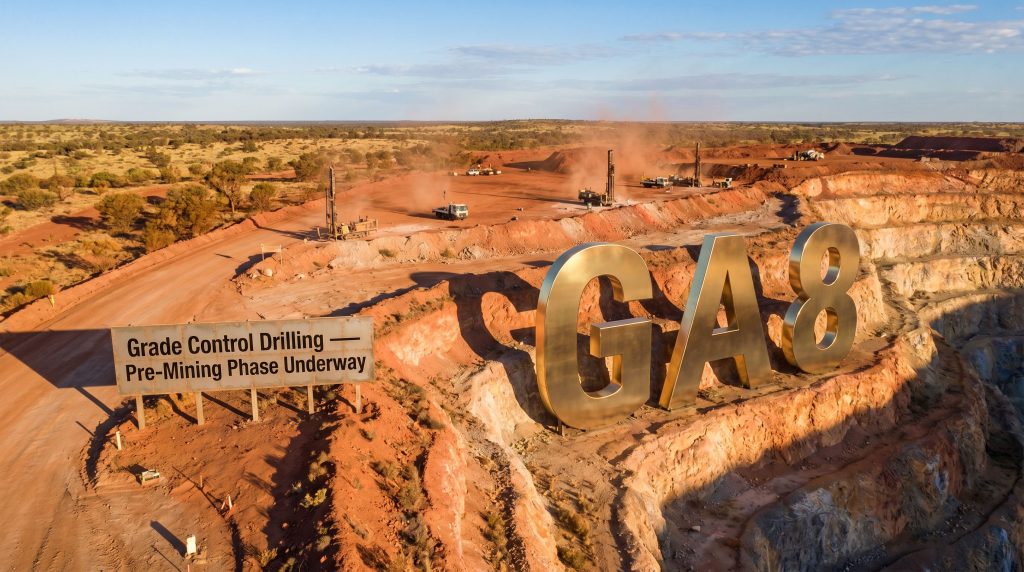
The update also showed the first phase of grade control drilling at the nearby Mt Stirling deposit is now largely complete. GoldArc and joint venture partner BML Ventures Pty Ltd are using the accumulating dataset to update mining models and advance mine planning ahead of anticipated approval of the Mining Development and Closure Proposal (MDCP).
For investors, the significance lies in both the quality of the grades and the stage of the work. This is not early exploration drilling aimed at finding a target. It is detailed pre-mining drilling designed to define ore boundaries, reduce dilution risk and support production scheduling.
"The Mt Stirling Well results in this batch are the strongest we've seen from that deposit," said Paul Stephen, Managing Director of GoldArc Resources. "At Mt Stirling, with the first phase of grade control substantially complete, our focus is shifting to the mine planning work that will support the MDCP approval process."
When big ASX news breaks, our subscribers know first
Mt Stirling Well Delivers Best Grade Control Results to Date
In the announcement, GoldArc said the third batch of grade control results from Mt Stirling Well (M37/1305) covered 50 holes for approximately 1,369m. The company described this as the strongest batch returned to date from the deposit.
Mt Stirling Well hosts a JORC Inferred Mineral Resource of 198,000t @ 2.3 g/t Au for 15,000oz. The latest results, according to GoldArc, are consistent with that resource grade and support the geological model used for ongoing mine planning work.
The strongest reported intercepts from this batch are set out below.
| Hole ID | From (m) | To (m) | Width (m) | Grade (g/t Au) |
|---|---|---|---|---|
| 26BSWRC1021 | 16 | 20 | 4 | 9.24 |
| Including | 18 | 19 | 1 | 27.5 |
| 26BSWRC1024 | 18 | 20 | 2 | 15.5 |
| Including | 19 | 20 | 1 | 25.5 |
| 26BSWRC1039 | 18 | 20 | 2 | 9.75 |
| Including | 18 | 19 | 1 | 18.7 |
| 26BSWRC1040 | 18 | 20 | 2 | 7.89 |
| Including | 18 | 19 | 1 | 13.6 |
| 26BSWRC1022 | 20 | 22 | 2 | 6.12 |
| Including | 21 | 22 | 1 | 11.1 |
| 26BSWRC1009 | 16 | 19 | 3 | 3.96 |
| Including | 18 | 19 | 1 | 8.74 |
All intervals were reported as downhole widths, using a 0.5 g/t Au cutoff, with up to 2m internal dilution and no top cuts applied.
Why Are Shallow Grades Particularly Relevant?
A key feature of the Mt Stirling Well results is that the better grades are shallow. Most of the standout intercepts were returned from depths of roughly 16m to 22m, which is relevant because shallow mineralisation can simplify open-pit planning if later mining approvals are obtained.
GoldArc also pointed out that Mt Stirling Well occurs in a different geological setting to Mt Stirling. At Mt Stirling Well, gold is hosted in narrow, flat-dipping quartz veins within a granitoid host rock. In simpler terms, the gold is associated with thin quartz-rich zones in intrusive rock, rather than the fault-hosted style seen next door at Mt Stirling.
Mt Stirling Results Refine the Deposit Edges for Mine Planning
The eighth batch of grade control results from Mt Stirling (M37/1306) included 40 holes for 688m, covering submission batches 39 to 41. According to the update, these holes targeted the eastern edge and western upper zone of the deposit.
These areas sit on the margins of the deposit and in the upper benches, where GoldArc said mineralisation is generally narrower than in the broader central zone reported in previous rounds. However, the grades remained elevated and are being used to refine ore and waste boundaries for mining studies.
Selected intercepts from this batch included:
| Hole ID | From (m) | Width (m) | Grade (g/t Au) | Included subinterval |
|---|---|---|---|---|
| BMLRC697 | 4 | 2 | 8.11 | 1m @ 14.9 g/t Au from 5m |
| BMLRC708 | 1 | 2 | 5.94 | 1m @ 8.65 g/t Au from 2m |
| BMLRC707 | 1 | 2 | 4.97 | 1m @ 9.44 g/t Au from 2m |
| BMLRC696 | 4 | 2 | 3.70 | 1m @ 6.96 g/t Au from 4m |
These narrower intersections matter because the outer edges of a deposit often determine where ore stops and waste begins. In practical terms, this influences how a pit shell is designed, how benches are sequenced and how much low-grade material could enter the ore stream.
GoldArc described Mt Stirling mineralisation as sitting within high-strain schistose-mylonitic deformation inside the Hydra Fault, hosted by strongly altered meta-basalt. The gold is commonly linked with silica-rich and sulphide-bearing intervals that also show elevated arsenic, providing a recognised geological marker during grade control.
Understanding Grade Control Drilling and Why It Matters
Grade control drilling is one of the most important technical steps between having a resource and preparing to mine it. While exploration drilling identifies mineralisation and resource drilling estimates its size and grade, grade control drilling works at a much tighter scale.
At Mt Stirling and Mt Stirling Well, the programme uses drill fences 8m apart with holes about 6m apart along each fence. This creates a dense data grid that can define grade changes at the bench or blast zone level.
For non-specialist investors, grade control drilling can be understood as precision mapping immediately ahead of mining. Furthermore, it helps identify exactly where higher-grade ore sits and where lower-grade or barren rock begins. This matters for several reasons:
- Ore dilution can be reduced, which means less waste rock may be mixed with ore
- Production scheduling can improve, helping operators decide what to mine first
- Mining models become more accurate, which can support pit design and bench planning
- Confidence rises at the operating scale, because grade is being tested at far closer spacing than in a standard resource drill pattern
Key Terms Explained
A few key terms from the announcement are worth clarifying:
| Term | Meaning |
|---|---|
| g/t Au | Grams of gold per tonne of rock |
| RC drilling | Reverse circulation drilling, a method that brings rock chips to surface for sampling |
| JORC Inferred Resource | A resource estimate with lower confidence than indicated resources, based on more limited data |
| Dilution | Waste rock mixing with ore, reducing the grade sent for processing |
| MDCP | Mining Development and Closure Proposal, the approval required before mining can start in Western Australia |
| QA/QC | Quality assurance and quality control checks used to verify assay results |
For investors tracking development-stage gold companies, strong grade control results can be more relevant than broad exploration intercepts. This is because they are directly tied to how mining may actually be executed.
Programme Progress Reaches About 70% of the Planned Drilling
GoldArc reported that approximately 23,654m of the combined 34,000m grade control programme has now been completed, representing about 70% of the total planned metres.
The work is fully funded by BML Ventures under a 50/50 net profit share arrangement. GoldArc retains 100% ownership of both Mt Stirling and Mt Stirling Well, while BML Ventures is funding the grade control programme. That funding structure is an important point in the update, as it means GoldArc is advancing detailed pre-mining work without directly paying for the full drilling campaign itself.
The results schedule reported by the company is summarised below:
| Batches | Dispatch date | Samples | Status |
|---|---|---|---|
| 1 to 3 | 7, 13 and 18 March 2026 | 2,053 | Previously announced 13 April 2026 |
| 5 to 6 | 25 March 2026 | 864 | Previously announced 5 May 2026 |
| 4, 7 to 10 | 25 March and 2 April 2026 | 1,972 | Previously announced 21 May 2026 |
| 11 to 13, 22 to 25 | April to May 2026 | 3,721 | Previously announced 28 May 2026 |
| 15 to 17, 26 | April to May 2026 | 1,267 | Previously announced 3 June 2026 |
| 18 to 20, 28 | April to May 2026 | 1,439 | Previously announced 11 June 2026 |
| 21, 31 | May to June 2026 | 786 | Previously announced 29 June 2026 |
| 39 to 41 | May to June 2026 | 1,752 | Reported in this announcement |
The drilling contractor is Datum Drilling, using RC methods. Samples are assayed at Bureau Veritas in Kalgoorlie using 40g fire assay with AAS finish. GoldArc said certified reference materials and blanks are inserted at a nominal rate of 1 in 20, and no significant QA/QC issues have been identified.
MDCP Approval Is Now the Key Near-Term Milestone
The announcement places increasing emphasis on the Mining Development and Closure Proposal, or MDCP. This is the regulatory approval required before mining operations can commence at Mt Stirling.
According to GoldArc, the first phase of grade control drilling at Mt Stirling is now largely complete, and the resulting dataset is being used to update mining models and support mine planning in preparation for anticipated MDCP approval. This is a meaningful shift in project stage, moving from defining mineralisation at a broad level to preparing the practical inputs needed for a mining proposal.
Subject to MDCP approval, GoldArc and BML Ventures said they anticipate moving toward the commencement of mining at Mt Stirling. In addition, the company stated that results from Mt Stirling Well are expected to feed into broader development planning across the Leonora North hub.
The next major ASX story will hit our subscribers first
Investment Takeaways From the Latest GoldArc Update
For investors assessing GoldArc as an ASX gold development story, the latest announcement adds several points of interest.
First, Mt Stirling Well has returned its strongest batch of grade control results so far, including multiple intercepts above 7 g/t Au and subintervals above 10 g/t Au. That supports the company's view that high-grade shoots are present and align with the existing resource model.
Second, Mt Stirling grade control is now largely through its first phase, which shifts attention toward mine planning rather than just assay delivery. That can be a more material stage for valuation if it leads to regulatory progress.
Third, the partner-funded nature of the 34,000m programme reduces GoldArc's direct financial burden while still advancing near-term development work.
Finally, GoldArc's total resource base stands at roughly 200,014oz of gold across Leonora North and Leonora South projects, as summarised below:
| Project / Deposit | Category | Tonnes | Grade (g/t Au) | Gold ounces |
|---|---|---|---|---|
| Leonora North – Mt Stirling | Indicated | 391,000 | 2.1 | 26,000 |
| Leonora North – Mt Stirling | Inferred | 2,158,000 | 1.6 | 111,000 |
| Leonora North – Mt Stirling Well | Inferred | 198,000 | 2.3 | 15,000 |
| Leonora South – Orion | Inferred | 370,000 | 2.2 | 26,409 |
| Leonora South – Sapphire | Inferred | 320,000 | 2.1 | 21,605 |
| Total | 3,437,000 | 1.82 | 200,014 |
The near-term watch list remains clear:
- Further grade control results from the remaining portion of the 34,000m programme
- Updated mining models at Mt Stirling as more data is incorporated
- Progress toward MDCP approval, which is the central regulatory milestone
- Leonora North development planning, particularly how Mt Stirling and Mt Stirling Well may be sequenced
GoldArc's latest update does not change the fact that MDCP approval remains the gating item before mining can begin. However, what it does show is that the company and its partner are moving through the detailed technical work required ahead of that decision point, with stronger Mt Stirling Well grades adding meaningful support to the development case.
Want to Track the Next Significant ASX Gold Discovery Before the Broader Market Does?
Discovery Alert's proprietary Discovery IQ model scans ASX announcements in real time, instantly identifying high-potential mineral discoveries across more than 30 commodities — converting complex data into clear, actionable opportunities for both short-term traders and long-term investors. Explore historic examples of major mineral discoveries and their market returns, then begin your 14-day free trial at Discovery Alert to position yourself ahead of the market.