Great Southern Mining Ltd
- ASX Code: GSN
- Market Cap: $28,703,214
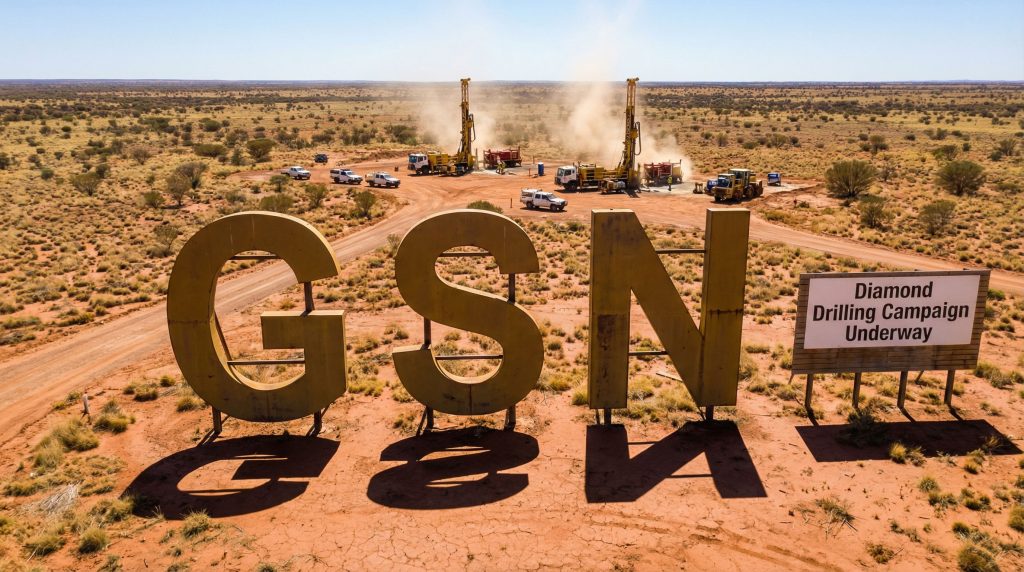
Great Southern Mining Ltd's diamond drilling at Golden Boulder represents a groundbreaking exploration initiative that could unlock significant value in Western Australia's proven Duketon Gold Belt. The company (ASX: GSN) has commenced its most ambitious drilling campaign to date, marking a pivotal moment in understanding what appears to be a substantial gold system with multiple mineralised trends extending over 3.5 kilometres.
The program features the first diamond drilling ever conducted in the area, with the initial hole targeting depths of 700 metres – significantly deeper than any previous drilling which maxed out at 155 metres. This represents a major step-change in GSN's approach to unlocking the potential of a discovery that has already revealed impressive high-grade intercepts and extensive mineralisation.
Breaking New Ground with Deep Diamond Drilling
The current program centres on two strategically positioned diamond holes at the Golden Boulder discovery. Furthermore, the first hole, co-funded through Western Australia's Exploration Incentive Scheme (EIS), will probe the Ogilvies location to depths of up to 700 metres. This represents the deepest exploration yet undertaken in an area where GSN believes surface gold intercepts may be indicators of a much larger system below.
Key Program Details:
| Location | Target Depth | Objective | Funding |
|---|---|---|---|
| Ogilvies | 700m | Test deep structural controls | EIS co-funded |
| Main Line | 220m | Target known mineralisation | Company funded |
The second diamond hole will focus on the Main Line mineralisation, where previous reverse circulation (RC) drilling has defined impressive high-grade intersections. For instance, these results include 5m at 14.57 g/t Au from 41m, including 1m at 70.94 g/t Au, 5m at 5.1 g/t Au from 25m, including 1m at 23.9 g/t Au, and 6m at 6.7 g/t Au from 48m, including 1m at 34.5 g/t Au.
Management Insight:
"This diamond drilling will be critical to GSN's understanding of the controls on mineralisation at Golden Boulder. This is certainly a very large gold system with at least three mineralised trends propagating to surface and extending over a strike length in excess of 3.5km." – Matthew Keane, Managing Director
When big ASX news breaks, our subscribers know first
Understanding Deep Structural Controls
Deep structural controls refer to large-scale geological features such as fault systems that act as conduits for gold-bearing fluids from deep within the Earth's crust. These structures are critical because they often determine where significant gold deposits form.
Consequently, the identification and understanding of these controls can reveal whether surface gold discoveries represent isolated occurrences or indicators of substantial deposits at depth. At Golden Boulder, geological interpretation suggests that the gold found in shallow drilling may represent "leakage" from a much larger system positioned deeper underground.
The Ogilvies target sits at a structural flexure where the regional shear system intersects quartz-dolerite rocks. This geological setting is known to favour significant gold deposition in the Duketon Belt and similar terranes worldwide.
Why This Matters for Exploration:
The integration of geophysical datasets, including reprocessed regional seismic data, indicates these first-order shears are mantle-tapping structures capable of transmitting gold-bearing fluids from depth to surface. Gold deposition is favoured where these fluids encounter chemically reactive lithologies or dilation zones created by structural flexures.
This geological model explains the approximately 50 historical gold workings in the area. In addition, it supports GSN's identification of at least three distinct lines of mineralisation across the Golden Boulder discovery.
Amy Clarke: The Emerging Discovery
While Golden Boulder commands attention as the primary target, GSN's Amy Clarke discovery is rapidly emerging as another significant opportunity. Late-2025 aircore drilling defined mineralisation over a 4.7-kilometre strike length with notable intercepts.
These results include 17m at 1.4 g/t Au from 20m, including 1m at 11.2 g/t Au, 2m at 23.9 g/t Au from 10m, and 5m at 3.4 g/t Au from 8m.
Upcoming Major Programs:
| Project | Planned Metres | Timeline | Focus |
|---|---|---|---|
| Golden Boulder | 10,000-15,000m RC | Late April-May | Infill and extension |
| Amy Clarke | 10,000-15,000m RC | Late April-May | Depth and strike testing |
Financial Strength Supports Aggressive Exploration
GSN enters this intensive exploration phase from a position of financial strength, having completed a $4.6 million capital raising in March 2026. This funding provides the company with the resources needed to execute its most comprehensive drilling programs to date across both Golden Boulder and Amy Clarke.
The EIS co-funding arrangement demonstrates the strategic value of GSN's projects, with up to $220,000 in support secured for Great Southern Mining Ltd's diamond drilling at Golden Boulder. This co-funding allows the company to pursue deeper, more expensive diamond drilling whilst preserving cash for the extensive RC programs planned for both discoveries.
Investment Thesis: Why Golden Boulder Could Be Transformative
The Golden Boulder discovery presents several compelling investment characteristics that distinguish it from typical early-stage exploration plays. However, these characteristics require careful evaluation to understand their full potential.
Scale Potential: With three identified mineralised trends extending over 3.5+ kilometres, the system displays the hallmarks of a significant gold deposit. The fact that previous drilling has been limited to 155 metres depth suggests substantial untested potential below current intercepts.
High-Grade Intercepts: Results such as 70.94 g/t Au and 34.5 g/t Au indicate the presence of genuinely high-grade gold zones within the broader mineralised system. These grades are exceptional for the Duketon Belt and suggest potential for economic extraction even at modest tonnages.
Proven District: The Duketon Gold Belt hosts multiple operating mines and significant deposits, providing strong geological precedent for major discoveries. Furthermore, GSN's tenure position along interpreted extensions of the Rosemont Fault system, which hosts several known gold deposits on adjacent Regis Resources tenure, provides additional geological confidence.
Infrastructure Proximity: All projects are located within 40km of operating mills, providing potential processing solutions for any future development. This proximity could significantly reduce capital requirements compared to greenfield developments in remote locations.
Technical Excellence: The Diorite Hill Program
Beyond the gold-focused programs, GSN completed an 804-metre diamond hole at the Diorite Hill Layered Intrusive Complex on 29 March, targeting platinum group elements (PGE) and base metals. This diversification demonstrates the company's technical capabilities and provides additional upside exposure to critical metals markets experiencing strong demand fundamentals.
The completed core logging revealed complex sequences of mafics and ultramafics, including metadolerites, olivine-bearing ultramafics, pyroxenites and gabbros. Minor sulphide mineralisation was observed, including disseminated pyrrhotite and pyrite with trace chalcopyrite.
These observations are consistent with continued cyclic emplacement of large volumes of mantle-derived melt that cooled slowly in deep crustal magma chambers. Consequently, the results may indicate potential for PGE mineralisation within the complex geological structure.
What Makes the Duketon Gold Belt Special?
The Duketon Gold Belt represents one of Western Australia's most endowed gold provinces, with major deposits including Regis Resources' operating mines and numerous satellite discoveries. The belt's geological characteristics favour the formation of structurally controlled gold deposits, particularly where first-order fault systems provide pathways for mineralising fluids.
GSN's position within this proven district provides several advantages. For instance, there is geological precedent through multiple successful discoveries and operating mines that demonstrate the belt's mineral potential.
In addition, established mining infrastructure reduces development costs and risks, whilst local availability of specialised geological and mining expertise provides operational advantages. Furthermore, nearby operating mills provide potential toll-processing opportunities that could accelerate any future development.
Why Should Investors Track Great Southern Mining?
GSN has positioned itself at what appears to be an inflection point where significant value creation becomes increasingly probable. The combination of fully-funded major drilling programs, high-grade historical intercepts, and unexplored depth potential at Golden Boulder creates a compelling near-term catalyst scenario.
The upcoming 10,000-15,000 metre drilling programs at both Golden Boulder and Amy Clarke represent the largest exploration commitment in the company's history. Results are expected to flow through the remainder of 2026, with this scale of drilling activity providing sufficient data to properly evaluate both discoveries and potentially advance them toward resource definition.
Key Tracking Points for Investors:
- Diamond drilling results from the 700m Ogilvies hole – potentially defining deep structural controls and validating the geological model
- RC program commencement in late April-May across both major discoveries
- Amy Clarke depth testing results from the 4.7km mineralised trend to determine vertical continuity
- Diorite Hill analytical results for PGE-base metals potential, providing commodity diversification
The next major ASX story will hit our subscribers first
What Could This Mean for GSN's Future?
The strategic significance of Great Southern Mining Ltd's diamond drilling at Golden Boulder extends beyond immediate exploration results. The program represents a methodical approach to understanding large-scale geological controls that could define the area's long-term mineral potential.
However, the true value lies in the systematic approach GSN has adopted. By using diamond drilling to understand structural controls before committing to large-scale RC programs, the company demonstrates technical sophistication that could accelerate discovery success.
Key Takeaway:
GSN has assembled one of the most prospective gold exploration portfolios in the proven Duketon Belt, with multiple large-scale targets now moving toward comprehensive testing. The combination of high-grade surface intercepts, untested depth potential, and major drilling programs scheduled for 2026 positions the company for potential significant discoveries that could substantially impact its valuation.
With strong financial backing and a clear exploration strategy, GSN appears well-positioned to capitalise on what may prove to be one of the Duketon Belt's next significant gold discoveries. The company's approach of integrating geological understanding with strategic drilling programs could unlock substantial value for shareholders whilst advancing our understanding of this highly prospective gold system.
Ready to Explore GSN's Gold Discovery Potential?
With Great Southern Mining commencing its most ambitious drilling programme to date at Golden Boulder, and major 10,000-15,000 metre campaigns planned across multiple discoveries, investors have a rare opportunity to track a company positioned at a potential inflection point. GSN's systematic approach to unlocking deep structural controls in the proven Duketon Gold Belt, combined with high-grade historical intercepts and substantial untested depth potential, creates compelling catalysts throughout 2026. To learn more about Great Southern Mining's exploration strategy, project portfolio, and upcoming drilling results that could define the company's future, visit the official GSN website and discover how this emerging gold explorer is positioning itself for potential breakthrough discoveries in Western Australia's premier gold province.