
August 9, 2026
When Headlines Lie: Why Geopolitical Risk Premiums Outlive the Crises That Create Them
Energy markets have a well-documented tendency to reprice dramatically on breaking news, then refuse to fully reverse those moves even when the triggering event appears to resolve. This phenomenon sits at the core of why Goldman Sachs Brent near $90 after Strait of Hormuz reopens remains a credible base case, even in a scenario where normal commercial shipping resumes through the world's most critical energy chokepoint.
The key to understanding this dynamic lies not in diplomacy, but in market structure. When a geopolitical disruption persists long enough to force physical market participants, including refiners, national oil companies, and major trading houses, to restructure their supply chains, those new arrangements create pricing inertia that cannot be undone by a single headline. This is the structural reality underpinning Goldman's base case, and it represents one of the most important yet underappreciated dynamics in global energy markets today.
Furthermore, the crude oil price trends emerging through 2025 laid significant groundwork for this environment, establishing the supply chain vulnerabilities that geopolitical shocks in 2026 are now amplifying.
The conventional assumption that oil prices fall sharply when a geopolitical flashpoint resolves breaks down when supply disruptions persist long enough to migrate from spot pricing into long-dated forward contracts.
When big ASX news breaks, our subscribers know first
The $90 Floor: What Goldman Sachs Is Actually Saying
Goldman Sachs' base-case Brent forecast of approximately $90 per barrel through the end of 2026 is not primarily a prediction about the Strait of Hormuz. It is a statement about the structure of the oil futures market and how risk premiums behave once they migrate from spot prices into longer-dated forward contracts.
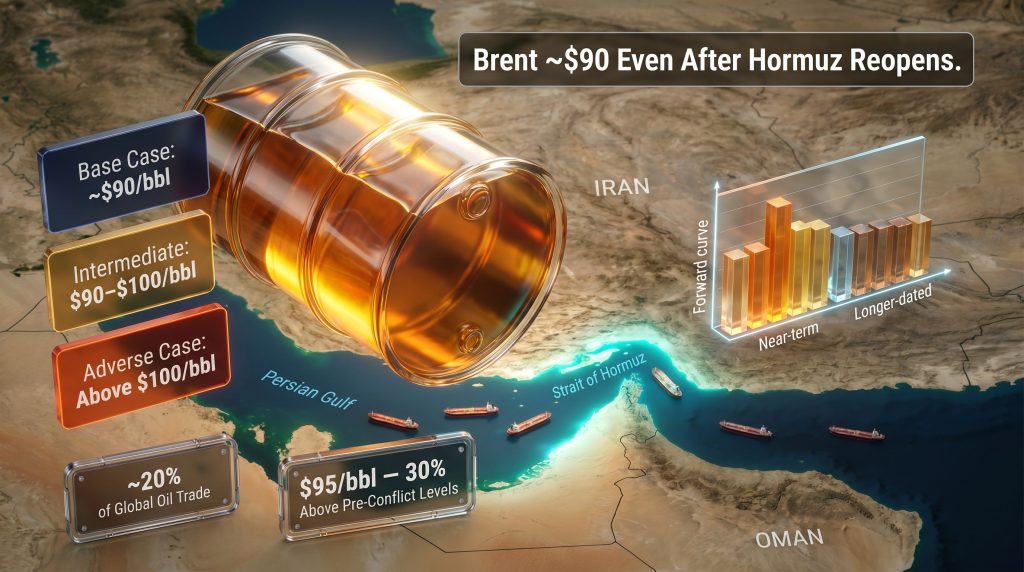
When Brent crude surged toward $95 per barrel on June 2, 2026, representing roughly a 30% premium above pre-conflict levels, this move reflected an initial spot market reaction to Iranian state media reports signalling preparations for a potential full Hormuz closure. Prices partially retreated toward the $93–$94 range after US diplomatic signals suggested negotiations were progressing constructively. However, this partial compression of the spot premium illustrated precisely the dynamic Goldman Sachs is forecasting: geopolitical risk premiums compress on headlines but do not fully unwind on headlines alone.
The critical distinction is between spot market responses and forward curve repricing:
- Spot market response: Immediate, volatile, and driven by headline risk and short-term positioning
- Forward curve repricing: Slower, structurally embedded, and resistant to reversal without sustained physical evidence of normalisation
- What the $90 forecast reflects: The forward curve has already absorbed a durable risk premium requiring observable supply chain evidence, not diplomatic announcements, to dissolve
Goldman's chief Asia-Pacific economist Andrew Tilton has indicated the firm's base case calls for Brent to average around $90 through year-end even under a Hormuz reopening scenario. The bank's stress-case scenario for a prolonged closure extending beyond one month places Brent above $100 per barrel through 2026. For broader context on how WTI and Brent futures are responding to these dynamics, the divergence between the two benchmarks has itself become an important market signal.
The 20% Chokepoint: Why the Strait of Hormuz Has No Real Substitute
Quantifying the World's Most Critical Energy Corridor
The Strait of Hormuz carries an estimated 20% of global oil and LNG trade through a navigational channel that is approximately 21 miles wide at its narrowest point, with a shipping lane only two miles wide in each direction. Understanding the scale of this dependency is essential context for any oil price forecast.
| Metric | Estimated Figure |
|---|---|
| Share of global oil trade transiting Hormuz | ~20% |
| Share of global LNG trade transiting Hormuz | ~20% |
| Primary regional exporters dependent on Hormuz | Saudi Arabia, UAE, Iraq, Kuwait, Iran |
| Primary alternative routing option | Abqaiq-Yanbu pipeline (partial capacity only) |
| Estimated normalisation period post-reopening | Several months (Wood Mackenzie estimate) |
The Abqaiq-Yanbu pipeline in Saudi Arabia represents the most significant alternative routing option, but its capacity is substantially below the total volume normally transiting the Strait. Consequently, a full Hormuz closure cannot be offset through existing infrastructure alone. This physical constraint is a core reason why supply chain normalisation following any significant disruption takes months rather than days.
Why Transit Conditions Matter as Much as Transit Volume
A critical and often overlooked distinction exists between the Strait being physically open and it operating as a normal commercial shipping route. As of early June 2026, transit through the Strait remains coordinated under heightened security conditions, with Iran's Revolutionary Guard maintaining effective influence over passage conditions.
Reuters reporting on Goldman's energy supply warnings confirms that even partial reopening does not restore the unrestricted commercial flows that refiners and trading houses require to unwind their alternative sourcing arrangements. Wood Mackenzie estimates that Middle Eastern energy supply chains could require several months to normalise even following a full reopening, limiting how quickly the market can remove disruption-related pricing. This multi-month normalisation timeline is the structural foundation of Goldman Sachs' $90 base case.
Goldman Sachs' Three-Scenario Framework for Brent in 2026
Rather than producing a single point forecast, Goldman Sachs operates with a probability-weighted scenario architecture that accounts for varying degrees of Hormuz disruption. This framework is more analytically useful than event-driven price predictions because it anchors positioning decisions to observable conditions rather than diplomatic timelines.
| Scenario | Hormuz Status | Goldman Sachs Brent Forecast | Key Assumption |
|---|---|---|---|
| Base Case | Full reopening | ~$90/bbl through year-end | Risk premium embedded in forward contracts |
| Intermediate | Partial or intermittent access | $90–$100/bbl | Supply chain normalisation delayed |
| Adverse/Stress | Prolonged closure (1+ months) | Above $100/bbl | Physical supply shortfall deepens |
| Fast Normalisation | Routine transits resume + EIA inventory builds | Below $82/bbl (Q3 base) | Premium unwinds faster than expected |
Scenario 1: Full Reopening and Why $90 Still Holds
Even under conditions where Hormuz fully reopens to commercial shipping, Goldman's base case maintains Brent near $90. The reasoning is structural rather than event-driven. European and Asian refiners that established alternative sourcing arrangements during the disruption period are unlikely to immediately reverse those decisions, particularly given the uncertainty about whether transit conditions will remain stable. This creates sustained demand for non-Gulf crude that supports elevated pricing beyond the reopening event itself.
Scenario 2: The Intermediate Range of $90–$100
If Hormuz remains subject to intermittent restrictions or security-coordinated transit rather than freely operating commercial shipping lanes, Goldman's intermediate scenario holds Brent in a $90–$100 range. In this scenario, the physical supply chain disruption persists long enough to prevent meaningful unwind of the risk premium, whilst stopping short of triggering the acute shortage dynamics that characterise the adverse case.
Scenario 3: The Adverse Case Above $100
A sustained Hormuz shutdown extending beyond one month would likely push Brent above $100 per barrel through 2026. In this scenario, the compounding effects of accelerated Atlantic Basin demand for US crude and LNG, strategic petroleum reserve drawdowns failing to offset sustained physical shortfalls, and structural tightening in refining margins create a self-reinforcing price dynamic. Goldman's own modelling of Brent at $93.60 under intermediate disruption conditions illustrates how quickly the stress case can become the base case if supply chain normalisation stalls.
What the $95 Spike Reveals About Risk Premium Mechanics
Spot Markets React Instantly; Forward Curves Move Slowly
Brent's surge to approximately $95 per barrel on June 2, 2026 and its subsequent partial retreat to the $93–$94 range following US diplomatic signals provides a real-time illustration of how geopolitical risk premiums behave across different parts of the forward curve. The spot market reacted violently to the threat of closure, then partially reversed on diplomatic commentary. However, the forward curve, which embeds the durable risk premium that Goldman Sachs is forecasting, moved far less dramatically in either direction.
This asymmetry between spot and forward market responses reflects a fundamental feature of how physical market participants operate. When a major refiner in South Korea or Germany establishes an alternative crude supply arrangement because its Persian Gulf volumes are disrupted, that arrangement involves offtake commitments, shipping contracts, and hedging positions that cannot be immediately unwound because of a Presidential press statement. The financial costs of reversing these arrangements on short notice are substantial, creating the contractual stickiness that keeps the forward curve elevated well beyond the resolution of the immediate diplomatic crisis.
The $82 Signal: What Would Actually Indicate Premium Unwinding
Goldman Sachs' Q3 base-case floor of approximately $82 per barrel represents the most important price level to monitor in this environment. A sustained move below this level would indicate that the market is removing disruption-related pricing materially faster than Goldman's institutional forecasters anticipated, providing genuine evidence that the geopolitical risk premium has been substantially dismantled.
A sustained Brent price below Goldman's Q3 base case of approximately $82 per barrel would signal that the market is removing disruption-related pricing faster than institutional forecasters anticipated, representing meaningful evidence that the geopolitical risk premium has been largely unwound.
Sector Winners and Losers in a Sustained $90 Brent Environment
Where the Structural Beneficiaries Sit
In an environment where Brent holds near $90 even after Hormuz reopens, the clearest structural beneficiaries are:
- US crude oil producers: Higher realised prices directly improve free cash flow, capital return capacity, and balance sheet strength, particularly for operators with competitive production cost structures
- LNG exporters: Elevated energy prices combined with sustained demand from European and Asian buyers seeking non-Gulf supply alternatives creates a durable demand tailwind
- Midstream and pipeline operators: Increased Atlantic Basin throughput volumes as alternative routing replaces Gulf transit supports utilisation rates and fee-based revenues
Where Margin Compression Is Most Acute
| Sector | $90 Brent Impact | Key Variable |
|---|---|---|
| US crude producers | Positive – higher realised prices | Production cost structure |
| LNG exporters | Positive – demand substitution effect | Contract vs. spot exposure |
| European refiners | Negative – input cost inflation | Crude sourcing flexibility |
| Asian petrochemicals | Negative – feedstock cost pressure | Hedging coverage ratios |
| Airlines and shipping | Negative – sustained fuel cost headwinds | Fuel hedge ratios |
European and Asian refiners face the sharpest margin compression because they carry both the elevated crude input cost and the additional logistics premium associated with longer-haul sourcing from US and West African producers. Petrochemical manufacturers experience a similar dynamic through feedstock cost inflation, whilst fuel-intensive transportation operators face sustained operating cost headwinds that cannot be easily passed through to customers in competitive markets.
The next major ASX story will hit our subscribers first
Positioning for Oil Price Risk Without Predicting Diplomacy
Why Forecasting Ceasefire Timelines Is Structurally Inferior
One of the most important strategic distinctions in this environment separates positioning around observable supply constraints from attempting to predict diplomatic outcomes. Markets cannot reliably determine whether US-Iran negotiations resolve within days or weeks, nor whether regional de-escalation agreements hold once announced. The broader geopolitical oil price drivers operating throughout this period demonstrate that framing an investment thesis around a specific diplomatic deadline converts the trade into a binary event bet, which is structurally inferior to a probability-weighted approach anchored to observable market conditions.
The Three Observable Indicators That Matter More Than Headlines
Investors seeking genuine confirmation that the geopolitical risk premium is unwinding should monitor the following observable signals rather than diplomatic announcements:
- Tanker traffic normalisation: Multiple consecutive weeks of routine commercial vessel transits through the Strait of Hormuz, operating independently of security coordination and without Iranian Revolutionary Guard restrictions
- US EIA Petroleum Status Report data: Rising US commercial crude inventory levels in weekly reports, indicating that supply chains are absorbing and redistributing volumes effectively
- Brent forward curve flattening: A measurable reduction in the backwardation premium embedded in near-term contracts relative to longer-dated forwards, signalling that the market is removing structural risk premium rather than just adjusting spot prices
These three indicators share a critical characteristic: they measure physical reality rather than political intention, making them far more reliable signals of genuine market normalisation than any statement from a diplomatic briefing.
The Brazilian Tariff Wildcard: A Second Layer of Energy Market Complexity
The US Trade Representative's June 2, 2026 announcement of proposed 25% Section 301 tariffs on a broad range of Brazilian goods introduces an additional variable into global energy trade flows that operates independently of the Hormuz situation. In addition, the tariff and trade war impact observed throughout 2025 established precedents for how quickly trade friction can reshape commodity sourcing decisions. Brazil is a significant crude oil producer and energy exporter, and tariff-related trade friction has the potential to influence Atlantic Basin crude pricing and refinery sourcing decisions.
Key details of the proposed tariff framework:
- Written public comments were due July 1, 2026
- A formal hearing was scheduled for July 6, 2026
- Specific exemptions were granted for beef, coffee, and aircraft components, suggesting a targeted rather than blanket trade restriction approach
- Brazilian crude exports to US refiners represent a meaningful Atlantic Basin supply flow that could be disrupted or repriced under a tariff regime
For energy investors, the Brazilian tariff proposal matters because it adds uncertainty to the Atlantic Basin supply picture at precisely the moment when US and Brazilian crude are in elevated demand as alternatives to disrupted Persian Gulf volumes. Furthermore, the trade war impact on oil markets more broadly suggests that any reduction in the competitiveness of Brazilian crude could tighten Atlantic Basin supply further, providing additional support for elevated Brent pricing independent of Hormuz developments.
Frequently Asked Questions: Goldman Sachs Brent Forecast and Hormuz Risk
Why does Goldman Sachs expect Brent near $90 even if Hormuz reopens?
Goldman Sachs' base-case forecast reflects the view that the geopolitical risk premium has migrated into long-dated forward contracts rather than remaining exclusively in spot pricing. Physical supply chain normalisation across Middle Eastern energy infrastructure takes several months according to Wood Mackenzie estimates, meaning the market cannot immediately remove disruption-related pricing even when the physical chokepoint reopens.
What percentage of global energy trade passes through the Strait of Hormuz?
Approximately 20% of global oil trade and a comparable share of global LNG trade transits the Strait of Hormuz annually, making it the single most consequential maritime energy chokepoint in the world with no equivalent-capacity alternative routing option currently available.
What price level would indicate the Hormuz risk premium is genuinely unwinding?
A sustained Brent price below approximately $82 per barrel, Goldman Sachs' Q3 base-case floor, would provide market evidence that disruption-related pricing is being removed faster than institutional forecasters anticipated. This signal carries more analytical weight than any diplomatic announcement because it reflects actual physical market behaviour.
What is Goldman Sachs' worst-case Brent scenario for a prolonged Hormuz closure?
Under a stress scenario involving a sustained Hormuz shutdown lasting more than one month, Goldman Sachs has indicated Brent could average above $100 per barrel through 2026, driven by compounding supply shortfall dynamics and the failure of strategic reserve drawdowns to fully offset lost Persian Gulf volumes.
Which indicators best signal genuine oil risk premium unwinding?
The most reliable indicators are: normalised tanker traffic through Hormuz sustained over multiple consecutive weeks, rising US commercial crude inventories in weekly EIA data, and measurable flattening of the Brent forward curve's near-term backwardation premium relative to longer-dated contracts.
Key Takeaways: The Strategic Framework for Brent at $90
The Goldman Sachs Brent near $90 after Strait of Hormuz reopens forecast represents more than a price target. It represents a methodology for navigating oil price uncertainty in an environment where geopolitical events increasingly create durable structural changes in energy market pricing rather than temporary disruptions that resolve cleanly.
The most important findings from this analysis:
- Brent reached approximately $95 per barrel in early June 2026, roughly 30% above pre-conflict levels, before partially retreating to the $93–$94 range following diplomatic signals
- Goldman Sachs' base case holds Brent near $90 per barrel through year-end regardless of whether Hormuz fully reopens
- The adverse scenario places Brent above $100 per barrel if closure extends beyond one month
- The genuine normalisation signal is Brent sustaining below $82 per barrel, Goldman's Q3 base-case floor
- Observable physical supply indicators — specifically tanker traffic data, EIA inventory builds, and forward curve structure — are materially more reliable positioning signals than diplomatic headlines
- The proposed 25% US tariffs on Brazilian goods introduce a secondary Atlantic Basin supply variable that could support elevated pricing independent of Hormuz developments
The most durable investment insight from Goldman's Hormuz analysis is not a price target, it is a methodology. Positioning around observable physical supply constraints rather than predicting geopolitical outcomes converts an inherently unpredictable situation into a probability-weighted framework that can be acted upon with measurably greater confidence.
This article is for informational purposes only and does not constitute financial advice. Oil price forecasts involve significant uncertainty, and actual market outcomes may differ materially from the scenarios described. Past price behaviour during geopolitical disruptions does not guarantee future performance. Investors should conduct their own due diligence and consult a qualified financial adviser before making investment decisions.
Want To Stay Ahead of Major Market-Moving Discoveries in Real Time?
While geopolitical risk premiums reshape global energy markets, significant mineral discoveries on the ASX can deliver equally transformative returns — and Discovery Alert's proprietary Discovery IQ model ensures subscribers receive instant notifications the moment those discoveries are announced, turning complex data into actionable opportunities. Explore historic examples of exceptional discovery outcomes and begin a 14-day free trial to position yourself ahead of the broader market.