Understanding Graphite Composite Architecture for Fuel Cell Applications
Carbon composite materials represent a pivotal engineering frontier where material science intersects with electrochemical energy conversion systems. The integration of graphitic carbon structures within polymer matrices creates multifunctional materials capable of addressing thermal management, electrical conductivity, and mechanical stability requirements simultaneously. As hydrogen fuel cell technology advances toward commercial viability, graphite composite for hydrogen fuel cells demand has intensified across automotive, stationary power, and portable electronics applications, driving innovation in electric vehicles transforming mining operations.
Material Science Foundations of Carbon-Polymer Integration
Graphite composite for hydrogen fuel cells represents a sophisticated materials engineering approach that combines the inherent properties of crystalline carbon with polymer matrix systems to achieve specific performance targets. The fundamental architecture involves dispersing graphite particles or fibres throughout a polymer host material, creating a continuous network that enables both electrical conduction and mechanical reinforcement.
Furthermore, the selection between flake graphite and synthetic graphite significantly influences final composite properties. Natural flake graphite, characterised by its layered crystalline structure, typically exhibits superior electrical conductivity due to its well-ordered carbon lattice arrangement. Recent materials development has demonstrated graphite structures with approximately 80% well-ordered crystalline arrangement, providing the foundation for enhanced electrical transport properties.
Polymer matrix selection criteria encompass thermal stability, chemical compatibility, and processing characteristics. Phenolic resins offer excellent thermal stability and chemical resistance, making them suitable for high-temperature fuel cell environments. However, polypropylene provides cost-effective processing capabilities, while specialised thermoplastics enable injection moulding for high-volume production applications.
Performance Requirements for Fuel Cell Component Integration
Critical performance thresholds for graphite composite for hydrogen fuel cells applications centre on electrical conductivity specifications that enable effective current collection and distribution. Industry benchmarks require minimum conductivity levels between 10-100 S/cm depending on specific component applications, with bipolar plates demanding higher conductivity ranges to minimise electrical resistance losses.
Thermal stability requirements reflect the operating environment within fuel cell stacks, where sustained temperatures above 80°C are common during normal operation. Advanced graphite composites have demonstrated thermal stability exceeding 400°C (752°F), providing substantial safety margins for transient temperature excursions and thermal cycling conditions.
Consequently, chemical resistance specifications address the acidic operating environment within proton exchange membrane fuel cells, where materials must withstand exposure to sulfonic acid groups and oxidising conditions. Mechanical strength requirements for bipolar plate applications typically demand tensile strength values in the 30-50 MPa range to ensure structural integrity under stack compression forces.
Manufacturing Process Optimisation for Composite Performance
Raw Material Processing and Quality Control Protocols
The transformation of raw graphite into high-performance composite materials begins with purification and particle size optimisation. Flake graphite processing involves removing mineral impurities and achieving consistent particle size distribution to ensure uniform dispersion within the polymer matrix. Quality control protocols must verify electrical properties at each processing stage to maintain consistency across production batches.
Recent developments in graphite composite for hydrogen fuel cells manufacturing have demonstrated the importance of integrated supply chain control. Companies utilising vertically integrated approaches, from raw material extraction through final component fabrication, report improved quality consistency and cost optimisation compared to traditional supply chain models. In addition, the critical minerals energy transition has highlighted the strategic importance of secure graphite supply chains.
University research partnerships have established baseline performance parameters for composite formulations, with collaborative programs initiated since 2021 focusing on polymer matrix optimisation and processing parameter development. These research initiatives have validated processing conditions that maintain graphite crystalline ordering while achieving target mechanical properties.
Advanced Fabrication Techniques and Process Control
Manufacturing process selection significantly influences final composite performance characteristics. The following comparison illustrates key trade-offs between different fabrication approaches:
| Process Type | Conductivity Range (S/cm) | Mechanical Strength | Production Volume | Cost Efficiency |
|---|---|---|---|---|
| Compression Moulding | 15-50 | High | Medium | Medium |
| Injection Moulding | 8-25 | Medium | High | High |
| Hot Pressing | 40-80 | Very High | Low | Low |
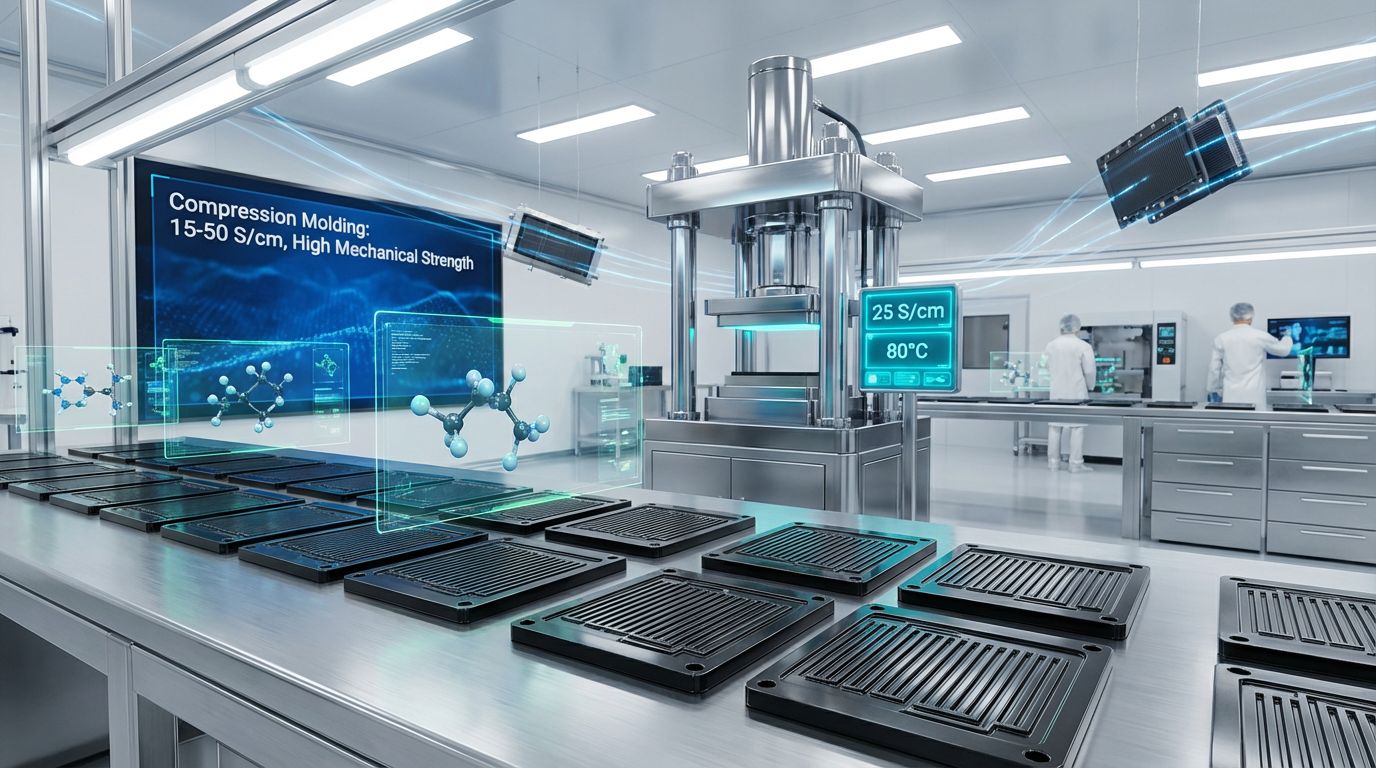
Compression moulding enables higher filler loading and superior electrical properties through controlled pressure application during curing. Recent graphite composite for hydrogen fuel cells developments have achieved 25 S/cm surface conductivity and 12 S/cm through-plane conductivity using optimised compression moulding techniques, positioning these materials within the higher performance range for bipolar plate applications.
For instance, injection moulding offers superior production scalability and dimensional control for complex geometries, making it attractive for high-volume automotive applications. However, the flow characteristics of graphite-filled polymers can limit achievable conductivity levels due to particle orientation effects during mould filling.
Hot pressing represents the premium manufacturing approach, capable of achieving conductivity levels approaching 40-80 S/cm through extreme pressure and temperature control. This technique is typically reserved for specialised applications where maximum performance justifies higher processing costs.
Performance Metrics and Validation Standards
Electrical Conductivity Characterisation Methods
Electrical performance evaluation for graphite composite for hydrogen fuel cells requires sophisticated measurement protocols that distinguish between surface conductivity and through-plane conductivity. Surface conductivity measurements reflect current transport parallel to the composite surface, while through-plane conductivity indicates charge transport capability perpendicular to the material surface.
Recent performance validation has demonstrated 25 S/cm surface conductivity and 12 S/cm through-plane conductivity in advanced graphite composites, positioning these materials significantly above standard polymer performance levels while approaching the conductivity range of materials specifically designed for electrical management applications. These advances complement the development of renewable energy solutions that rely on efficient energy storage systems.
Industry benchmark specifications for bipolar plate applications typically require:
- Surface conductivity >25 S/cm
- Through-plane conductivity >12 S/cm
- Stable performance across temperature ranges from ambient to 90°C
- Resistance to degradation under electrochemical cycling conditions
Mechanical Property Validation Under Operating Conditions
Mechanical performance evaluation encompasses tensile strength, flexural strength, and fatigue resistance under simulated fuel cell operating conditions. Tensile strength requirements typically range from 30-50 MPa for bipolar plate applications, with recent composite developments achieving approximately 40 MPa tensile strength while maintaining electrical conductivity targets.
The mechanical performance must account for thermal cycling effects, where materials experience repeated heating and cooling during fuel cell startup and shutdown cycles. Long-term mechanical stability requires materials to maintain structural integrity through thousands of thermal cycles without developing stress fractures or delamination.
Consequently, compressive strength specifications become critical during fuel cell stack assembly, where bipolar plates must withstand compression forces that ensure proper sealing and electrical contact between adjacent components. Advanced composites demonstrate the ability to withstand assembly forces while maintaining dimensional stability under sustained compression loading.
Thermal Management Performance Characteristics
Thermal management capabilities represent a crucial performance dimension, where materials must simultaneously conduct electrical current and dissipate heat generated during electrochemical reactions. Graphite composites offer superior thermal conductivity compared to unfilled polymers, enabling passive heat spreading within fuel cell stacks.
Recent testing has validated thermal stability above 400°C (752°F) for advanced graphite composites, substantially exceeding typical fuel cell operating temperatures of 60-90°C. This thermal stability margin provides confidence for operation under transient conditions and thermal excursions that may occur during system malfunction or extreme environmental conditions.
Furthermore, thermal expansion coefficient matching becomes important when graphite composites interface with other fuel cell components, particularly membrane electrode assemblies and metallic current collectors. Dimensional stability under thermal cycling prevents stress concentration that could lead to component failure or performance degradation.
Component Applications and Integration Strategies
Bipolar Plate Design Optimisation
Bipolar plates represent the primary application for this technology, where these components must simultaneously distribute reactant gases, collect electrical current, and remove product water while maintaining structural integrity under stack compression forces. The development aligns with broader mining innovation trends that emphasise efficiency and sustainability.
Gas distribution channel design optimisation requires balancing pressure drop considerations with current collection efficiency. Graphite composites enable moulding of complex channel geometries that optimise gas flow distribution while maintaining electrical connectivity across the plate surface. The demonstrated 25 S/cm surface conductivity provides adequate current collection capability for automotive fuel cell applications.
Moreover, weight reduction represents a significant advantage compared to metallic bipolar plates, with typical weight savings of 40-60% compared to stainless steel alternatives. This weight reduction becomes particularly important for mobile applications where system mass directly impacts vehicle efficiency and range.
Electromagnetic Interference Shielding Integration
These materials demonstrate substantial electromagnetic interference (EMI) shielding capabilities, addressing signal integrity challenges in modern fuel cell systems with extensive electronic control systems. Testing has confirmed EMI shielding performance consistent with levels required for telecommunications and automotive equipment applications.
The EMI shielding mechanism relies on the conductive graphite network within the polymer matrix, which attenuates electromagnetic fields through reflection and absorption. Thin composite sections can effectively shield electronic components from external interference while preventing internal signal transmission that could disrupt nearby systems.
Frequency response characteristics indicate effective shielding across automotive-relevant frequency ranges, including switching frequencies used in power electronics and communication protocols employed in vehicle control networks. This multifunctional capability allows single components to address both electrical conductivity and signal management requirements.
Economic Analysis and Market Positioning
Cost Structure Comparison with Alternative Materials
The economic case centres on material cost advantages combined with manufacturing efficiency improvements compared to traditional metallic components. Raw material costs for graphite-polymer composites typically represent 40-60% less than equivalent stainless steel bipolar plates while delivering superior corrosion resistance.
Manufacturing cost efficiencies arise from polymer processing techniques that enable complex geometries and integrated features without secondary machining operations. Injection moulding and compression moulding processes allow single-step production of bipolar plates with integrated gas distribution channels, sealing surfaces, and current collection features.
In addition, lifecycle cost benefits extend beyond initial material and manufacturing costs to include reduced maintenance requirements due to corrosion resistance and longer service life compared to metallic alternatives. The chemical inertness eliminates concerns about metallic ion contamination that can degrade fuel cell performance over time.
Supply Chain Integration and Geographic Considerations
Supply chain resilience for graphite composite materials involves balancing natural graphite sourcing with processing facility location optimisation. Vertically integrated approaches, from graphite extraction through composite fabrication, provide greater quality control and cost predictability compared to distributed supply chains. This approach becomes crucial when considering Australia's critical minerals reserve strategies.
Geographic distribution strategies must consider proximity to both raw material sources and end-use manufacturing facilities. North American supply chain development has received government support through critical minerals initiatives, with projects receiving referrals through major project offices and financial backing from export development organisations.
Processing facility location optimisation involves evaluating industrial infrastructure, skilled workforce availability, and proximity to automotive manufacturing centres. Industrial cities with established polymer processing capabilities offer advantages for manufacturing scale-up.
Testing Standards and Validation Protocols
International Standards Framework
Validation requires compliance with multiple testing standards that address electrical, mechanical, and environmental performance requirements. ASTM International standards provide testing protocols for electrical conductivity (ASTM D149, D257), thermal properties (ASTM D4496), and mechanical properties (ASTM D3410, D3411).
ISO standards for fuel cell components (ISO 12127) establish testing protocols specific to fuel cell operating environments, including chemical compatibility, thermal cycling, and long-term durability requirements. Automotive industry specifications through SAE and JIS standards address additional requirements for mobile fuel cell applications.
However, certification requirements vary by application and geographic market, with automotive applications requiring more stringent validation than stationary power systems. The testing protocol development continues to evolve as fuel cell technology matures and operating experience accumulates.
What Are the Accelerated Ageing Requirements?
Durability testing involves accelerated ageing protocols that simulate extended operation under realistic conditions. Thermal cycling tests typically require 1000+ cycles between ambient and operating temperatures to validate dimensional stability and mechanical integrity.
Chemical compatibility testing exposes materials to simulated fuel cell environments, including acidic conditions and oxidising atmospheres, for extended periods to identify potential degradation mechanisms. Long-term performance validation requires 5000+ hour testing under continuous operation to establish confidence in commercial deployment.
Advanced graphite composites have demonstrated the ability to maintain electrical and mechanical properties through extended testing protocols, providing confidence for commercial fuel cell applications requiring multi-year service life.
Future Technology Development Pathways
Nanotechnology Enhancement Opportunities
The integration of advanced carbon nanomaterials represents a significant opportunity to enhance performance beyond current capabilities. Graphene incorporation in fuel cell technology can improve electrical conductivity while maintaining processing characteristics suitable for large-scale manufacturing.
Carbon nanotube reinforcement offers potential for simultaneous improvement in electrical conductivity and mechanical strength, though processing challenges related to dispersion and cost remain areas of active development. Hybrid composite formulations combining multiple carbon allotropes may enable performance optimisation for specific applications.
Consequently, nanotechnology integration requires careful consideration of manufacturing scalability and cost implications, as performance improvements must justify additional material and processing costs for commercial viability.
Advanced Manufacturing Technology Integration
Additive manufacturing techniques, including 3D printing, offer opportunities for complex geometry fabrication and rapid prototyping of components. These techniques enable design optimisation that would be difficult or impossible with traditional manufacturing processes.
Automated fibre placement and automated tape laying processes developed for aerospace applications may find application in high-performance fuel cell components where maximum electrical and mechanical properties justify premium manufacturing costs.
For instance, in-situ polymerisation processes offer potential for enhanced interfacial bonding between graphite particles and polymer matrices, potentially improving both electrical and mechanical properties compared to conventional mixing and moulding approaches.
Market Expansion Beyond Traditional Fuel Cell Applications
The multifunctional capabilities position these materials for applications beyond traditional fuel cell components. Electric vehicle thermal management systems represent a significant market opportunity where electrical conductivity and thermal management capabilities provide value.
Aerospace electromagnetic shielding requirements continue to drive demand for lightweight, non-corrosive materials that can provide EMI protection in demanding environments. The combination of EMI shielding, thermal stability, and weight savings positions graphite composites as attractive alternatives to metallic shielding materials. Companies are expanding applications for these composites into stealth materials and other high-performance sectors.
Industrial heating element applications may benefit from the controlled electrical conductivity and thermal stability of graphite composites, particularly in applications requiring complex geometries or corrosive environment resistance.
Disclaimer: This analysis includes forward-looking statements regarding technology development and market opportunities. Actual results may vary based on technical challenges, market conditions, and competitive developments. Performance specifications cited represent laboratory testing results and may not reflect commercial product performance under all operating conditions.
Looking to Capitalise on Advanced Material Technology Investments?
Discovery Alert's proprietary Discovery IQ model provides immediate notifications when ASX companies announce breakthrough developments in advanced materials and clean energy technologies, helping investors identify opportunities before broader market recognition. Explore how major technological discoveries have historically generated substantial returns by visiting Discovery Alert's dedicated discoveries page and begin your 30-day free trial today to gain a competitive advantage in emerging technology sectors.