
August 21, 2026
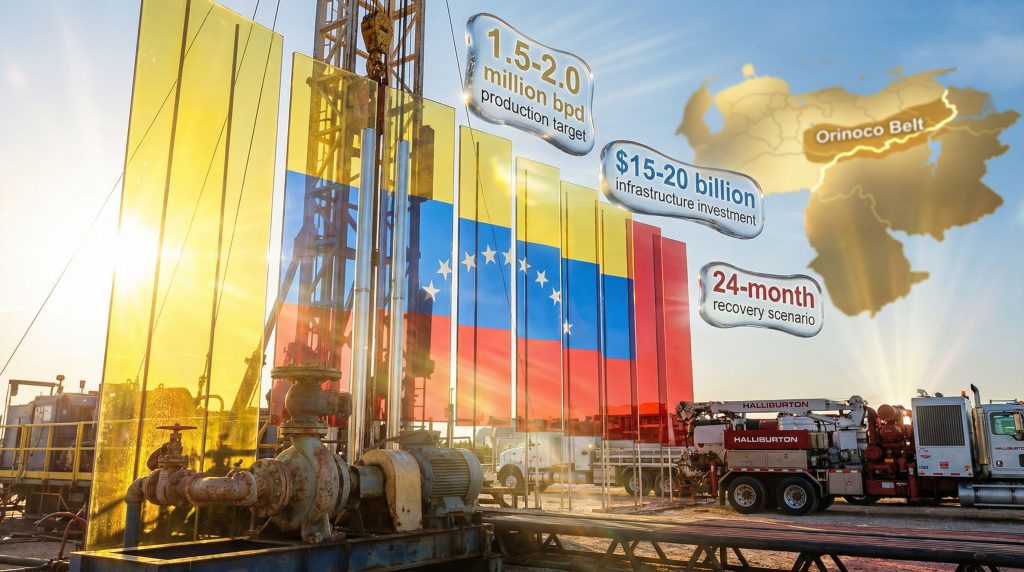
Risk-Driven Scenario Models: Halliburton Re-Entry to Venezuela and Its Potential to Reshape Latin American Energy Markets
When big ASX news breaks, our subscribers know first
What Strategic Factors Drive Halliburton's Venezuela Market Re-Entry Timeline?
Forecasting the Halliburton re-entry to Venezuela demands a layered understanding of the region's dynamic regulatory, geopolitical, and operational landscape. Unlike previous energy service expansions, Venezuela's case is marked by complex risk matrices and technical hurdles not seen in more stable markets.
Furthermore, recent Trump tariffs and oil rally developments have added additional complexity to the regional energy equation. These factors must be carefully evaluated alongside traditional market considerations.
Key Strategic Factors:
-
Political Transition Scenarios: Emerging transitional administration structures in Venezuela are assessed using proprietary probability models, measuring both the durability of interim governments and the likelihood of subsequent policy continuity.
-
Sanctions Relief Pathways: The pivotal prerequisite for Halliburton's reactivation remains clear: securing an OFAC (Office of Foreign Assets Control) license. U.S. regulatory authorities demand strict compliance, so corporate legal teams must navigate multi-stage license approval processes.
These include due diligence, reporting, and routine third-party audits. However, tariffs impact investment decisions must also be factored into the strategic planning process.
-
Payment Security Structures: Halliburton's executive leadership has underscored that project mobilisation is contingent on robust payment mechanism guarantees. This typically involves:
- Escrow account arrangements managed through international financial custodians
- Use of letters of credit with enforceability in neutral jurisdictions
- Third-party government or multilateral institution-backed guarantees to mitigate sovereign default risk
These contractual instruments are indispensable, given Venezuela's historical record of arrears and currency inconvertibility.
- Operational Readiness: Halliburton preserved its Venezuelan physical assets—including facilities and equipment—after withdrawing its workforce in 2020, opting for a stand-by posture rather than a complete divestment.
This deliberate asset retention enables potential remobilisation within just weeks once external approvals are secured. Consequently, this provides an edge over competitors forced to reacquire or repurpose equipment after a full exit.
Halliburton's Q4 2025 earnings underscored the near-term commercial upside of a Venezuela restart. Markets responded favourably with share prices surging 5.4% after CEO Jeff Miller articulated readiness to move quickly given regulatory and payment protections, as reported by Reuters.
- Local Workforce and Supply Chain: Since expatriate staff exited at the end of 2020, Halliburton must assess the availability and skills of the local workforce. This includes anticipated retraining needs and compliance with Venezuelan labour quotas for foreign energy projects.
Why Does Venezuela Represent a Critical Strategic Pivot for Major Oilfield Services Companies?
Venezuela's vast resource potential—anchored by the Orinoco Belt's more than 300 billion barrels of proven heavy oil reserves—offers a rare growth counterweight amid weakening North American shale returns.
Additionally, current oil price movements create both opportunities and challenges for companies considering Venezuelan market entry. Moreover, the broader US‑China trade impact continues to influence global energy market dynamics.
Strategic Positioning Advantages:
- Technical Expertise Differentiation: Developing Venezuela's extra-heavy crude (typically 8-12° API gravity) demands advanced techniques: high-pressure steam injection, proprietary completion designs, and tailored fluid management.
Few global service companies possess the institutional experience and technical solutions for efficient Orinoco Belt operations. In addition, the Halliburton re-entry to Venezuela strategy leverages decades of accumulated technical knowledge.
- Historical Operational Knowledge: Halliburton's continuous four-decade presence in Venezuela furnished it with deep geological insights and an intimate understanding of local regulatory nuances.
This institutional memory becomes a "competitive moat," especially valuable during post-sanctions recovery. Furthermore, speed and operational confidence drive contract awards in this competitive landscape.
- Regional Strategic Integration: Besides the Venezuela opportunity, Halliburton is orchestrating an integrated Latin American strategy. This emphasises operational scale in Brazil, Argentina, Ecuador, and Guyana.
Revenue Diversification Imperatives:
-
The North American oilfield services market has entered a phase of margin compression and declining rig activity. Consequently, firms are compelled to seek overseas growth drivers.
-
Venezuela's oil sector, due to chronic underinvestment and deferred maintenance, is poised for multi-year service contracts. The government pursues aggressive production recovery targets, influenced by OPEC production impact decisions.
Market Opportunity Table:
| Latin Market Growth Priority | Key Service Differentiators | National Oil Reserves (billion barrels) |
|---|---|---|
| Venezuela | Heavy crude, asset recovery | ~300+ |
| Brazil | Deepwater, completions | ~13 |
| Argentina | Shale, unconventionals | ~2.5 |
| Guyana | Offshore, exploration | ~11 |
What Economic Models Support Venezuela's Oil Infrastructure Investment Case?
Elevated political and operational risks in Venezuela dictate unique investment models tailored to regional instability and payment uncertainties.
Risk-Adjusted Return Components:
-
Political Risk Premium: Investors and service contractors typically require an additional return in the range of 15-25% above normal Latin American benchmarks. This reflects the ongoing threat of policy reversals, nationalisation, or payment default.
-
Currency Hedging Costs: Venezuela's bolívar remains highly volatile and subject to strict capital controls. Oilfield services contracts commonly allocate 8-12% for currency hedging solutions.
However, real market availability for such derivatives may be limited. For instance, companies must navigate these challenges whilst considering broader market volatility factors.
- Insurance and Bonding Expenses: Sovereign risk insurance, provided by multilateral or specialist insurers, adds another 5-8% on top of base project cost. This coverage is essential for securing external financing and protecting against expropriation or contractual disputes.
Infrastructure Degradation:
Current estimates by regional engineers suggest that after years of deferred maintenance, up to 60-70% of existing production facility capacity is offline. Consequently, this requires comprehensive remediation and modernisation efforts.
Investment and Recovery Timeline Table:
| Risk Factor | Estimated Premium/Cost |
|---|---|
| Political Instability Premium | 15-25% of contract value |
| FX Hedging Costs | 8-12% of contract value |
| Political Risk Insurance / Bonding | 5-8% of project costs |
"Services providers must price contracts to include both explicit and latent risk costs—failure to do so could erase margins even amid robust top-line opportunity."
Disclaimer: All economic model estimates are subject to global oil price volatility, further U.S. sanctions adjustments, and unforeseen local disruptions. These scenarios should be interpreted as illustrative, not predictive.
How Do International Arbitration Cases Impact Service Company Re-Entry Strategies?
Legal tension between international service companies and the Venezuelan state has become both a safeguard and a bargaining chip. Recent arbitration filings provide a blueprint for de-risking re-entry and contract enforcement in a legally fluid environment.
ICSID Arbitration Mechanisms:
-
Jurisdictional Nuances: While international law offers the ICSID system as a forum for resolving investor-state disputes, Venezuela's 2012 withdrawal from the ICSID Convention complicates enforceability of any new arbitration award.
-
Precedent Effects: High-profile claim submissions (such as Halliburton's December 2025 ICSID filing) serve as test cases. These signal to both the Venezuelan government and other foreign investors the willingness and capacity to enforce contract rights internationally.
-
Contractual Leverage: The ability to credibly threaten arbitration, even outside an active ICSID treaty, shifts some negotiating power in favour of re-entering service companies. Recent UNCITRAL precedents, such as ongoing U.S. energy company cases, show enforcement is possible through alternative legal routes.
"Companies must structure agreements to be enforceable under international arbitration rules and through third-party jurisdictions, not solely local Venezuelan courts."
Legal Risk Mitigation Table:
| Legal Protection Mechanism | Key Features |
|---|---|
| ICSID/UNCITRAL Arbitration Clauses | Neutral international venue, enforceability |
| Escrow Structures and Collateral | Limits counterparty payment risk |
| Treaty vs. Contractual Enforcement | Navigates Venezuela's changed treaty participation |
What Operational Challenges Define Venezuela's Oil Infrastructure Reconstruction Requirements?
Restoring Venezuela's energy infrastructure to export-scale operation presents deep technical and integration complexities. The Halliburton re-entry to Venezuela must address these systematic challenges comprehensively.
Critical System Degradation:
-
Production Facilities: Line-by-line equipment audits show that between three-fifths and two-thirds of mechanical throughput has been lost since 2018. This stems from lack of spare parts, power outages, and chronic maintenance shortfalls.
-
Transportation Networks: Pipeline corrosion, vandalism, and deferred inspection have produced significant integrity issues. Oil export terminal operations currently function at less than half historic capacity.
-
Processing Plants: Refinery systems, particularly those handling Orinoco-grade crudes, require modernisation of coking and hydrotreating capabilities. Furthermore, they need incorporation of lower-emission upgrades to meet international trade standards.
Integration and Compliance:
Service companies must coordinate multi-vendor drilling, completion, and production crews, often with incompatible equipment and IT systems. Additionally, Venezuela's drive to attract foreign participation is balanced by stricter environmental oversight.
This includes greenhouse gas limitation protocols and biodiversity impact reviews—especially in Orinoco Delta developments. Moreover, Halliburton CEO Jeff Miller has emphasised readiness to address these operational complexities.
Operational Rehabilitation Steps:
- Asset condition assessment and preservation plan
- Workforce skills gap analysis and training programme roll-out
- Stepwise logistics corridor reactivation, focusing on critical-path equipment
- Layered compliance monitoring aligned to both Venezuelan and OECD ESG standards
The next major ASX story will hit our subscribers first
Which Market Dynamics Will Determine Service Company Success in Post-Sanctions Venezuela?
The evolving post-sanction market is characterised by both local protectionism and emerging international competition. However, the Halliburton re-entry to Venezuela presents unique positioning advantages.
Competitive Landscape Shifts:
European- and Asia-based service firms, many not bound by U.S. sanctions, have cultivated relationships with PDVSA during the period of North American absence. Their continued presence introduces strong competition in both technical services and contract negotiations.
Venezuelan government policy now frequently requires local content quotas—mandating workforce participation rates for Venezuelans and procurement from domestic suppliers. Consequently, companies must adapt their operational strategies accordingly.
Contract Structure Innovations:
-
Performance-Based Agreements: Modern contract models tie service fees to agreed production increases, aligning operator and service company incentives for accelerated field recovery.
-
Equity Participation Models: Some contractors negotiate for partial field development stakes as reward for assuming early-stage risk and driving incremental barrel recovery.
-
Barter Arrangements: Ongoing hard currency shortages mean that service provision may be compensated, partially or wholly, via crude allocation or refined products off-take agreements.
Key Success Factors for Service Companies:
- Technical flexibility and adaptation to Venezuela's unique geological environment
- Navigating shifting regulatory and ESG terrain
- Ability to co-invest and structure contracts resilient to both currency and policy shocks
What Regional Integration Opportunities Emerge from Venezuela's Market Re-Opening?
Beyond direct field operations, Venezuela's reactivation could catalyse full-spectrum regional integration. The strategic implications extend far beyond individual company operations.
Latin American Service Hubs:
Halliburton and peers can orchestrate centralised logistics, procurement, and technology hubs, using Venezuela as a springboard for broader South American operations. Furthermore, skilled workforce pools can be redeployed across projects in Colombia, Brazil, or Guyana.
Supply Chain Optimisation:
Service companies gain purchasing scale by negotiating multi-country equipment procurement contracts. In addition, centralised engineering, maintenance, and repair facilities could simultaneously support operations in several nations.
Table: Regional Integration Advantages
| Integration Approach | Strategic Benefit |
|---|---|
| Cross-border logistics coordination | Reduced turnaround, lower costs |
| Technology standardisation | More reliable operations, better ESG |
| Workforce interchangeability | Talent efficiency, knowledge sharing |
How Will ESG Considerations Shape Service Company Operations in Venezuela?
Navigating environmental and social governance is no longer optional for oilfield services in frontier markets. The Halliburton re-entry to Venezuela must incorporate comprehensive ESG frameworks from inception.
Environmental Frameworks:
International lending syndicates and customers now routinely require projects to demonstrate low-emission extraction capacity. This includes minimising flaring and capturing fugitive emissions.
Biodiversity hotspots such as the Orinoco Delta necessitate operational controls on habitat impact and contamination prevention. Consequently, operators deploy advanced monitoring and remediation technologies.
Social Governance Commitments:
Halliburton and key competitors have implemented community engagement protocols, ensuring local communities are compensated for impacts. Moreover, they are incorporated into employment pipelines through structured programmes.
Workforce development programmes, including specialised training for Venezuelan energy sector roles, serve dual purposes: governmental compliance and operational efficiency.
ESG Compliance Checklist:
- Adopt global reporting frameworks (e.g., GRI, SASB) for project disclosures
- Implement biodiversity management and restoration plans for new developments
- Monitor and publicly report greenhouse gas, water, and waste metrics
What Investment Timeline Scenarios Should Stakeholders Consider?
Investment horizons in the Venezuelan oil services sector can be staged into distinct operational phases, each with discrete risk, approval, and return profiles.
Phase 1: Market Re-Entry (0-12 months)
- Obtain necessary OFAC licenses and secure Venezuelan regulatory approvals
- Begin equipment inspections, facility upgrades, and workforce recruitment
- Implement pilot demonstration projects to prove operational capability and build trust with both the government and investors
Phase 2: Scaled Operations (12-36 months)
- Expand contracts to cover multi-field service provision
- Deploy new capital into infrastructure revamps and technology upgrades
- Form joint ventures with both international oil companies and vetted Venezuelan partners
Phase 3: Market Leadership (36+ months)
- Roll out advanced digital oilfield solutions and sustainable process improvements
- Lead regional integration initiatives, leveraging Venezuela as a hub
- Set new standards for ESG compliance and reporting, using success stories to drive further expansion
"Stakeholders must remain aware that all investment schedules remain highly susceptible to shifting geopolitical winds, renewed sanctions, commodity price shocks, and evolving local labour market dynamics."
This article is intended solely for informational and analytical purposes. All investment, legal, or policy forecasts are subject to rapid change in volatile operating environments. Stakeholders should seek independent expert assessment before making financial commitments in Venezuela's oilfield sector.
Looking to Capitalise on Major Energy Sector Developments?
Discovery Alert's proprietary Discovery IQ model delivers real-time alerts on significant ASX mineral discoveries, instantly empowering subscribers to identify actionable opportunities ahead of the broader market. Begin your 30-day free trial today and secure your market-leading advantage in the evolving energy and resources landscape.