The North American natural gas sector stands at a pivotal juncture where technological advancement, infrastructure development, and market demand convergence are reshaping traditional energy landscapes. The Haynesville drilling expansion represents a transformative opportunity that extends beyond traditional development boundaries, creating new investment corridors and operational frameworks. Historical production patterns established over decades are being challenged by new geological understanding, enhanced drilling techniques, and evolving economic frameworks that make previously marginal areas commercially viable.
Strategic basin evaluation methodologies now incorporate multi-decade planning horizons, recognising that sustained development requires coordinated infrastructure investment, regulatory alignment, and market positioning. The integration of advanced completion technologies with optimised drilling practices has unlocked resource potential in areas once considered economically challenging, creating new investment opportunities and competitive dynamics across traditional energy corridors.
Economic Forces Reshaping Natural Gas Development Strategies
The current natural gas market environment reflects a complex interplay of supply-demand fundamentals, infrastructure constraints, and technological advancement that collectively support expanded development activities. Furthermore, US natural gas forecast models indicate natural gas trading ranges of $4.27 to $4.60 per million British thermal units (MMBtu) through 2026, providing economic stability for long-term capital commitments and multi-year drilling programs.
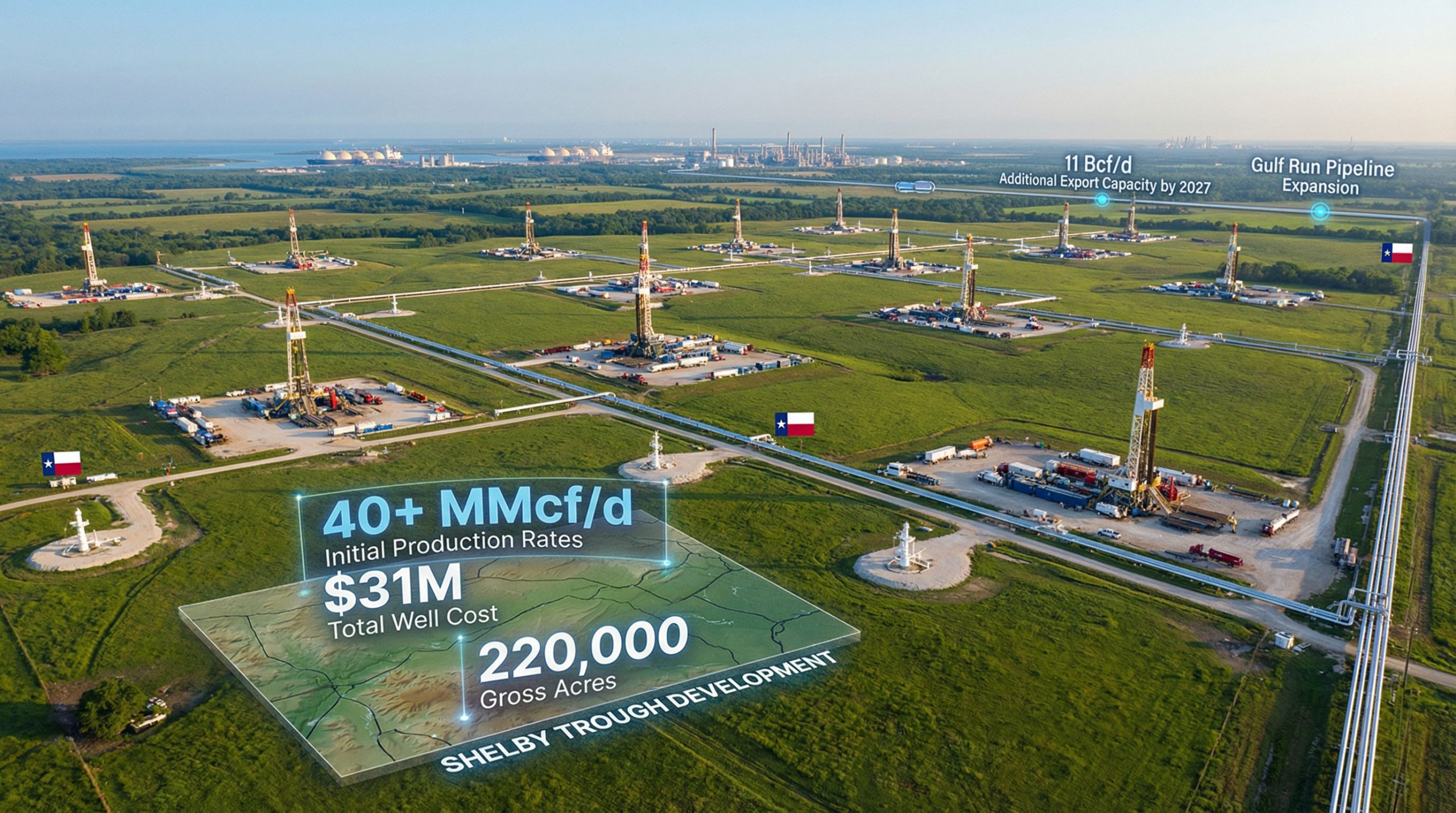
Breakeven economics in core development areas have improved significantly, with operational costs declining to $2.50 to $2.85 per thousand cubic feet (mcf) in premium locations. This cost reduction trajectory stems from drilling efficiency improvements, completion optimisation, and economies of scale achieved through coordinated development approaches. Western expansion areas demonstrate particularly compelling economics, with total well costs decreasing from $39 million to $31 million, representing a 21% cost reduction that fundamentally alters project economics.
Infrastructure bottlenecks, while presenting near-term challenges, create strategic positioning advantages for companies with established acreage positions and development partnerships. The coordination between drilling activities and infrastructure expansion requires sophisticated planning that balances capital deployment timing with market access optimisation.
Key Economic Drivers Supporting Development:
- Sustained natural gas price environment above breakeven thresholds
- Technology-driven cost reduction in drilling and completion operations
- Infrastructure development creating long-term market access
- Export demand growth providing additional revenue streams
- Domestic industrial consumption expansion supporting base demand
LNG Export Infrastructure Driving Accelerated Development
The Gulf Coast LNG export capacity expansion represents a fundamental shift in North American natural gas demand patterns, with 11 billion cubic feet per day (Bcf/d) of additional export capacity projected by 2027. This infrastructure development creates immediate demand pressure that supports accelerated drilling programs and justifies long-term capital commitments across multiple basins. Additionally, understanding LNG supply implications becomes crucial for strategic planning.
Major export facilities including Golden Pass and Plaquemines terminals are driving development urgency as operators seek to secure supply positions for long-term contracts. The integration of upstream development with midstream infrastructure and export facilities creates value chain optimisation opportunities that enhance overall project economics.
Gulf Coast petrochemical integration adds another demand layer, with industrial facilities requiring consistent, competitively priced natural gas feedstock. This industrial consumption base provides demand stability that complements export market volatility, creating more predictable revenue streams for upstream developers.
International market positioning for responsibly sourced gas aligns with environmental, social, and governance (ESG) requirements that increasingly influence capital allocation decisions and market access opportunities. This positioning advantage supports premium pricing potential and enhanced market access for certified production.
Geographic Expansion Corridors and Strategic Positioning
The Haynesville drilling expansion encompasses multiple geographic corridors, each with distinct geological characteristics, infrastructure requirements, and development timelines. The Shelby Trough Development spans 220,000 gross acres under structured partnerships that coordinate technical expertise with mineral ownership to optimise development economics.
Western Haynesville Frontier areas in Leon, Freestone, Limestone, and Robertson counties represent the next major development phase, with geological evaluation indicating commercial viability under current market conditions. These areas benefit from proximity to existing infrastructure while offering lower entry costs compared to established core areas.
Louisiana Core Areas continue attracting significant capital investment, with 72 wells drilled in 2025 by major operators demonstrating sustained confidence in basin economics. The concentration of drilling activity in proven areas supports infrastructure utilisation while providing operational efficiency benchmarks for expansion areas.
East Texas Integration strategies focus on century-long mineral aggregation approaches that provide development flexibility and control over drilling timing. This long-term perspective enables coordinated development that optimises both individual well performance and basin-wide infrastructure utilisation.
Strategic acreage positioning involves companies like Black Stone Minerals controlling 40,000 undeveloped net acres with expansion potential, representing decades of drilling inventory under favourable economic scenarios. These positions provide development optionality and timing flexibility that supports capital allocation optimisation.
Development Partnership Models and Capital Structure Evolution
Contemporary development approaches emphasise partnership structures that optimise risk-return profiles while accelerating development timelines. Multi-year drilling commitments spanning two decades of inventory provide investment certainty while maintaining operational flexibility to adapt to changing market conditions. Moreover, effective investment strategy insights help shape these partnership frameworks.
Phased Drilling Programme Structure:
- Years 1-2 (2026-2027): Initial 2-well pilot programmes for geological validation
- Years 3-6: Ramping to 12 gross wells annually with proven completion designs
- Long-term Trajectory: Sustained development across 200,000+ net acres
- Capital Allocation: $1.2 billion+ committed to drilling and completion programmes
Partnership framework evolution integrates mineral rights holders with technical operators, creating value through specialised expertise application and capital efficiency. These structures enable resource owners to maintain development control while accessing operational expertise and capital resources necessary for large-scale development.
Minimum lateral-foot obligations structure development pace while ensuring consistent activity levels that support infrastructure utilisation and workforce development. This approach balances development urgency with capital discipline, enabling sustained activity levels that optimise long-term economics.
Partnership Benefits:
- Risk sharing across multiple stakeholders
- Technical expertise integration with mineral ownership
- Capital efficiency through coordinated development
- Long-term alignment of interests and objectives
- Flexibility to adapt to market condition changes
Infrastructure Development as the Critical Path Forward
Pipeline capacity expansion represents the critical path for sustained production growth, with multiple major projects coordinated to support increased drilling activity. The Gulf Run Pipeline expansion by Energy Transfer provides additional takeaway capacity that reduces basis differentials and improves netback pricing for producers.
Williams' Louisiana Energy Gateway (LEG) project creates integrated infrastructure solutions that connect upstream development with downstream markets, including export facilities and industrial consumers. This infrastructure investment coordination reduces individual operator costs while improving overall system efficiency.
Regional Gathering System Development includes projects like the Pelican Pipeline that provide localised infrastructure solutions for specific development areas. These systems enable producers to access multiple transportation options while reducing operational complexity and transportation costs.
Transportation Solutions such as Momentum's NG3 Project create additional capacity options that support development flexibility and market access optimisation. The coordination of multiple infrastructure projects creates redundancy that reduces operational risk while providing competitive transportation pricing.
Gillis Hub Integration Strategy:
- Central Louisiana processing and distribution centre optimisation
- LNG terminal feed capacity coordination
- Petrochemical facility supply chain integration
- Export terminal timing and capacity allocation
- Regional storage and balancing services
Production Performance Metrics and Operational Excellence
Current production performance indicators demonstrate the economic viability of expanded development programmes, with major operators achieving 2.9+ billion cubic feet equivalent per day (Bcfe/d) from 116 wells drilled with $1.2 billion+ in drilling and completion capital expenditures.
Operational Performance Benchmarks:
| Operator Category | Daily Production (Bcfe/d) | 2025 Well Count | Capital Allocation |
|---|---|---|---|
| Major Operators | 2.9+ Bcfe/d | 116 wells | $1.2B+ D&C capex |
| Regional Players | Variable | 72 wells (Louisiana) | Partnership-based |
| Emerging Developers | Ramping | 2-12 wells/year | Phased investment |
Western Haynesville Performance Indicators:
- Initial production rates exceeding 40 million cubic feet per day (MMcf/d)
- Estimated Ultimate Recovery competitive with legacy well performance
- Lateral optimisation achieving 28% completion cost reduction
- Drilling efficiency improvements of 33% expense reduction
These performance metrics validate the technical and economic assumptions underlying expansion development plans while demonstrating continuous improvement in operational efficiency and cost management. Furthermore, US rig count trends provide additional context for operational planning.
Western Haynesville: The Next Major Development Frontier
The Western Haynesville emergence as a major development play reflects fundamental improvements in cost structure and technical performance that make previously marginal areas economically attractive. Total well costs declining from $39 million to $31 million represent a 21% cost reduction that approaches legacy Haynesville economics.
Cost Structure Transformation Analysis:
- 2022 Baseline: $39 million total well cost
- 2025 Projection: $31 million total well cost
- Breakeven Improvement: Approaching $2.70/mcf levels
- Competitive Positioning: Nearing legacy Haynesville economics
Technical Performance Validation includes initial production rates exceeding 40 MMcf/d with ultimate recovery estimates approaching core area performance levels. Drilling and completion optimisation reduces cycle times while maintaining production performance, creating operational efficiency that supports sustained development. Recent industry reports highlight how monster gas wells outperforming legacy deposits demonstrate the potential of these new development areas.
Infrastructure development coordination supports Western Haynesville growth by providing market access and transportation options necessary for commercial development. The timing coordination between infrastructure investment and drilling programmes optimises capital deployment while reducing operational risk.
Development Advantages:
- Lower entry costs compared to core areas
- Proximity to existing infrastructure systems
- Geological similarity to proven development areas
- Operational flexibility for drilling and completion optimisation
- Market access through multiple transportation options
Market Scenario Analysis and Price Sensitivity Modeling
Natural gas price scenarios significantly impact development economics and profitable acreage percentages, with sensitivity analysis providing framework for investment decision-making and capital allocation optimisation.
Price Sensitivity Modelling Results:
| Gas Price ($/MMBtu) | Profitable Acreage (%) | Development Scenario |
|---|---|---|
| $4.00 | 13% | Conservative development |
| $6.00 | 45% | Moderate expansion |
| $8.00 | 72% | Aggressive growth |
Demand Growth Projections encompass multiple consumption categories that collectively support sustained natural gas demand growth. Electricity generation expansion through natural gas-fired plant construction provides baseload demand that supports long-term development planning.
Industrial consumption growth, particularly in Gulf Coast petrochemical operations, creates additional demand that complements export market opportunities. These industrial consumers require consistent supply and competitive pricing, creating market stability that supports upstream investment.
Export market acceleration through global LNG demand growth provides upside potential that justifies development investment in higher-cost areas. International market access through Gulf Coast export facilities creates pricing optionality that enhances project economics.
Seasonal demand variations including peak winter heating and summer cooling demand create price volatility that can benefit producers with operational flexibility and storage capacity access.
Regulatory Environment and Environmental Compliance Integration
Permitting trends demonstrate regulatory support for responsible development, with 10.86% increase in permit applications during the first five months of 2025, totalling 296 permits approved compared to 267 in the comparable 2024 period. This regulatory efficiency supports development timeline predictability while maintaining environmental protection standards.
State regulatory frameworks continue supporting responsible development through streamlined permitting processes that balance environmental protection with economic development objectives. Regulatory predictability enables long-term planning and capital commitment necessary for large-scale development projects.
Environmental compliance integration includes advanced technologies and operational practices that minimise environmental impact while maintaining economic viability. Water management and recycling technologies reduce freshwater consumption while managing produced water disposal efficiently.
ESG Integration Strategies:
- Responsibly sourced gas certification programmes for market differentiation
- Carbon footprint optimisation across all operational phases
- Community engagement and local economic development initiatives
- Advanced water management and recycling technology implementation
- Continuous monitoring and reporting of environmental performance metrics
Environmental compliance costs are increasingly integrated into project economics from initial planning stages, ensuring sustainable development that meets both regulatory requirements and market expectations for responsible resource development.
Investment Framework and Strategic Capital Allocation
Capital deployment efficiency metrics focus on multi-year development agreements that provide investment certainty while maintaining operational flexibility to adapt to changing market conditions. Partnership structures optimise risk-return profiles by combining technical expertise, capital resources, and mineral ownership in coordinated development approaches.
Infrastructure investment coordination reduces individual operator costs while improving system-wide efficiency and reliability. Technology advancement continues driving per-well economics improvement through enhanced drilling techniques, completion optimisation, and production management systems. Additionally, understanding energy transition trends is essential for long-term strategic planning.
Strategic Positioning for Energy Transition
Natural gas serves as a bridge fuel supporting renewable energy integration whilst LNG export infrastructure creates long-term value and market access opportunities. Domestic energy security considerations support sustained development, and industrial feedstock supply chain resilience benefits from diversified production sources. Moreover, industry partnerships such as BSM Caturus advancing Haynesville expansion demonstrate the collaborative approach driving this growth.
Investment Risk Management:
- Diversified acreage positions across multiple development areas
- Phased development approaches that adapt to market conditions
- Infrastructure access through multiple transportation options
- Partnership structures that share technical and financial risks
- Long-term contracts providing revenue stability and market access
Investment success requires balancing current market opportunities with long-term strategic positioning, recognising that energy transition creates both challenges and opportunities for natural gas development. Companies that successfully navigate this transition while maintaining operational excellence and cost discipline are positioned to capture value across multiple market cycles.
Future Outlook and Strategic Implications
The Haynesville drilling expansion represents a fundamental transformation in North American natural gas development, driven by converging technological advancement, infrastructure investment, and market demand growth. Success requires coordinated development approaches that optimise individual well performance while supporting basin-wide infrastructure utilisation and long-term market positioning.
Furthermore, the evolution from mature play to expansion frontier demonstrates how technological innovation, strategic planning, and coordinated market positioning create new growth opportunities in established resource areas. This transformation provides a framework for sustainable development that balances economic returns with environmental responsibility while supporting North American energy security objectives.
Critical Success Factors:
- Maintaining cost discipline while scaling operations efficiently
- Coordinating infrastructure development with drilling programme timing
- Adapting operational strategies to evolving market conditions and regulatory requirements
- Leveraging partnership structures to optimise capital efficiency and risk management
- Integrating environmental compliance and ESG considerations into all development phases
The transformation of the Haynesville drilling expansion from traditional development boundaries into new geographic corridors reflects the sector's ability to adapt and innovate in response to changing market dynamics and technological capabilities.
Disclaimer: This analysis contains forward-looking statements and projections based on current market conditions and available information. Natural gas markets are subject to significant volatility influenced by economic, regulatory, and geopolitical factors. Investment decisions should be based on comprehensive due diligence and professional financial advice.
Looking to Capitalise on North American Energy Opportunities?
Discovery Alert's proprietary Discovery IQ model delivers real-time alerts on significant ASX mineral discoveries, including energy transition metals crucial for infrastructure development powering projects like the Haynesville expansion. Visit Discovery Alert's dedicated discoveries page to explore historic examples of exceptional returns from major mineral discoveries, then begin your 30-day free trial to position yourself ahead of the market in Australia's dynamic resources sector.