July 14, 2026
The Emerging Market Equation Reshaping Global Heavy Equipment
For decades, the heavy construction equipment industry measured its health almost exclusively through the lens of North American and European demand cycles. Infrastructure spending bills in Washington or housing booms in Germany were the bellwethers. However, a structural shift has been underway for years, and Q1 2026 data from one of the sector's most strategically positioned manufacturers makes that shift impossible to ignore. When a single regional corridor can generate sales growth nearly three times the rate of a company's overall revenue increase, the centre of gravity for this industry has moved.
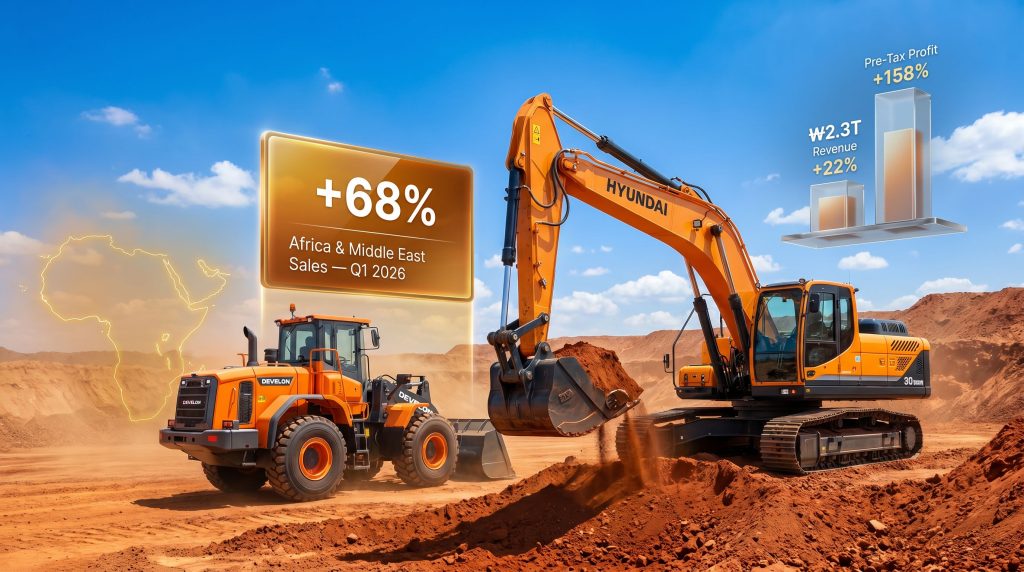
That is precisely the story embedded in HD Construction Equipment's (HDCE) first quarter 2026 performance, where HD Construction Equipment Africa and Middle East sales up 68% year-on-year stands as the headline figure in a broader narrative about margin expansion, brand architecture, and the long-term investment case for emerging market equipment exposure.
When big ASX news breaks, our subscribers know first
Two Brands, One Commercial Strategy
HDCE operates as the heavy machinery division within the HD Hyundai corporate group, carrying commercial responsibility for two complementary product families: the established Hyundai construction equipment lineup and the Develon brand, which functions as a challenger offering targeting different buyer segments and procurement contexts.
Understanding why this dual-brand structure matters requires thinking about how large-scale mining and infrastructure operators actually procure equipment fleets. Institutional buyers in frontier markets rarely want a single-tier offering. They need:
- Proven, premium-specification excavators for high-output mining operations where downtime carries severe financial consequences
- Cost-competitive alternatives for newer operations, government contractors, or projects with tighter capital budgets
- A single supply relationship capable of servicing both categories with unified parts logistics and dealer support
The Hyundai brand addresses the first need. Develon serves the second. Together, they allow HDCE to compete across multiple buyer tiers within the same procurement cycle without the margin erosion that typically accompanies head-to-head internal competition. Furthermore, this architecture is not merely a marketing decision; it is a structural competitive advantage that becomes increasingly valuable as HDCE deepens its penetration in markets where fleet procurement decisions are often made at the government or sovereign wealth fund level.
Q1 2026 Financial Performance: Reading Beyond the Revenue Line
The headline numbers from HDCE's March quarter 2026 results are significant, but the relationship between them is where the real insight lies.
| Metric | Q1 2026 Result | Year-on-Year Change |
|---|---|---|
| Total Revenue | W2.3 trillion (~US$1.57 billion) | +22% |
| Pre-Tax Profit | W224.4 billion (~US$152.5 million) | +158% |
| Africa and Middle East Sales | Regional outperformance | +68% |
A 22% revenue increase is a strong quarterly result by any measure in this sector. However, pre-tax profit growing at 158% on the back of a 22% revenue increase signals something more structurally significant than volume alone: operating leverage is being realised. This means fixed costs are being spread across a meaningfully larger revenue base, pricing power is holding in key markets, and the product mix is shifting toward higher-margin configurations, likely the larger excavator classes that dominate African mining procurement.
The divergence between revenue growth and profit growth is one of the clearest indicators of a business reaching operational scale in its target markets. When margins expand this aggressively on moderate revenue growth, it typically reflects a combination of pricing discipline, mix improvement, and overhead absorption benefits that compound as volumes increase.
For context, Mining Magazine confirmed that Caterpillar recorded a 22% sales increase in the same March quarter, placing HDCE's overall revenue growth rate in close alignment with its largest global competitor. The divergence, however, lies in regional composition: HDCE's 68% surge in Africa and the Middle East represents an emerging market growth rate that significantly exceeds what Caterpillar's more globally distributed revenue base typically reflects in these corridors.
Ethiopia: A Case Study in Market Dominance Through Early Commitment
No analysis of HDCE's African performance can proceed without a detailed examination of Ethiopia, a market that has become something approaching a textbook example of how decisive early entry creates compounding competitive advantages in frontier economies.
Ethiopia accounts for more than one-third of HDCE's total African sales volume. The company holds an estimated 80% excavator market share in a country that has emerged as one of sub-Saharan Africa's most consequential mining economies, driven primarily by an expanding gold extraction sector in the eastern and southern regions of the country. Indeed, record gold prices in recent years have accelerated fleet investment by mining operators seeking to maximise extraction output during elevated price windows.
In January 2026, HDCE delivered 120 large excavators to Ethiopian gold mining operations, a landmark order that illustrates the scale at which institutional procurement now operates in this market. This was not a speculative placement of inventory; it was a deliberate, large-batch fleet supply agreement with established mining operators who have standardised on HDCE equipment across their operations.
The strategic significance of standardisation cannot be overstated. When a mining company builds its operational infrastructure, parts inventory, technician training, and maintenance scheduling around a single OEM's product family, switching costs become prohibitive. Every unit delivered reinforces the next procurement decision. Consequently, HDCE's 80% market share in Ethiopia is not simply a sales statistic; it is a structural moat that compounds with each fleet expansion cycle.
African Equipment Demand by the Numbers
The growth in African construction equipment sales extends well beyond Ethiopia's gold sector, reflecting a continent-wide demand recovery that intersects commodity cycle momentum with long-deferred infrastructure investment.
| Segment | 2023 Units Sold | 2024 Units Sold | Growth Rate |
|---|---|---|---|
| Excavators and Medium/Large Wheel Loaders (Africa) | 13,500 | 18,200 | +34.8% |
| 30-Tonne Class Excavators (3-Year Trend) | Baseline | More than doubled | ~26%+ annually |
The 30-tonne class excavator is HDCE's primary volume driver in Africa. This weight category sits at the intersection of versatility and output capacity: large enough for serious open-cut mining and earthmoving work, but sufficiently mobile and cost-efficient to serve infrastructure applications like road construction, port development, and dam projects. African buyers across multiple sectors converge on this specification.
Furthermore, the copper supply crunch unfolding across global markets is accelerating investment in new African mining operations, which in turn drives additional heavy equipment procurement cycles. A March 2024 order for 60 units destined for Sudan illustrates how demand is beginning to diversify geographically beyond Ethiopia, suggesting HDCE's dealer network and brand recognition are radiating outward across the East African corridor.
The Post-COVID Recovery Arc and First-Mover Advantage
African excavator markets experienced severe contraction during the COVID-19 disruption period, with annual sales declining by close to 50% from their peak across several consecutive years between 2021 and 2023. Supply chain failures, delayed capital expenditure approvals, and logistics disruptions compressed what had been a steadily growing market into a prolonged trough.
The recovery began to materialise visibly in Q1 2024, with unit sales showing approximately 50% year-on-year improvement from the compressed base. The critical strategic observation here concerns timing and positioning rather than the recovery rate itself.
Companies that maintained dealer networks, parts availability, and customer relationships through the downturn entered the recovery phase with embedded commercial infrastructure that competitors had either withdrawn or never built. HDCE's existing presence in Ethiopia and other African markets meant it captured disproportionate recovery-phase demand without needing to rebuild its market position from scratch, a dynamic that helps explain why its regional growth rate so substantially exceeds overall sector averages.
The Middle East: Institutional Scale and Logistics Architecture
The Middle East component of HDCE's regional outperformance operates through a different demand mechanism but produces similarly compelling numbers. Where African growth is rooted primarily in commodity extraction, Middle Eastern equipment demand draws its energy from some of the world's largest government-directed infrastructure programmes.
In early 2025, HDCE secured an order for 557 units across the Middle East and Türkiye, a single transaction that demonstrates the institutional scale of procurement in this region. Orders of this magnitude are typically placed through centralised government purchasing agencies or sovereign-linked construction conglomerates managing multi-year megaproject pipelines. In addition, the Saudi exploration push into new resource territories is creating parallel demand for heavy extraction equipment across the broader region.
Türkiye plays a dual role in HDCE's Middle East strategy. It functions as a direct sales market in its own right, driven by ongoing domestic construction activity, and simultaneously serves as a logistics and distribution gateway for equipment moving into neighbouring markets. The country's port infrastructure, established trade relationships, and geographic positioning between European supply chains and Middle Eastern demand centres make it a natural regional distribution hub.
Comparing Africa and Middle East as Strategic Growth Corridors
| Dimension | Africa | Middle East |
|---|---|---|
| Primary Demand Driver | Mining and resource extraction | Mega-infrastructure and urban development |
| Key Growth Markets | Ethiopia, Sudan | Saudi Arabia, UAE, Türkiye |
| HDCE Market Position | Dominant (80% share in Ethiopia) | Expanding (557-unit order win in 2025) |
| Growth Catalyst | Commodity cycles and fleet replacement | Government-directed capital expenditure |
| Risk Profile | Higher (political and logistics complexity) | Moderate (policy-dependent spending cycles) |
The risk profiles of these two corridors deserve careful attention from investors and industry observers. African markets carry greater political and logistics risk: infrastructure for equipment transportation, parts distribution, and financing is less developed, and country-specific volatility can disrupt procurement cycles. Middle Eastern markets are less structurally risky in the logistics sense, but their dependence on government spending priorities means that policy shifts or fiscal adjustments can rapidly alter procurement volumes.
Equipment Categories Powering the Regional Surge
Excavators as the Revenue Engine
The 30-tonne class excavator is not the only product benefiting from African and Middle Eastern demand, but it is the category where HDCE's competitive positioning is most entrenched. These machines are the workhorses of both open-cut gold mining in East Africa and large civil earthmoving projects across the Gulf states.
At the ultra-heavy end of the product range, the Hyundai HX1000L, a 100-tonne class excavator, targets the kind of large-scale, high-output open-cut mining operations that are expanding across sub-Saharan Africa as gold and copper extraction intensifies. This machine category serves operations where productivity per unit is the primary purchasing criterion, and where downtime costs can exceed the daily operating cost of the equipment itself.
Wheel Loaders, Graders, and Fleet Integration
Beyond excavators, medium and large wheel loaders are gaining significant traction as part of integrated fleet procurement packages. When a mining operator or infrastructure contractor standardises on HDCE for excavators, the commercial logic of extending that relationship to wheel loaders and graders is compelling: unified parts inventory, single-vendor maintenance contracts, and consistent operator training programmes reduce operational complexity substantially.
Infrastructure-oriented equipment, including motor graders for road construction and articulated haulers for earthmoving, is also experiencing accelerating demand. This reflects African governments prioritising connectivity projects and Gulf states continuing to execute urban development programmes at a scale requiring sustained heavy equipment deployment across multiple years.
The next major ASX story will hit our subscribers first
The 2030 Revenue Horizon: Ambition, Structure, and Sustainability Questions
HDCE has articulated a post-merger financial roadmap that anchors the company's strategic ambition in specific numerical targets. According to Korea Times, the newly merged entity has set ambitious multi-year sales milestones that reflect both regional momentum and structural integration benefits.
| Milestone | Target Revenue | Timeline |
|---|---|---|
| 2026 Annual Sales Target | W8.72 trillion (~US$6.6 billion) | FY2026 |
| Post-Merger Long-Term Target | W14.8 trillion (~US$10.3 billion) | 2030 |
These figures represent a significant scaling ambition relative to the Q1 2026 annualised revenue run rate. Achieving the 2030 target would require roughly 4.5 times the revenue of a single strong quarterly result, implying sustained high-single-digit to low-double-digit annual growth across all regions through the remainder of the decade.
Africa is identified within HDCE's strategic framework as a key emerging market within this plan. Whether the continent can sustain the growth rates that Q1 2026 data reflects depends on several intersecting factors:
- Gold and copper price trajectories: African equipment demand is heavily correlated with commodity prices. Sustained gold prices above US$2,000 per troy ounce historically justify fleet expansion in East African mining operations. A significant price correction would likely slow, though not halt, procurement activity.
- Geographic diversification beyond Ethiopia: Ethiopia currently representing more than one-third of African sales creates concentration risk. North Africa, West Africa, and Southern Africa remain meaningfully underpenetrated by HDCE relative to their economic scale and resource base.
- Dealer network and parts infrastructure: In high-growth frontier markets, the constraint on equipment sales is often not demand but supply-side capability: the ability to deliver equipment, provide financing to buyers, and maintain machines once deployed.
- Chinese OEM competitive pressure: Brands including XCMG, Sany, and Zoomlion have been systematically building African distribution networks and offering aggressive financing terms that appeal to cost-sensitive buyers. HDCE's 80% market share in Ethiopia is formidable, but it is not immune to competitive erosion if Chinese manufacturers invest sufficiently in local support infrastructure.
In addition, the broader surge in critical minerals demand tied to the global energy transition is expected to underpin African and Middle Eastern equipment procurement well beyond the current cycle. Furthermore, Saudi mining licences being issued at an accelerating rate signal that Middle Eastern resource extraction activity will increasingly complement the region's infrastructure-driven equipment demand in coming years.
What This Means for the Broader Heavy Equipment Industry
The performance data from HDCE's Q1 2026 results carries implications that extend beyond a single company's quarterly earnings. HD Construction Equipment Africa and Middle East sales up 68% is a data point that the entire sector should be examining carefully. Several broader industry dynamics are visible in these numbers:
- Emerging markets are becoming the primary growth engine for global heavy equipment manufacturers, not merely a supplementary revenue source managed alongside mature market stability.
- Brand consolidation at the OEM level is proving its commercial logic in competitive frontier markets. The Hyundai/Develon dual-brand architecture allows HDCE to address a wider buyer spectrum than a single-brand competitor, and the Q1 2026 margin expansion suggests this approach is generating financial returns, not just market share statistics.
- Mining-infrastructure demand convergence in Africa and the Middle East is creating multi-year procurement cycles that extend the revenue visibility for well-positioned suppliers. A mining operator who places a 120-unit excavator order in January 2026 is also a parts, service, and fleet-expansion customer for the following decade.
- Profitability scaling faster than revenue is the defining financial characteristic of HDCE's current growth phase. A 158% pre-tax profit increase on a 22% revenue increase is not a coincidence; it is the result of operational leverage reaching an inflection point as regional volumes cross meaningful scale thresholds.
Consequently, the story of HD Construction Equipment Africa and Middle East sales up 68% is ultimately about structural market positioning rather than cyclical fortune. The companies that will define the next decade of this industry are those that recognised emerging market opportunity early, built the commercial infrastructure to serve it at scale, and are now reaping the compounding benefits of that commitment.
Disclaimer: This article contains forward-looking statements and financial projections derived from corporate guidance and industry analysis. These should not be construed as investment advice. Past performance and stated revenue targets are not guarantees of future results. Investors should conduct independent due diligence before making any investment decisions related to companies or sectors discussed in this article. Financial figures have been sourced from publicly available reporting and industry publications.
Want to Identify the Next Major Mineral Discovery Before the Market Does?
Discovery Alert's proprietary Discovery IQ model delivers real-time alerts on significant ASX mineral discoveries — including the gold and copper sectors driving African equipment demand — instantly translating complex geological data into actionable investment insights for traders and long-term investors alike. Explore why historic mineral discoveries have generated extraordinary returns by visiting Discovery Alert's dedicated discoveries page, and begin your 14-day free trial today to position yourself ahead of the broader market.