Ozaurum Resources Ltd
- ASX Code: OZM
- Market Cap: $25,247,563
OzAurum Resources Confirms Heap Leach Results at Mulgabbie North as Plant Refurbishment Nears Completion
OzAurum Resources (ASX: OZM) has reported strong heap leach column testwork from the James Stage 1 Open Pit at its Mulgabbie North Gold Project in Western Australia, with gold recoveries of up to 82% at a -12mm crush size and laboratory indications of 88% recovery at the intended -8mm operating crush size. The company also reported a high-grade diamond drill intercept of 6m @ 11.64 g/t Au from 22m, including 1m @ 61.10 g/t Au from hole MNODH 022.
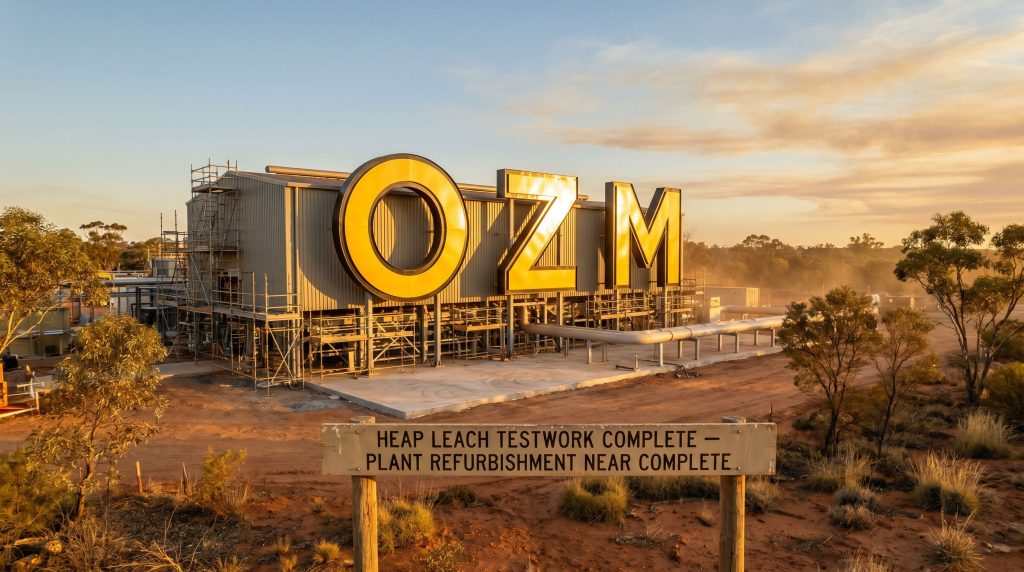
According to the ASX update, the testwork covered the ore types OzAurum intends to process by heap leach, while plant refurbishment by Polaris Engineering Services is nearing completion. For investors, the combination of favourable metallurgy, shallow mineralisation, and advancing plant readiness is relevant because it may support a lower-capital route toward potential gold production, subject to further technical work and project establishment.
When big ASX news breaks, our subscribers know first
Heap Leach Testwork Supports the Proposed Processing Route
In the report, OzAurum stated that independent column testwork was completed by ALS Balcatta under the supervision of Randall Pyper of Kappes Cassiday & Associates Australia. The work tested material from different geological zones within the James deposit.
The result that stands out most is Column 2, based on drill hole MNODH 020, which tested lower saprolite and transition ore from 34m to 44m downhole. This column delivered 82% gold recovery at -12mm, with a head grade of 1.35 g/t Au.
The company also stated that laboratory work indicates a potential increase to 88% recovery if the ore is crushed to -8mm, which is the size OzAurum intends to use if heap leach production commences.
| Column | Drill hole | Ore type | Interval tested | Head grade | Crush size | Recovery | Timing detail |
|---|---|---|---|---|---|---|---|
| Column 2 | MNODH 020 | Saprolite / transition | 34m to 44m | 1.35 g/t Au | -12mm | 82% | 60% in 7 days, 80% in 14 days |
| Column 2 projected | MNODH 020 | Saprolite / transition | 34m to 44m | 1.35 g/t Au | -8mm | 88% | Laboratory indication |
| Column 3 | MNODH 022 | Paleochannel | 21m to 29m | 2.50 g/t Au | -12mm | >60% at 21 days, >75% at 39 days | Preliminary only |
The Column 3 result is also relevant. This test used paleochannel ore from MNODH 022 and, according to the announcement, is still underway. Preliminary recoveries are reported at more than 60% after 21 days and more than 75% after 39 days.
Importantly, the company noted that recoveries are now being recorded across three different ore types. That consistency matters because it suggests heap leaching may not be restricted to a narrow part of the deposit.
"These results clearly demonstrate the strong potential for a low-cost heap leach operation at Mulgabbie North. We now have column testwork across all the geological domains that we intend to process via heap leach, which gives us confidence moving forward with the Mulgabbie North Project via heap leach production. This project has the potential to be a long-life mining and production facility. With dry commissioning of the first 4 modules of plant now complete, we are increasingly confident in advancing towards a near-term production scenario."
— Andrew Pumphrey, CEO and Managing Director, OzAurum Resources
Why the Metallurgical Data Matters for Investors
Metallurgical testwork helps determine how much gold can realistically be recovered from mined material. In simple terms, strong drill results show where the gold is, while strong metallurgy helps show whether that gold may be extracted efficiently.
For a junior gold company, heap leaching is often considered because it can require less upfront capital than a conventional milling plant. Instead of grinding ore finely in a large processing circuit, ore is crushed, stacked on a lined pad, and irrigated with a solution that dissolves the gold. The gold-bearing solution is then collected and processed.
That is why the combination of recovery rate, leach speed, and reagent use is important. In OzAurum's case, the announcement reported all three as favourable.
| Metric | OZM reported result | Why it matters |
|---|---|---|
| Gold recovery | Up to 82%, with lab indication to 88% at -8mm | Higher recovery can improve project economics |
| Leach kinetics | 60% recovered in 7 days and 80% in 14 days for Column 2 | Faster recovery can support quicker production cycles |
| Cyanide consumption | ~0.21 kg/t | Lower reagent use may reduce operating costs |
| Ore type coverage | Results across multiple ore domains | May reduce processing uncertainty across planned feed material |
The reported cyanide consumption of about 0.21 kg/t is especially relevant because OzAurum noted this is well below a typical consumption rate of around 0.5 kg/t. Lower reagent intensity can support a more competitive operating cost profile, although field performance can differ from laboratory conditions.
Furthermore, the company stated that the metallurgical samples are considered representative of ore that could eventually be placed on a heap leach pad. Even so, investors should note the company's own caution that MNODH 022 Column 3 results remain preliminary and require further analysis.
Educational Section: What Heap Leach Metallurgy Means
Heap leach metallurgy is a testing process used to assess whether ore is suitable for heap leach processing and how well it may perform. For non-specialist investors, several terms in this announcement are worth understanding.
What Is Heap Leaching?
Heap leaching is a gold extraction method often used for near-surface ore. Crushed material is stacked on a pad and a dilute cyanide solution is applied. As the liquid moves through the ore, it dissolves gold, which is then recovered from the collected solution.
What Is Gold Recovery?
Gold recovery refers to the percentage of contained gold extracted during processing. If ore contains 100 units of gold and 82 units are recovered, the recovery is 82%.
What Are Leach Kinetics?
Leach kinetics describe how quickly gold dissolves during the process. Faster kinetics can matter because they may shorten the time between stacking ore and recovering gold.
What Is Saprolite, Transition Ore, and Paleochannel Ore?
- Saprolite is deeply weathered rock near the surface that is usually softer and easier to process.
- Transition ore sits between weathered surface rock and fresh hard rock below.
- Paleochannel ore comes from ancient buried river channels where gold may have accumulated in sediments.
Why Does Crush Size Matter?
Smaller crush sizes expose more rock surface area to the leach solution. That can improve recovery, but it may also increase crushing costs. In this case, OzAurum stated that moving from -12mm to -8mm may lift laboratory recovery from 82% to 88% for Column 2 ore.
For investors assessing early-stage gold developers, these metrics help frame whether a project may progress using a simpler, lower-capital processing route or may require more intensive treatment.
High-Grade Diamond Intersection Adds Support to the Geological Model
Alongside the metallurgical update, the ASX announcement included a high-grade drill result from the paleochannel metallurgical hole MNODH 022. The company reported:
- 6m @ 11.64 g/t Au from 22m
- Including 1m @ 61.10 g/t Au
The hole was drilled vertically to 36m, with the mineralised interval at shallow depth. That shallow position is relevant in the context of an open pit development concept because ore close to the surface is generally more accessible than deeper mineralisation.
The company also reported a second diamond result from MNODH 021 of 3m @ 0.92 g/t Au from 26m. While less prominent than MNODH 022, it adds further data from the same project area.
According to the geological discussion in the report, Mulgabbie North mineralisation sits along the Relief Shear, a corridor up to 50m true width extending about 8km within OzAurum tenure. High-grade mineralisation is associated with fault intersections and quartz veining, and mineralisation at the Cross Fault area remains open at depth for future RC drilling.
The company also observed similarities between north-south striking faults at Mulgabbie North and structures associated with other gold deposits in the broader Carosue Dam district. That is a geological comparison rather than a statement of equivalent outcome, but it provides useful regional context for the exploration model.
Mineral Resource Provides the Base Case for Development Studies
The metallurgical update sits against an existing JORC 2012 Mineral Resource Estimate for Mulgabbie North of 260,000 ounces of gold at 0.70 g/t Au, reported at a 0.30 g/t Au cut-off to 150m depth.
| Classification | Tonnes | Grade | Contained ounces |
|---|---|---|---|
| Measured | 1,475,000 | 0.82 g/t Au | 39,000 oz |
| Indicated | 5,620,000 | 0.71 g/t Au | 128,000 oz |
| Inferred | 4,543,000 | 0.64 g/t Au | 93,000 oz |
| Total | 11,638,000 | 0.70 g/t Au | 260,000 oz |
Measured and Indicated material totals 167,000 ounces, which gives the project a meaningful base of higher-confidence inventory for further mine planning work.
However, the announcement is clear on an important limitation. No Ore Reserve has currently been defined on the Mulgabbie North tenements, and the potential for a mining operation and ore sales has yet to be established. That distinction matters because a Mineral Resource is not the same as an economically mineable reserve.
Plant Refurbishment Progress Points to the Next Development Stage
The production angle in the announcement is supported by progress on the agglomeration and heap leach plant refurbishment being carried out by Polaris Engineering Services. According to the update:
- Dry commissioning has been completed for the feed bin, feed conveyor, agglomeration drum, and main discharge conveyor
- These units are expected to be delivered to site after the feed spray bar is fitted
- The lime and cement silo system is reported to be 95% complete
- New silo conveyors have been delayed by the supplier but are expected shortly
- Concrete foundations at Mulgabbie North were delayed by three weeks due to high rainfall, with pouring expected that week
This sequence is relevant because metallurgical results carry more weight when the associated plant is already advancing through commissioning and transport stages. It does not confirm production, but it does indicate that the company is progressing the physical infrastructure required for a heap leach start-up scenario.
The next major ASX story will hit our subscribers first
What to Watch From Here
Based on the ASX announcement, several near-term items appear likely to attract investor attention:
- Final Column 3 metallurgical results from MNODH 022
- Delivery of plant components to Mulgabbie North
- Completion of concrete foundations at site
- Further RC and diamond drilling, particularly at depth in the Cross Fault area
- Any future update on a staged development pathway across the broader 8km Relief Shear corridor
The immediate significance of the release is that OzAurum has added technical support to its heap leach concept across the ore types it intends to process. Combined with a 260,000-ounce resource base, a shallow high-grade paleochannel intercept, and late-stage refurbishment of plant modules, the announcement moves the project further along the development curve.
For investors following junior ASX gold developers, the next question is straightforward: can the company convert favourable laboratory metallurgy and plant readiness into a defined operating plan? According to the current update, that process is moving forward, but further technical confirmation and development work remain necessary before any mining operation is established.
Want to Stay Ahead of the Next Major ASX Gold Discovery?
Discovery Alert's proprietary Discovery IQ model delivers real-time alerts the moment significant mineral discoveries are announced on the ASX, turning complex geological and metallurgical data into actionable investment insights — exactly the kind of edge that matters when following junior gold developers like OzAurum Resources. Start your 14-day free trial today, and explore historic examples of exceptional discovery returns that demonstrate why being early to a major find can make all the difference.