July 13, 2026
The Capital Mechanics Behind West Africa's Most Watched Gold Mine Revival
When commodity trading houses begin deploying long-duration capital into brownfield mining assets, it signals something more significant than a single transaction. It reflects a fundamental recalibration of where institutional risk appetite intersects with resource quality, jurisdictional maturity, and price environment. In West Africa's gold sector, that recalibration is now visible in concrete terms through the Heath Goldfields Bogoso-Prestea gold mine financing and offtake deal, a transaction that reconfigures how structured capital reaches historically significant African mining assets.
Understanding what makes this deal architecturally distinct, and what it communicates to the broader market, requires examining the mechanics of modern commodity finance, not just the headline figures.
When big ASX news breaks, our subscribers know first
What the Transaction Actually Involves
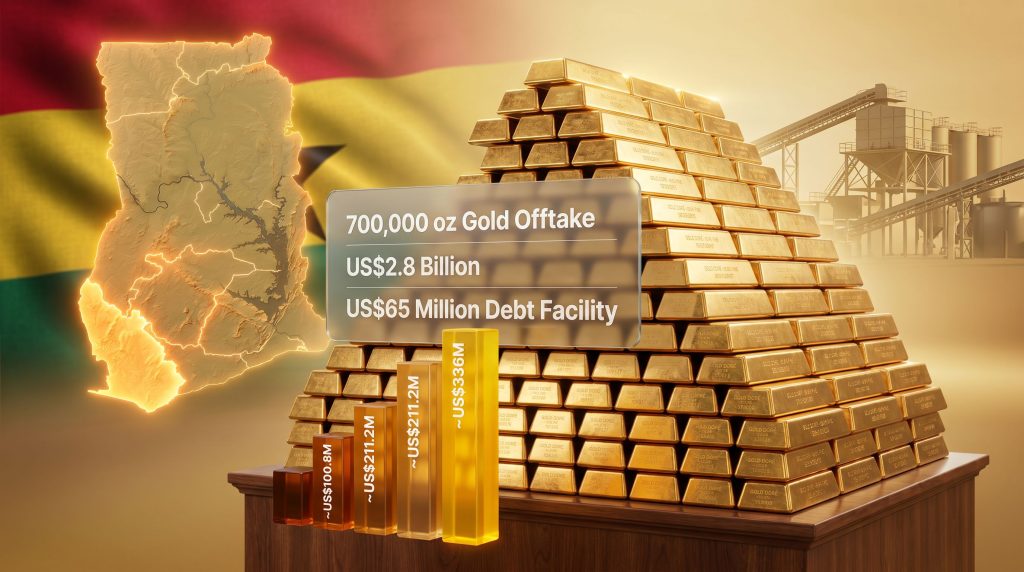
At its core, the Heath Goldfields Bogoso-Prestea gold mine financing and offtake deal combines two interdependent instruments into a single integrated structure. Verdant IMAP, acting as exclusive financial advisor to Heath Goldfields, arranged a US$65 million debt facility alongside a 700,000-ounce gold offtake commitment from Trafigura. The offtake volume carries an estimated commercial value of approximately US$2.8 billion at prevailing gold prices, making it one of the largest single offtake commitments recorded for a West African gold operation in recent years.
The debt facility is earmarked for capital expenditure aligned with the medium-term mine plan and general corporate requirements, effectively funding the operational transition between the initial restart phase and full production capacity. Deliveries under the offtake arrangement are structured to commence in line with the company's phased production schedule.
Key Transaction Parameters
| Parameter | Detail |
|---|---|
| Debt Financing Volume | US$65 million |
| Offtake Volume Committed | 700,000 ounces of gold doré |
| Estimated Commercial Value | ~US$2.8 billion |
| Processing Facility Capacity | 1.5 million tonnes per annum (CIL) |
| Mine Restart | December 2024 (initial); first gold poured February 2026 |
| Resource Base (M&I) | 5.1 million ounces (SK-1300 compliant) |
| Production Ramp-Up Target | 3,000–8,000 ounces per month |
| Jobs Created | Over 1,400 direct and indirect |
| Local Contractor Engagement | 15+ Ghanaian contractors |
| Government Carried Interest | 10% (Ghana government) |
| Financial Advisor | Verdant IMAP (exclusive) |
How Offtake-Linked Debt Financing Works in Practice
The term offtake agreement in mining refers to a pre-committed purchase contract between a producer and a buyer, guaranteeing a commercial home for future production before it is extracted. For lenders evaluating project finance, these agreements serve a critical function: they replace speculative revenue assumptions with contractually committed cash flow visibility.
In markets where conventional project finance remains structurally constrained, particularly for African mid-tier and emerging producers lacking investment-grade credit ratings, offtake arrangements function as collateral substitutes. The lender's exposure is partially de-risked by the knowledge that production has a committed buyer at commercially benchmarked terms. Furthermore, the gold price outlook through 2025 and into 2026 has reinforced the attractiveness of these structures for both parties.
What distinguishes the Bogoso-Prestea structure is that Trafigura occupies both sides of the transaction simultaneously, acting as both debt capital provider and commercial offtaker. This integrated counterparty model is increasingly common in commodity finance but remains largely invisible to observers focused purely on the headline deal size.
Offtake-linked financing packages effectively compress the capital formation cycle for mine restarts by removing the revenue uncertainty that typically delays drawdown approvals from conventional lenders. When a single counterparty underwrites both the debt and the purchase obligation, due diligence timelines shorten and execution risk decreases materially.
It is worth distinguishing between the three main structured finance instruments operating across African gold markets:
- Streaming agreements: A financier pays upfront capital in exchange for the right to purchase a fixed percentage of future production at a pre-agreed, below-market price. Revenue upside accrues to the streamer, not the operator.
- Royalty arrangements: A fixed percentage of gross or net revenue is paid to a financier or royalty holder, typically without volume obligations attached.
- Offtake agreements: A buyer commits to purchasing a specified quantity at market-linked pricing, providing the producer with revenue certainty without sacrificing price upside.
The Bogoso-Prestea deal is explicitly structured as the third model, with pricing benchmarked to prevailing international gold prices, meaning Heath Goldfields retains full exposure to gold price appreciation above the benchmark. In an environment where prices have remained elevated through 2025 and into 2026, this distinction carries meaningful financial consequences. According to Reuters' reporting on the Trafigura agreement, the deal represents a significant milestone for Ghanaian gold production.
The Asset: Why Bogoso-Prestea Attracts Tier-1 Capital
The Bogoso-Prestea corridor sits within Ghana's Western Region, one of the most geologically productive gold belts on the African continent. The mine has operated across various ownership structures since 1912, accumulating a documented production history exceeding 9 million ounces over more than a century. That longevity is not merely historical colour; it communicates something specific to commodity traders conducting due diligence on a potential counterparty.
A mine with century-long production history carries de-risked geological evidence that its ore systems are persistent, mineable, and recoverable through known processing methods. For Trafigura evaluating offtake counterparty risk, this documented production pedigree reduces the uncertainty that typically attaches to earlier-stage or less-proven assets. The broader gold market outlook has, consequently, reinforced institutional appetite for exactly this type of well-documented brownfield opportunity.
The resource base stands at 5.1 million ounces of Measured and Indicated resources, reported in compliance with SK-1300, the US Securities and Exchange Commission's mineral resource disclosure framework. SK-1300 compliance is increasingly demanded by international institutional counterparties as a precondition for engagement, because it mandates qualified person sign-off, standardised estimation methodologies, and disclosure of economic assumptions underlying the resource classification.
Processing Infrastructure as a Capital Efficiency Advantage
The on-site 1.5 million tonne per annum carbon-in-leach (CIL) processing facility represents a critical differentiation factor between Bogoso-Prestea and comparable exploration-stage assets seeking structured finance. CIL processing involves leaching gold from crushed ore using cyanide solution, then recovering dissolved gold onto activated carbon. The presence of existing, permitted processing infrastructure eliminates the capital intensity, permitting timeline, and construction risk that typically delays brownfield finance until after commissioning.
For a transaction structured around production ramp-up certainty, the ready availability of processing capacity removes one of the principal execution risks lenders assess before approving drawdowns. The US$65 million can consequently be deployed directly into mine plan execution rather than infrastructure construction.
Trafigura's Strategic Positioning in African Precious Metals
The Bogoso-Prestea commitment represents Trafigura's entry into the Ghanaian gold market and its second precious metals offtake arrangement in Africa overall, following an earlier financing arrangement in Sierra Leone concluded in December 2025. This sequential geographic expansion across West African jurisdictions indicates a deliberate supply chain development strategy, rather than opportunistic deal-by-deal activity.
When a trading house of Trafigura's scale commits both debt capital and a purchase obligation to a single asset, the reputational threshold implied by that commitment is substantial. These organisations maintain rigorous internal due diligence processes, legal review requirements, and risk committee approvals before authorising transactions of this magnitude. The act of commitment itself therefore functions as an external validation signal that recalibrates risk perception among other institutional investors evaluating comparable West African assets.
This dynamic, sometimes described in commodity finance as the anchor investor effect, can materially lower the cost of subsequent capital raises for the same operator or for comparable operators in the same jurisdiction. In addition, mining private equity participants are increasingly observing these anchor commitments as entry signals for follow-on investment activity.
Ghana's Competitive Position Among West African Gold Jurisdictions
Ghana's status as Africa's leading gold producer is not purely a function of geological endowment. The country's Minerals Commission operates a mature licensing and fiscal framework that has evolved over decades of interaction with major international mining houses, producing a regulatory environment that institutional counterparties understand and can model.
The 10% carried interest structure held by the Ghanaian government in operations like Bogoso-Prestea serves a governance alignment function that is frequently overlooked in deal analysis. When a national government holds a direct economic stake in an operation's success, it creates structural incentives for regulatory cooperation that reduce the expropriation and policy reversal risks that periodically affect comparable operations in less stable jurisdictions.
| Country | Political Stability Context | Established Fiscal Mining Terms | Recent Institutional Commitments |
|---|---|---|---|
| Ghana | Relatively stable, mature framework | Yes, long-established | Heath Goldfields/Trafigura US$2.8B commitment |
| Mali | Elevated uncertainty, recent renegotiations | Terms revised 2023-2025 | Limited new institutional engagement |
| Burkina Faso | Elevated instability | Framework under revision | Reduced foreign investment activity |
| Guinea | Moderate, evolving | Developing | Selective project-level activity |
The next major ASX story will hit our subscribers first
Production Pathways and Revenue Scenarios
Heath Goldfields has outlined a phased production architecture for Bogoso-Prestea. The initial phase targets surface oxide ore extraction, which is typically lower-cost and faster to ramp than underground operations because it avoids shaft development capital and ventilation complexity. The current production corridor spans 3,000 to 8,000 ounces per month, creating a wide operational range that reflects the genuine uncertainty of early-stage ramp-up performance.
The US$65 million debt facility is designed to fund the transition from this initial surface phase toward underground mining integration, which would expand resource access, extend mine life, and improve unit economics through higher-grade ore contribution.
Illustrative Revenue Sensitivity Analysis
| Scenario | Monthly Production | Gold Price Assumption | Estimated Annual Revenue |
|---|---|---|---|
| Conservative | 3,000 oz | US$2,800/oz | ~US$100.8 million |
| Base Case | 5,500 oz | US$3,200/oz | ~US$211.2 million |
| Optimistic | 8,000 oz | US$3,500/oz | ~US$336 million |
Disclaimer: The figures in the table above are illustrative modelling scenarios derived from publicly disclosed production targets and observed gold price ranges. They do not constitute financial advice, forward guidance, or investment recommendations. Actual outcomes will depend on operational performance, gold price movements, and numerous other variables.
A critical consideration not reflected in simple revenue models is the processing recovery rate of the CIL facility. Gold recovery in CIL processing is never 100%; industry recovery rates for comparable West African oxide gold operations typically range between 88% and 95%, depending on ore mineralogy, grind size, carbon activity, and leach residence time. The difference between an 88% and a 95% recovery rate across 700,000 ounces of committed offtake represents a meaningful volume variance that influences both debt serviceability calculations and offtake delivery scheduling.
The Indigenous Ownership Dimension
Heath Goldfields operates as a Ghanaian-owned mining company, a structural characteristic that carries increasing relevance in a continental environment where resource sovereignty narratives are reshaping how African governments and communities evaluate foreign capital participation in domestic mineral assets.
The company's restart of Bogoso-Prestea has generated over 1,400 direct and indirect employment positions and engaged more than 15 local Ghanaian contractors across operational and support functions. These figures matter not only for community relations and social licence to operate, but because they represent the kind of demonstrable local economic contribution that reduces the political risk premium typically attached to foreign-dominated mining operations in developing economies.
The combination of indigenous ownership with international institutional financing, specifically a Tier-1 commodity trader providing both debt and offtake, represents an increasingly important model for African resource development. It preserves domestic control over a nationally significant asset while accessing the global capital markets necessary to fund capital-intensive production at scale.
What This Deal Means for the Broader Market
The Heath Goldfields Bogoso-Prestea gold mine financing and offtake deal establishes several reference points that will influence how comparable transactions are structured and priced across West Africa's gold sector. Furthermore, this transaction arrives at a moment when gold M&A activity globally is signalling renewed institutional conviction in the asset class.
- The US$65 million debt volume combined with a 700,000-ounce purchase obligation demonstrates that brownfield mine restarts with documented production history and existing processing infrastructure can attract integrated financing from Tier-1 commodity counterparties without requiring major equity dilution.
- SK-1300 resource compliance is emerging as a practical precondition for unlocking institutional-scale offtake commitments, raising the reporting standards bar for African gold operators seeking similar arrangements.
- The transaction reinforces Ghana's competitive differentiation from higher-risk regional peers at a moment when institutional capital is actively reassessing West African allocation following years of elevated political uncertainty in Mali and Burkina Faso.
- For the broader African mining finance ecosystem, Verdant IMAP's execution of this transaction at institutional scale demonstrates growing advisory capacity within Africa-focused capital markets, reducing the historical dependency on large international investment banks for complex cross-border commodity finance mandates.
However, the implications extend beyond Ghana alone. For investors tracking undervalued gold stocks with credible production pathways, this transaction offers a useful framework for evaluating which assets are likely to attract similar structured capital in the near term. Readers seeking further context on the Ghanaian mining sector and related West African gold investment activity can explore additional reporting published by African Mining Market at africanminingmarket.com.
Want to Identify the Next Major Gold Discovery Before the Market Does?
Discovery Alert's proprietary Discovery IQ model delivers real-time alerts on significant ASX mineral discoveries, instantly translating complex geological data into actionable investment insights for traders and investors at every experience level — start your 14-day free trial today and explore Discovery Alert's discoveries page to understand why major mineral discoveries have historically generated extraordinary market returns.