Understanding High-Velocity Vertical Processing Systems
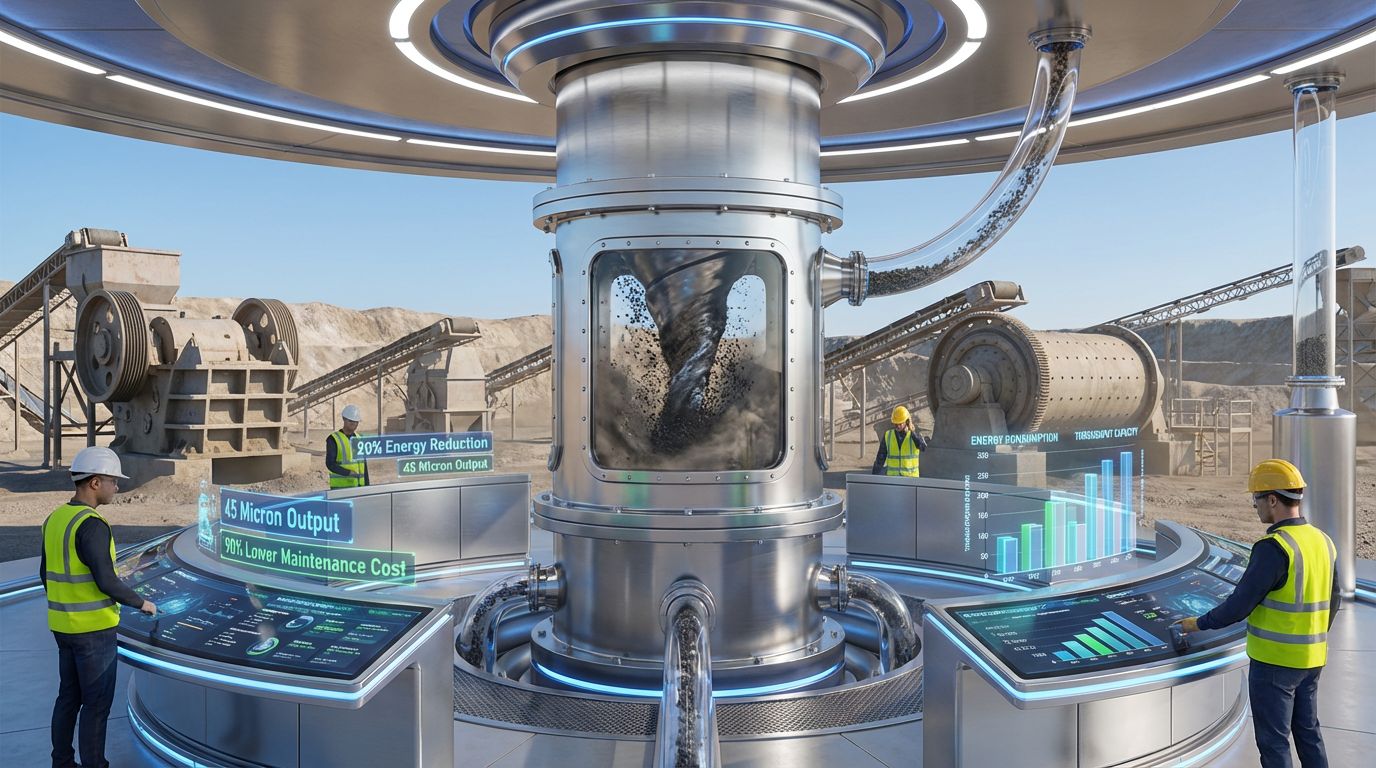
The mineral processing industry stands at the threshold of a technological transformation that challenges fundamental assumptions about rock breakage and particle size reduction. Traditional comminution approaches, which have dominated mining operations for over a century, rely on multi-stage crushing sequences followed by grinding mills that consume massive amounts of energy while producing inconsistent results. Advanced vertical attrition systems represent a paradigm shift toward single-pass processing that exploits natural material properties rather than overwhelming them with brute force. The Powermaster rock grinding technology exemplifies this revolutionary approach to mineral processing.
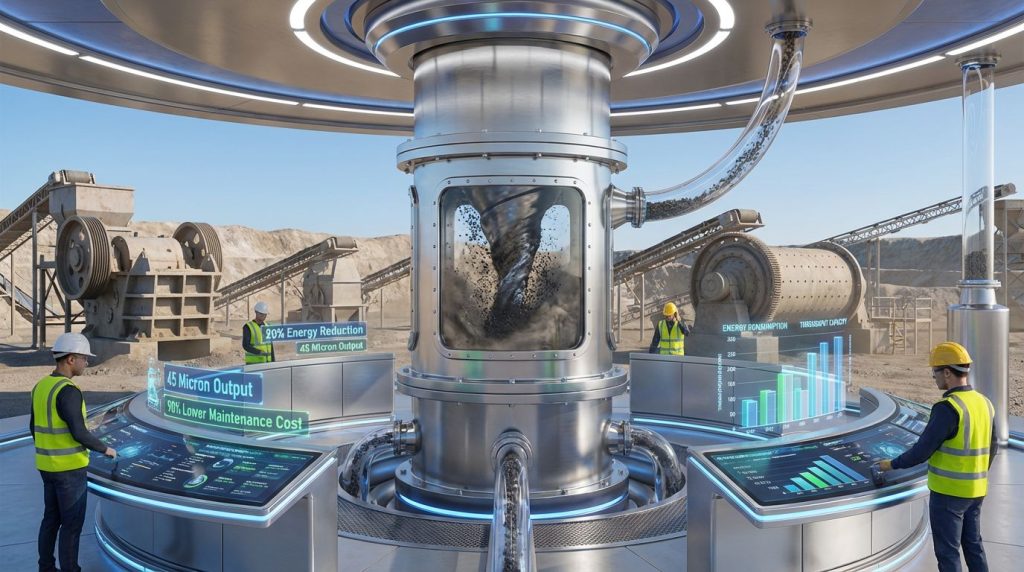
Modern high-efficiency rock processing technology centres on the principle of matter-on-matter grinding, where feed materials serve as their own grinding medium within a controlled high-velocity environment. This approach eliminates the need for steel balls or rods traditionally used in grinding mills, reducing mechanical wear while achieving superior particle size distribution. Furthermore, the industry trends innovation demonstrates how advanced processing systems align with sector-wide modernisation efforts. The technology operates through precise vortex generation that creates micro-collisions along natural fracture planes in rock structures, resulting in more efficient breakage patterns and reduced energy consumption.
Key Performance Characteristics:
• Feed size acceptance up to 24 inches in diameter
• Target output consistently achieving 45-micron particle sizes
• Processing rates demonstrating 300 tons per hour throughput capacity
• Energy efficiency improvements exceeding 20% compared to conventional systems
• Water consumption reduced to minimal levels through dry processing capabilities
The fundamental difference between traditional ball mill operations and vertical attrition systems lies in particle breakage mechanisms. Conventional grinding relies on impact and abrasion forces applied externally to the material, often creating inefficient energy transfer and uneven particle size distributions. Advanced vertical systems generate controlled vortex patterns that cause materials to fracture along their weakest structural points, maximising the effectiveness of applied energy while minimising waste heat generation.
The Critical Role of Energy Management in Mineral Processing
Energy consumption represents the single largest operational expense category for most mining operations, with comminution processes typically accounting for 50 to 70 percent of total site-level electricity demand. This energy intensity stems from the fundamental physics of rock breakage, where enormous forces must be applied to overcome molecular bonds and create new surface area through particle size reduction. Traditional processing circuits compound this challenge by requiring multiple energy inputs across sequential crushing and grinding stages.
The economic implications of comminution energy consumption extend far beyond immediate electricity costs. Peak power demand during grinding operations can strain electrical grid infrastructure, particularly at remote mining sites where power generation capacity is limited and expensive. Additionally, energy-intensive operations face increasing regulatory pressure regarding carbon emissions, with many jurisdictions implementing carbon pricing mechanisms that directly impact operational profitability.
Financial Impact Analysis:
| Cost Category | Traditional Systems | Advanced Single-Pass | Reduction |
|---|---|---|---|
| Energy consumption | Baseline 100% | 80% or less | 20%+ savings |
| Maintenance expenses | High frequency | Minimal requirements | 90% reduction |
| Water treatment costs | Substantial | Nearly eliminated | 95%+ savings |
| Equipment footprint | Large multi-stage | Compact single unit | 60%+ space savings |
Mining companies operating in regions with high electricity costs or unstable power supplies face additional operational risks that energy-efficient processing technologies can mitigate. Australia's mining sector, for example, has experienced electricity price increases of over 80% in the past decade, making energy efficiency improvements critically important for maintaining competitiveness in global commodity markets.
The environmental dimension of energy consumption in mining operations has become increasingly significant as stakeholder pressure and regulatory requirements intensify. Carbon footprint reduction initiatives often focus on comminution optimisation because of the sector's substantial contribution to overall emissions. Furthermore, energy transition trends indicate that sustainable processing methods will become mandatory rather than optional. Companies implementing energy-efficient processing technologies can achieve measurable progress toward sustainability goals while improving operational economics simultaneously.
Technical Advantages of Matter-on-Matter Grinding Mechanisms
Vertical attrition systems fundamentally alter the physics of particle breakage by creating controlled collision environments where materials fracture themselves rather than being crushed by external media. This approach generates high-velocity vertical vortex patterns that accelerate particles to optimal collision velocities while maintaining precise control over impact angles and frequency. The result is more efficient energy transfer and superior liberation characteristics compared to conventional grinding methods.
The elimination of steel grinding media produces multiple operational benefits beyond reduced metal contamination. Grinding ball consumption in traditional mills can cost mining operations $2-5 per ton of processed ore, representing substantial ongoing expenses that vertical attrition systems eliminate entirely. Additionally, the absence of steel media reduces noise generation significantly, improving workplace safety conditions and reducing sound mitigation requirements.
Technical Performance Specifications:
• Particle breakage efficiency: 80% of feed material achieving target size specifications
• Processing consistency: Maintained throughput under varying feed hardness conditions
• Contamination elimination: Zero metallic contamination from grinding media
• Noise reduction: Operating decibel levels substantially below conventional mill standards
• Wear resistance: Machine surface protection through controlled particle interaction
The vortex generation mechanism in advanced vertical systems creates unique fluid dynamics that optimise particle interaction patterns. Unlike ball mills where collision energy dissipates randomly, controlled vortex environments direct kinetic energy precisely to maximise fracture effectiveness. This targeted energy application results in more uniform particle size distributions and improved mineral liberation characteristics essential for downstream processing efficiency.
Material hardness variations present significant challenges for conventional grinding circuits, often requiring adjustment of steel media ratios, mill speeds, or processing times to maintain consistent output quality. Vertical attrition systems demonstrate superior adaptability to feed hardness changes because the matter-on-matter grinding mechanism automatically adjusts collision intensity based on material properties, maintaining consistent performance across diverse ore types. The Powermaster rock grinding technology demonstrates this adaptability across various ore hardness conditions.
Comparative Analysis: Single-Pass versus Multi-Stage Processing
Traditional mineral processing operations typically require four to six distinct comminution stages, each demanding separate equipment installations, power supplies, and maintenance protocols. Primary crushers reduce run-of-mine material from several feet to approximately 8-10 inches, secondary crushers further reduce particles to 2-3 inches, tertiary crushers achieve sub-inch sizes, and grinding mills complete the process to final liberation sizes. This sequential approach creates multiple failure points, energy losses between stages, and complex material handling requirements.
Single-pass processing consolidates these operations into one continuous system, eliminating interstage material handling, reducing equipment complexity, and minimising energy losses between processing steps. The integration of multiple comminution functions reduces capital equipment requirements by 40-60% while simplifying operational procedures and maintenance scheduling. This consolidation particularly benefits smaller mining operations where space constraints and capital limitations make traditional multi-stage systems impractical.
Operational Efficiency Comparison:
Maintenance Requirements: Traditional systems require scheduled maintenance across multiple equipment pieces with different service intervals, creating complex scheduling challenges and higher parts inventory requirements. Single-pass systems reduce maintenance touchpoints by 90%, simplifying operations and reducing downtime risk.
The space efficiency advantages of single-pass systems extend beyond immediate equipment footprint considerations. Traditional processing circuits require substantial infrastructure for material conveying, intermediate storage, dust collection, and safety systems around each crushing stage. Consolidated processing reduces total facility construction costs by 30-50% through simplified building requirements, reduced structural steel needs, and streamlined utility distribution.
Processing flexibility represents another significant advantage of single-pass systems over conventional multi-stage approaches. Traditional circuits often require extensive reconfiguration when processing different ore types or adjusting product specifications, involving changes to crusher settings, screen sizes, and mill parameters across multiple stages. However, data-driven mining operations enable more sophisticated control systems that can optimise single-pass processing parameters automatically. Advanced single-pass systems accommodate feed variability and product specification changes through centralised control adjustments, improving operational responsiveness and reducing transition times.
Material Processing Capabilities and Applications
The versatility of advanced grinding systems extends across diverse material categories, from hard igneous rocks to complex polymetallic ores and industrial waste streams. Testing results demonstrate consistent processing performance across materials ranging from 3-4 Mohs hardness up to 7-8 Mohs hardness, indicating broad applicability across most mining operations. This material flexibility eliminates the need for ore-specific equipment configurations that traditional systems often require.
Processing Performance by Material Type:
• Granite processing: Achieving 45-micron output from 24-inch feed in single pass
• Porphyry copper ores: Maintaining throughput while improving liberation characteristics
• Complex polymetallic ores: Processing mixed sulfide/oxide assemblages effectively
• Construction waste concrete: Breaking reinforced concrete to aggregate specifications
• Quartzite and siliceous materials: Handling highly abrasive feeds without excessive wear
The matter-on-matter grinding mechanism proves particularly effective with materials exhibiting natural fracture planes or crystal boundaries that conventional crushing often fails to exploit efficiently. Metamorphic rocks, for instance, often contain foliation planes that vertical attrition systems can utilise for more efficient breakage, reducing energy consumption while improving particle shape characteristics important for downstream processing or construction applications.
Industrial mineral processing represents a growing application area where product quality specifications often exceed those required for base metal operations. Advanced grinding systems can achieve precise particle size distributions essential for ceramic, glass, and chemical industry applications where conventional grinding produces excessive fines or irregular particle shapes. The elimination of metal contamination proves critical for high-purity industrial mineral production, where trace metal content can disqualify products from premium market segments.
Recycling and urban mining applications benefit significantly from the feed flexibility that advanced grinding systems provide. Construction and demolition waste typically contains mixed materials including concrete, steel reinforcement, brick, and ceramic components that challenge conventional processing equipment. Single-pass systems can handle this material diversity while producing clean aggregate outputs suitable for new construction applications, supporting circular economy initiatives and reducing landfill disposal requirements.
Water Conservation and Dry Processing Benefits
Water scarcity increasingly constrains mining operations worldwide, with many projects facing regulatory restrictions, community opposition, or simple physical unavailability of adequate water supplies. Traditional wet grinding and flotation circuits typically consume 1-4 cubic metres of water per ton of processed ore, creating substantial operational costs and environmental liabilities. Dry processing eliminates 80-95% of process water requirements, providing operational flexibility in water-constrained regions while reducing environmental impact.
The elimination of slurry transport systems reduces infrastructure complexity and maintenance requirements significantly. Wet processing circuits require extensive pumping systems, pipeline networks, and slurry storage facilities that are subject to erosion, corrosion, and plugging problems. Dry systems reduce pumping energy consumption by eliminating slurry transport requirements, contributing additional energy savings beyond the primary grinding efficiency improvements.
Water Impact Comparison:
| Process Stage | Wet Processing | Dry Processing | Water Savings |
|---|---|---|---|
| Material transport | 500-800 L/ton | 0 L/ton | 100% |
| Dust suppression | 50-100 L/ton | 10-20 L/ton | 80% |
| Equipment cleaning | 100-200 L/ton | 20-50 L/ton | 75% |
| Process cooling | 200-300 L/ton | 0 L/ton | 100% |
Wastewater treatment represents a major expense and regulatory compliance challenge for traditional mining operations. Process water typically contains suspended solids, chemical additives, and dissolved metals that require expensive treatment before discharge or recycling. Dry processing systems eliminate most wastewater generation, reducing treatment costs and regulatory compliance risks while improving overall environmental performance.
Desert and arid region mining operations face particular water supply challenges that dry processing can address effectively. Many copper and gold mines in Nevada, Chile, and Australia operate in regions where water acquisition costs exceed $3-8 per cubic metre, making dry processing economically attractive regardless of other performance benefits. Additionally, reduced water usage minimises conflicts with local communities and agricultural users competing for scarce water resources. The integration of renewable energy in mining with water-efficient processing creates synergistic environmental benefits.
Economic Impact Assessment for Mining Operations
The financial implications of advanced comminution technology extend across multiple cost categories, from immediate energy savings to long-term maintenance cost reductions and capital efficiency improvements. Energy cost savings of 20-30% can reduce operating expenses by $2-6 per ton of processed material, depending on local electricity rates and processing throughput volumes. These savings compound over mine life, creating substantial net present value improvements for long-term operations.
Capital expenditure analysis reveals significant advantages for single-pass systems compared to traditional multi-stage installations. Equipment acquisition costs for integrated systems typically run 15-25% below equivalent multi-stage configurations when accounting for all crushing, grinding, and material handling components. Additionally, reduced infrastructure requirements lower construction costs and accelerate project development timelines, improving overall project economics.
Return on Investment Analysis:
Payback Period Calculations: Based on demonstrated performance improvements, mining operations processing 1,000 tons per day can achieve payback periods of 18-36 months for advanced grinding system investments, depending on site-specific energy costs and maintenance savings realisation.
Labour cost implications vary by operation but generally favour simplified single-pass systems that require fewer operators and less specialised maintenance expertise. Traditional multi-stage circuits often require 3-5 operators per shift, while integrated systems can operate effectively with 1-2 operators, reducing ongoing labour expenses and simplifying workforce management. Additionally, reduced equipment complexity lowers training requirements and improves operational safety through fewer moving parts and hazard points.
The economic benefits of improved product quality often exceed direct processing cost savings, particularly for operations producing industrial minerals or construction aggregates. Better particle size control and improved liberation characteristics can increase product sales prices by 10-20% in premium market segments, while reduced metal contamination opens access to high-purity applications with substantial price premiums.
Technology Evaluation Frameworks in Major Mining Companies
Large mining corporations employ sophisticated technology assessment protocols that emphasise risk mitigation, performance validation, and integration compatibility over purely economic considerations. Demonstration plant testing typically requires 6-12 months of continuous operation under varying conditions to establish performance consistency and identify potential operational challenges. This extended validation process reflects the industry's conservative approach to technology adoption and the high costs associated with production disruptions.
Technology transfer considerations play crucial roles in evaluation processes, particularly regarding intellectual property protection, vendor support capabilities, and long-term technology development roadmaps. Mining companies increasingly require technology vendors to demonstrate comprehensive service networks and spare parts availability before committing to major equipment purchases, reflecting lessons learned from past experiences with specialised equipment lacking adequate support infrastructure.
Evaluation Criteria Framework:
• Performance validation: Minimum 90% uptime demonstration over 6-month periods
• Integration compatibility: Seamless interface with existing downstream processing circuits
• Risk assessment: Comprehensive failure mode analysis and mitigation strategies
• Economic justification: Internal rate of return exceeding corporate hurdle rates
• Vendor stability: Financial strength and long-term technology support commitments
The demonstration process often involves third-party verification through consulting firms or research institutions to provide independent performance validation. Engineering consulting firms specialising in mineral processing frequently conduct detailed audits of new technology performance, providing objective assessments that support internal decision-making processes. This independent validation proves particularly important for publicly traded companies where technology investment decisions require board-level approval and shareholder scrutiny.
Regulatory compliance evaluation has become increasingly important as environmental regulations tighten and community expectations regarding mining operations evolve. New processing technologies must demonstrate compliance with noise, dust, water usage, and emissions standards across multiple jurisdictions where mining companies operate. The complexity of multi-jurisdictional compliance creates preference for technologies that consistently meet or exceed regulatory requirements regardless of local variations.
Implementation Challenges and Market Adoption Barriers
Conservative industry culture presents the most significant barrier to advanced grinding technology adoption, stemming from decades of experience with proven conventional systems and high costs associated with production disruptions. Mining industry technology adoption cycles typically span 15-25 years from initial development to widespread implementation, reflecting the sector's risk-averse approach to operational changes. This conservatism intensifies during commodity price downturns when companies defer non-essential investments and focus on operational optimisation of existing systems.
Technical integration challenges arise from the need to interface new grinding systems with existing downstream processing circuits designed around traditional comminution outputs. Particle size distributions, surface area characteristics, and liberation patterns from advanced systems may require adjustments to flotation, leaching, or magnetic separation processes to optimise overall circuit performance. These integration requirements often necessitate pilot plant testing and process optimisation that extend implementation timelines and increase costs.
Market Adoption Timeline:
| Phase | Duration | Key Activities | Success Factors |
|---|---|---|---|
| Technology demonstration | 2-3 years | Performance validation | Consistent results |
| Early adopter trials | 3-5 years | Commercial installations | Economic benefits |
| Market expansion | 5-8 years | Widespread adoption | Vendor support network |
| Industry standard | 8-12 years | Dominant market position | Cost competitiveness |
Workforce adaptation requirements create additional implementation barriers, particularly regarding operator training and maintenance skill development. Advanced grinding systems require different operational expertise than traditional crushing circuits, necessitating comprehensive training programs and potentially higher wage rates for specialised operators. Mining companies often struggle to attract and retain qualified personnel, making technology transitions that require significant retraining particularly challenging.
Financing considerations influence adoption decisions, especially for smaller mining companies with limited access to capital. Advanced grinding systems require substantial upfront investments that may strain cash flows despite attractive long-term economic returns. Traditional financing sources often prefer proven technologies with established performance track records, creating challenges for innovative equipment vendors seeking to expand market penetration.
Future Evolution of Comminution Technology
Industry transformation indicators suggest accelerating adoption of energy-efficient processing technologies driven by rising energy costs, stricter environmental regulations, and declining ore grades requiring finer grinding. Global mining industry energy costs have increased 40-60% over the past decade, creating strong economic incentives for efficiency improvements. Simultaneously, environmental regulations increasingly focus on energy consumption and carbon emissions, making efficiency a compliance requirement rather than merely an economic optimisation.
Declining ore grades worldwide necessitate finer grinding to achieve adequate mineral liberation, favouring advanced technologies that can achieve ultrafine particle sizes efficiently. Average copper ore grades have declined from 2.5% to 0.6% over the past century, requiring more sophisticated processing to maintain economic viability. This trend toward lower grades and more complex mineralogy creates opportunities for processing technologies that excel at fine grinding and liberation optimisation.
Technology Development Trajectories:
• Artificial intelligence integration: Predictive control systems optimising processing parameters in real-time
• Advanced materials science: Wear-resistant component materials extending equipment life substantially
• Process intensification: Higher throughput densities reducing equipment footprint requirements
• Digitalisation convergence: Remote monitoring and autonomous operation capabilities
• Sustainability optimisation: Closed-loop systems minimising waste generation and resource consumption
Market adoption projections suggest significant acceleration in advanced grinding technology implementation over the next decade. Industry analysts project 25-40% market penetration by 2035, driven primarily by economic advantages in high-energy-cost regions and regulatory pressure in environmentally sensitive areas. This adoption rate would represent unprecedented speed for mining industry technology transitions, reflecting the compelling economic and environmental benefits of advanced systems.
The competitive landscape continues evolving as traditional equipment manufacturers develop competing technologies while new entrants focus on innovative approaches. Patent activity in advanced comminution has increased 300% over the past five years, indicating substantial research and development investment across the industry. This innovation surge suggests continued technological advancement and cost reduction that will accelerate market adoption and improve performance characteristics.
Revolutionary Processing Technology Demonstrations
Recent technological demonstrations have validated the potential for Powermaster rock grinding technology to transform traditional mineral processing operations. These field trials demonstrate how single-pass systems can achieve superior performance metrics while reducing operational complexity and environmental impact.
The mining industry has witnessed extraordinary developments in processing technology, with companies like Powermaster Corporation leading the charge toward more efficient and sustainable operations. Their breakthrough approach to matter-on-matter grinding represents a fundamental shift away from conventional multi-stage processing circuits.
Site-specific applications have shown that Powermaster rock grinding technology can process diverse ore types while maintaining consistent throughput and product quality standards. These practical demonstrations provide the evidence mining companies require before committing to major technology investments.
Environmental Remediation Applications
The application of advanced grinding technology extends beyond primary ore processing to include environmental remediation projects. Mine reclamation innovation increasingly incorporates efficient processing systems to handle legacy waste materials and contaminated soils. This dual-purpose approach maximises technology utilisation while addressing environmental liabilities.
Processing of mine tailings and waste rock using advanced grinding systems can recover valuable minerals while reducing environmental footprint. Single-pass systems prove particularly effective for reprocessing historical tailings, where conventional methods often prove uneconomical due to low grade and challenging material characteristics.
The environmental benefits compound when considering the reduced water consumption, eliminated steel media contamination, and improved energy efficiency of advanced processing systems. These characteristics align with increasingly stringent environmental regulations and community expectations for sustainable mining practices.
Industry Transformation: The convergence of economic pressure, environmental regulation, and technological capability creates unprecedented opportunity for fundamental changes in mineral processing approaches, with energy-efficient grinding technologies positioned to capture substantial market share over the coming decade.
Ready to Capitalise on the Next Major Mining Technology Breakthrough?
Discovery Alert's proprietary Discovery IQ model delivers real-time notifications on significant ASX mineral discoveries and revolutionary mining technology developments, instantly empowering subscribers to identify actionable opportunities ahead of the broader market. Explore Discovery Alert's discoveries page to understand how major breakthroughs in mining technology and mineral discoveries can generate substantial returns, then begin your 30-day free trial to position yourself at the forefront of mining industry transformation.