August 26, 2026
The West Built the Gold Market. The East Is Rebuilding It From Scratch.
For roughly two centuries, the architecture of global gold trading has rested on three pillars: London's over-the-counter bullion market, New York's COMEX futures exchange, and Switzerland's refining and vault network. These Western institutions did not merely facilitate gold trading; they defined what gold trading meant at an institutional level. Price discovery, settlement conventions, custodial standards, and contract specifications all flowed outward from this Anglo-American-Swiss axis.
That arrangement is now facing its most serious structural challenge in modern financial history. Not from a single policy decision or geopolitical event, but from a deliberate, multi-year accumulation of physical infrastructure, regulatory frameworks, and market incentives concentrated in Asia. The Hong Kong gold futures physical delivery record set on August 19, 2026 is one data point in that broader story, but it is a revealing one.
When big ASX news breaks, our subscribers know first
What the Numbers Actually Show
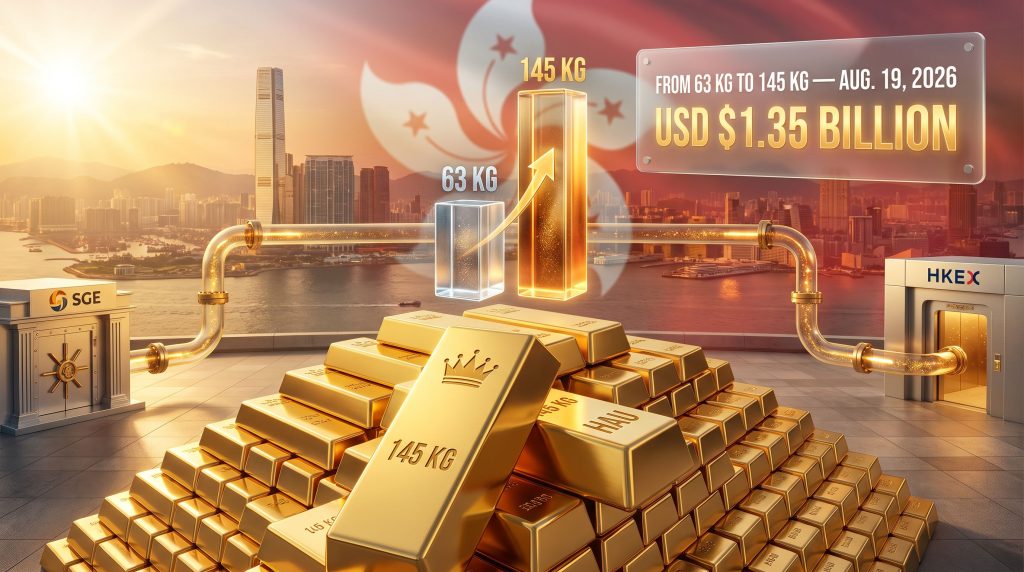
On August 19, 2026, Hong Kong Exchanges and Clearing (HKEX) physically delivered 145 kilograms (319.67 pounds) of gold through its USD-denominated gold futures contract. That figure more than doubled the previous all-time record of 63 kg, which was set in December 2018, the same year the contract originally launched. Furthermore, according to reporting from the South China Morning Post, US sanctions reshaping trade flows have played a significant role in accelerating this shift.
| Metric | Figure |
|---|---|
| Record single-day physical delivery (Aug. 19, 2026) | 145 kg (319.67 lbs) |
| Previous record (December 2018) | 63 kg |
| Increase over prior record | Approximately +130% |
| USD Gold Futures Contract launch year | 2018 |
| Average daily trading volume (July 6 to Aug. 19, 2026) | 9,974 contracts |
| Total trading value over the same period | USD $1.35 billion |
| Contracts traded on July 6, 2026 (day policies activated) | 4,286 |
| Contracts traded the day before policy activation | 0 |
The contrast between zero contracts one day and 4,286 the next is not a coincidence. It reflects the direct impact of structural policy changes HKEX implemented on July 6, 2026, specifically designed to revitalise a contract that had sat effectively dormant.
The 145 kg single-day delivery milestone is not merely a volume statistic. It is operational proof that Hong Kong's gold infrastructure can process real bullion settlement at scale, which is a prerequisite any market must satisfy before it can credibly position itself as a global trading hub.
Three Policy Levers That Restarted a Dormant Market
The July 6 revitalisation framework introduced three interlocking mechanisms that together produced a rapid market response:
Fee Waivers as an Entry-Cost Catalyst
HKEX suspended its standard $1-per-contract-per-side trading fee through June 30, 2027. While one dollar per side may sound trivial, at institutional trading volumes this cost accumulates significantly and creates friction that discourages participation in lower-liquidity environments. Removing it entirely flattened the barrier to entry for new participants testing the contract.
Designated Liquidity Provider Programmes
Structured incentives were introduced for approved liquidity providers to maintain continuous bid-ask spreads. This directly addresses the self-reinforcing problem that plagues inactive contracts: low volume discourages market makers, which widens spreads, which further discourages volume. By compensating liquidity providers to stay active regardless of organic flow, HKEX broke that cycle.
Active Trader Reward Structures
Volume-based incentive tiers were established to attract both institutional and high-frequency participants. The combination of all three mechanisms produced a compounding effect: fee elimination attracted initial participants, liquidity provider programmes ensured prices were available to trade against, and volume incentives rewarded those who committed meaningful size.
HKEX acknowledged that the contract had been inactive for a period and stated that the incentive programmes were designed to support initial liquidity as a foundation for longer-term market development. For those seeking to understand the mechanics of physical delivery for gold futures, HKEX provides detailed documentation on eligibility requirements and settlement procedures.
The unanswered question, and the one most relevant to long-term market watchers, is what trading volume looks like after June 2027 when the fee waivers expire. Organic, self-sustaining liquidity beyond the incentive window will be the real indicator of whether Hong Kong's gold futures market has genuine institutional traction.
How Hong Kong's Clearing System Compares to the LBMA Model
One day after the revitalised futures contract launched, Hong Kong began trial operations of a new government-owned gold clearing and settlement system operated by the Hong Kong Precious Metals Central Clearing Company. The system was designed to replicate the core financial infrastructure functions performed by the London Bullion Market Association (LBMA). In addition, understanding how the LBMA and COMEX gold markets currently operate provides essential context for appreciating the scale of this challenge.
| Feature | LBMA (London) | HKEX / HK Clearing System |
|---|---|---|
| Settlement model | OTC, loco London | OTC + futures-linked physical delivery |
| Benchmark price | LBMA Gold Price (AM/PM fix) | HAU ticker (newly introduced) |
| Vault geography | London-centric | Hong Kong + SGE-linked vaults |
| Physical delivery | Limited futures delivery | Actively incentivised |
| Cross-market connectivity | Global correspondent banking | SGE Delivery Connect partnership |
The critical addition within Hong Kong's clearing architecture is a new gold price reference ticker designated HAU, intended to give global market participants direct access to Hong Kong-denominated gold pricing. This positions HAU as a direct challenger to both the LBMA's twice-daily fix and COMEX's settlement prices as reference benchmarks.
It is worth understanding what this actually means in practice. The LBMA Gold Price functions as the reference rate for an enormous portion of global gold contracts, ETF valuations, central bank transactions, and physical supply agreements. Any competing benchmark that achieves meaningful institutional adoption would redistribute pricing authority in a way that has not occurred since the modern London fix system was established. The HAU ticker is currently nascent, but the intent behind it is unambiguous.
The Shanghai Gold Exchange Partnership: A Seamless Asian Corridor
Perhaps the most technically significant element of Hong Kong's evolving gold infrastructure is its operational linkage with the Shanghai Gold Exchange (SGE), the world's largest physical gold exchange by volume. This development is closely tied to China's gold market dominance, which has been building steadily over the past decade.
The mechanism, called Delivery Connect, enables gold stored in HKEX-approved Hong Kong vaults to be transferred directly into the SGE system, and vice versa. Once metal enters either system, it qualifies for settlement without requiring re-assaying or independent physical shipment between jurisdictions. This eliminates one of the most significant friction costs in cross-border bullion settlement.
The practical implications are substantial:
- Institutional investors can access both Hong Kong and mainland Chinese gold liquidity through a unified settlement corridor
- Physical gold does not need to physically move between jurisdictions to change ownership or settlement eligibility
- Warehousing, delivery facilitation, and financial connectivity are covered under the cooperation agreement
- Western custodians and correspondent banks are bypassed entirely for intra-Asian transactions
The SGE-HKEX Delivery Connect linkage is operationally significant because it combines the world's largest physical gold exchange with Hong Kong's internationally accessible, USD-denominated financial infrastructure. The result is a unified Asian gold liquidity corridor that did not exist five years ago.
For context, the SGE settled approximately 1.7 trillion yuan (roughly $235 billion USD) in gold transactions in 2023 alone, according to SGE data. Connecting that volume base to Hong Kong's futures and clearing infrastructure creates a gravitational pull that is difficult to ignore for international participants seeking physical gold exposure in Asia.
Vault Capacity: The Infrastructure Prerequisite No One Talks About
Trading volumes and clearing systems mean little without physical storage infrastructure capable of absorbing institutional-scale gold flows. Hong Kong officials have announced plans to expand the region's gold storage capacity from approximately 200 tonnes to more than 2,000 tonnes within three years, representing a tenfold increase. However, London vault gold reserves currently dwarf these figures, underscoring how significant the gap remains.
| Metric | Current | Target | Timeline |
|---|---|---|---|
| Gold storage capacity | ~200 tonnes | 2,000+ tonnes | Within 3 years (by ~2029) |
| Capacity growth factor | Baseline | 10x increase | Multi-year buildout |
For perspective, Switzerland's gold vaulting infrastructure is estimated to hold several thousand tonnes across private and central bank custodial facilities, making it the global standard for bullion storage depth. London's network of LBMA-approved vaults holds an estimated 8,000 to 9,000 tonnes including central bank deposits.
Hong Kong's 2,000-tonne target does not immediately challenge those numbers, but it crosses a critical threshold: sufficient physical depth to support meaningful futures contract delivery without the risk of squeeze dynamics that can destabilise smaller markets. The expansion also signals that the infrastructure development is a long-term institutional commitment rather than a short-term promotional exercise.
The next major ASX story will hit our subscribers first
A Multi-Dimensional Assessment of Hong Kong's Hub Ambitions
Evaluating whether Hong Kong can genuinely challenge Western gold market dominance requires looking across four distinct dimensions simultaneously:
Pillar 1: Price Discovery Authority
The HAU ticker is newly introduced and lacks the historical depth and institutional adoption that gives the LBMA fix its authority. Building benchmark credibility takes years of consistent use by major participants. The intent is clear; execution is the challenge.
Pillar 2: Physical Settlement Capability
The Hong Kong gold futures physical delivery record demonstrates operational readiness at current scale. The vault expansion to 2,000+ tonnes is the critical test of whether the system can absorb large-scale institutional demand without structural strain.
Pillar 3: Regulatory and Institutional Framework
Government-owned clearing infrastructure and the SGE partnership provide institutional credibility that private-sector initiatives alone could not achieve. The framework mirrors Western models while embedding Asian market connectivity. Consequently, central bank gold trends are increasingly aligned with this eastward shift in gold infrastructure.
Pillar 4: Market Liquidity and Participation
Average daily volume of 9,974 contracts and $1.35 billion in total trading value over approximately six weeks indicates genuine market interest. Whether that interest persists after incentive programmes expire in mid-2027 will determine whether Hong Kong has built a sustainable market or merely a well-promoted one.
Three Scenarios for the Global Gold Market's Future Structure
| Scenario | Description | Key Driver |
|---|---|---|
| Gradual Multipolar Market | Hong Kong and SGE grow as regional hubs alongside, not replacing, London and New York | Most probable near-term trajectory |
| Accelerated Eastern Pivot | Geopolitical escalation drives rapid institutional migration to Asian settlement systems | Dependent on macro-political triggers |
| Fragmented Dual-Track System | A USD-based Western market and a CNY/HKD-linked Eastern market operate in parallel | Possible if currency bifurcation deepens |
The most likely near-term outcome is a gradual multipolar arrangement. London and New York's institutional depth, correspondent banking relationships, and decades of market precedent create enormous inertia. Displacement is not a near-term prospect. What is already happening, however, is the construction of a parallel system capable of handling an increasing proportion of global gold flows independently of Western infrastructure.
That distinction matters for investors. A multipolar gold market means pricing may eventually reflect supply and demand dynamics originating in Asia more directly than current Western-dominated benchmarks capture. Furthermore, gold and the monetary shift driven by China's expanding role suggests this trend carries deep structural momentum. It also means physical gold settlement outside the LBMA/COMEX framework becomes a realistic operational choice, not a theoretical one.
Frequently Asked Questions
What is the HKEX USD Gold Futures Contract?
A dollar-denominated gold futures product listed on Hong Kong Exchanges and Clearing, originally launched in 2018 and revitalised in July 2026 with new liquidity incentives and physical delivery mechanisms after a period of inactivity.
What does physical delivery mean in gold futures markets?
Physical delivery refers to the actual transfer of gold bullion to satisfy a futures contract obligation, as opposed to cash settlement. Markets that support and incentivise physical delivery are considered more operationally credible for participants who need real metal, including refiners, central banks, and large institutional buyers.
What is the HAU gold price ticker?
HAU is a new gold price reference introduced by Hong Kong's Precious Metals Central Clearing Company, designed to provide a Hong Kong-based benchmark accessible to global market participants. It is analogous in ambition to the LBMA's AM/PM fix, though currently in early-stage adoption.
Why does the SGE partnership matter for gold investors?
The Shanghai Gold Exchange is the world's largest physical gold exchange. Its operational integration with Hong Kong's clearing system creates a seamless cross-border settlement corridor that reduces friction for participants seeking physical gold exposure outside Western custodial systems.
What happens to the HKEX gold futures market after the fee waivers expire in June 2027?
This is the central open question. Post-incentive trading volume will be the clearest indicator of whether the revitalisation has generated genuine organic liquidity or remains dependent on artificial cost advantages.
Key Takeaways
- The Hong Kong gold futures physical delivery record of 145 kg on August 19, 2026 is more than double the previous peak of 63 kg set in December 2018
- Three structural policy levers (fee waivers, liquidity provider programmes, and active trader incentives) transformed a contract with zero daily volume into one averaging 9,974 contracts per day within six weeks
- The HAU price ticker represents Asia's most direct institutional challenge yet to London's LBMA gold price benchmark authority
- The SGE Delivery Connect partnership creates a unified Asian physical gold corridor eliminating re-assaying and independent shipment requirements between Hong Kong and mainland China
- A planned tenfold expansion in vault capacity from 200 to 2,000+ tonnes signals long-term institutional commitment to physical gold settlement
- The broader trajectory points toward a gradually multipolar global gold market, with Asia building independent infrastructure capable of handling increasing proportions of global bullion flows without reliance on Western settlement systems
This article is for informational purposes only and does not constitute financial or investment advice. Data regarding trading volumes, delivery records, and infrastructure plans is drawn from publicly available HKEX announcements and market reporting as of August 2026. Forecasts and scenario analyses represent analytical frameworks, not predictions of future outcomes. Investors should conduct independent due diligence before making any investment decisions.
Want to Invest in the Commodities Driving the Next Major Market Shift?
As gold market infrastructure reshapes itself across Asia, real-time intelligence on significant mineral discoveries becomes more valuable than ever — and Discovery Alert's proprietary Discovery IQ model delivers instant ASX alerts, turning complex commodity data into actionable insights for investors at every level. Explore how historic mineral discoveries have generated substantial returns and begin your 14-day free trial today to position yourself ahead of the market.