
August 10, 2026
Why Retail Investor Forums Have Become a Real-Time Market Intelligence Layer
The psychology of crowd behaviour has always shaped financial markets, but in the age of digital forums and real-time information sharing, its influence has become measurably faster and more concentrated. Australia's HotCopper platform, which attracts more than 600,000 average monthly users, represents one of the most powerful retail investor feedback loops in the Asia-Pacific equities space. Understanding what drives discussion on that platform on any given trading day has become, for many active traders, just as important as reading broker research.
Monday sessions in particular carry a distinct psychological character. After a weekend of reflection, research, and forum browsing, retail investors arrive at Monday's open with pre-formed conviction. When that conviction meets a verified corporate catalyst, the resulting price action can be dramatic, and that is exactly what played out on the ASX on 10 August 2026.
Monday's HotCopper trends Basin Energy BetMakers Technology Group Wide Open Agriculture featured three companies generating outsized retail attention: Basin Energy (ASX: BSN), BetMakers Technology Group (ASX: BET), and Wide Open Agriculture (ASX: WOA). Each move was anchored to a distinct catalyst type, and dissecting those catalysts reveals as much about investor psychology as it does about company fundamentals.
When big ASX news breaks, our subscribers know first
Basin Energy (ASX: BSN): Decoding the Rare Earth Drilling Catalyst
What Makes MREO Mineralisation Strategically Significant?
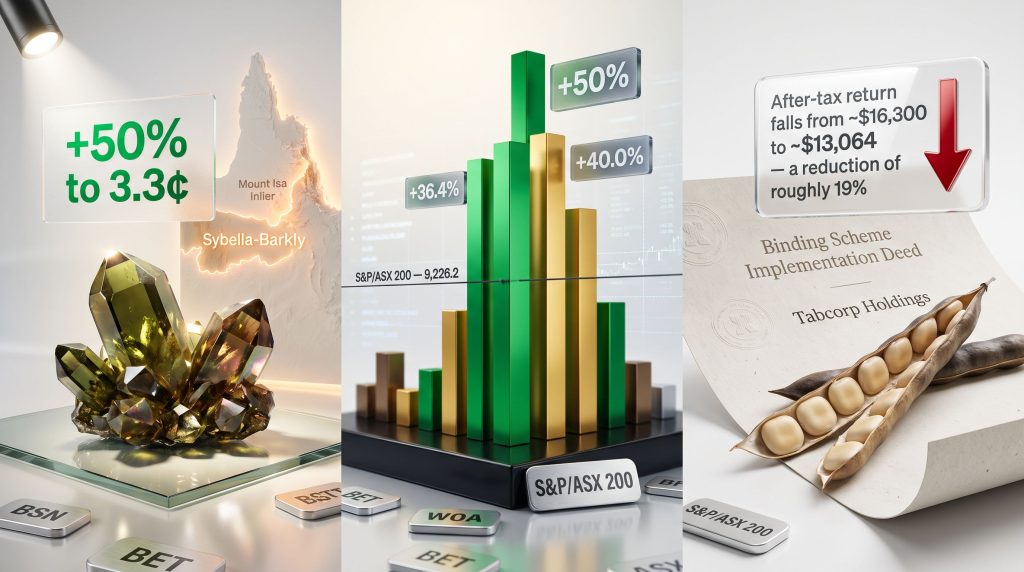
Not all rare earth discoveries attract the same level of investor attention. The distinction between magnet rare earth oxides (MREOs) and other rare earth compounds is critical to understanding why Basin Energy's Newmans project in northwest Queensland generated a 50% single-session price surge to 3.3 cents per share.
MREOs are the specific rare earth compounds used in the manufacture of permanent magnets, the components that sit at the heart of electric vehicle motors, offshore wind turbine generators, and precision defence systems. The strategic importance of rare earths cannot be overstated, particularly within the MREO category, where heavy rare earth oxides (HREOs) such as dysprosium and terbium command a particular premium because they enhance the thermal stability of permanent magnets. This scarcity-and-application combination is what separates HREO-bearing deposits from the far more common light rare earth oxide (LREO) discoveries that dominate most exploration pipelines.
Basin Energy's Newmans discovery carries both MREO and HREO mineralisation, a combination that places it in a comparatively rare category of early-stage exploration projects from a strategic materials standpoint.
Shallow Geometry and Corridor Scale: What Investors Are Actually Pricing
Beyond mineralisation type, two geological attributes are driving retail interest in the Newmans project:
- Shallow mineralisation depth: Lower strip ratios and reduced capital intensity in eventual mining scenarios make shallow deposits significantly more economical. For junior explorers, shallow mineralisation is a proxy for project viability at smaller production scales.
- A 3.3 kilometre mineralised corridor: Corridor scale defines the upper boundary of resource estimation potential. A 3.3 km strike length, confirmed through maiden scout drilling completed in Q2 2026, suggests the mineralised system has meaningful lateral extent, which is a critical prerequisite for a commercially significant resource.
The current follow-up drilling program is designed to test the continuity of that shallow MREO system across the corridor, essentially converting spatial extent into geological confidence. Furthermore, assay results from this program are expected in mid-to-late September 2026, creating a defined catalyst window that sustains speculative interest even after the initial announcement-day move.
| Metric | Detail |
|---|---|
| Price Move (10 Aug 2026) | +50% to 3.3¢ |
| Mineralised Corridor Length | 3.3 km |
| Mineralisation Style | Shallow MREO with HREO component |
| Scout Drilling Completed | Q2 2026 |
| Assay Results Expected | Mid-to-late September 2026 |
| Project Location | Sybella-Barkly, Northwest Queensland |
The Sub-5¢ Price Psychology: Why Percentage Gains Dominate Retail Thinking
A 50% move in a stock trading below 5 cents carries a very specific psychological weight for retail investors. The absolute dollar movement is small, but the percentage return is large enough to trigger momentum-chasing behaviour from traders scanning for percentage leaders. For those new to interpreting drill results, HotCopper trending dynamics amplify this effect: once a stock appears in percentage-gain rankings, new forum participants encounter the catalyst narrative for the first time, extending the information diffusion cycle well beyond the initial announcement readership.
Investor Note: Scout drilling confirms the presence of mineralisation but does not establish a JORC-compliant resource. The gap between drill intercept announcements and a formal mineral resource estimate can be significant, both in time and in what that estimate ultimately implies for project economics. Assay results in September will be the next material data point.
BetMakers Technology Group (ASX: BET): Acquisition Premium Psychology and Scheme Mechanics
Understanding the SID Structure Before Reacting to the Price Move
BetMakers Technology Group surged 36.4% to 22.5 cents after confirming a binding Scheme Implementation Deed (SID) with Tabcorp Holdings, under which Tabcorp would acquire 100% of BET's issued shares. For retail investors unfamiliar with scheme-of-arrangement mechanics, the price move can appear straightforward. The underlying legal structure, however, deserves more careful attention.
A Scheme Implementation Deed is fundamentally different from a standard on-market takeover bid. In a takeover bid, an acquirer purchases shares directly from willing sellers on the open market or via an off-market offer. In a scheme of arrangement, the entire transaction is put to a shareholder vote, and if approved by the required thresholds, it binds all shareholders, including those who voted against the scheme.
The critical thresholds for scheme approval in Australia typically require:
- Approval by at least 75% of votes cast by shareholders
- Approval by a majority in number (more than 50%) of shareholders voting
- Subsequent court approval of the scheme
The BetMakers board recommended the scheme unanimously, subject to the absence of a superior proposal. This unanimous recommendation is a significant signal: it removes the risk of internal board dissent undermining the vote, and it aligns management incentives with shareholder approval.
What the Acquisition Tells Us About BET's Strategic Positioning
BetMakers had undergone a notable transformation in the period leading up to the Tabcorp announcement, developing what the company characterised as a market-leading wagering technology platform with an efficient operating model. The framing of BetMakers as an international growth platform, referenced in the context of the deal, signals that Tabcorp's interest extends beyond domestic synergies. For a company of Tabcorp's scale, acquiring proprietary technology rather than developing it internally is a classic build-vs-buy calculus that has accelerated across the wagering technology sector globally.
| Metric | Detail |
|---|---|
| Price Move (10 Aug 2026) | +36.4% to 22.5¢ |
| Deal Structure | Binding Scheme Implementation Deed (SID) |
| Acquirer | Tabcorp Holdings |
| Board Recommendation | Unanimous (subject to no superior proposal) |
| Shareholder Vote Required | Yes |
Retail Investor Risk Consideration: In a scheme-of-arrangement structure, investors face a binary outcome once the vote is called. Accepting the scheme consideration is the primary path to liquidity at the premium price. Holding out is only rational if a credible superior proposal is likely to emerge. In most announced Australian schemes where the board recommends unanimously, competing bids are rare, though not impossible.
Wide Open Agriculture (ASX: WOA): The Non-Binding Agreement Problem and the 40% Move
Legal Reality vs. Market Reaction: The Framework Agreement Distinction
Wide Open Agriculture's 40% single-session gain to 1.4 cents following its non-binding framework agreement with Netherlands and India-based plant protein manufacturer Proeon Foods illustrates one of the most persistent tension points in retail small-cap investing: the gap between commercial intent and legal commitment. According to recent market commentary, WOA has attracted growing attention among small-cap watchers in recent months.
A non-binding framework agreement establishes the operating principles and commercial intent between two parties without creating enforceable obligations to transact. It is, in essence, a structured letter of intent that allows both parties to conduct joint technical trials and commercial evaluation without exposure to breach-of-contract liability if the relationship does not progress.
The commercial logic behind this structure is sound. For a company like WOA, which has built an intellectual property position around lupin-based ingredients, conducting manufacturing trials with a partner before locking into a binding contract is prudent risk management. The framework agreement explicitly protects WOA's IP during the trial phase, which is a materially important provision. Without IP protection, joint development activity could expose proprietary processing knowledge to a manufacturing partner who might later compete or work with competitors.
Lupin Protein: An Emerging Category With Genuine Differentiation Potential
Lupin-based ingredients occupy an interesting structural position within the broader plant protein manufacturing landscape. Unlike soy, pea, and rice protein, which dominate the contract manufacturing sector, lupin is a legume with naturally high protein content, low antinutritional factors compared to soy, and an allergen profile that is distinct from the major tree nut and legume allergen classes (though lupin allergy does exist and requires labelling disclosure in several jurisdictions).
For WOA, Proeon's dual manufacturing footprint in the Netherlands and India represents both European market access and production cost optionality. The designation as a preferred contract manufacturing partner, while non-binding, implies a level of commercial exclusivity intent that markets interpret as meaningful even at the framework stage.
| Metric | Detail |
|---|---|
| Price Move (10 Aug 2026) | +40.0% to 1.4¢ |
| Agreement Type | Non-Binding Framework Agreement |
| Manufacturing Partner | Proeon Foods |
| Partner Operations | Netherlands and India |
| Key IP Outcome | WOA intellectual property protected under agreement |
| Product Focus | Lupin-based ingredients |
Retail Risk Awareness: A non-binding agreement carries no legal obligation to proceed to a formal manufacturing contract. Investors should monitor whether joint technical trials progress to commercial milestones before treating this as a confirmed revenue catalyst. The path from framework to binding agreement typically involves months of operational validation.
Monday's Broader ASX Context: Index Weakness, Small-Cap Strength
Reading Divergence Between Large-Cap and Speculative Markets
The broader market context on 10 August 2026 created an interesting backdrop for the small-cap moves described above. The S&P/ASX 200 opened lower, with early weakness concentrated in rate-sensitive and large-cap sectors. By mid-session, the index had partially recovered, with the All Ordinaries and Small Ordinaries both trading modestly in the green.
| Index | Level | Change |
|---|---|---|
| S&P/ASX 200 | 9,226.2 | +37.4 |
| All Ordinaries | 9,415.2 | +29.9 (+0.32%) |
| S&P/ASX Small Ords | 3,537.6 | +9.90 (+0.28%) |
| S&P/ASX 100 | 7,750.3 | +34.7 (+0.45%) |
The divergence between large-cap index softness and speculative small-cap strength is a recognisable pattern in markets where risk appetite is segmented. When institutional investors adopt a cautious posture on large-cap positions, retail capital can flow disproportionately toward small-cap catalysts, amplifying individual stock moves relative to the broader tape. Those looking for broader context can consult an ASX mining stocks guide to better understand these dynamics.
Arena REIT was among the weakest performers on the day, declining approximately 19.8%, while Holista CollTech fell around 20.9%, illustrating that the same speculative market conditions that produce triple-digit percentage gainers can simultaneously generate severe sector-specific drawdowns.
Capital Gains Tax Reform and Junior Explorer Funding: A Structural Threat in Plain Sight
The MCA's Case Against Proposed CGT Changes
Running parallel to the stock-specific moves on Monday was a materially important policy development that received less market attention than it deserved. The Minerals Council of Australia (MCA) formally submitted its opposition to proposed Federal Government changes to capital gains tax treatment for junior minerals exploration investments, presenting detailed modelling of the investor-level impact.
The MCA's calculations are instructive. Under the current framework, a retail investor on a 37% marginal tax rate who invests $10,000, holds for five years without dividends, and realises a $20,000 capital gain would receive approximately $16,300 in after-tax returns after applying the existing 50% CGT discount. Under the proposed changes, that same investor would receive approximately $13,064, a reduction of roughly 19% in net return.
| Scenario | After-Tax Return |
|---|---|
| Current 50% CGT discount applied | ~$16,300 |
| Under proposed CGT changes | ~$13,064 |
| Reduction | ~$3,236 (approximately 19%) |
Why the Timing of This Reform Matters to the Critical Minerals Sector
The structural context behind the MCA's concerns is significant. Greenfields exploration spending, which refers to exploration conducted in areas with no prior resource discovery, has declined as a share of total Australian exploration expenditure from roughly one-third in recent years to approximately one-quarter in the most recent financial year. This is not a trivial shift. Greenfields exploration is the discovery engine that creates tomorrow's operating mines, and consequently, without adequate funding, the pipeline of future projects contracts.
MCA CEO Tania Constable framed the proposed reform as particularly poorly timed, given accelerating global demand for critical minerals supply chain resilience. The argument is that suppressing individual investor participation in junior explorer capital raises undermines the very sector that governments elsewhere are actively trying to develop as a strategic priority. In addition, junior explorer tax incentives and junior explorer funding mechanisms are already under pressure, making any further policy headwinds particularly consequential for the sector.
Policy Impact Note: The proposed CGT changes operate as a systemic headwind to junior explorer capital formation, independent of any individual company's project merit. Retail investors who are active in the junior minerals exploration space should factor this policy risk into their long-term return modelling, not just their individual stock selection.
The next major ASX story will hit our subscribers first
Frequently Asked Questions: ASX Small-Cap Mechanics and Monday's Key Moves
What Is HotCopper and Why Does It Influence ASX Small-Cap Stocks?
HotCopper is Australia's largest retail investor forum, drawing more than 600,000 average monthly users. Forum discussion volume and trending stock lists can amplify price discovery in small-cap and micro-cap ASX stocks, particularly in the hours immediately following announcement releases.
What Is a Scheme Implementation Deed on the ASX?
A Scheme Implementation Deed (SID) is a binding contract between a target company and an acquirer that formalises the terms of a proposed acquisition via a court-approved scheme of arrangement. It requires shareholder approval at defined thresholds and court sanction before implementation, distinguishing it from a standard takeover bid.
What Are Magnet Rare Earth Oxides and Why Do They Matter?
MREOs are the rare earth compounds used in permanent magnet manufacturing, which are essential components in EV motors, wind turbines, and defence applications. HREO content within an MREO deposit, such as dysprosium and terbium, commands a valuation premium due to scarcity and the functional role these elements play in high-temperature magnetic performance.
How Does a Non-Binding Framework Agreement Differ From a Binding Contract?
A non-binding framework agreement establishes commercial intent and operating principles without creating enforceable legal obligations. It is a precursor to a binding agreement, typically contingent on successful completion of technical trials, IP validation, and commercial negotiation between the parties.
How Could Proposed CGT Changes Affect Junior ASX Explorers?
If the 50% CGT discount is reduced or removed for individual investors in junior explorers, after-tax returns on speculative investments decline, reducing the incentive to commit capital to greenfields exploration companies. The MCA estimates this reduction at approximately 19% for a representative investor scenario.
Key Takeaways From Monday's HotCopper Trends
- Catalyst specificity drives magnitude: The three largest single-session moves on 10 August 2026 were each anchored to a distinct, verifiable, company-specific event rather than macro sentiment or sector rotation.
- Forum amplification is asymmetric: Monday's HotCopper trends Basin Energy BetMakers Technology Group Wide Open Agriculture illustrates how trending status accelerates price discovery in small-caps, but the durability of any given move depends on whether the underlying catalyst has genuine fundamental substance or is purely sentiment-driven.
- Legal structure matters in corporate events: The difference between a SID, a non-binding framework agreement, and a drilling announcement creates vastly different risk-return profiles for retail investors who treat percentage gains as equivalent signals.
- Policy risk moves slowly but cuts deeply: The proposed CGT reform does not affect any single stock in isolation, but it represents a systemic threat to the funding ecosystem that sustains ASX junior explorer activity across the board.
- Geological differentiation is investable: Not all rare earth discoveries are equivalent. Understanding the distinction between MREO and LREO mineralisation, and the additional premium embedded in HREO content, gives investors a framework for assessing whether a discovery warrants the valuation re-rating the market assigns to it.
This article is for informational purposes only and does not constitute financial or investment advice. Readers should conduct independent research and consult a licensed financial adviser before making any investment decisions. Forecasts, price targets, and scenario projections referenced in this article involve inherent uncertainty and should not be relied upon as predictions of future outcomes.
Want to Stay Ahead of the Next Major ASX Mineral Discovery?
Discovery Alert's proprietary Discovery IQ model scans ASX announcements in real time, delivering instant alerts on significant mineral discoveries — the kind that have historically driven the dramatic single-session moves analysed above — so subscribers can act before the broader market catches on. Explore historic examples of exceptional discovery returns and begin your 14-day free trial at Discovery Alert to position yourself at the front of the market.