May 13, 2026
When Forum Sentiment Meets Structural Demand: Reading Wednesday's Critical Minerals Surge
There is a particular class of trading session that separates casual market observers from serious critical minerals investors: the day when a handful of small-cap developers simultaneously receive binding commercial agreements, and the broader market moves in the opposite direction entirely. Wednesday's HotCopper trends Arafura Anson Core Lithium coverage on May 13, 2026, was precisely that kind of day on the ASX.
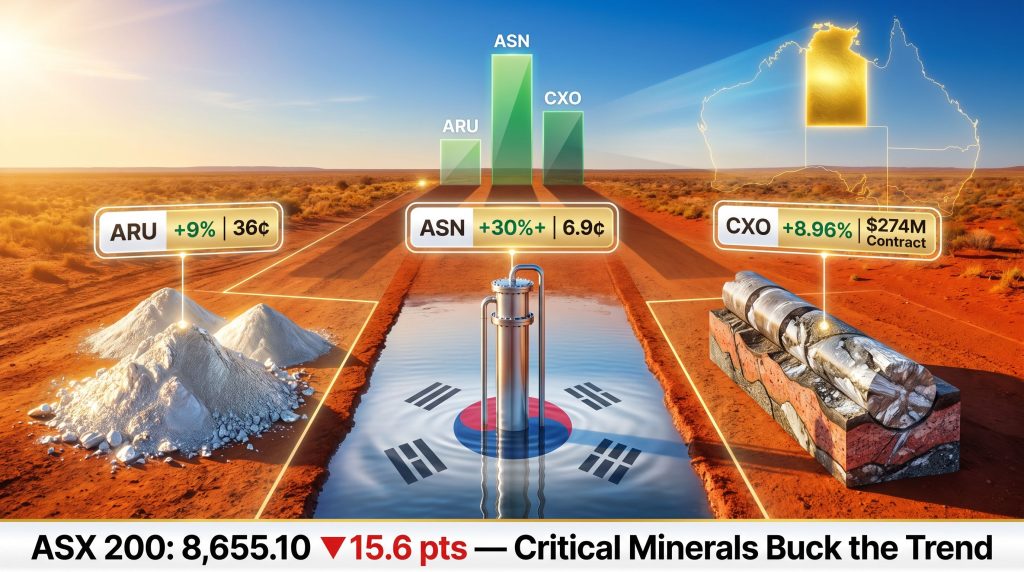
While the S&P/ASX 200 retreated 15.6 points to 8,655.10, setting a fresh 20-day low, three stocks dominated discussion for reasons that had nothing to do with broader index sentiment. Arafura Rare Earths (ASX: ARU), Anson Resources (ASX: ASN), and Core Lithium (ASX: CXO) each received catalysts that were specific, binding, and commercially substantive.
Understanding why these three names captured the attention of Australia's largest retail investor forum requires unpacking both the immediate announcements and the deeper structural forces that gave those announcements their weight.
"The divergence between a retreating ASX 200 and surging critical minerals developers on the same day is not a coincidence. It reflects a market that is beginning to price sector-specific supply chain urgency rather than broad macro optimism."
When big ASX news breaks, our subscribers know first
Why Wednesday's HotCopper Trends Carry Extra Weight in 2026
HotCopper functions as a real-time sentiment aggregator for Australian retail investors, and its influence on small-cap price discovery is well established. With millions of daily interactions flowing through its forums, a stock that trends on HotCopper during market hours frequently sees amplified trading volume as retail participants react to, and then reinforce, emerging price moves.
What makes Wednesday sessions particularly consequential is the confluence of mid-week ASX announcement windows and forum feedback loops that build through the morning session. When a genuinely significant announcement lands before the open, it seeds a discussion thread that compounds through the day. On May 13, three separate threads ran hot simultaneously, each driven by a distinct but thematically connected catalyst.
The macro environment amplifying all three stories is difficult to overstate. Furthermore, the critical minerals demand surge has been driven by the global electric vehicle market's structural expansion, intensifying downstream demand for both lithium and neodymium-praseodymium (NdPr). Against that backdrop, binding commercial agreements for pre-production Australian and American critical minerals developers carry a geopolitical premium that would have seemed unusual even three years ago.
Arafura Rare Earths (ASX: ARU): Unpacking the Traxys Offtake Term Sheet
What the Binding Agreement Actually Commits To
The Arafura Traxys rare earth deal was the headline catalyst for Wednesday's HotCopper trends discussion around ARU. The agreement covers up to 500 tonnes per annum of NdPr oxide from the Nolans rare earths project in the Northern Territory, structured across a five-year initial term with a mutual option for a two-year extension, giving the deal a potential total duration of seven years.
The counterparty matters here. Traxys North America is part of the Traxys Group, a globally active commodity trading firm with established networks across the critical minerals supply chain. The stated intention to route product into the US supply chain, including potential integration with the EXIM-managed project vault, adds a layer of strategic positioning that distinguishes this from a routine offtake arrangement.
| Metric | Detail |
|---|---|
| Offtake Volume | Up to 500 tpa NdPr oxide |
| Contract Duration | 5 years + 2-year mutual extension option |
| Counterparty | Traxys North America |
| End Market | US supply chain / EXIM project vault |
| Wednesday Price Move | +9% to 36 cents per share |
| Approximate Market Cap | ~AUD $450 million |
The NdPr Value Chain: Why Oxide Is the Critical Intermediate
One detail that retail forum discussions frequently compress is the distinction between rare earth ore, concentrate, and oxide. NdPr oxide is not the final product used in motors or magnets. It sits at a specific intermediate stage in the rare earth value chain, positioned between primary mining output and the separated metals that magnet manufacturers actually require.
The journey from ore body to oxide involves:
- Mining and crushing of rare earth bearing rock at Nolans
- Beneficiation to produce a rare earth concentrate
- Hydrometallurgical processing to produce a mixed rare earth carbonate or equivalent intermediate
- Solvent extraction and further refining to produce NdPr oxide
- Downstream conversion by buyers into separated neodymium and praseodymium metals before magnet production
This means Arafura's project is positioned at a meaningful point in the value chain, beyond basic mining, but the Traxys agreement is for the oxide stage, not the separated metals. For investors evaluating the Nolans project's margin structure, understanding where in the processing chain the revenue is captured is essential context that forum posts often overlook.
The EXIM Angle and US Geopolitical Context
The reference to the EXIM-managed project vault in the Traxys announcement is worth examining carefully. The US Export-Import Bank has increasingly been involved in financing structures designed to secure non-Chinese sources of critical minerals for the US supply chain. An EXIM project vault arrangement typically involves strategic stockpiling or committed offtake that connects pre-production Western developers to US end-market buyers through a financially structured intermediary.
China's rare earth export restrictions imposed in April 2026 elevated the urgency of these arrangements significantly. When China restricts access to the rare earth elements that underpin permanent magnet production, Western developers with binding offtake agreements tied to US supply chains move from speculative to strategically relevant. That shift in status is part of what drove ARU's +9% move to 36 cents on Wednesday.
It is worth noting that the Traxys agreement represents an offtake commitment, not a construction financing solution. Nolans still requires project financing to reach production, and that financing timeline remains a key risk factor that forum participants flagged actively in Wednesday's threads.
Anson Resources (ASX: ASN): The POSCO Joint Venture and DLE's Commercial Frontier
Breaking Down the Binding Agreement Structure
Anson Resources generated the largest single-day price move of the three Wednesday HotCopper trends Arafura Anson Core Lithium session, with ASN trading as high as 6.9 cents per share intraday, representing a gain exceeding 30% on the session. The catalyst was a binding agreement between the boards of Anson and POSCO Holdings for the development of a direct lithium extraction (DLE) demonstration plant at the Green River lithium brine project in Utah, USA.
The financial structure is particularly noteworthy. POSCO will pay Anson a $7.2 million facilitation fee, and critically, POSCO will independently fund the design, construction, and operation of its proprietary DLE technology at the site. Consequently, this means Anson receives both a cash payment and a fully funded technological validation of its resource without bearing the capital expenditure itself.
Understanding Direct Lithium Extraction: The Technology Behind the Move
Direct lithium extraction technology is one of the most actively discussed technological developments in the global lithium sector, yet it remains genuinely misunderstood by many retail investors. The core distinction from conventional lithium brine production is the elimination of evaporation ponds, which in traditional operations can take 12 to 24 months to concentrate lithium-bearing brines sufficiently for processing.
DLE instead uses selective sorbent materials, ion-exchange resins, or membrane-based systems to extract lithium directly from subsurface brine, dramatically compressing the production cycle. The key advantages DLE offers over evaporation-based methods include:
- Significantly reduced water consumption, critical in arid regions where water rights are fiercely contested
- Compressed extraction timelines from months-long evaporation cycles to weeks or even days
- Higher lithium recovery rates from the same brine resource
- Smaller surface disturbance, which can simplify environmental permitting
- The ability to reinject depleted brine, reducing long-term resource depletion concerns
POSCO has developed its own proprietary DLE technology, which gives the Green River demonstration plant a level of technical credibility that a generic or unproven DLE process would not carry.
Investor Education Note: A DLE demonstration plant is a proof-of-concept facility designed to validate lithium recovery rates, water balance, and operational parameters at a specific brine resource. It is not a commercial production operation. The path from demonstration to full-scale production involves additional feasibility work, environmental permitting, capital raises, and technology scale-up milestones that could span multiple years.
Why POSCO's Involvement Is Strategically Significant
POSCO Holdings is one of South Korea's largest and most diversified industrial groups, with an established presence across the global battery materials supply chain. Unlike a smaller trading company or speculative joint venture partner, POSCO brings both financial depth and genuine downstream demand for lithium products.
The distinction between a binding agreement and a memorandum of understanding (MoU) is one that sophisticated investors should internalise. MoUs are frequently signed in the mining sector with little downstream consequence. A board-approved binding agreement, by contrast, signals that legal due diligence has been completed, commercial terms have been agreed, and both parties have committed to specific obligations. That structural difference is part of why ASN's move on Wednesday was so pronounced.
The Green River project's location in Utah also positions it advantageously within the US domestic lithium supply framework. The Inflation Reduction Act's requirements for battery minerals sourced from North America create commercial incentives for US-located lithium production that are increasingly relevant to downstream battery manufacturers.
Core Lithium (ASX: CXO): What a $274M Contract Signals About Finniss
Reading the Recommissioning Signal Correctly
Core Lithium's announcement of a $274 million underground mining contract awarded to Develop Global for services at the BP33 location within the Finniss lithium project in the Northern Territory was the third major catalyst driving Wednesday's HotCopper trends discussion. CXO gained 8.96% by midday trading on the news.
To understand why this announcement carried weight, context is essential. Core Lithium suspended operations at Finniss in early 2024 following a severe global lithium price downturn that made continued open-cut mining economically unviable. The mothballing was widely covered and marked a painful chapter for shareholders who had watched Finniss become one of Australia's first new lithium producers before the price collapse.
| Metric | Detail |
|---|---|
| Contract Value | $274 million |
| Contract Duration | 3 years + 2-year extension option |
| Mining Contractor | Develop Global |
| Target Location | BP33 underground, Finniss Lithium Project (NT) |
| Wednesday Price Move | +8.96% |
| Approximate Market Cap | ~AUD $280 million |
BP33 Underground: Why Grade Changes the Economics
The shift from open-cut to underground lithium mining at Finniss is not merely an operational decision. It reflects a fundamentally different ore body being targeted. The BP33 underground resource is considered to contain higher-grade lithium mineralisation than the previously mined open-cut operations at the site.
In hard rock lithium mining, ore grade, typically measured as a percentage of lithium oxide (Li₂O), directly determines processing economics. Higher-grade ore produces more lithium carbonate equivalent (LCE) per tonne of rock processed, which reduces the unit cost of production and improves project margins at any given lithium price.
The contract structure itself, three years with a two-year extension option, suggests a staged approach: validate the underground ore body and processing economics during the initial term before committing to longer-duration expenditure. Develop Global's Northern Territory experience is a relevant operational consideration, as the NT presents specific logistical and regulatory conditions that require established local relationships.
Forum Discussion: What Retail Investors Are Watching
HotCopper discussion around CXO on Wednesday concentrated on two forward-looking questions: whether existing offtake agreements remain in place or require renegotiation following the operational suspension, and whether the recommissioning will require an equity placement that could dilute current shareholders.
For longer-term investors, the more important signal is management's willingness to commit to a nine-figure mining services contract. This represents the clearest public expression of confidence in the lithium price recovery thesis since the 2024 suspension.
Comparing All Three: Development Stage, Risk Profile, and Catalyst Quality
A Structured Investment Comparison
| Factor | Arafura (ARU) | Anson Resources (ASN) | Core Lithium (CXO) |
|---|---|---|---|
| Commodity | Rare Earths (NdPr) | Lithium (brine / DLE) | Lithium (hard rock) |
| Project Location | Northern Territory, AUS | Utah, USA | Northern Territory, AUS |
| Development Stage | Pre-production / offtake secured | DLE demonstration phase | Recommissioning / underground |
| Wednesday Catalyst | Binding Traxys offtake | POSCO JV + $7.2M fee | $274M Develop Global contract |
| Price Move (Wed) | +9% | +30%+ | +8.96% |
| Key Risk | Project financing | Demo-to-commercial scale-up | Lithium price recovery |
| Strategic Alignment | US rare earth supply chain | US IRA / Korean battery supply | Australian domestic lithium |
What Separates Genuine Catalysts from Forum Noise
A critical discipline for investors who follow Wednesday's HotCopper trends Arafura Anson Core Lithium discussions, or any daily forum trend summary, is distinguishing between binding commercial agreements and the speculative rumours or exploration updates that generate forum activity without equivalent fundamental weight.
All three Wednesday catalysts share a structural characteristic that elevates them above typical forum-driven speculation:
- ARU's Traxys offtake is a binding term sheet, not a heads of agreement or MoU
- ASN's POSCO arrangement is a board-approved binding agreement, not an expression of interest
- CXO's Develop Global contract is an awarded mining services contract, not a tender or shortlisting
This distinction matters because forum-driven price spikes that are not anchored by binding commercial commitments tend to mean-revert quickly as attention cycles to the next trending discussion.
The next major ASX story will hit our subscribers first
The Broader Critical Minerals Landscape Shaping These Stories
Geopolitics, Supply Chains, and the Western Restocking Imperative
The three stocks that dominated Wednesday's HotCopper trends are individually interesting, but collectively they represent a broader structural theme: the accelerating effort by Western economies to build critical minerals supply chains that do not depend on Chinese processing and export capacity.
China's April 2026 rare earth export restrictions are the most recent and visible expression of a supply chain vulnerability that policymakers in the US, Australia, South Korea, and Europe have been attempting to address for years. When China controls the majority of global rare earth processing capacity and then restricts exports, projects like Nolans shift from long-dated development stories to near-term strategic priorities.
The lithium market presents a parallel but distinct dynamic. Global lithium carbonate prices have shown signs of recovery in May 2026, with month-on-month movements reflecting restocking activity from major battery manufacturers. This improving price environment is directly relevant to Core Lithium's decision to recommission Finniss underground operations.
Hard Rock Versus Brine Lithium: Why the Technology Choice Matters for Investors
Comparing CXO and ASN as lithium investment propositions requires understanding the fundamental differences between hard rock and brine-based production:
- Hard rock lithium (CXO/Finniss) involves conventional mining, crushing, and flotation to produce spodumene concentrate, which is then converted to lithium chemicals. Capital costs are relatively well understood, but operating costs per tonne of LCE are typically higher than brine operations.
- Brine lithium with DLE (ASN/Green River) involves subsurface brine extraction and direct processing. If DLE technology performs as projected at commercial scale, operating costs could be substantially lower than hard rock equivalents, but the technology validation risk at scale remains real.
- Strategic buyers differ: Korean and Japanese battery manufacturers have historically shown preference for spodumene-based supply chains. US buyers, incentivised by IRA requirements, may show greater interest in domestically produced brine lithium.
Risk Factors Every Retail Investor Should Understand
Following Wednesday's HotCopper trends without internalising the associated risk landscape is an incomplete analytical exercise. Key risks across all three stocks include:
- Dilution risk: Small-cap developers at the pre-production or recommissioning stage frequently require equity placements to fund construction or operations
- Technology risk: DLE at commercial scale remains an evolving capability; demonstration success does not guarantee commercial-scale replication
- Commodity price risk: Both lithium and rare earth prices are volatile and sensitive to Chinese policy decisions, global EV demand trajectories, and broader macroeconomic conditions
- Financing risk: Binding offtake and JV agreements do not automatically resolve project financing requirements
- Regulatory risk: US water rights approvals for Green River, Northern Territory environmental processes for Nolans and Finniss, and EXIM funding conditionality all introduce timing uncertainty
This article is provided for informational purposes only and does not constitute financial advice. All statistics, price movements, and market capitalisations referenced reflect information available as of May 13, 2026, and are subject to change. Readers should conduct independent research and consult a licensed financial adviser before making any investment decisions.
Frequently Asked Questions
What is HotCopper and why does it influence ASX stock prices?
HotCopper is Australia's largest retail investor discussion forum, drawing millions of daily interactions from traders and investors focused primarily on ASX-listed companies. When a stock trends on the platform during market hours, it signals elevated retail attention that frequently translates into increased intraday trading volume, particularly in smaller-capitalisation resource stocks where retail participation forms a significant share of daily turnover.
What did Arafura Rare Earths announce on May 13, 2026?
Arafura secured a binding offtake term sheet with Traxys North America for up to 500 tonnes per annum of NdPr oxide from its Nolans project. The five-year deal includes a mutual two-year extension option, and Traxys intends to route the product into the US supply chain, including potential integration with the EXIM-managed project vault.
What is Direct Lithium Extraction and why does it matter for Anson Resources?
DLE is a processing technology that extracts lithium directly from subsurface brines using selective sorbents or ion-exchange systems, bypassing the lengthy evaporation pond process used in conventional brine operations. POSCO's proprietary DLE technology being deployed at Anson's Green River project in Utah adds technical validation to a resource that would otherwise remain at an early development stage.
Why did Core Lithium award a $274 million mining contract if Finniss was previously suspended?
The BP33 underground ore body at Finniss is understood to contain higher-grade lithium mineralisation than the open-cut operations previously conducted at the site. Higher-grade underground ore can justify different economic parameters, particularly as lithium prices recover from their 2024 lows. The contract award signals management's conviction that BP33's economics are viable under current and anticipated market conditions.
Does trending on HotCopper make a stock a good investment?
Forum trending status alone is not a reliable investment signal. The quality of the underlying catalyst is the more important determinant of whether a price move is likely to be sustained. Wednesday's three catalysts were unusual in that each involved binding or board-approved commercial agreements rather than exploration results or speculative rumours, which represents a structurally stronger informational foundation than typical forum-driven momentum.
Want To Be First When The Next Major ASX Discovery Is Announced?
Discovery Alert's proprietary Discovery IQ model scans ASX announcements in real time, instantly identifying high-potential mineral discoveries across more than 30 commodities — turning complex data into actionable opportunities for both short-term traders and long-term investors. Explore historic examples of exceptional discovery returns and begin your 14-day free trial at Discovery Alert to position yourself ahead of the broader market.