
August 5, 2026
When Market Breadth Speaks Louder Than Headlines
Retail investor forums are often dismissed as echo chambers, yet the weekly patterns of attention and discussion that emerge from platforms like HotCopper frequently anticipate institutional moves, reflect genuine sentiment shifts, and surface emerging narratives before they reach mainstream financial media. Understanding why certain stocks dominate forum traffic in a given week reveals as much about market psychology as it does about the underlying companies themselves.
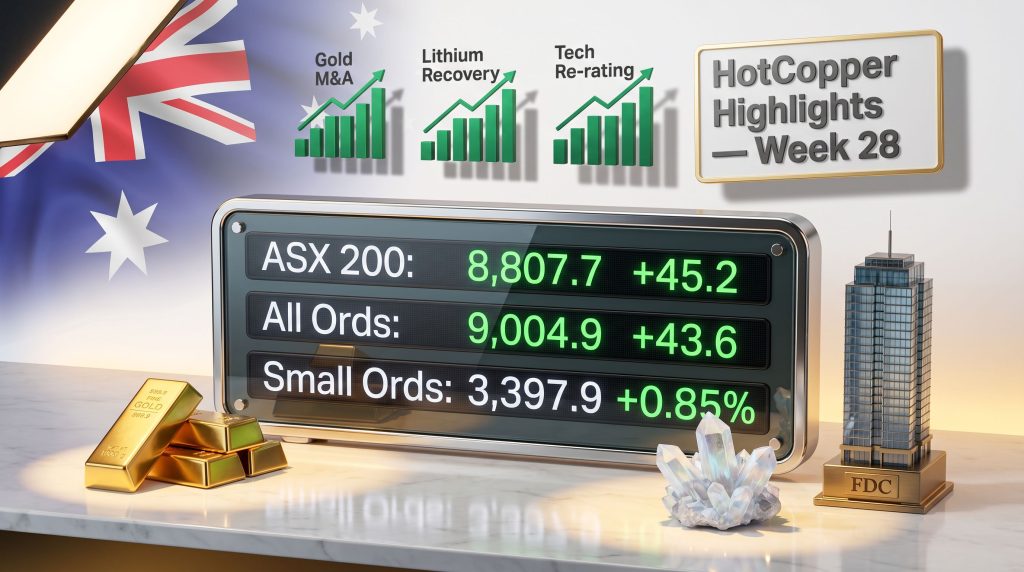
HotCopper Highlights Week 28 ASX stocks tell a particularly layered story. The final trading session of the week closed on 10 July 2026 with the ASX 200 finishing at 8,807.7 points, up 45.2 points on the day. The All Ordinaries reached 9,004.9, adding 43.6 points for a gain of 0.49%. Most notably, the S&P/ASX Small Ordinaries outpaced both, climbing 28.7 points or 0.85% to close at 3,397.9. Small-cap outperformance relative to large-cap indices is a meaningful signal, suggesting that risk appetite extended well beyond blue-chip names and into the speculative end of the market. For broader context, the Australian share market performance across 2025 provides useful comparison points for understanding the current trajectory.
Market Snapshot, Week 28 Close (10 July 2026):
ASX 200: 8,807.7 (+45.2 pts) | All Ordinaries: 9,004.9 (+43.6 pts, +0.49%) | S&P/ASX Small Ordinaries: 3,397.9 (+28.7 pts, +0.85%). Small-cap strength outpacing large-cap indices points to broad-based risk-on positioning across the market.
When big ASX news breaks, our subscribers know first
Most Viewed ASX Stocks on HotCopper: Week 28 Breakdown
Vault Minerals: A $5.6 Billion Takeover Contest That Rewrote the ASX Gold Playbook
Few corporate events capture retail investor attention quite like a contested takeover, and Week 28 delivered one of the most dramatic bidding wars seen in the Australian gold sector in recent memory. Vault Minerals attracted the highest viewing traffic on HotCopper after Genesis Minerals launched a rival $5.6 billion offer for the company, decisively eclipsing an earlier agreed merger proposal from Regis Resources.
The structural detail that drew the sharpest commentary from forum participants was a striking financial comparison: the Genesis Minerals bid was reported as roughly equivalent to the entire market capitalisation of Regis Resources itself. In other words, one company was bidding an amount for a target that another company would have needed to spend its entire market value to match. This kind of comparison reframes the competitive dynamics immediately.
| Bidder | Reported Offer Scale | Offer Status |
|---|---|---|
| Regis Resources | Multi-billion (lower tier) | Superseded agreed merger |
| Genesis Minerals | ~$5.6 billion rival bid | Preferred offer as of Week 28 |
What makes gold sector M&A activity particularly significant in the current environment is the backdrop of sustained gold price strength. When acquirers are willing to stretch valuations to this degree, it typically signals one of two things: either extraordinary strategic conviction about the target's asset quality, or a competitive fear that missing out carries a higher long-term cost than overpaying. Both scenarios create elevated execution risk for the winning bidder.
Key Investor Consideration: A takeover bid valued at or near the acquirer's own market capitalisation represents an extreme concentration of strategic commitment. While such bids can deliver significant premiums for target shareholders, they also introduce leverage and integration risks that can weigh on the acquiring company's share price for extended periods post-completion.
The Vault Minerals situation reflects a broader consolidation pattern developing across the ASX gold space. With elevated gold prices improving the economics of mid-tier projects and larger producers seeking production growth through acquisition rather than greenfield development, the pool of attractive targets is narrowing. This competitive scarcity is precisely what drives bidding contests of this magnitude, and it may well signal further M&A activity among ASX-listed gold developers in the months ahead.
Critically, from a retail investor perspective, the HotCopper discussion threads around Vault Minerals illustrate how forum activity functions as a real-time sentiment amplifier during corporate events. Existing shareholders seek context; prospective buyers evaluate the risk-reward of entering at elevated prices; and short-term traders assess the probability of further bid escalation. Each group generates discussion volume, which in turn draws more participants into the conversation.
Telstra: Share Price Resilience Through a National Outage Scandal
Telstra's presence among the most viewed stocks in Week 28 was driven not by upside catalysts but by a high-profile operational failure. The company experienced a national triple zero outage that disrupted emergency services, transport systems, business payments, and communications across every major Australian city. The incident drew significant media scrutiny, particularly given that Optus had faced similar fallout from a comparable outage in September 2025.
What made the Telstra situation notable from an investment analysis perspective was the near-complete absence of share price reaction. Despite widespread coverage and public criticism, Telstra's stock remained largely unmoved throughout the week.
Several structural factors help explain this dynamic:
- Telstra operates as a near-monopoly provider of critical telecommunications infrastructure in Australia, meaning customers and institutional clients have limited alternatives regardless of service disruptions
- As a regulated utility, Telstra's revenue base is partially insulated from reputational damage that would more severely penalise a consumer-discretionary business
- Institutional investors typically apply a longer-term lens to regulated infrastructure stocks, discounting single incidents unless they trigger regulatory fines or structural remedies
- The Optus precedent, while significant in terms of public relations damage, did not produce a permanent de-rating of the telecommunications sector as a whole
Investor Note: Share price stability during a reputational crisis does not automatically confirm fundamental strength. For regulated infrastructure companies like Telstra, resilience may simply reflect a lack of credible alternatives in the sector. Retail investors should distinguish carefully between price stability and operational reliability when assessing long-term holdings.
The more instructive observation is that HotCopper forum traffic around Telstra during this period functioned less as a trading signal and more as a barometer for reputational risk assessment. High viewing volumes with minimal price movement suggest participants were monitoring the situation rather than acting on it. This is a nuanced but important distinction: not all forum traffic translates into buying or selling pressure.
FDC Consolidated Holdings: Anatomy of the ASX's Largest IPO of 2026
The third most-viewed stock of Week 28 was FDC Consolidated Holdings, a construction sector company that completed what has been classified as the largest IPO to list on the ASX in 2026. Its market debut attracted considerable attention, with initial performance drawing favourable comparisons to drone technology stocks that had successfully listed earlier in the year.
The construction sector has been notably underrepresented among recent ASX listings, making FDC's debut thematically significant beyond its headline size. In an IPO market that has shown preference for technology and resources names, a large-scale construction listing introduces a different kind of infrastructure exposure for investors seeking diversification.
| Company | Sector | 2026 IPO Classification | Debut Performance |
|---|---|---|---|
| FDC Consolidated Holdings | Construction | Largest of 2026 | Positive debut |
| Various drone tech listings | Technology | Smaller-cap | Generally positive |
The central question animating HotCopper discussion was straightforward: can FDC sustain its debut-day gains? This is a perennially relevant concern for IPO investors. Academic research consistently shows that IPO first-day returns are frequently not sustained over the subsequent 12 months, with many new listings underperforming the broader market after the initial enthusiasm fades. Furthermore, post-debut price stabilisation in the first two to four weeks is often watched closely as an early indicator of whether institutional support will hold. Investors tracking new listings can also monitor the ASX 52-week highs and lows for useful context on how debut prices compare to broader market ranges.
Most Discussed ASX Stocks on HotCopper: Week 28 Community Sentiment
Liontown Resources: Decoding the Lithium Recovery Debate
Among the most discussed stocks in Week 28, a detailed Liontown Resources analysis helps explain why it retained its position as a focal point for retail investor debate, centred on one overarching question: is the recent strength in lithium prices the beginning of a durable recovery, or a temporary reprieve before another leg lower?
The framing of lithium as "white battery gold" within the investor community reflects both the commodity's critical role in energy storage and its tendency to attract the kind of long-term conviction that sustains forum discussion even through extended price weakness. Several competing dynamics are shaping the current debate:
-
Supply-demand rebalancing: Global lithium production capacity expanded aggressively during the price boom of 2022-2023, creating an oversupply condition that weighed heavily on prices through 2024 and into 2025. The question now is whether demand growth from accelerating EV adoption has finally begun to absorb that surplus.
-
Technology disruption on the supply side: Direct Lithium Extraction technology represents a potentially transformative shift in how lithium is produced. Unlike conventional evaporation pond methods that can take 12-24 months to process brine, DLE can extract lithium directly from subsurface brines in hours or days, with significantly higher recovery rates. Prairie Lithium's announcement during Week 28 of one of the world's largest DLE units adds important context to this supply-side dimension.
-
ASX-listed developer positioning: Mid-tier lithium developers like Liontown occupy a structurally complex position. They are large enough to attract institutional attention but remain exposed to commodity price volatility in a way that diversified majors are not.
DLE Technology Explained: Direct Lithium Extraction is an emerging processing method that selectively captures lithium ions from brine sources using adsorption, ion exchange, or membrane technologies. The key advantage over traditional solar evaporation is speed and recovery efficiency, though commercialisation at scale remains an area of active development. Prairie Lithium's Week 28 announcement of one of the world's largest DLE installations represents a notable milestone for this technology's commercial maturity.
BrainChip Holdings: Australia's Most Persistently Debated Tech Stock
BrainChip Holdings returned to prominence in HotCopper discussion during Week 28, aided by a modest recovery in Australian technology stocks that gave retail investors fresh grounds for reassessment. The company's neuromorphic computing technology, which processes data using architectures modelled on biological neural networks rather than conventional von Neumann processors, has been the subject of sustained bullish conviction from a dedicated retail investor base.
Neuromorphic chips are designed for edge AI processing, meaning they perform inference tasks locally on a device rather than relying on cloud connectivity. This architecture offers theoretical advantages in power efficiency and latency, making it relevant for applications in autonomous vehicles, robotics, medical devices, and IoT hardware. The commercial promise is genuine. However, the gap between that promise and demonstrated revenue-generating customer deployments has been the persistent friction point in BrainChip's investment case.
The bulls and bears in the BrainChip debate can be summarised as follows:
Bull case:
- Neuromorphic computing addresses real limitations of conventional AI hardware, particularly around energy consumption at the edge
- First-mover positioning in a segment of the AI chip market that remains nascent
- Long development cycles in semiconductor design mean commercial timelines should be judged against industry norms rather than software company expectations
Bear case:
- Sustained commercialisation delays have eroded early momentum
- Major semiconductor companies including Intel and IBM have their own neuromorphic research programmes, representing significant competitive threats
- Speculative valuation premium requires commercial milestone delivery to be justified
WiseTech Global: How a Founder's Exit Became a Positive Catalyst
The catalyst for the broader Australian technology stock recovery in Week 28 originated with a governance event rather than a product announcement or earnings beat. WiseTech Global founder Richard White stepped down from his role, a development that shareholders received positively and that produced a meaningful uplift in the stock's price.
This outcome speaks directly to the concept of key man risk in listed company analysis. Key man risk describes the degree to which investor confidence in a company is tied to the presence of a single individual, typically a founder or dominant executive. When that individual accumulates controversy over time, their departure can transition from a feared disruption to a welcomed de-risking event.
Governance Insight: Key man risk is a genuinely material consideration in listed company analysis. When a founder's public profile and associated controversy becomes inseparable from the market's perception of the company, their exit can represent a net positive for both institutional and retail investor confidence, even if it introduces short-term operational uncertainty.
The spillover effects from WiseTech's recovery extended across the ASX technology sector, consequently lifting sentiment for names including BrainChip. This is a recognisable pattern in smaller, thematically connected market segments: when a sector leader re-rates positively, it tends to elevate the narrative for adjacent stocks, even where the fundamental connections are limited.
Three Dominant Themes Emerging From Week 28 Forum Activity
Theme 1: Gold Sector Consolidation Is Accelerating
The Vault Minerals bidding war is best understood not as an isolated corporate event but as a visible expression of structural M&A pressure building across the ASX gold sector. With sustained gold price strength improving project economics and production growth difficult to achieve organically at scale, larger producers are increasingly turning to acquisition as their primary growth lever. Investors should note that mid-tier gold developers with credible resource bases and advancing project timelines represent the highest-probability targets in this environment.
Theme 2: Critical Minerals Conviction Persists Despite Cyclical Noise
Liontown's sustained discussion volume, even through extended periods of lithium price uncertainty, reveals something important about how retail investors have internalised the energy transition thesis. The debate has moved on from whether lithium demand will recover to debating the timing and magnitude of the next upcycle. This represents a maturation in the community's understanding of commodity cycles, even if the emotional volatility of individual positions has not diminished.
Theme 3: Governance Quality Is Being Priced Into ASX Tech Valuations
WiseTech's re-rating in response to a leadership transition signals that ASX technology stocks in 2026 are being evaluated on governance quality as well as product fundamentals. This is a meaningful evolution for a sector historically dominated by growth-at-all-costs narratives. Furthermore, investors who can identify technology companies with both strong product differentiation and improving governance profiles may be better positioned to capture sustained re-rating opportunities.
Week 28 at a Glance: ASX Investor Intelligence Summary
| Theme | Key Stock(s) | Investor Implication |
|---|---|---|
| Gold M&A consolidation | Vault Minerals | Takeover premiums possible for mid-tier gold developers |
| Telco resilience under pressure | Telstra | Defensive positioning, but operational risk warrants ongoing monitoring |
| Landmark IPO debut | FDC Consolidated Holdings | Post-debut price stabilisation is the key signal to watch |
| Lithium recovery debate | Liontown Resources | Long-term conviction intact; near-term caution warranted |
| Deep-tech speculation | BrainChip Holdings | Sentiment-driven; commercial milestones remain the key de-risking trigger |
| Governance-led re-rating | WiseTech Global | Leadership transitions can be positive catalysts when key man risk is resolved |
The next major ASX story will hit our subscribers first
Frequently Asked Questions: HotCopper Highlights Week 28
What stocks were most viewed on HotCopper in Week 28 of 2026?
Vault Minerals, Telstra, and FDC Consolidated Holdings led the most-viewed rankings. Vault was driven by the Genesis Minerals $5.6 billion rival takeover bid, Telstra by its national outage controversy, and FDC by its status as the largest ASX IPO of 2026.
What stocks were most discussed on HotCopper in Week 28 of 2026?
Liontown Resources, BrainChip Holdings, and WiseTech Global dominated community discussion, reflecting ongoing debates around lithium price recovery trajectories, the persistent commercialisation debate around neuromorphic computing, and the market implications of WiseTech's founder transition.
What was the ASX's largest IPO of 2026?
FDC Consolidated Holdings, a construction sector company, completed the largest IPO to list on the ASX in 2026 during Week 28. Its debut performance drew comparisons to drone technology stocks that had listed successfully earlier in the year.
Why did WiseTech Global shares rise in Week 28?
The stock responded positively to the announcement that founder Richard White would step down, with investors interpreting the move as a material reduction in key man risk. This governance concern had been a persistent weight on the company's valuation, and its resolution was viewed as a net positive by both retail and institutional participants.
How does HotCopper forum activity relate to ASX market movements?
HotCopper, as Australia's largest retail investor forum, functions as a real-time sentiment barometer. Stocks with high viewing volumes but low price volatility, like Telstra in Week 28, suggest monitoring behaviour rather than active trading. Stocks with high discussion volumes tied to fundamental debates, like Liontown, reflect genuine conviction-level engagement that can influence retail positioning over time.
What is Direct Lithium Extraction and why does it matter for lithium investors?
Direct Lithium Extraction is a processing technology that captures lithium from brine sources without the lengthy evaporation pond methods traditionally required. DLE can reduce processing timeframes from months to hours while improving lithium recovery rates. Its commercial scaling, as evidenced by Prairie Lithium's Week 28 announcement, could alter the supply economics of the lithium market and is a variable that investors in ASX-listed lithium developers should monitor closely.
The information presented in this article is intended for educational and informational purposes only and does not constitute financial or investment advice. All market data referenced reflects conditions as at 10 July 2026. Readers are encouraged to conduct independent research and consult with a licensed financial adviser before making any investment decisions. Past performance and forum sentiment are not reliable indicators of future market outcomes.
Want To Catch The Next Major ASX Mineral Discovery Before The Market Does?
Discovery Alert's proprietary Discovery IQ model scans ASX announcements in real time, instantly delivering actionable alerts on significant mineral discoveries across more than 30 commodities — the same kind of edge that has historically driven extraordinary returns, as showcased on Discovery Alert's dedicated discoveries page. Start your 14-day free trial at Discovery Alert and position yourself ahead of the broader market.