July 22, 2026
When Every Shipping Lane Matters: The New Geography of Oil Risk
The global oil market has historically priced risk through a single-chokepoint lens. Analysts would model scenarios around Hormuz, or the Suez Canal, or the Red Sea in isolation, assign a probability weight, and arrive at a risk premium that faded as diplomatic tensions eased. That framework is now structurally broken. The current environment presents something qualitatively different: a simultaneous stress test across multiple critical nodes of the global energy logistics network, with no obvious release valve in sight.
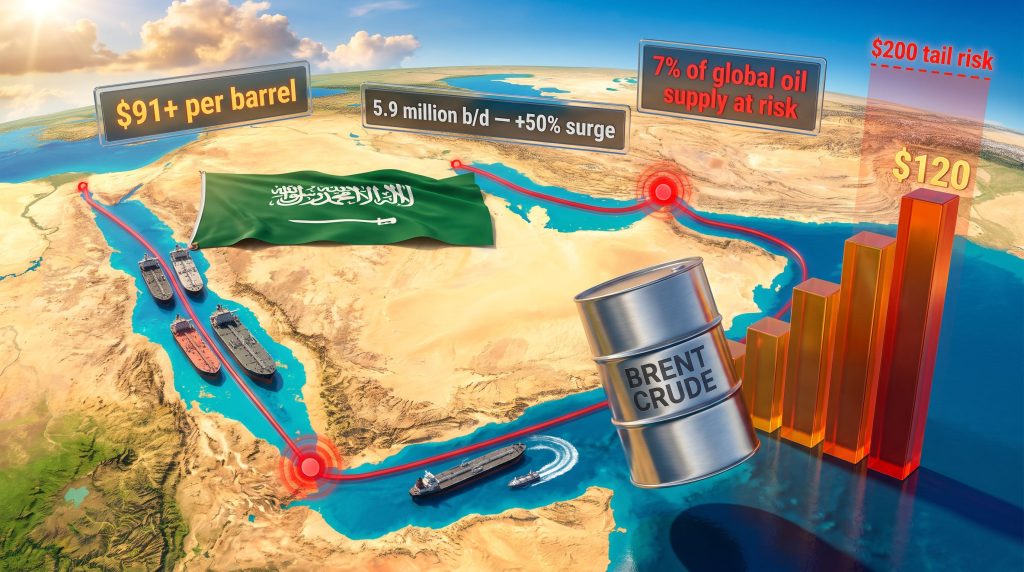
The Houthi threats and oil price surge that pushed ICE Brent crude above $91 per barrel in late July 2026 cannot be understood as a standalone event. They represent the most visible expression of a broader systemic fracture in Middle Eastern energy logistics, one that commodity analysts, shipping insurers, and energy-importing governments are only beginning to fully price. For broader context on oil price trends heading into this period, the groundwork was already shifting well before these events unfolded.
When big ASX news breaks, our subscribers know first
The Two-Chokepoint Trap: Why This Time Is Different
Most historical disruptions to global oil trade have involved pressure on a single maritime corridor. The current crisis has broken that pattern decisively. Two of the world's most strategically critical shipping lanes are now under simultaneous active threat.
- The Strait of Hormuz handles approximately 20% of global oil trade, connecting Gulf producers to Asian and European buyers
- The Bab el-Mandeb Strait serves as the Red Sea's southern gateway, controlling access between the Indian Ocean and the Suez Canal route
- US-Iran hostilities have already restricted Hormuz transits, compressing the primary Gulf export corridor
- The Houthi declaration of a naval blockade against Saudi Arabia now places the Bab el-Mandeb simultaneously under active threat
What makes this configuration so market-moving is the compounding nature of dual-chokepoint pressure. When one corridor is threatened, cargo can theoretically be rerouted through the other. When both face concurrent disruption, no viable large-scale alternative exists for Gulf producers. Consequently, energy markets are not pricing a single disruption event but rather the potential systemic failure of Middle Eastern oil logistics at the infrastructure level.
Furthermore, this oil market disruption compounds pre-existing vulnerabilities that were already straining global supply chains. The scale of simultaneous pressure across multiple nodes is, by most historical measures, unprecedented in the post-Cold War era.
Key structural insight: Iran's strategic calculus relies heavily on proxy escalation rather than direct state-to-state confrontation. This creates persistent market uncertainty because a ceasefire between the US and Iran does not automatically translate into Houthi de-escalation. The Houthi entry into broader hostilities, including their first missile strikes against Israel, signals a deliberate and independently motivated expansion of their operational perimeter.
Yanbu: Saudi Arabia's Most Exposed Infrastructure Node
Understanding why Houthi threats and the oil price surge are directly connected requires a close look at Saudi Arabia's export geography. With Hormuz transits already compromised, the kingdom has rerouted the majority of its crude production westward through the East-West Pipeline toward the Red Sea port of Yanbu.
| Metric | Volume |
|---|---|
| Saudi East-West Pipeline total capacity | ~7 million b/d |
| Yanbu port export capacity ceiling | ~4.0 to 4.5 million b/d |
| Additional volumes to Red Sea coast refineries | ~1.5 to 2.0 million b/d |
| Saudi Aramco Yanbu loading (week of July 17, 2026) | 5.9 million b/d |
| Increase vs. March to June 2026 average | +50% |
That 5.9 million b/d figure is particularly striking. According to Bloomberg, Saudi Aramco loaded an unprecedented volume through Yanbu in the week ending July 17, surpassing the port's own infrastructure limitations and running 50% above its prior quarterly average. The most credible interpretation is that Aramco anticipated the escalation and moved aggressively to pre-position crude before Houthi threats could restrict tanker access.
This is a classic supply-chain pre-emption strategy: front-load deliveries before a logistics window closes. The very fact that Aramco executed this move at such scale suggests internal intelligence or risk modelling pointed toward an imminent deterioration in Red Sea access conditions.
The structural vulnerability Yanbu now represents is severe. With Hormuz already compromised, there is no viable alternative export corridor for Saudi crude at scale. A successful Houthi interdiction of Yanbu-bound tankers would effectively strand a material portion of the kingdom's 4 million b/d of crude exports with nowhere to go.
Tankers Reverse Course: The First Physical Proof of Disruption
When Houthi forces issued formal warnings to global shipping companies, threatening strikes against any vessels loading cargo at Saudi ports, the threat carried credibility. The group had already demonstrated operational capability through prior successful drone and missile attacks on commercial shipping. Markets took note immediately.
Two tankers provided the clearest early confirmation of real-world disruption:
- The Rodos, a vessel chartered to deliver Saudi crude to India, executed a U-turn in the Red Sea after the blockade declaration
- The Xin Long Yang, bound for China with Saudi crude, reversed course in direct response to the Houthi threat
These were not precautionary measures taken on uncertain intelligence. They were direct commercial decisions by ship operators responding to a declared naval blockade. The physical rerouting of cargo flows, rather than just the threat of disruption, is what pushed Brent above $91 per barrel and validated the geopolitical risk premium already building in paper markets.
Mapping the Price Escalation Scenarios
The Houthi threats and oil price surge dynamic operates across a spectrum of possible outcomes, each with distinct probability weights and price implications.
Scenario 1: Partial Interdiction (Base Case)
- Houthi drone and missile activity forces 20 to 30% of Red Sea-bound Saudi tankers to reroute via the Cape of Good Hope
- Additional voyage time of 10 to 14 days per transit effectively tightens available supply by reducing tanker fleet utilisation
- Shipping insurance premiums for Red Sea routes escalate, adding cost layers that flow through to refined product prices
- Estimated Brent range: $91 to $105 per barrel
Scenario 2: Full Yanbu Blockade (Elevated Risk)
- Saudi Arabia loses functional access to its primary westward crude export terminal
- Combined with existing Hormuz restrictions, effective Gulf export capacity declines materially beyond the 10% supply reduction already registered since the US-Iran conflict began
- A Bab el-Mandeb closure alone could restrict access to approximately 7% of global oil supply
- Estimated Brent range: $105 to $130 per barrel
Scenario 3: Sustained Dual-Chokepoint Closure (Tail Risk)
- Prolonged simultaneous closure of both Hormuz and Bab el-Mandeb with no diplomatic resolution
- Goldman Sachs has publicly flagged oil reaching $120 per barrel under extended Middle East conflict conditions
- Independent analysis from institutions including Macquarie Group has cited $200 per barrel as a tail-risk scenario if Hormuz closure is sustained for an extended period
- Estimated Brent range: $130 to $200+ per barrel
Investor warning: Price projections at the upper range assume sustained closure of both chokepoints with no diplomatic off-ramp. This remains a low-probability scenario, but its non-negligible likelihood under current escalation trajectories justifies including it in any responsible risk framework. Investors should treat commodity price forecasts as scenario tools rather than point predictions.
Cascading Consequences: Beyond the Headline Crude Price
The downstream consequences of Houthi threats and the oil price surge extend well beyond benchmark crude movements. Several interconnected market pressures are already becoming visible.
Freight and Insurance Markets
Vessels rerouted around the Cape of Good Hope face voyage extensions of up to two weeks per round trip. This removes effective tanker capacity from the global fleet without any change in the underlying supply of crude, creating a phantom tightening of physical availability. War risk insurance premiums for Red Sea transits have escalated sharply, with those costs eventually transmitted to end consumers through refined product prices.
Asian Import Pressure: India and China
- India's crude import bill has already surged by 60% as regional conflict drives benchmark prices higher, with the IMF formally flagging elevated oil prices as a key risk to India's GDP growth trajectory
- China, simultaneously executing a liquefied natural gas buying spree to secure alternative gas supplies amid Hormuz disruption, now faces the additional prospect of its Saudi crude supply lanes through the Red Sea being compromised
- India has now emerged as the world's top long-term LNG buyer in 2025 according to GIIGNL data, a strategic pivot reflecting the country's growing urgency around energy supply security
European Diesel Crunch
European diesel inventories are trending toward multi-year lows, with the continent navigating supply tightness before the latest Red Sea escalation added further pressure. Any sustained reduction in Middle Eastern crude flows constraining refinery throughput in Asia and the Gulf will worsen European diesel availability, with refined product markets in the region particularly exposed to upstream disruption.
US Retail Gasoline
US gasoline prices have climbed back above $4 per gallon, reflecting upstream pressure from crude price increases now transmitting into retail fuel costs. This creates political pressure that adds another dimension to the geopolitical calculus around conflict resolution timelines. In addition, these geopolitical trade tensions are increasingly influencing policy decisions far beyond the energy sector itself.
The next major ASX story will hit our subscribers first
Industry Responses: Adaptation Strategies Across the Supply Chain
The energy industry is responding to the structural disruption with a combination of tactical repositioning and longer-term strategic realignment.
Alternative Pipeline Infrastructure
Chevron has advanced discussions with Iraq and Syria on a cross-border pipeline project designed to route Iraqi crude to the Eastern Mediterranean, a corridor that would completely bypass both Hormuz and the Red Sea. This represents a genuine attempt to create a third major export route for Gulf production that is immune to the current dual-chokepoint problem.
European Producer Consolidation
Norway's Vaar Energi, majority-owned by Italy's ENI, has merged with regional peer BlueNord in a $1.33 billion deal, creating Europe's largest independent oil and gas producer. The strategic timing of this consolidation reflects the premium being placed on non-Middle Eastern supply assets in a market pricing sustained geopolitical disruption.
M&A Signalling Higher-for-Longer Confidence
- US shale operator Magnolia Oil & Gas has agreed to acquire rival WildFire Energy for $4.1 billion, expanding Eagle Ford and Austin Chalk acreage while lifting output by 50% to 160,000 boe/d
- Global trading firm Vitol is reportedly in advanced discussions to divest its US shale joint venture VT Energy Partners to a private equity consortium of Carnelian Energy and EnCap Investments for approximately $2.3 billion
Both transactions signal that sophisticated capital allocators are betting on elevated crude prices persisting long enough to justify major asset repositioning.
The Multi-Vector Chokepoint Crisis: Beyond the Red Sea
The Houthi threat and its oil price consequences are the most visible element of a broader multi-node disruption across the global energy logistics network. However, the stress extends across several other critical corridors simultaneously.
Black Sea: Kazakhstan's Export Lifeline Under Attack
The Caspian Pipeline Consortium suspended crude loadings at its Black Sea terminal after two tankers were attacked during loading operations. This terminal handles approximately 80% of Kazakhstan's oil exports, representing roughly 1.6 million b/d of crude supply. Kazakhstan's state-owned KazMunayGas has separately agreed to pay its share of a $5 billion environmental penalty at the Kashagan field, adding significant financial pressure to an already operationally stressed producer.
Panama Canal: Water Scarcity Compounds Constraints
The Panama Canal Authority has moved to suspend 5% of its vessel booking system and reduce daily transits to 34 vessels per day due to declining water levels at Gatun Lake. This restriction matters significantly in the current context because the Cape of Good Hope rerouting triggered by Red Sea disruptions increases demand for Pacific routing alternatives, making Panama Canal congestion more consequential than it would be in a stable shipping environment.
LNG Market Dislocation
LNG shipments through the Strait of Hormuz have effectively ground to a halt as the conflict escalates, triggering a 10% spike in Asian LNG spot prices. Pakistan, already paying the highest spot LNG prices in four years, has been forced into emergency cargo procurement as Qatari supply falters. Egypt's national gas company EGPC is reportedly in talks with Shell and TotalEnergies to secure 15 to 18 LNG cargoes per month over a three-year horizon. Japan's JERA, which supplies the equivalent of 30% of Japan's total electricity output, is evaluating a US IPO to accelerate its international supply diversification agenda.
The End of the Abundance Assumption
Prominent commodity analyst Jeff Currie has argued publicly that the assumption of perpetual oil surplus, a framework that dominated market thinking through much of the 2010s, has now definitively ended. This argument is gaining traction in the current environment for structural reasons that go beyond any single geopolitical event.
OPEC market influence has been central to this shift, with the group's spare capacity progressively deployed over the past two years. Non-OPEC production growth, meanwhile, is concentrated in geographically constrained regions, most notably US shale, which faces its own infrastructure bottlenecks. Geopolitical risk premiums, once treated as transient price spikes that would fade with diplomatic resolution, are increasingly becoming a permanent structural feature of oil pricing.
The EU's proposed expansion of free emissions allowances under its ETS mechanism by approximately 80 million additional permits through 2030 reflects recognition that energy-intensive industries cannot simultaneously absorb elevated crude prices and rising carbon costs. India's decision to maintain its ethanol blending ceiling at the E20 level, which currently displaces approximately 100,000 b/d of crude imports, signals that biofuel policy will not provide meaningful near-term demand relief under the current price shock.
For a comprehensive crude oil market overview that places these developments in their full context, the structural changes now underway represent a fundamental repricing of energy risk across global markets. Furthermore, Brent's breach of $108 in earlier escalation episodes demonstrates that the market has already rehearsed these higher price levels under comparable threat conditions.
Key Data Reference: Houthi Threats and the Oil Price Surge
| Data Point | Figure |
|---|---|
| Brent crude level breached | $91+ per barrel |
| Saudi Aramco Yanbu loading (week of July 17) | 5.9 million b/d |
| Loading increase vs. Q1 to Q2 2026 average | +50% |
| East-West Pipeline total capacity | ~7 million b/d |
| Yanbu port export ceiling | ~4.0 to 4.5 million b/d |
| Global supply at risk via Bab el-Mandeb | ~7% |
| Gulf supply decline since US-Iran conflict began | ~10% |
| Goldman Sachs conflict scenario forecast | $120/barrel |
| Tail-risk dual chokepoint projection | $200/barrel |
| Asian LNG spot price increase | +10% |
| Kazakhstan CPC export volume at risk | ~1.6 million b/d |
| Panama Canal daily transit cap | 34 vessels/day |
| India crude import bill increase | +60% |
| US gasoline price threshold breached | $4/gallon |
| Magnolia/WildFire Energy deal value | $4.1 billion |
| Vaar Energi/BlueNord merger value | $1.33 billion |
| Vitol VT Energy Partners divestiture value | ~$2.3 billion |
Disclaimer: All price forecasts and scenario projections referenced in this article represent analyst estimates and modelled outcomes based on current market conditions. They are not investment advice. Actual oil price outcomes will depend on geopolitical developments, diplomatic resolutions, OPEC+ policy decisions, and macroeconomic factors that cannot be predicted with certainty. Investors should conduct independent due diligence before making any financial decisions based on commodity price expectations.
Want to Know Which ASX Resources Companies Could Benefit From Rising Oil Prices?
Discovery Alert's proprietary Discovery IQ model scans ASX announcements in real time, instantly identifying significant mineral and energy discoveries that could represent actionable opportunities in a market increasingly shaped by energy supply disruptions and commodity price surges — explore historic discoveries and their returns to understand the scale of what early positioning can deliver, then begin your 14-day free trial at Discovery Alert to stay ahead of the next major market-moving announcement.